40 GSPS Sampling – Comparing Time and Quadrature Interleaving20 GHz Direct Sampling: All in One Nyquist, Part 3: Time Interleaving and a Comparison of Options
From
Ian Beavers, Peter Delos, Brian Reggiannini and Connor Bryant, Analog Devices*
11 min Reading Time
Part 3 of the “All-in-One Nyquist” series explores practical approaches to interleaving ADC cores for direct sampling up to 20 GHz. The authors present time and quadrature interleaving side by side, showing how correction techniques like PFILT and CFIR influence performance. The conclusion: both methods are viable, but the best choice depends on system requirements, bandwidth, and application constraints.
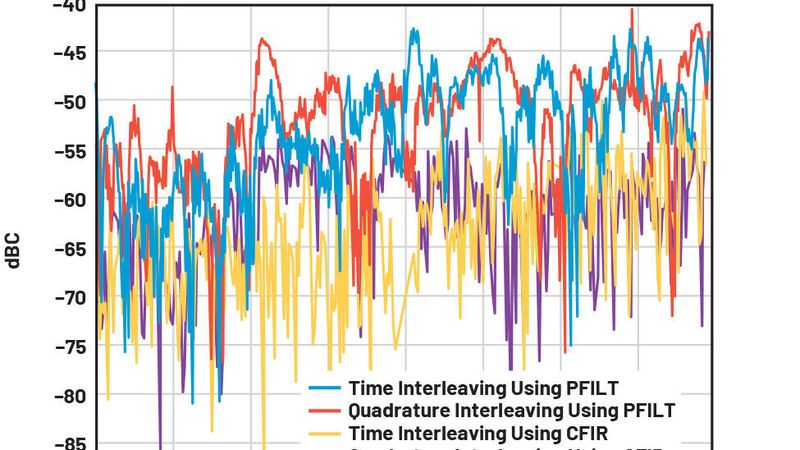
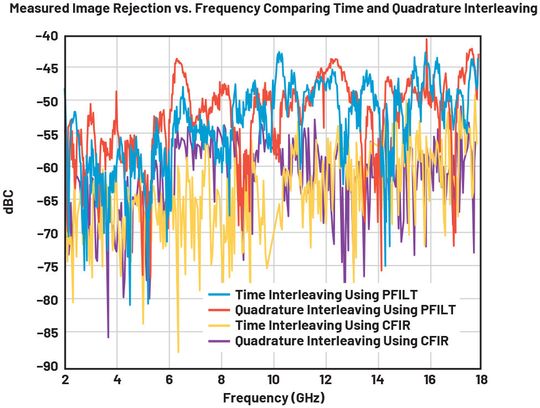
Figure 10: Measured image rejection comparing time and quadrature interleaving. Note that the errors are roughly about the same and in both cases the CFIR correction has improved performance due to the fact the CFIR operates at the decimated rate and the filter taps have a longer effective period.
(Source: Analog Devices)
Leveraging a quadrature error correction (QEC) algorithm can be a differentiating method to expand the Nyquist bandwidth in a software-defined MxFE system. Using QEC is critical to expanding the capabilities of a 2-channel ADC receiver used in a quadrature sampling system. However, there are also options to use QEC in a more typical time-interleaving configuration. While either method has distinct merits, a comparison within this discussion will show there is often a superior choice that is application dependent.
Part 1 described the interleaving objectives, discussed errors creating interleaving artifacts, and introduced the range of 40 GSPS analog-to-digital conversion (ADC) options using the AD9084. Part 2 presented a direct quadrature sampling option, along with a quadrature correction mechanism in detail. Part 3 presents methods to provide time-interleaving options.
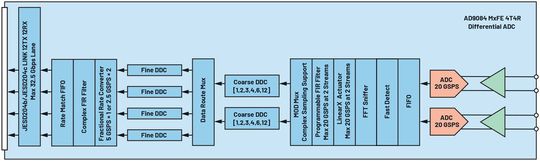
A visual of the embedded digital signal processing (DSP) described in Part 1 is shown in Figure 1. Provisions are included in the clock distribution to internally invert clocks to adjacent ADC channels within the device. The simplest time-interleaving option is to offload all the data from two channels at the full sample rate. Unfortunately, this option requires stitching the data from two channels together within the FPGA or ASIC at the full rate, prior to processing. The power and overhead of this option make it less desirable on its own. An alternate time-interleaving option is one that exploits the data filtering within the embedded DSP, like the quadrature sampling option.
Figure 1: One-half of an MxFE receive path section, showing dual ADCs and embedded DSP
(Source: Analog Devices)
The full data rate power concern creates the need for an option that time interleaves adjacent ADCs, utilizes embedded DSP, and offloads data at reduced rates by leveraging digital downconversion (DDC). Next, it described how to resolve ADC Nyquist boundaries by exploiting phase information. A unique value shown in these concepts is the option to trade channel count vs. sample rate without increasing the digital data rates, yet still maintaining the use of the programmable embedded DSP capabilities.
Time-Interleaved Slices
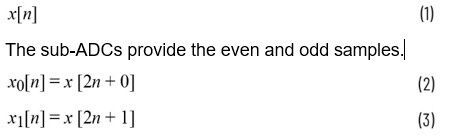
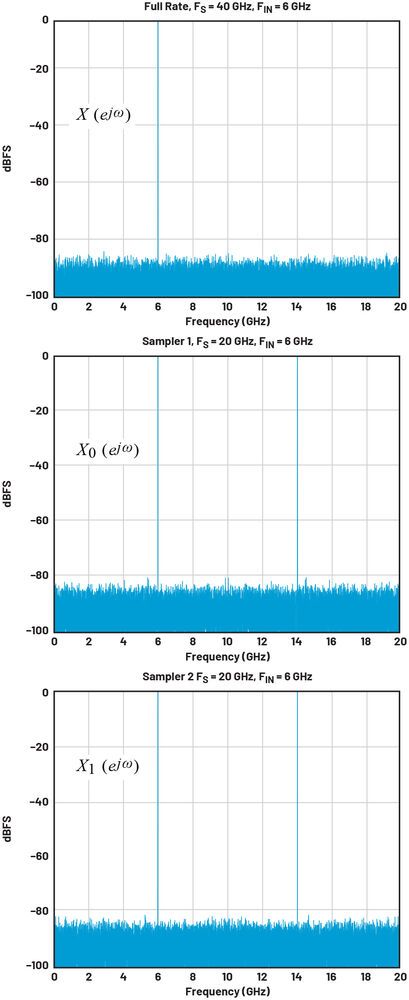
Imagine decimating ADC data into even and odd data samples. Each data stream is at half of the sample rate and contains every other sample shifted by one. This is what happens when interleaving ADC slices. Each slice is at half the rate and contains every other sample. A traditional approach is to stitch that data together at the full sample rate. An alternate approach is to utilize the phase information between the two slices that enables resolving Nyquist zones without increasing the digital data rates. Figure 2 introduces the concept of interleaved slices visualized in the frequency domain.
For example, let’s look at a 2× time-interleaved ADC:
(Source: Analog Devices)
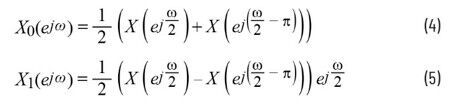
If we interpret the sub-ADC signals in the frequency domain, we can relate them back to the desired full-rate signal using equations 4 and 5.
(Source: Analog Devices)
Each sub-ADC signal consists of two aliasing signals from opposite Nyquist zones. The polarity of the aliasing is different for even vs. odd samples. We can exploit this fact to separate the first and second Nyquist zones in postprocessing.
Figure 2: Interpreting interleaved slices in the frequency domain
(Source: Analog Devices)
Time Interleaving Followed by FIR Filters
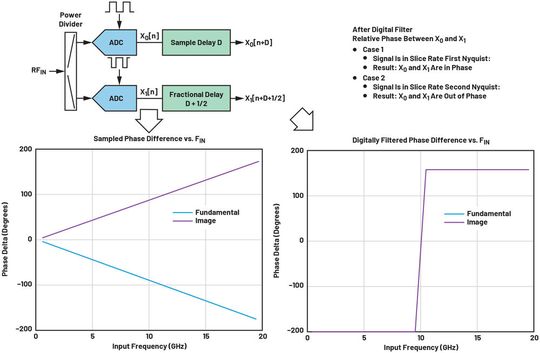
Working with phase information, a method can be created to resolve a slice rate first or second Nyquist signal. Figure 3 illustrates an approach to the solution. Recognize that time delay is a linear phase vs. frequency. Thus, at the ADC output, there is a linear phase vs. input frequency where the slope is based on the time delay of one-half of the slice rate period. The phase difference of both the fundamental and the image frequency is shown in the lower half of Figure 3 compared to the input frequency.
Figure 3: Phase difference between interleaved slices. At the ADC output, there is a time delay difference between the two slices of a half a clock period. This results in a linear phase vs. frequency. If a fractional delay filter of one-half sample is then applied at the output to one ADC channel, the phase in the first Nyquist is compensated, but in the second Nyquist there is a phase flip between the interleaved slices. This is the property to be exploited with the embedded DSP of the ADC.
(Source: Analog Devices)
At the output of the ADC, although we see the phase vs. frequency slope, there is not enough information with which to work. If we add a fractional delay of a ½ sample to one of the ADC slices, an important property emerges. The result is that the outputs of the ADCs are in phase if the input frequency is in the first Nyquist and are at a 180° phase difference if the signal is in the second Nyquist. This property enables a method to sum the signals and create a Nyquist zone cancellation method.
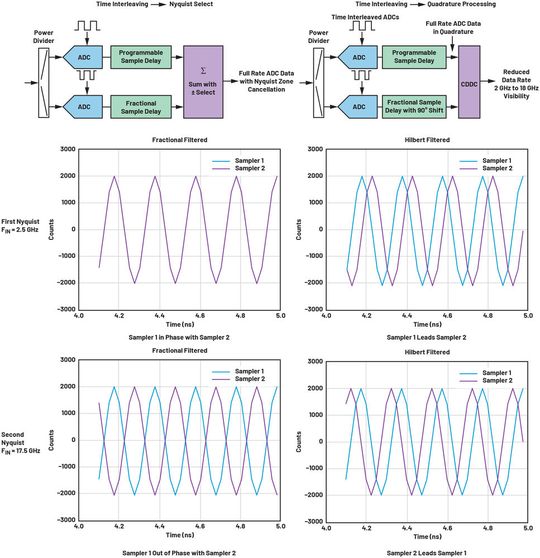
Figure 4: Two time-interleaving options are shown that exploit embedded filters. On the left, if a half-sample delay is added on one of the interleaving slices, the signals in the second Nyquist will be in phase and signals in the second Nyquist will be out of phase. On the right, if a Hilbert transform is included in the FIR coefficients, the result is that the signals are in quadrature at the FIR output with a phase flip at the Nyquist boundaries, similar to quadrature sampling described in Part 2.
(Source: Analog Devices)
This summing method is useful when the signal of interest is not near fs/2. For signals crossing the fs/2 boundary, an alternate approach is needed. If a Hilbert transform or a 90° shift is added to the fractional digital filter, then the phase delta is in quadrature at the filter outputs. The quadrature result also has a phase reversal between I and Q at fs/2 and can be used as quadrature inputs to a complex DDC, making this option analogous to the quadrature sampling option described in Part 2. This can be seen in Figure 4.
Date: 08.12.2025
Naturally, we always handle your personal data responsibly. Any personal data we receive from you is processed in accordance with applicable data protection legislation. For detailed information please see our privacy policy.
Consent to the use of data for promotional purposes
I hereby consent to Vogel Communications Group GmbH & Co. KG, Max-Planck-Str. 7-9, 97082 Würzburg including any affiliated companies according to §§ 15 et seq. AktG (hereafter: Vogel Communications Group) using my e-mail address to send editorial newsletters. A list of all affiliated companies can be found here
Newsletter content may include all products and services of any companies mentioned above, including for example specialist journals and books, events and fairs as well as event-related products and services, print and digital media offers and services such as additional (editorial) newsletters, raffles, lead campaigns, market research both online and offline, specialist webportals and e-learning offers. In case my personal telephone number has also been collected, it may be used for offers of aforementioned products, for services of the companies mentioned above, and market research purposes.
Additionally, my consent also includes the processing of my email address and telephone number for data matching for marketing purposes with select advertising partners such as LinkedIn, Google, and Meta. For this, Vogel Communications Group may transmit said data in hashed form to the advertising partners who then use said data to determine whether I am also a member of the mentioned advertising partner portals. Vogel Communications Group uses this feature for the purposes of re-targeting (up-selling, cross-selling, and customer loyalty), generating so-called look-alike audiences for acquisition of new customers, and as basis for exclusion for on-going advertising campaigns. Further information can be found in section “data matching for marketing purposes”.
In case I access protected data on Internet portals of Vogel Communications Group including any affiliated companies according to §§ 15 et seq. AktG, I need to provide further data in order to register for the access to such content. In return for this free access to editorial content, my data may be used in accordance with this consent for the purposes stated here. This does not apply to data matching for marketing purposes.
Right of revocation
I understand that I can revoke my consent at will. My revocation does not change the lawfulness of data processing that was conducted based on my consent leading up to my revocation. One option to declare my revocation is to use the contact form found at https://contact.vogel.de. In case I no longer wish to receive certain newsletters, I have subscribed to, I can also click on the unsubscribe link included at the end of a newsletter. Further information regarding my right of revocation and the implementation of it as well as the consequences of my revocation can be found in the data protection declaration, section editorial newsletter.
Image Correction for Time Interleaving
The previous section discusses several ways that the outputs of two time-interleaved ADCs can be combined to achieve a 2× full-rate signal when assuming that both ADCs are otherwise perfectly matched. However, in practice, there will be gain, phase, and delay mismatch between the ADCs and the branches of the preceding power divider. As with the quadrature sampling technique, the mismatch between ADC paths can be corrected using a half-complex filter structure at the ADC output, or alternatively by summing the outputs of full-complex filters from a pair of DDC channels.
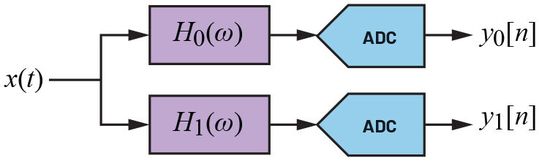
Figure 5: A time-interleaving model
(Source: Analog Devices)
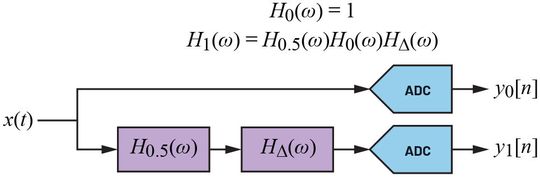
As seen in Figure 5, the time-interleaving system can be modeled as an ideal power splitter feeding two analog signal paths with differing transfer functions, with H0 (ω) representing the transfer function of the path capturing the even-numbered samples, and H1 (ω) representing the transfer function of the path capturing the odd-numbered samples. The even and odd signal paths will be referred to as the 0-path and the 1-path.
Figure 6: A relative time-interleaving model in terms of a nominal ½-sample delay H0.5 (ω) and a mismatch response HΔ (ω).
(Source: Analog Devices)
Like QEC, time-interleaving correction is a relative form of equalization. For example, in Figure 6, the 0-path can be thought of as ideal, and the 1-path can be matched to the 0-path. Therefore, the response of the 1-path can be modeled as the combination of (a) a nominal ½-sample delay, (b) the common response of the 0-path, and (c) a mismatch or delta response of the 1-path relative to the 0-path.
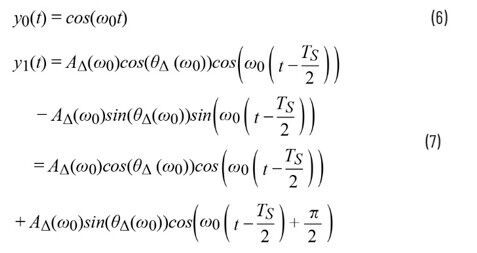
Using simple trigonometric identities, the output of the 1-path can be decomposed into a sum involving delayed cosine terms.
(Source: Analog Devices)
In the absence of mismatch between the 0-path and the 1-path (that is, HΔ (ω) = 1 ), the ideal outputs of the quadrature sampling configuration can be defined as:
(Source: Analog Devices)
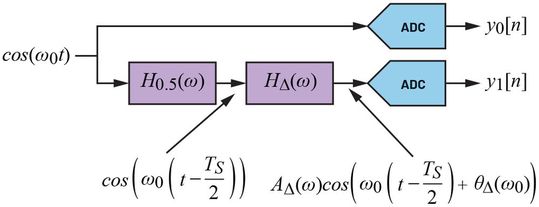
Figure 7 shows the result of stimulating this relative time-interleaving model with a sinusoidal input x(t) = cos (ω0t). The nominal ½-sample delay H0.5 (ω) and the mismatch response HΔ (ω) = AΔ (ω) e(jθΔ (ω)) modify the amplitude and phase of the 1-path signal as shown.
Figure 7: Stimulating the time-interleaving model with a sinusoidal input
(Source: Analog Devices)
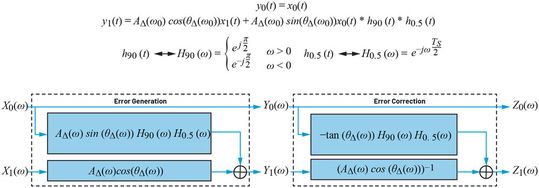
Therefore, for a sinusoidal or other narrowband signal centered at frequency ω0, the actual outputs can be written in terms of the ideal outputs. The time-interleaving configuration can be viewed as a 2 × 2 linear system that generates time-interleaving error. Time-interleaving error correction is performed by inverting this 2 × 2 linear system to recover the ideal outputs x0 (t) and x1 (t), as shown in Figure 8.
Figure 8: A relative time-interleaving model showing both error generation and error correction via a half-complex filter structure. The cross-over filter that spills from the 0-path to the 1-path must implement a half-sample delay (H0.5 (𝜔)) and a 90° phase shift (H90 (𝜔)).
(Source: Analog Devices)
Note that for the single-tone case depicted in this example, the error correction solution shown in Figure 8 is one of many possible solutions, where the solutions vary by adjusting one filter relative to the other. The error correction solution becomes unique when attempting to simultaneously correct signals in multiple Nyquist zones, but that unique solution is beyond the scope of this article.
This time-interleaving error generation model has similarities with the quadrature sampling error generation model, but there is one significant difference. With a single-tone stimulus, the quadrature sampling error can be modeled and corrected using single-tap real-valued filters. In other words, the correction requires only a gain correction in each of the two real-valued filters. However, time-interleaving correction requires a phase correction and therefore requires a multi-tap crossover filter that spills from the 0-path into the 1-path.
With the topology given, the outputs z0 [n] and z1 [n] represent the even-numbered and odd-numbered samples, respectively, of a 2× interleaved signal sampled at twice the rate. The interleaved output z[n] is constructed as follows:
(Source: Analog Devices)
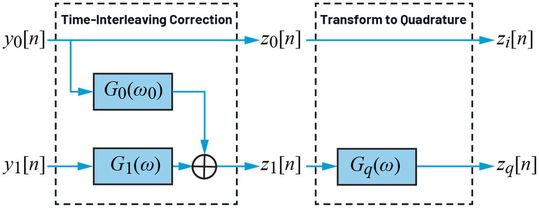
However, as described in previous sections, the ½-sample delay combined with a Hilbert transform can optionally be used to transform the z0 [n] and z1 [n] into a quadrature representation. Figure 9 shows the cascade of time-interleaving correction via filters G0 (ω) and G1 (ω), and the transformation to quadrature via Gq (ω), resulting in quadrature outputs z[n] = zi [n] + jzq [n].
Figure 9: Combining time-interleaving correction, to correct for analog mismatch between the 0-path and the 1-path, with a Hilbert transform to convert to a quadrature signal representation.
(Source: Analog Devices)
The cascaded filter stages can be merged into a single half-complex filter structure by including the quadrature transformation in the first stage.
(Source: Analog Devices)
Now, with a corrected quadrature output signal, the analysis provided in previous sections can be applied to defer the correction from the ADC output, using the programmable filter (PFILT), to the DDC output, using the complex filter (CFIR).
Figure 10: Measured image rejection comparing time and quadrature interleaving. Note that the errors are roughly about the same and in both cases the CFIR correction has improved performance due to the fact the CFIR operates at the decimated rate and the filter taps have a longer effective period.
(Source: Analog Devices)
Measurements are shown in Figure 10 comparing time interleaving vs. quadrature interleaving when using either the PFILT or CFIR for the respective error correction. The results show that the errors are about the same in magnitude for either the time or quadrature interleaving with the CFIR offering improved performance in both cases.
As described in Part 2, the errors after correction with the PFILT are limited by the frequency ripple caused by long transmission lines and impedance mismatch from the RF splitters to the two ADC channels. The PFILT response can approach similar results to the CFIR response after the aforementioned issues are corrected.
Comparison of Interleaving Options
Multiple interleaving options have been described. Next, a comparison of options is warranted. Measurements in Figure 10 show the image rejection performance is about the same for quadrature vs. time interleaving, so the decision about which option is best comes down to other practical application considerations.
Full Rate Offload vs. Embedded DSP
For cases where a full 40 GSPS of data is desired, this is possible and enabled with the latest MxFE solutions. The practical limitation becomes the absorption of the increased data, then calibrating and reforming a 40 GSPS data stream prior to processing. For many cases, it is highly desirable to still monitor a full 20 GHz first Nyquist bandwidth, yet utilize the embedded DSP to reduce the digital backend overhead. The options utilizing the embedded DSP have been the bulk of the descriptions, however offloading full rate data remains a realistic option if desired.
Time vs. Quadrature Interleaving
Quadrature interleaving has two benefits:
Use of the embedded FFT in complex mode
The input to the quadrature hybrid can be viewed like a balanced amplifier. Reflections from the ADC will be passed to the termination port providing better broadband impedance matching.
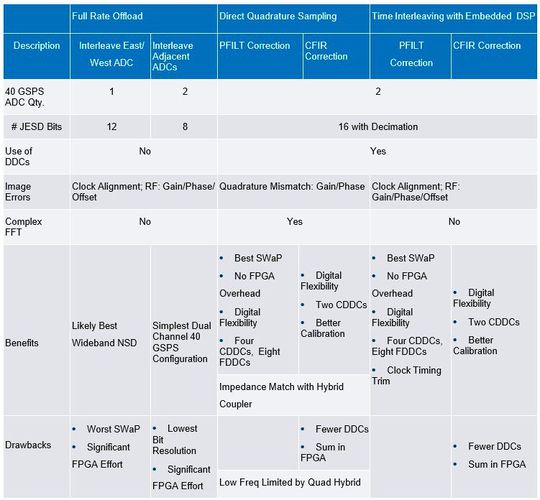
Table 1: Comparison of Interleaving Options
(Source: Analog Devices)
The primary drawback of the quadrature sampling is the frequency range limitations of commercially available quadrature hybrids. Commercial parts supporting a 2 GHz to 18 GHz range are available, which is historically a broad bandwidth. If an even larger band is desired, resistive power dividers are readily available that can extend to a lower frequency range.
PFILT vs. CFIR correction
While both the PFILT and the CFIR on the AD9084 support time-interleaving correction, there are pros and cons to each. The PFILT runs at the full ADC sample rate, which allows for a single set of filter coefficients to correct over wide bandwidths and also enables full usage of the embedded DSP functionality. However, the CFIR supports impulse responses of longer duration, which directly translates to improved performance in this application. Table 1 gives a summary of the trade-offs.
Conclusion
In this three-part series, practical methods to enable first Nyquist sampling through 20 GHz with commercially available ADCs have been described. In Part 1, the objectives were introduced and provided an overview of options. In Part 2, direct quadrature sampling was described in detail along with impairments and corrections needed. Part 3 concluded with time-interleaving options and a comparison of options available. Throughout the series, a technical foundation has been provided to show the results achieved in addition to final measurements.
Much effort has gone into maintaining dynamic range and noise performance while simultaneously pushing sample rates. The AD9084 20 GSPS ADCs provide best-in-class performance with input bandwidths through 18 GHz. The performance of those ADCs has remained while interleaving one step further to 40 GSPS and providing options that may be chosen by the user based on application objectives.
Future Work
Future work will be focused primarily on software and firmware upgrades enabling a streamlined integration of the interleaving options in end systems. Evaluation board modification to optimize the RF splitters next to the ADCs will be incorporated.
Acknowledgments
The authors would like to thank the design teams. A combination of the ADC sample rates, input bandwidth, and embedded DSP provided the foundation to develop the concepts discussed. We would also like to thank the long heritage of ADC designers and Analog Devices who paved the decades of design work culminating in 20 GHz first Nyquist, high dynamic range sampling.
* Ian Beavers is a field applications engineer and customer labs manager for the Aerospace and Defense Systems Team located at Analog Devices, Durham, North Carolina. He has worked for the company since 1999. Ian has over 25 years of experience in the semiconductor industry. Ian earned a bachelor’s degree in electrical engineering from North Carolina State University and an M.B.A. degree from the University of North Carolina at Greensboro.* Peter Delos is a technical lead in the Aerospace and Defense Group at Analog Devices in Greensboro, North Carolina. He received his B.S.E.E. degree from Virginia Tech in 1990 and M.S.E.E. degree from NJIT in 2004. Peter has over 30 years of industry experience. Most of his career has been spent designing advanced RF/analog systems at the architecture level, PWB level, and IC level. He is currently focused on miniaturizing high performance receiver, waveform generator, and synthesizer designs for phased array applications.* Brian Reggiannini is a senior principal engineer in system design. He has designed, implemented, and supported system-level calibrations for several generations of Analog Devices’ wireless transceiver products. His technical interests include signal processing, machine learning, embedded systems, and systems involving digitally assisted analog components. Brian earned Sc.B., Sc.M., and Ph.D. degrees from Brown University in 2007, 2009, and 2012, respectively.* Connor Bryant is a system applications engineer at Analog Devices working in the Aerospace and Defense Business Unit in Durham, North Carolina. He joined ADI in 2023. He is currently focused on RF mixed-signal chain design and analysis. He received his B.S.E.E degree from NC State University in 2022 and his M.S.E.E degree from NC State University in 2023.
References
Ali, Ahmed. High Speed Data Converters. IET, August 2016.




:quality(80)/p7i.vogel.de/wcms/0c/2c/0c2c1e0fe6dd4396ea5a5e6867f73692/bravetech-web-final-4204x2363v1.jpeg "(Source: EDA)")
:quality(80)/p7i.vogel.de/wcms/8a/d3/8ad3ae1e0dbacbb4e2b86dbf1c8ad35e/pentagon-ai-3838x2157v1.jpeg "The Pentagon pushes to embed several AI Platforms in classified operations. (Picture: AI-generated illustration.)")
:quality(80)/p7i.vogel.de/wcms/b4/93/b4938c8015a199ad0c93c0e6121a222a/tbvlqxeig7b28bdakm5fgl7nqzr0x6kmcvbrjsz045fckebse3lpuocy4thjnbox1qfojc8noi2liaflibnfbqg8znq57p3qnddowexg6eyqooccfzs-jncsktdbfxbxxuictuw4ert6tbflviq8wrnfgvwnjblrbl0nciijmefegsjyrtavx8hkr8kr6xvu-2400x1350v1.jpeg "An Iron Dome air defence launcher fires an interceptor missile during operations in 2021. (Photo: IDF Spokesperson’s Unit, Wiki Commons (CC BY-SA 3.0))")
:quality(80)/p7i.vogel.de/wcms/b2/8f/b28faa98f05fb550a0d3392f43134d64/0131010326v1.jpeg "Due to the threat posed by China, Taiwan is turning to drones for armaments. The picture shows an example of this. German drone manufacturers are now increasingly seeking contact with partners on the \"potato island\". (Source: Taiwan Drones)")
:quality(80)/p7i.vogel.de/wcms/d7/af/d7af4bc810cccf8776c81e5576e0b05d/liebherr-alm-machine-campsas-copyright-liebherr-800x533-w800-800x450v1.jpeg "(Source: Liebherr)")
:quality(80)/p7i.vogel.de/wcms/4e/30/4e30dfffc4a19c22f1131538778658f8/04-aus-einer-hand--f-c3-bchrende-20stahl--und-schmiedel-c3-b6sungen-f-c3-bcr-die-r-c3-bcstungsindustriev1.jpeg "Dillinger is the only supplier in Germany to be comprehensively approved in accordance with TL 2350-0000, and its Difender armor steels cover almost all of the Bundeswehr's requirements. The picture shows the Fuchs armored transport vehicle. (Source: Rheinmetall)")
:quality(80)/p7i.vogel.de/wcms/04/c5/04c559cc29adcd71a473b628d6aa7087/chatgpt-20image-2027--20apr--202026-2c-2001-27-59-1536x864v1.png "For the first time, China has imposed sanctions on European defence manufacturers over their dealings with Taiwan. (Picture: AI generated, ChatGPT)")
:quality(80)/p7i.vogel.de/wcms/a2/ff/a2ff11a8617ed088375fcc81ec7eb8e5/aluminum-ingots-6-20151016-1339386186-3648x2052v1.jpeg "Aluminium from smelters in the Gulf region count for 13 per cent of German imports. (Photo: Wikimedia Commons, CC BY-SA 4.0)")
:quality(80)/p7i.vogel.de/wcms/5c/11/5c11007aaa749981fa63c79b735c1366/20260420-ariane-64-launch-1018x573v1.png "Ariane 6 is set to launch for the second time in a four-booster configuration from Kourou. (Source: Arianespace)")
:quality(80)/p7i.vogel.de/wcms/5d/39/5d39a8ad1e0ad6b47e0a84c60edb5f40/ksc-20260411-ph-fmx01-0002orig-1200x800-1200x675v1.jpeg "(Source: SpaceX)")
:quality(80)/p7i.vogel.de/wcms/48/0c/480ca4a429f9c387b495879c09c4de9d/natilus-horizon-render-1920x1079v1.png "The Natilus Horizon passenger plane during liftoff. (Source: Natilus)")
:quality(80)/p7i.vogel.de/wcms/ad/f4/adf46e90c630d90dfad7aece46113c29/nasa-image-from-orion-space-capsule-to-earth-898x505v1.jpeg "Infineon IR HiRel's radiation-hardened semiconductors support the electronic system inside the Orion capsule. (Source: NASA)")
:quality(80)/p7i.vogel.de/wcms/eb/98/eb98363f4ac45e45731b0ca9d778d3af/vlad-aivazovsky-circuit-board-8221377-3823x2152v1.png "(Source: Vlad Aivazovsky on Pixabay)")
:quality(80)/p7i.vogel.de/wcms/2e/97/2e9773af320eac77ae3a29811ca4dabd/touchwaves-flight-jacket-1504x846v1.jpeg "Touchwaves’ haptic technology is designed for seamless, low-profile integration into standard-issue flight gear, providing critical sensory data without adding bulk or restricting movement (Source: Touchwaves)")
:quality(80)/p7i.vogel.de/wcms/27/32/27322d250fb21c5dc25c4e203d12f280/unif-sweden-916799-3264x1836v1.jpeg "Helsing’s expansion into Stockholm underscores the growing role of AI-driven technologies in strengthening Nordic and European defence capabilities. (Source: Unif on Pixabay)")
:quality(80)/p7i.vogel.de/wcms/51/05/510508999711379694f345af8cbf6441/0130929992v1.jpeg "At Rheinmetall, billion-dollar contracts are pouring in. Now the Bundeswehr has ordered systems worth over a billion euros, including those for the digitalization of individual infantry soldiers, so they can meet modern requirements on the battlefield ... (Image:Rheinmetall)")
:quality(80)/p7i.vogel.de/wcms/92/7d/927d241d8718196f4e70064ab0f9d31a/dsc04220-1440x809v1.jpeg "As part of a ceremonial conference on “whole-of-government defence and resilience”, Fraunhofer FKIE provided its first insights into research and innovation topics at its new institute site in Leipzig. Prof. Dr Christoph Igel, Deputy Director of Fraunhofer FKIE and network spokesperson for the Saxon research network “Innovation in Integrated Security and Sustainability” (I2SN), opened the conference. (Source: Fraunhofer FKIE/Jörg Riethausen)")
:quality(80)/p7i.vogel.de/wcms/7c/03/7c039e78ecf1bf358e631728c1811565/edited-1672x940v1.png "EDA Deputy Chief Executive Anders Sjöborg (left) together with ESA Director General Josef Aschbacher and respective teams at the signing ceremony in Brussels
(Source: EDA )")
:quality(80)/p7i.vogel.de/wcms/f9/2f/f92f1ef8c739c34c70d99f7b0997621b/stra007-20--20cover-20image-5472x3076v1.jpeg "(Source: Stratasys)")
:quality(80)/p7i.vogel.de/wcms/5e/18/5e184e4961f190c86a1ea3227104cab5/26pm03-20kompakte-20l-c3-b6sungen-20f-c3-bcr-20luft--20und-20raumfahrt-202-2362x1329v1.jpeg "(Picture: Keysight)")
:quality(80)/p7i.vogel.de/wcms/67/4c/674c54baa745be497cecb716826af339/stahlwille-hero-1807x1016v1.jpeg "A new modular tool solution designed for safety, precision, and mobility in aviation maintenance. (Source: STAHLWILLE)")
:quality(80)/p7i.vogel.de/wcms/0d/01/0d01a051ba894332a8091e3a3f9394e1/hytorc-defense-solutions-boxersatz-1899x1068v1.jpeg "HYTORC’s Defence Solutions toolkit, proven on the GTK Boxer, enables safe, traceable fastening of critical components across multiple Bundeswehr platforms. (Source: Image: HYTORC)")
:quality(80)/p7i.vogel.de/wcms/f3/4e/f34ed744bb30817d3432c7ad522e6f30/engine-1v1.jpeg "Engineering with aluminium profiles really can be this easy – the item Engineeringtool and its smart functions help you save valuable time. (Source: item)")
:quality(80)/p7i.vogel.de/wcms/fb/8e/fb8e5ae2aa27bcf3e466815505ca4ff2/alumin-1v1.jpeg "The aluminium profile technology of the item Building Kit System has been used to build a huge variety of structures for decades. (Source: item)")
:quality(80)/p7i.vogel.de/wcms/be/84/be84bbede3e40b1101cd3efa35a6ffa0/overview-of-20work-bench-design-in-productionv1.jpeg "With modular work bench design, you can convert or extend a work bench with ease by changing or adding accessories. This means changes can be implemented quickly and cost-effectively, thus boosting quality and productivity. (Source: item)")



:quality(80)/p7i.vogel.de/wcms/41/26/4126c55dcf2ac2d2f43c46e0294b052c/0124191716v1.jpeg "Figure 1: Spectral view: (a) Analog domain spectrum showing two signals spaced in frequency; (b) sampled spectrum of a 40 GSPS ADC; in this case, the two signals in the analog domain can be resolved in one Nyquist band; (c) sampled spectrum of interleaved ADCs each at 20 GSPS. Note the amplitude spectrums are on top of each other, preventing the resolution of the two signals. This article shows that the phase information between the interleaved slices is different and enables multiple options for interleaving ADCs including both quadrature interleaving and time interleaving. (Source: Analog Devices)")
:quality(80)/p7i.vogel.de/wcms/ef/f5/eff5d3e9d6d187b2d1bc8aba10a5abc8/0124221412v1.jpeg "Quadrature sampling principles compared with a ZIF architecture. (Source: Analog Devices)")