Electromobility is becoming more and more widespread: after e-scooters, e-bikes and electric cars, trucks and buses, tanks are now also set to get an electric drive. At least that's what the German defense supplier Renk is planning: in collaboration with the British defense company QinetiQ, Renk wants to equip the Leopard 2 tank with a hybrid drive. But how suitable is an electric tank for everyday use on the battlefield?
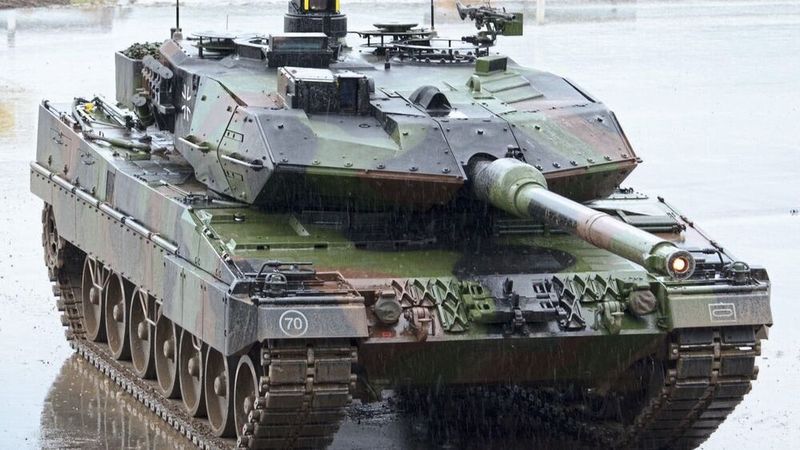
The Leopard 2 main battle tank: perhaps the army's best-known weapon system. 1,500 HP accelerate the 60-ton colossus to almost 70 km/h.
(Image: GNU Free Documentation License)
Electric drives in a military context are not a new invention. Engineers were already experimenting with hybrid-electric locomotives during the First World War to bring ammunition trains closer to the front where steam boilers were too conspicuous. The problem: weight and sensitivity.
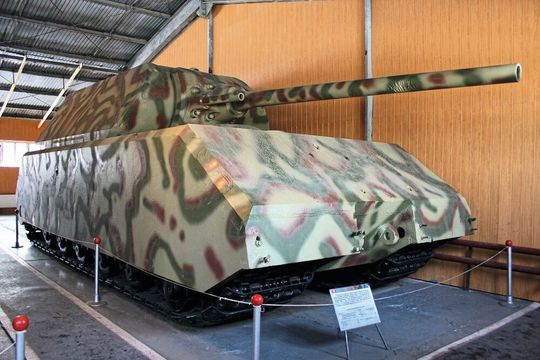
There were also similar experiments during the Second World War. German tank developers experimented with electric drive - for example in Ferdinand Porsche's Maus project. The 188-tonne colossus used an internal combustion engine to drive generators that fed the electric motors. However, the result was too heavy, too complex and too maintenance-intensive.
The Maus tank: The 188-ton tank was powered by petrol or diesel-electric engines.
(Image: public domain)
Even more recently, around the 1980s, the US Army tested all-electric vehicles for reconnaissance purposes. However, the batteries were still too heavy and therefore the range was too short.
Electric drives allow military vehicles to stalk silently
Thanks to the enormous progress made in battery technology, electric drives are no longer utopian, even in military technology. The Australian government, for example, is planning to gradually replace its army vehicles with electric equivalents. The advantage: electric military vehicles are almost silent on the road.
According to Renk, it is precisely this advantage that speaks in favor of the planned Leopard 2 with hybrid drive. The so-called "silent-watch operation" causes very little noise. In addition, the tank could quickly leave its position ("escape boost") in an emergency thanks to the additional electric drive, as starting a tank's diesel engine takes a lot of time.
In practice, the hybrid tank would drive purely electrically until the combustion engine switches on at a certain speed. Charging at a charging station is not necessary, as the batteries are charged by the diesel drive via a generator. Consequently, no charging stations need to be available on the battlefield.
Hybrid drives for military tracked vehicles
But would all-electric military vehicles also be conceivable? In the case of the Leopard 2, the answer to this question is currently still a clear "no". All you have to do is estimate the energy consumption of the 60-ton monster, as the e-engine electric mobility portal has shown. According to this, the fuel consumption of the Leopard 2 is up to 530 liters of diesel per 100 kilometers when used off-road; on normal roads, it is still around 410 liters.
The best cells currently available have an energy density of 450 Wh/liter. Since a purely electrically powered tank does not require fuel tanks, the Leo's tanks with their volume of 1,200 liters could be filled with batteries. This would result in a battery capacity of 540 kWh. As the MTU MB 873 Ka-501 turbine would also be eliminated, this would result in a gross battery capacity of around 1 MWh, of which 960 kWh would be usable based on experience.
1,200 liters of diesel weigh about 1 ton, the diesel engine about 2.2 tons. The imaginary battery would weigh around 6.25 tons. This would make the electric Leopard around three tons heavier than the diesel model. The electric Leopard would consume around 1,412.25 kWh per 100 kilometers, giving it a range of just 67 kilometers. If the energy requirements of the entire on-board electrics and electronics are also taken into account, the possible range drops even further - and it would be even shorter in winter.
As we know, there are no fast-charging stations on a battlefield, so the all-electric Leo would have to be constantly accompanied by a tanker with a diesel generator to recharge the batteries if necessary - a fantastic target for enemy attacks! With today's battery technology, an electric tank comparable to the Leopard 2 is therefore conceivable, but a very bad idea.
Fully electric wheeled armored vehicle with diesel engine as a range extender
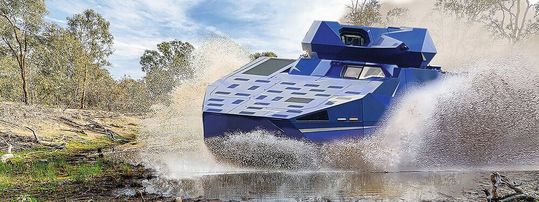
But it doesn't have to be a 60-ton tracked vehicle if you're thinking of all-electric military vehicles. A few years ago, Flensburger Fahrzeugbau GmbH (FFG) proved what is possible with its all-electric Genesis wheeled armored vehicle, which can even dive. The prototype is an 8x8 wheeled armored vehicle in which each of its eight wheels is driven by a 171 kW electric motor. A diesel engine, which is also installed, works as a range extender that charges the batteries while the vehicle is in motion.
Date: 08.12.2025
Naturally, we always handle your personal data responsibly. Any personal data we receive from you is processed in accordance with applicable data protection legislation. For detailed information please see our privacy policy.
Consent to the use of data for promotional purposes
I hereby consent to Vogel Communications Group GmbH & Co. KG, Max-Planck-Str. 7-9, 97082 Würzburg including any affiliated companies according to §§ 15 et seq. AktG (hereafter: Vogel Communications Group) using my e-mail address to send editorial newsletters. A list of all affiliated companies can be found here
Newsletter content may include all products and services of any companies mentioned above, including for example specialist journals and books, events and fairs as well as event-related products and services, print and digital media offers and services such as additional (editorial) newsletters, raffles, lead campaigns, market research both online and offline, specialist webportals and e-learning offers. In case my personal telephone number has also been collected, it may be used for offers of aforementioned products, for services of the companies mentioned above, and market research purposes.
Additionally, my consent also includes the processing of my email address and telephone number for data matching for marketing purposes with select advertising partners such as LinkedIn, Google, and Meta. For this, Vogel Communications Group may transmit said data in hashed form to the advertising partners who then use said data to determine whether I am also a member of the mentioned advertising partner portals. Vogel Communications Group uses this feature for the purposes of re-targeting (up-selling, cross-selling, and customer loyalty), generating so-called look-alike audiences for acquisition of new customers, and as basis for exclusion for on-going advertising campaigns. Further information can be found in section “data matching for marketing purposes”.
In case I access protected data on Internet portals of Vogel Communications Group including any affiliated companies according to §§ 15 et seq. AktG, I need to provide further data in order to register for the access to such content. In return for this free access to editorial content, my data may be used in accordance with this consent for the purposes stated here. This does not apply to data matching for marketing purposes.
Right of revocation
I understand that I can revoke my consent at will. My revocation does not change the lawfulness of data processing that was conducted based on my consent leading up to my revocation. One option to declare my revocation is to use the contact form found at https://contact.vogel.de. In case I no longer wish to receive certain newsletters, I have subscribed to, I can also click on the unsubscribe link included at the end of a newsletter. Further information regarding my right of revocation and the implementation of it as well as the consequences of my revocation can be found in the data protection declaration, section editorial newsletter.
The Genesis prototype: an all-electric 8x8 wheeled tank with 1,860 hp.
(Image: FFG)
The Genesis prototype weighs 25 tons and can transport deployment modules weighing up to 15 tons. The vehicle reaches a top speed of up to 100 km/h and has a range of up to 150 kilometers in purely electric mode, and even up to 600 kilometers with the range extender running.
In addition to manned military vehicles, unmanned vehicles of up to 20 tons could initially also be equipped with hybrid engines. According to Renk, electrification and hybridization open up great opportunities for growth. The company is certain that military forces around the world will rely on hybrid drives and the digitalization of their vehicles in the future. However, this would entail higher costs. Renk CEO Susanne Wiegand therefore anticipates a massive increase in global defense spending.
This is also confirmed by an analysis by the global market research and management consulting company Global Market Insights Inc. according to which the size of the military vehicle electrification market amounted to around USD 4.7 billion in 2023 and is expected to grow to more than USD 38.5 billion by 2032.
Fuel must also be transported in the future
Electrification of military vehicles is certainly the right way forward for environmental reasons. However, it will ultimately not be possible to do without diesel, as the fuel will still be needed for generators to charge the quiet vehicles. One way out of this dilemma would be the fuel cell, which could charge the smaller and lighter batteries of fully electric vehicles. Numerous trucks and buses already on our roads today prove that it works. The tanker vehicles would then have to drive hydrogen instead of diesel to the battlefield. (tk)
Thomas Kuther is a freelance specialist journalist and owner of Kuther Media Service.




:quality(80)/p7i.vogel.de/wcms/a5/e5/a5e5eecaf9443bd94c6833c158d7cced/20260924-en-5431005-1-640x360v1.jpeg "(Source: Saab AB)")
:quality(80)/p7i.vogel.de/wcms/e0/e7/e0e7bcd804912a34cd152be69b05a70f/rfa-esaboost-uk-1024x682-1024x576v1.jpeg "(Source: RFA)")
:quality(80)/p7i.vogel.de/wcms/32/42/3242e8a344e00905a0d8c7fc465178a9/defence-industry-sruvey-990x557v1.jpeg "(Source: European Commission)")
:quality(80)/p7i.vogel.de/wcms/b2/db/b2db599d38480ee76cb0632c3c5ac968/sentinel3c-sadeploymentthalesaleniaspace-alban-pichon-3-1680x944v1.jpeg "(Source: Thales Alenia Space, A. Pichon)")
:quality(80)/p7i.vogel.de/wcms/13/12/1312059ec82b1ed9e3df080350b29dc4/f46335bf-a581-4786-959f-4a0e9a74aed1-1671x940v1.png "Military radar architecture using distributed RF sensor nodes connected through optical fibre to central processing. (Source: KI-generiert / Gemini)")
:quality(80)/p7i.vogel.de/wcms/0a/14/0a1495d9b570ae32a5a7cc748b9a3c60/st-hannover-035-1920x1079v1-999x562v1.jpeg "Fastening technology you can experience first-hand—visitors to Schraubtec in Bochum (Germany) can see it for themselves at the Ruhr Congress on September 30, 2026. (Source: PHOTOVISION-DH GmbH)")
:quality(80)/p7i.vogel.de/wcms/cd/a9/cda92b173afa9d0b455d4f11b281c9ea/0094-to-image--capstone-cdr-1440x810v1.png "(Source: Terran Orbital)")
:quality(80)/p7i.vogel.de/wcms/e0/45/e045bc5414d7263fb308bdd501b5fcc1/0133113962v1.jpeg "The HSWL 354 is the transmission used, for example, in the Leopard 2 main battle tank. Renk manufactures this system and is now preparing to significantly increase its cycle time. As a result, Renk is placing greater emphasis on the military sector as a customer ... (Source: Renk)")
:quality(80)/p7i.vogel.de/wcms/5a/5a/5a5a0a2b51dbe1dd52c884b951db8cc7/aefa03eb-8efe-4b02-b8dd-824db7ae426f-1672x940v1.png "(Source: KI-generiert / Gemini)")
:quality(80)/p7i.vogel.de/wcms/1f/c2/1fc25ec2bd47a47b4617766e40033de2/image-2000-74f03b8e935a22580e24d2b05fe5ca3c-1920x1079v1.jpeg "The Airbus A310 ZERO-G stands ready for the 47th DLR parabolic flight campaign. It took place in Bordeaux from 7 to 18 September 2026. A total of twelve experiments from the fields of biology, physics, technology and materials science were on board. (Source: DLR (CC BY-NC-ND 3.0))")
:quality(80)/p7i.vogel.de/wcms/22/81/22812f686fd6ec1235f02392a3df56b9/34370ad9-163a-5941-9825-9c87a0e50000-1920x1079v1.png "Ariane 6 A64 flight VA267 with 32 satellites for Amazon LEO constellation, ready for launch at Europe's Spaceport in Kourou, French Guiana on 12 February 2026. (Source: ESA—M. Pédoussaut)")
:quality(80)/p7i.vogel.de/wcms/04/6b/046bda5de33193b13ebda873c3372868/iris2-1ceuropean-commission-1-1680x944v1.jpeg "(Source: European Commission)")
:quality(80)/p7i.vogel.de/wcms/cb/a2/cba2ecda891b2874327a30f69f773bdb/hexaforce-15-1920x1079v1.jpeg "(Source: Thales/Gauthier Chauffrut)")
:quality(80)/p7i.vogel.de/wcms/9d/8a/9d8addea8cc4e6f7a4793563ca397f2a/ai-im-milit-r-1672x940v1.png "(Source: KI-generiert / Gemini)")
:quality(80)/p7i.vogel.de/wcms/7f/5f/7f5fba2c729ec3aa256bf1a18d74529b/ai-chip-1672x940v1.png "(Source: KI-generiert / Gemini)")
:quality(80)/p7i.vogel.de/wcms/64/1b/641b6474b2a614cde7730c89ef2a3015/2026-09-09-rheinmetall-veroeffentlicht-battlesuite-schnittstellen-e8c18194-1225x690v1.jpeg "Rheinmetall’s Battlesuite provides a modular digital platform for connecting and integrating sensors, hardware and software components. (Source: Rheinmetall AG)")
:quality(80)/p7i.vogel.de/wcms/f1/c8/f1c88c768ba87dd2d71c708945c7df78/s960-applied-intuition04-960x640-960x540v1.jpeg "(Source: UK Government)")
:quality(80)/p7i.vogel.de/wcms/ef/1e/ef1eaddf8243b9c30cbfef17a4151def/aufmacherv1.jpeg "What works against drones—and what should be kept in mind when it comes to chain-based defence strategies? (Source: Mattheck)")
:quality(80)/p7i.vogel.de/wcms/b1/f0/b1f00d146f272acbef15ea82996259de/s960-halo-shield-2-960x540v1.png "Quell’s SkySpyke system in action (Source: UK Government)")
:quality(80)/p7i.vogel.de/wcms/2b/3d/2b3d42b7dc255aaaf5cadf57dab47d3b/43907b28dda9-sky-striker-demo-2-1600x899v1.webp "Diehl Defence and Elbit Systems demonstrate the capabilities of the SkyStriker loitering munition during a live demonstration. (Source: Diehl Defence)")
:quality(80)/p7i.vogel.de/wcms/90/a8/90a849f0023f11d1eb642eb4751a0321/bild2-h-c3-a4nel-ict-20truck-20and-20trailer-20parts-4320x2429v1.jpeg "Product information is visible at all times and retrieval of items
is confirmed by employees directly on the display of the Hänel MP 14 N
controller. (Source: René Marks)")
:quality(80)/p7i.vogel.de/wcms/4e/ca/4ecaa39f247490eded591b652c33aee3/thilmann-hcp-web-20kleiner-20ausschnitt-1442x811v1.jpeg "Entering the defence market can be challenging for start-ups, says HCP Sense CEO Ansgar Thilmann. (Picture: HCP Sense)")
:quality(80)/p7i.vogel.de/wcms/7a/51/7a511b80041d3f1335f3a5aa56fe75da/delivery-7022432-1280-1280x720v1.png "(Source: Mohamed_hassan)")
:quality(80)/p7i.vogel.de/wcms/f9/2f/f92f1ef8c739c34c70d99f7b0997621b/stra007-20--20cover-20image-5472x3076v1.jpeg "(Source: Stratasys)")
:quality(80)/p7i.vogel.de/wcms/ec/a9/eca9062ccbe4b042f8515846340410d8/aerospace-and-defence-stairways-platforms-and-much-morev1.jpeg "Modular constructions enable flexible modification. That applies to larger structures such as stairways and platforms, too. And that means aerospace and defence companies can reconfigure their maintenance platforms fast (itemitem)")
:quality(80)/p7i.vogel.de/wcms/30/2a/302a7b5723ad38fbde812fd3a468ad04/safety-on-stairways-in-industry-key-considerationsv1.jpeg "Stairways and platforms are used widely in maintenance and assembly areas in the aerospace and defence sectors. (Source: item)")
:quality(80)/p7i.vogel.de/wcms/f3/4e/f34ed744bb30817d3432c7ad522e6f30/engine-1v1.jpeg "Engineering with aluminium profiles really can be this easy – the item Engineeringtool and its smart functions help you save valuable time. (Source: item)")
:fill(fff,0)/p7i.vogel.de/companies/69/6d/696de2483d115/logo--fastems-rgb-horizontal.jpeg "logo--fastems-rgb-horizontal (Fastems)")
:fill(fff,0)/images.vogel.de/vogelonline/companyimg/84700/84735/65.jpg "logo_item_rgb_neu.jpg ()")
:quality(80)/p7i.vogel.de/wcms/a9/a5/a9a51ed74a731b1676a4b931dde90885/rheinmetall-ermine-4x4-ermine-6x6-hq--r6ii6338-2-2000x1124v1.jpeg "Rheinmetall’s Hermelin: a lightweight hybrid vehicle that can also be operated remotely. (Source: Rheinmetall AG)")
:quality(80)/p7i.vogel.de/wcms/7a/8b/7a8bb2bd0b936077fab324ff13ff9322/just-20imagine-20--20thomas-20benz-3648x2053v1.jpeg "At the Bundeswehr University Munich, Prof. Dieter Gerling researches and teaches in the field of alternative electric powertrains. (Source: just imagine - Thomas Benz)")