The harsh conditions in space put connectors to the test. Issues such as fretting corrosion can lead to mission failure. This article explains how developers have successfully used advanced connector designs in recent Mars missions, ensuring reliable operation despite shocks, vibrations, and extreme temperatures.
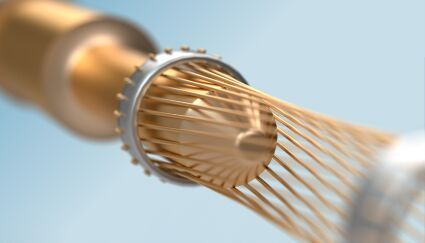
Hypertac hyperboloid contact connectors from Smiths Interconnect.
(Image: Smiths Interconnect)
When the Mars rover Curiosity embarked on its mission to the Red Planet in 2011, it marked the beginning of a journey of remarkable ambition and scale. Curiosity was launched aboard an Atlas V rocket from Cape Canaveral, Florida, and traveled through space for several months before successfully enduring the challenging entry into the scorching Martian atmosphere and landing in the 150-kilometer-wide (approx. 90 miles-wide) Gale Crater.
That was just the beginning of an extraordinary scientific mission. Since then, the 3-meter-long (approx. 10 ft), 900-kilogram spacecraft has spent thousands of days traversing the rocky and hilly terrain, transmitting crucial information about the planet's geology, chemistry, and potential habitability. Incredibly, Curiosity continues its mission to this day—a longevity that highlights the ingenuity of the scientists and engineers who have made this interplanetary endeavor a lasting success.
Such groundbreaking space exploration is the sum of many parts. Like its successor Perseverance, Curiosity relies on the robust and resilient performance of multiple systems and components that must work seamlessly together over extended periods. One example is connectors: the success of the Curiosity mission depends on reliable power supply and communication onboard. Without absolutely secure connections, the entire mission could have come to a halt.
The challenge: Connections in space
How do space missions like Curiosity and Perseverance ensure reliable connections for power distribution, data transmission, and signaling when maintenance or replacement is impossible? To answer this question, it is worth examining the numerous hazards these connections face in the harsh environment of space. These include extreme temperature fluctuations and intense vibrations during launch. Each of these factors can compromise the integrity of connectors, which are critical to the operation of spacecraft. Here, the phenomenon of fretting corrosion poses a significant challenge. If left unaddressed, it could jeopardize the success of entire missions.
Fretting corrosion refers to the wear and deterioration between two contact surfaces exposed to repeated tangential movements, often caused by vibrations or temperature fluctuations. These micro-movements, typically only a few thousandths of a millimeter, cause the contact surfaces to rub against each other, gradually wearing away the protective coatings at the connector's contact points.
In electrical connectors, the contacts consist of a plug pin or blade and a socket. These are typically coated with a thin layer of gold, which is chemically inert and resistant to oxidation. However, gold is a relatively soft metal and prone to wear. Beneath the gold coating, a layer of electroless nickel forms a barrier between the gold and the substrate. While nickel is more durable than gold, it is prone to oxidation, forming non-conductive oxide layers when exposed to air.
Through micro-movements, the gold coating wears away, exposing the underlying nickel. The nickel oxidizes, and these oxide particles accumulate in the grooves of the surface irregularities, which consist of tiny ridges and pits in the metal's texture. As friction continues, the presence of oxide particles in these grooves increases electrical resistance. This obstructs current flow, leading to power loss, signal distortion, and eventually the complete failure of the connector – resulting in a total mission failure.
Limitations of conventional connectors
Developers working on space missions—as well as in other areas with high reliability demands, such as conventional aerospace and defence technology, medical technology, and metrology—are aware of the problem of fretting corrosion. Traditional methods to combat this phenomenon include increasing contact force, applying lubricants, or using mechanical locking mechanisms. However, each of these approaches has its limitations or drawbacks, especially in space, where extreme environmental conditions and the need for long-term reliability without intervention play a crucial role.
Date: 08.12.2025
Naturally, we always handle your personal data responsibly. Any personal data we receive from you is processed in accordance with applicable data protection legislation. For detailed information please see our privacy policy.
Consent to the use of data for promotional purposes
I hereby consent to Vogel Communications Group GmbH & Co. KG, Max-Planck-Str. 7-9, 97082 Würzburg including any affiliated companies according to §§ 15 et seq. AktG (hereafter: Vogel Communications Group) using my e-mail address to send editorial newsletters. A list of all affiliated companies can be found here
Newsletter content may include all products and services of any companies mentioned above, including for example specialist journals and books, events and fairs as well as event-related products and services, print and digital media offers and services such as additional (editorial) newsletters, raffles, lead campaigns, market research both online and offline, specialist webportals and e-learning offers. In case my personal telephone number has also been collected, it may be used for offers of aforementioned products, for services of the companies mentioned above, and market research purposes.
Additionally, my consent also includes the processing of my email address and telephone number for data matching for marketing purposes with select advertising partners such as LinkedIn, Google, and Meta. For this, Vogel Communications Group may transmit said data in hashed form to the advertising partners who then use said data to determine whether I am also a member of the mentioned advertising partner portals. Vogel Communications Group uses this feature for the purposes of re-targeting (up-selling, cross-selling, and customer loyalty), generating so-called look-alike audiences for acquisition of new customers, and as basis for exclusion for on-going advertising campaigns. Further information can be found in section “data matching for marketing purposes”.
In case I access protected data on Internet portals of Vogel Communications Group including any affiliated companies according to §§ 15 et seq. AktG, I need to provide further data in order to register for the access to such content. In return for this free access to editorial content, my data may be used in accordance with this consent for the purposes stated here. This does not apply to data matching for marketing purposes.
Right of revocation
I understand that I can revoke my consent at will. My revocation does not change the lawfulness of data processing that was conducted based on my consent leading up to my revocation. One option to declare my revocation is to use the contact form found at https://contact.vogel.de. In case I no longer wish to receive certain newsletters, I have subscribed to, I can also click on the unsubscribe link included at the end of a newsletter. Further information regarding my right of revocation and the implementation of it as well as the consequences of my revocation can be found in the data protection declaration, section editorial newsletter.
Therefore, many commercially available connectors based on conventional contact designs are not well-suited for the harsh environmental conditions in space. The traditional pin-and-socket contact design—where the ends of the socket contact are shaped into a circular form to establish contact with the pin—is particularly prone to fretting corrosion. This is especially true in applications exposed to vibrations, shocks, or temperature fluctuations.
The tuning fork contact resembles the pin-and-socket contact but features a different design. These contacts are stamped from flat material and shaped into a fork-like form. Tuning fork contacts are often supplied in strip and reel formats, with the socket portion selectively coated to save costs. The pin contact is square and embedded in standard PCB connectors. Like the pin-and-socket contact, the tuning fork contact provides two contact points between the plug and socket sections. However, these contacts tend to perform poorly in harsh environments like those mentioned.
Finally, there is the bent metal contact, also referred to as a shielding or grounding contact. This consists of a stamped, selectively coated contact delivered in strip and reel formats. This contact design is simple, features a single contact point, and is often used in cost-effective applications such as battery contacts. While bent metal contacts are inexpensive and straightforward in construction, they have a significant drawback: excessive compression can lead to cold deformation and permanent distortion. Therefore, this type of contact is not recommended for applications with high reliability demands, where consistent performance and durability are required.
Advanced contact design for space applications
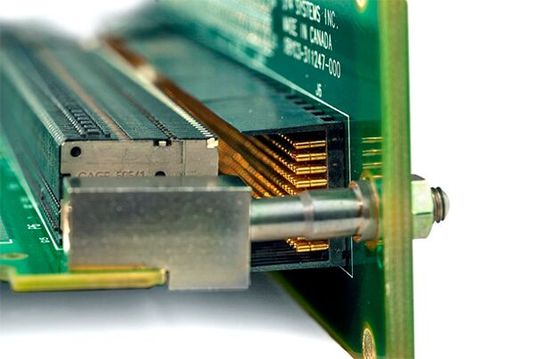
KVPX connectors from Smiths Interconnect.
(Image: Smiths Interconnect)
So what is the solution for a reliable connection in space? The developers of the Curiosity and Perseverance projects found the answer by exploring the history of a high-performance contact technology originally developed in the mid-1950s to address electrical interruptions caused by strong vibrations in rail transportation. Over the years, the Hypertac® hyperboloid contact has established itself for its reliability in demanding applications through continuous refinement.
This contact consists of a hyperboloid-shaped basket of wires that run obliquely to the axis of the socket. These wires are chemically nickel-plated and gold-plated, with the gold layer being 50 μm thick. When the pin is inserted into the basket, the wires wrap around it, forming numerous redundant linear contact points. These provide a low-resistance current path between the pin and the basket. The contact area covers approximately 360° and extends along the entire length of the pin.
Due to its design, the Hypertac hyperboloid contact has a higher current-carrying capacity than comparable contacts and is rated for up to 100,000 mating cycles. This makes it suitable for applications requiring high reliability, as mentioned earlier. While repeated mating in space is not an issue, the proven performance of Hypertac contact technology in its miniaturized form has become the preferred choice for applications demanding the highest reliability. It was the perfect solution for Curiosity and Perseverance.
Both missions utilized 2mm cPCI connectors from Smiths Interconnect, which are based on the Hypertac hyperboloid technology. Rigorous testing under extreme environmental conditions was conducted at the Jet Propulsion Laboratory, including temperature fluctuations, corrosive atmospheres, excessive shocks and vibrations, contact mating/unmating cycles, and other critical NASA requirements. The cPCI connector has proven itself under the harshest conditions in demanding applications where failures are not tolerated, making it the ideal component for the Mars rovers.
Advantages of Hypertac in high-reliability systems
The commercialization of the Hypertac hyperboloid contact technology is progressing rapidly. Today, it serves as the foundation for additional connector series used in high-reliability applications. The KVPX connector system from Smiths Interconnect, for example, is based on this technology to provide a robust and reliable solution for environments where connectors must withstand extreme conditions such as vibrations, shocks, and temperature fluctuations. KVPX connectors feature space-grade 0.4mm hyperboloid sockets, which offer high resistance to fretting corrosion due to multiple linear contact points and low insertion forces. The contact's self-cleaning action ensures reliable electrical performance even under the harshest environmental conditions.
KVPX connectors meet the electrical requirements of the VITA 46 and VITA 48 standards for embedded systems in aerospace and military applications. The connectors enable data transfer rates of up to 16 Gbps for differential signals and up to 8 GHz for single-ended/reference signals. Additionally, they exceed vibration standards: successful tests have shown that they can withstand vibrations up to 15 Geff and shocks up to 100 G, surpassing the requirements of VITA 47. The KVPX system is rated for over 4,000 mating cycles, making it a robust choice for programs with high reliability demands, such as the latest fifth-generation fighter jets.
Securing the future of space exploration
In summary, Curiosity and Perseverance have ushered in a golden age of modern space exploration. Numerous other missions are currently under development and execution, which will further push the boundaries of our knowledge. The success of all these ventures depends on reliable power and data connections within the systems.
Fretting corrosion remains a significant challenge for connectors in harsh environments. However, with technologies such as the Hypertac hyperboloid contact, it can be effectively minimized. Connector systems from Smiths Interconnect, based on Hypertac contact technology, have proven to be a reliable solution for demanding applications – not only in Curiosity and Perseverance but also in aerospace, defence, and other industries.
To learn more about fretting corrosion and the Hypertac hyperboloid contact technology, download our white paper "Understanding Fretting Corrosion in Ruggedised Backplane Connectors" here or watch our on-demand webinar. (mbf)
*Kevin DeFord is Product Commercial Senior Manager, Kyle Gobble is Product Line Manager, DSA, and Benedetta Conte is Product Marketing and Communications Manager at Smiths Interconnect.




:quality(80)/p7i.vogel.de/wcms/5b/2c/5b2cceb9038883edfacb76a61fca350b/vw-os-4-25--28cropped-29-3136x1765v1.jpeg "VW Osnabrück: Following Rheinmetall, KNDS is now also interested in at least a partial takeover of the plant. One popular example for the shift from civilian to military production. (Picture: Wiki Commons)")
:quality(80)/p7i.vogel.de/wcms/ec/ee/ecee771dce48d9c693f8869da717ceeb/robertwaghorn-jet-2974131-4777x2687v1.jpeg "European allies intensify cooperation efforts to boost defence capabilities and ensure long-term security stability. (Source: Robert Waghorn on Pixabay)")
:quality(80)/p7i.vogel.de/wcms/be/0b/be0b550a4fc2724afeed0713f65e7675/spexer-anechoic-chamber-1280x720v1.png "(Source: Hensoldt AG)")
:quality(80)/p7i.vogel.de/wcms/6f/0f/6f0fc6e3348925946d77fa2339e53005/0130142731v1.jpeg "Heidelberger Druckmaschinen Aktiengesellschaft establishes a joint venture with Ondas. The aim is to provide and market effective drone defence systems in Europe and Ukraine. (Source: Ondas)")
:quality(80)/p7i.vogel.de/wcms/2c/2c/2c2c63c23a1be1fe8259e3da28ebaff2/figure3-3864x2172v1.jpeg "(Source: AI-generated)")
:quality(80)/p7i.vogel.de/wcms/a2/66/a266453da44556de3d18a0976597a605/sintavia-press-release-image-31726-1333x750v1.jpeg "Scooped version of representative heat exchanger. (Source: Sintavia)")
:quality(80)/p7i.vogel.de/wcms/2e/15/2e15396bd28d5cc96f2c339a6b7bf1e8/l3harris-disco-1220-1217x684v1.jpeg "(Source: L3Harris Technologies)")
:quality(80)/p7i.vogel.de/wcms/0c/70/0c701a79c1f183921b8ee9341ef61db8/0129694966v1.jpeg "Robonode's DVK Development Kit: This is available through Codico's sample shop. (Image:8DEVICES)")
:quality(80)/p7i.vogel.de/wcms/b4/ae/b4ae65d3fb3903a13571d9ea3e61da8a/mock-up-vleo-def-1920x1079v1.jpeg "Illustration of the VLEO-DEF satellite in orbit (Source: EDA)")
:quality(80)/p7i.vogel.de/wcms/11/c8/11c8d30d75151329d2700176eb7a0383/0130110840v1.jpeg "Zenadrone, a subsidiary of Zenatec, is working on developing an operational low-cost drone as a disposable concept (symbol image). The first prototype already exists. In the future, it is intended to counter increasing enemy drone attacks without significant financial effort... (Source: Zenadrone)")
:quality(80)/p7i.vogel.de/wcms/c8/4c/c84cef4bf459f1280823827c3e3615c2/7cf414af-d41d-46ac-b22b-890f9f32d24c-2048x1151v1.jpeg "In Manching, Germany, Airbus is currently preparing two Valkyries for their first flight with its European mission system. The picture shows one of them. (Source: Airbus)")
:quality(80)/p7i.vogel.de/wcms/e3/d7/e3d7de9cfaac27f48ee6e162f9b309e9/0128899731v1.jpeg "Here, Lufthansa's first anniversary aircraft lands in Frankfurt. (Image:Lufthansa)")
:quality(80)/p7i.vogel.de/wcms/06/37/0637c7dd3fab9b00a8e96f98133cd1dc/260304-d-d0477-1005-5892x3317v1.png "A B-52H Stratofortress idles prior to taking off in support of Operation Epic Fury in March 2026. (Source: U.S. Air Force)")
:quality(80)/p7i.vogel.de/wcms/13/2b/132bb2831ae98c4c3bdd0ee2990ba1eb/bareways-20deck-20--20crisis-20coordination-20platformv1.jpeg "(Source: Bareways)")
:quality(80)/p7i.vogel.de/wcms/93/f1/93f1e4dba53b2c9589fab17a525df55e/adobestock-163119218-2480x1394v1.jpeg "(Source: Kernkonzept GmbH)")
:quality(80)/p7i.vogel.de/wcms/8d/76/8d764c984e44153da8f0dfa88cd6d75e/0129843677v1.jpeg "A successful drone attack on two data centers of the Amazon subsidiary AWS shows that the danger of drones is virtually unavoidable in modern warfare ... (Source: Cerberus)")
:quality(80)/p7i.vogel.de/wcms/14/d3/14d3e0847d222af54aa5ab625480507f/0130015022v1.jpeg "A German-French battle tank project was approved some time ago (symbol image). But a modern drive system is also needed for it. This is now being developed by Rolls-Royce Power Systems and ZF in the coming years... (Image:Rheinmetall)")
:quality(80)/p7i.vogel.de/wcms/bd/21/bd2191aab59c430b3c74a2be07120333/image-196-1294x728v1.png "(Image:SkyDefender © Thales)")
:quality(80)/p7i.vogel.de/wcms/d4/dc/d4dc9a59e1698ae295b1e6e64a29a55b/geralt-handshake-5768632-1280-1280x720v1.jpeg "Rheinmetall and Nooteboom Trailers are collaborating on the development and marketing of heavy equipment trailer systems designed for transporting modern tracked and wheeled military vehicles. (Image:Gerd Altmann from Pixabay)")
:quality(80)/p7i.vogel.de/wcms/22/54/2254d1e2667aff755e7aba0bcaf2eb42/0130021093v1.jpeg "Daimler Truck and Quantum Systems are jointly developing unmanned military vehicles. (Image:Quantum Systems)")
:quality(80)/p7i.vogel.de/wcms/f9/2f/f92f1ef8c739c34c70d99f7b0997621b/stra007-20--20cover-20image-5472x3076v1.jpeg "(Source: Stratasys)")
:quality(80)/p7i.vogel.de/wcms/5e/18/5e184e4961f190c86a1ea3227104cab5/26pm03-20kompakte-20l-c3-b6sungen-20f-c3-bcr-20luft--20und-20raumfahrt-202-2362x1329v1.jpeg "(Picture: Keysight)")
:quality(80)/p7i.vogel.de/wcms/67/4c/674c54baa745be497cecb716826af339/stahlwille-hero-1807x1016v1.jpeg "A new modular tool solution designed for safety, precision, and mobility in aviation maintenance. (Source: STAHLWILLE)")
:quality(80)/p7i.vogel.de/wcms/0d/01/0d01a051ba894332a8091e3a3f9394e1/hytorc-defense-solutions-boxersatz-1899x1068v1.jpeg "HYTORC’s Defence Solutions toolkit, proven on the GTK Boxer, enables safe, traceable fastening of critical components across multiple Bundeswehr platforms. (Source: Image: HYTORC)")
:quality(80)/p7i.vogel.de/wcms/f3/4e/f34ed744bb30817d3432c7ad522e6f30/engine-1v1.jpeg "Engineering with aluminium profiles really can be this easy – the item Engineeringtool and its smart functions help you save valuable time. (Source: item)")
:quality(80)/p7i.vogel.de/wcms/fb/8e/fb8e5ae2aa27bcf3e466815505ca4ff2/alumin-1v1.jpeg "The aluminium profile technology of the item Building Kit System has been used to build a huge variety of structures for decades. (Source: item)")
:quality(80)/p7i.vogel.de/wcms/be/84/be84bbede3e40b1101cd3efa35a6ffa0/overview-of-20work-bench-design-in-productionv1.jpeg "With modular work bench design, you can convert or extend a work bench with ease by changing or adding accessories. This means changes can be implemented quickly and cost-effectively, thus boosting quality and productivity. (Source: item)")
:fill(fff,0)/p7i.vogel.de/companies/64/fe/64fec73b1a2fb/logo-master-ggbbytimken-286blue.jpeg "logo-master-ggbbytimken-286blue (GGB)")
:fill(fff,0)/p7i.vogel.de/companies/69/6d/696de2483d115/logo--fastems-rgb-horizontal.jpeg "logo--fastems-rgb-horizontal (Fastems)")
:fill(fff,0)/images.vogel.de/vogelonline/companyimg/84700/84735/65.jpg "logo_item_rgb_neu.jpg ()")
:quality(80)/p7i.vogel.de/wcms/bd/c5/bdc585ad8e8f17cc17231a22f1732a22/satellite-67718-1280-1280x719v1.jpeg "Connectors for space applications face their challenges, including shock loads and outgassing. (Bild: WikiImages // https://pixabay.com/photos/satellite-spacecraft-space-67718/)")
:quality(80)/p7i.vogel.de/wcms/62/4a/624af07b9e933f3ae479465c780f9405/0126750590v1.jpeg "In airplanes, armored vehicles, and missile systems, connectors must withstand constant vibrations and shocks. (Image:Wiremaster)")