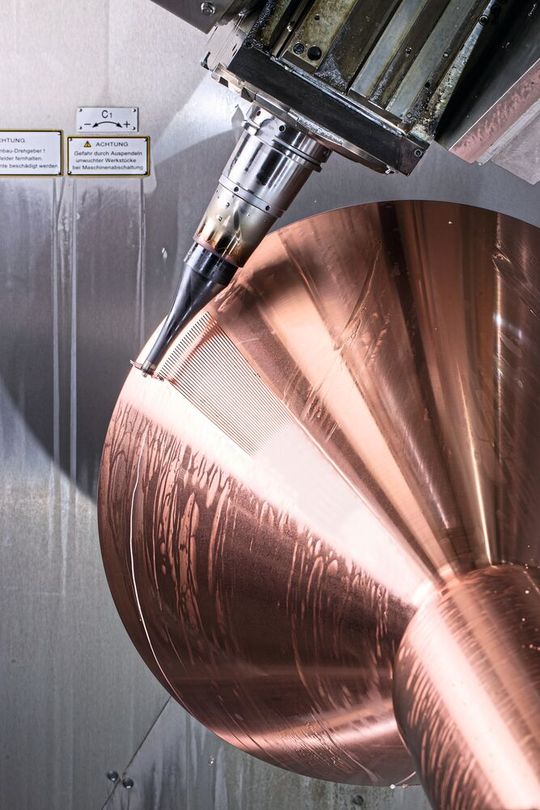
Slot milling in the combustion chambers of the Vulcain 2.1 and Vinci engines.
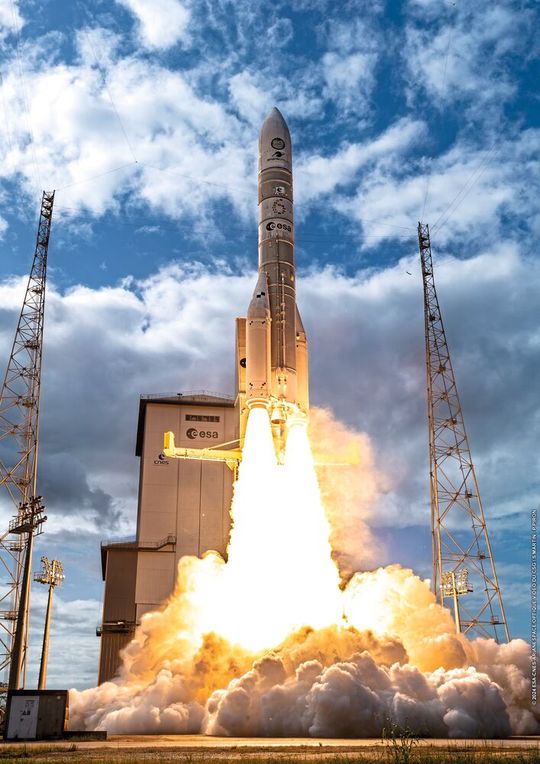
Under a roaring tail of fire and massive clouds of steam, the new Ariane 6 launch rocket lifted off into space on July 9, 2024.
(Source: ArianeGroup)
On July 9, 2024, at 20:59:50, engineers sat tensely behind countless monitors, listening to the countdown: 10, 9, 8, 7…. Exactly at 21:00 German time, the word "Décollage" (French for liftoff) was spoken. Under a roaring tail of fire and huge clouds of steam, the new Ariane 6 launch vehicle lifted off into space from Kourou in French Guiana. The team in Kourou was in a celebratory mood after the first mission. But not only there. Public viewing of the launch took place at all ArianeGroup locations as well. "We have been anticipating and working hard for this moment for eight years," says Stefan W.. He is responsible for the machining production of the ArianeGroup's engines at the Ottobrunn site. The production of the individual components and assemblies is quite literally rocket science. Tight tolerances, exotic materials, and high component costs—nothing can go wrong during production. Stefan W. and his experienced machining team rely on precision tools and the technical expertise of Paul Horn GmbH.
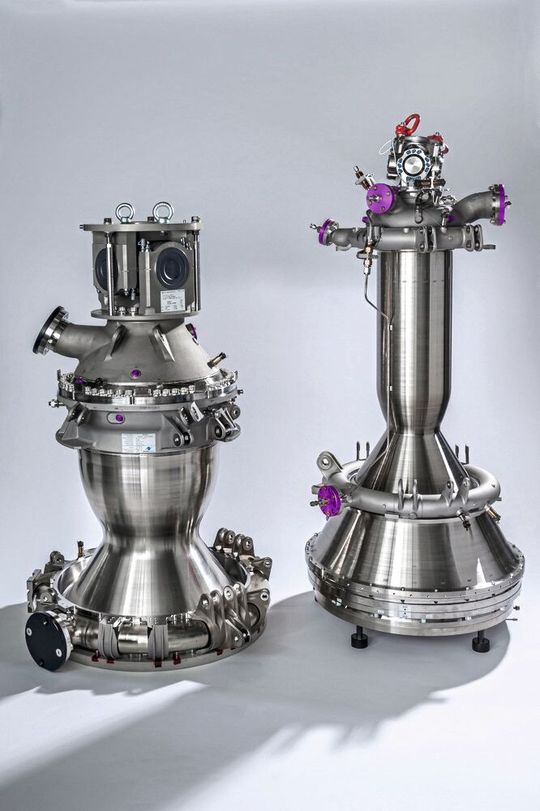
Vinci and Vulcain 2.1 are the names of the two rocket engines that provide propulsion for the new Ariane 6. With approximately 130 tons of thrust each, equivalent to four million horsepower, the engines are marvels of engineering. Unlike conventional aircraft turbines, rocket engines do not draw in air from the outside to compress and accelerate it before expelling it again. Thrust is generated by expelling propellant mass in the opposite direction of travel (reaction principle). For this reason, rocket engines can provide the necessary thrust even in the vacuum of space, whereas aircraft engines would lack air to draw in. The required thrust is created by burning liquid oxygen (LOX) and liquid hydrogen (LH2). Under the high pressure of turbopumps, the mixture is ignited in the engine's combustion chamber. The resulting pressure is then converted into kinetic energy.
Directly connected to the combustion chamber of an engine is the nozzle. The specially shaped exit opening increases the exhaust velocity, resulting in higher thrust and greater internal pressure in the combustion chamber. The high temperatures produced by the fuel mixture combustion require active cooling. The structure of a nozzle can be imagined as a tightly wound spiral made of thin Inconel tubes that are welded together. The cryogenic fuel flows through the thin tubes, cooling the inner walls of the nozzle.
Vulcain 2.1 and Vinci are the names of the two rocket engines that provide thrust for the new Ariane 6.
(Source: ArianeGroup)
Effective cooling is also crucial for the combustion chamber. The combustion chamber is the central component of a rocket engine. At around 3,500 degrees Celsius (approx. 6,330°F) inside, cooling is likewise active through cooling channels, through which the cryogenic fuel flows under high pressure. However, anyone thinking of high-temperature-resistant nickel-based alloys as the material for the combustion chamber would be mistaken. The combustion chambers of the Vulcain 2.1 and Vinci engines are manufactured by the ArianeGroup from a special and patented copper alloy. "The simple reason lies in the high thermal conductivity of this material," explains Stefan W. The cooling channels are milled into the surface of the combustion chamber in a special arrangement.
Horn tools in use
The forged raw part weighs around 700 kg when employees clamp it onto the WFL turning/milling center. After contour turning, the process moves on to milling the cooling grooves. During initial trials in the development phase, this was still done with conventional disc cutters. For the right tool solution, the Ariane team turned to Horn's field representative responsible for them, Michael Götze: "During almost every visit here in Ottobrunn, we are presented with new tasks that require tool-related solutions. These are exactly the kind of challenges where we can demonstrate what is technically possible with our tools."
The machining task was clear: milling the narrow and deep slots, just a few millimeters wide, in a full cut while adhering to tight tolerances. Additionally, a high surface quality of the groove flanks and the groove bottom was required. "In addition to the tolerances, it was also important to us that the grooves are virtually burr-free," explains Stefan W. Götze suggested milling the cooling channels using Horn's "DG" tool system. With the modular interchangeable head milling system "DG," Horn offers a highly precise, economical, and resource-efficient tooling system. The tool achieves high precision through a guide pin, a precision trapezoidal thread, and a cone/plane interface. The repeatability of the system is within the µ-range. "We offer the system in numerous standard variants. For special customer requirements, it can also be easily adapted to the respective machining task," says Götze.
Date: 08.12.2025
Naturally, we always handle your personal data responsibly. Any personal data we receive from you is processed in accordance with applicable data protection legislation. For detailed information please see our privacy policy.
Consent to the use of data for promotional purposes
I hereby consent to Vogel Communications Group GmbH & Co. KG, Max-Planck-Str. 7-9, 97082 Würzburg including any affiliated companies according to §§ 15 et seq. AktG (hereafter: Vogel Communications Group) using my e-mail address to send editorial newsletters. A list of all affiliated companies can be found here
Newsletter content may include all products and services of any companies mentioned above, including for example specialist journals and books, events and fairs as well as event-related products and services, print and digital media offers and services such as additional (editorial) newsletters, raffles, lead campaigns, market research both online and offline, specialist webportals and e-learning offers. In case my personal telephone number has also been collected, it may be used for offers of aforementioned products, for services of the companies mentioned above, and market research purposes.
Additionally, my consent also includes the processing of my email address and telephone number for data matching for marketing purposes with select advertising partners such as LinkedIn, Google, and Meta. For this, Vogel Communications Group may transmit said data in hashed form to the advertising partners who then use said data to determine whether I am also a member of the mentioned advertising partner portals. Vogel Communications Group uses this feature for the purposes of re-targeting (up-selling, cross-selling, and customer loyalty), generating so-called look-alike audiences for acquisition of new customers, and as basis for exclusion for on-going advertising campaigns. Further information can be found in section “data matching for marketing purposes”.
In case I access protected data on Internet portals of Vogel Communications Group including any affiliated companies according to §§ 15 et seq. AktG, I need to provide further data in order to register for the access to such content. In return for this free access to editorial content, my data may be used in accordance with this consent for the purposes stated here. This does not apply to data matching for marketing purposes.
Right of revocation
I understand that I can revoke my consent at will. My revocation does not change the lawfulness of data processing that was conducted based on my consent leading up to my revocation. One option to declare my revocation is to use the contact form found at https://contact.vogel.de. In case I no longer wish to receive certain newsletters, I have subscribed to, I can also click on the unsubscribe link included at the end of a newsletter. Further information regarding my right of revocation and the implementation of it as well as the consequences of my revocation can be found in the data protection declaration, section editorial newsletter.
Custom solution brings success
A customised version of the DG system is used for milling the grooves. During several fundamental trials, the tool underwent multiple optimisation phases. In total, the team tested seven different variants. For virtually burr-free machining, the individual cutting edges are ground sharp and staggered relative to each other. The internal coolant supply directs the coolant to both flanks of the cutting edges. This enables not only high precision and tool life but also the flushing of chips from the narrow grooves. The tool’s solid steel base carrier is mounted in a finely balanced, shrink-fitted holder. This ensures vibration-free machining despite the long overhang.
The tool mills several hundred meters of coolant slots into the combustion chamber.
(Source: Horn/Sauermann)
The tool mills several hundred meters of cooling grooves into the combustion chamber. The required tolerances and surface finishes can be reliably achieved with the machining strategy. "At the beginning, we had the problem that the surface quality was too good. The groove flanks need to have a certain roughness for the next production step. Creating a poorer surface with a good tool is not easy. However, we managed to achieve it by adjusting a few parameters," says Stefan W.
Less than a centimeter between hell and the Arctic
The sealing of the cooling channels is done through an electroplating process. After the machining process, technicians apply a special wax into the grooves. This is where the problem of excessive surface smoothness becomes evident. If the surface is too smooth, the wax does not adhere properly. Subsequently, the combustion chamber is coated with a nickel layer on the outside. The applied wax is then removed from the channels after electroplating using heat and pressure. In operation, liquid hydrogen flows through the channels under high pressure as a cooling medium before it is burned in the combustion chamber to provide sufficient thrust. The trick lies in the high thermal conductivity of the copper alloy, ensuring that the combustion chamber does not melt during operation.
"Our top priority is care and precision. For this reason, we also place very high demands on the selection of tool systems. Horn is one of our top suppliers in this regard," says Stefan W. Furthermore, ArianeGroup manufactures numerous other components at the Ottobrunn site, such as the turbopumps for fuel injection. The final assembly of the engines takes place at the Bremen site.
28,000 km/h
The Vulcain 2.1 engine is an advanced development of the version used in the Ariane 5 rocket. It is deployed in the main stage of the Ariane 6 and is even more efficient than its predecessors. For course correction during flight, the engine can swivel up to seven degrees in all directions. However, the 130 tons of thrust produced by the Vulcain 2.1 are not sufficient to lift the Ariane 6. The engine contributes only around 10 percent of the thrust needed at launch. During the launch phase, the actual thrust is provided by the so-called boosters. In combination with the boosters, the engine reaches an altitude of 150 kilometers (approx. 100 miles) within the first eight minutes. After reaching a certain altitude, the booster rockets separate, leaving the Vulcain 2.1 to provide thrust on its own. Together, the Vulcain 2.1 and Vinci engines ultimately accelerate the payload to a speed of 28,000 km/h (approx. 17,400 mph).
Once the rocket reaches a certain altitude, the upper stage separates from the main stage of the rocket. Simply put: the rocket splits into two parts. After the lower part detaches, the Vinci engine in the upper part (upper stage) ignites. While the lower part of the rocket falls into the sea, the upper stage continues its journey into space. The unique feature of the newly developed Vinci engine is that it can be reignited multiple times. This means the upper stage can target different orbits. This capability of reignition is a distinctive feature of the Ariane 6.
Launch weight up to 870 tons
The Ariane 6 is between 56 and 62 meters tall (approx. between 180 and 200 ft tall), depending on the payload fairing, and has a diameter of 5.4 meters (approx. 18 ft). Depending on the payload, the rocket launches with either two solid rocket boosters (Ariane 62) or four solid rocket boosters (Ariane 64). The launch weight of the 62 version is 540 tons. With four boosters, the Ariane 64 weighs up to 870 tons. ArianeGroup plans for nine launches per year in the future. Typically, one or two satellites are transported into their designated orbits by a single rocket. The individual components of the Ariane 6 rocket come from various locations in Germany and France. The assemblies are then transported by sea to Kourou in French Guiana.
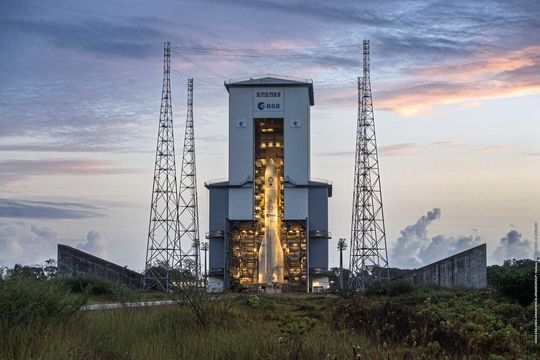
The spaceport in Kourou is one of the best-located launch sites in the world.
(Source: ArianeGroup)
The spaceport in Kourou is one of the best-located launch sites in the world. Its proximity to the equator provides the rocket with a velocity boost of 461 m/s (approx. 1,512 ft/s) eastward due to Earth's rotation. Additionally, the equatorial location facilitates placing satellites into geostationary orbit. The proximity to the Atlantic Ocean and the sparsely populated rainforest ensure that no people are endangered during launches.
In Kourou, Stefan W. has been able to contribute to several launches of the Ariane space program during his career. He was also on-site for the assembly of the first Ariane 6. The partnership between ArianeGroup and Horn has existed for over 35 years. The tool manufacturer advises ArianeGroup on complex tooling requirements and supports the optimisation of demanding machining processes.
About ArianeGroup
ArianeGroup is an industrial company that conducts missions to ensure sovereignty in the fields of space and defence. With more than 8,300 highly qualified employees in France and Germany, ArianeGroup possesses unique expertise in accessing space. The company's competencies cover the entire spectrum of civilian and military launch vehicle systems, from design, development, production, integration, and flight preparation to maintenance and dismantling. ArianeGroup is the prime contractor for the ESA's European Ariane 6 launch vehicle and for the French procurement agency DGA's strategic ballistic missile M51 for France's oceanic deterrent forces.
As a globally recognised specialist for innovative and competitive solutions, ArianeGroup masters the most advanced technologies and applications, from propellant chemistry and composite materials to liquid and solid propulsion systems as well as electric propulsion for space applications. In addition, ArianeGroup, both independently and through its subsidiaries Sodern, Pyroalliance, Nuclétudes, and APP, offers a wide range of equipment and services for space, defence, and industry. In the launch vehicle segment, the subsidiary Arianespace markets and operates the Ariane 6 launch vehicle, while the subsidiary MaiaSpace develops and markets the reusable Maia launch vehicle. ArianeGroup is a joint venture between Airbus and Safran.




:quality(80)/p7i.vogel.de/wcms/27/29/2729da9d77bbe3a97ef364594a4d7fa5/screenshot-202026-03-23-20134204-932x524v1.png "(Source: AI-generated)")
:quality(80)/p7i.vogel.de/wcms/d6/0d/d60dbd35064daafce089426fa50a27e2/0130207422v1.jpeg "The largest new construction project for the German Navy is stalling. It is years behind schedule. It involves several F126 frigates. Now the armaments group Rheinmetall is counting on taking over the project in order to finish it quickly ... (Source: Ladies Naval)")
:quality(80)/p7i.vogel.de/wcms/c6/47/c64705c706eefa87feeb5a39ab057c2c/0130179612v1.jpeg "The Leopard 2 main battle tank (here the latest A8 version) is used by many NATO countries. The Franco-German MGCS tank system, which is currently under development, is intended to replace it, but is not running so smoothly. This is not stopping KNDS from going public this year. (Source: KNDS)")
:quality(80)/p7i.vogel.de/wcms/5b/2c/5b2cceb9038883edfacb76a61fca350b/vw-os-4-25--28cropped-29-3136x1765v1.jpeg "VW Osnabrück: Following Rheinmetall, KNDS is now also interested in at least a partial takeover of the plant. One popular example for the shift from civilian to military production. (Picture: Wiki Commons)")
:quality(80)/p7i.vogel.de/wcms/a3/66/a3666c01ec1a8b58da812faa80ab9f31/0130225449v1.jpeg "In 2004, the decision was made for the first \"Droop+Rein FOGS M40,\" a machine characterized by stability, precision, and flexibility. (Image:Starrag / Ralf Baumgarten)")
:quality(80)/p7i.vogel.de/wcms/b1/58/b158a5cc771fac7941d6bc3414becb5a/zeroe-20fully-20electric-20hydrogen-powered-20four-20pod-20aircraft-zeroe-turboprop-aib-vcity-16-9-5000x2811v1-999x562v1.jpeg "Airbus is working on the propulsion of short-haul aircraft using hydrogen and fuel cells as part of the “GENtwoPRO” project. (Source: Airbus SAS 2025)")
:quality(80)/p7i.vogel.de/wcms/2c/2c/2c2c63c23a1be1fe8259e3da28ebaff2/figure3-3864x2172v1.jpeg "(Source: AI-generated)")
:quality(80)/p7i.vogel.de/wcms/a2/66/a266453da44556de3d18a0976597a605/sintavia-press-release-image-31726-1333x750v1.jpeg "Scooped version of representative heat exchanger. (Source: Sintavia)")
:quality(80)/p7i.vogel.de/wcms/ec/51/ec5163dcff6037ee93f45877d8e78f4f/0130224490v1.jpeg "The internal coolant supply directs the coolant to both flanks of the cutting edges. This allows for high precision and tool life while flushing chips from the narrow slots. (Image:Horn/Sauermann)")
:quality(80)/p7i.vogel.de/wcms/c2/5e/c25e38d6d559fc809a10bdceb15ebced/0129879115v1.jpeg "The twin of this sample is located on the outside of the ISS as part of the \"SESAME\" experiment. (Image:Empa)")
:quality(80)/p7i.vogel.de/wcms/3a/da/3adad9cc561900df0446f19c74a4d4df/0129938355v1.jpeg "Ganfeng Lithium, together with Geely subsidiary Aerofugia, has developed semi-solid batteries for eVTOLs. (Image:Aerofugia)")
:quality(80)/p7i.vogel.de/wcms/b4/ae/b4ae65d3fb3903a13571d9ea3e61da8a/mock-up-vleo-def-1920x1079v1.jpeg "Illustration of the VLEO-DEF satellite in orbit (Source: EDA)")
:quality(80)/p7i.vogel.de/wcms/06/37/0637c7dd3fab9b00a8e96f98133cd1dc/260304-d-d0477-1005-5892x3317v1.png "A B-52H Stratofortress idles prior to taking off in support of Operation Epic Fury in March 2026. (Source: U.S. Air Force)")
:quality(80)/p7i.vogel.de/wcms/13/2b/132bb2831ae98c4c3bdd0ee2990ba1eb/bareways-20deck-20--20crisis-20coordination-20platformv1.jpeg "(Source: Bareways)")
:quality(80)/p7i.vogel.de/wcms/93/f1/93f1e4dba53b2c9589fab17a525df55e/adobestock-163119218-2480x1394v1.jpeg "(Source: Kernkonzept GmbH)")
:quality(80)/p7i.vogel.de/wcms/8d/76/8d764c984e44153da8f0dfa88cd6d75e/0129843677v1.jpeg "A successful drone attack on two data centers of the Amazon subsidiary AWS shows that the danger of drones is virtually unavoidable in modern warfare ... (Source: Cerberus)")
:quality(80)/p7i.vogel.de/wcms/84/63/8463d680832f3be7e5b3b5a189a0cac7/drohnen-1536x864v1.png "(Source: Elbit Systems Deutschland GmbH & Co. KG)")
:quality(80)/p7i.vogel.de/wcms/14/d3/14d3e0847d222af54aa5ab625480507f/0130015022v1.jpeg "A German-French battle tank project was approved some time ago (symbol image). But a modern drive system is also needed for it. This is now being developed by Rolls-Royce Power Systems and ZF in the coming years... (Image:Rheinmetall)")
:quality(80)/p7i.vogel.de/wcms/bd/21/bd2191aab59c430b3c74a2be07120333/image-196-1294x728v1.png "(Image:SkyDefender © Thales)")
:quality(80)/p7i.vogel.de/wcms/d4/dc/d4dc9a59e1698ae295b1e6e64a29a55b/geralt-handshake-5768632-1280-1280x720v1.jpeg "Rheinmetall and Nooteboom Trailers are collaborating on the development and marketing of heavy equipment trailer systems designed for transporting modern tracked and wheeled military vehicles. (Image:Gerd Altmann from Pixabay)")
:quality(80)/p7i.vogel.de/wcms/f9/2f/f92f1ef8c739c34c70d99f7b0997621b/stra007-20--20cover-20image-5472x3076v1.jpeg "(Source: Stratasys)")
:quality(80)/p7i.vogel.de/wcms/5e/18/5e184e4961f190c86a1ea3227104cab5/26pm03-20kompakte-20l-c3-b6sungen-20f-c3-bcr-20luft--20und-20raumfahrt-202-2362x1329v1.jpeg "(Picture: Keysight)")
:quality(80)/p7i.vogel.de/wcms/67/4c/674c54baa745be497cecb716826af339/stahlwille-hero-1807x1016v1.jpeg "A new modular tool solution designed for safety, precision, and mobility in aviation maintenance. (Source: STAHLWILLE)")
:quality(80)/p7i.vogel.de/wcms/0d/01/0d01a051ba894332a8091e3a3f9394e1/hytorc-defense-solutions-boxersatz-1899x1068v1.jpeg "HYTORC’s Defence Solutions toolkit, proven on the GTK Boxer, enables safe, traceable fastening of critical components across multiple Bundeswehr platforms. (Source: Image: HYTORC)")
:quality(80)/p7i.vogel.de/wcms/f3/4e/f34ed744bb30817d3432c7ad522e6f30/engine-1v1.jpeg "Engineering with aluminium profiles really can be this easy – the item Engineeringtool and its smart functions help you save valuable time. (Source: item)")
:quality(80)/p7i.vogel.de/wcms/fb/8e/fb8e5ae2aa27bcf3e466815505ca4ff2/alumin-1v1.jpeg "The aluminium profile technology of the item Building Kit System has been used to build a huge variety of structures for decades. (Source: item)")
:quality(80)/p7i.vogel.de/wcms/be/84/be84bbede3e40b1101cd3efa35a6ffa0/overview-of-20work-bench-design-in-productionv1.jpeg "With modular work bench design, you can convert or extend a work bench with ease by changing or adding accessories. This means changes can be implemented quickly and cost-effectively, thus boosting quality and productivity. (Source: item)")
:fill(fff,0)/p7i.vogel.de/companies/69/6d/696de2483d115/logo--fastems-rgb-horizontal.jpeg "logo--fastems-rgb-horizontal (Fastems)")
:fill(fff,0)/images.vogel.de/vogelonline/companyimg/84700/84735/65.jpg "logo_item_rgb_neu.jpg ()")
:quality(80)/p7i.vogel.de/wcms/27/d0/27d0c4b6b75509f0b372fb7feab520d8/0127791641v1.jpeg "No errors allowed: Continuous quality control during the machining process is essential.(Source: Horn/Sauermann)")
:quality(80)/p7i.vogel.de/wcms/6d/da/6ddae850532e6755ebab0ce35b89f939/0129308642v1.jpeg "A successful collaboration: Horn CEO Markus Horn, Thomas W., and Stefan W.(Source: Horn/Sauermann)")
:quality(80)/p7i.vogel.de/wcms/8a/f0/8af007aec24665687ecd2ca97f5c88b1/0127791636v1.jpeg "The solidly constructed steel tool holder is shrunk into a finely balanced mount. This ensures low-vibration machining despite the long overhang.(Source: Horn/Sauermann)")
:quality(80)/p7i.vogel.de/wcms/aa/8e/aa8e953c31d09551aaba5dc010581e51/0129308284v1.jpeg "The internal coolant supply directs the coolant to both flanks of the cutting edges. This enables, in addition to high precision and tool life, the flushing of chips from the narrow slots.(Source: Horn/Sauermann)")
:quality(80)/p7i.vogel.de/wcms/d5/8a/d58aa4c789d793f59768eeab5a523dd6/0116023398v1.jpeg "For testing purposes, bavius has clamped a large aluminum plate in the machine. The milling of full slots determines the maximum possible cutting parameters. (Image:bavius)")
:quality(80)/p7i.vogel.de/wcms/54/4e/544e2db7f7061c53dedd9f55086d4ef7/0117644822v1.jpeg "The high-frequency data acquisition by piezoelectric sensors enables EPFL to gain a deep understanding of propulsion dynamics. (Image:Kistler Group)")