Avionics is undergoing a transformation, bringing new technologies, opportunities, and markets into play. These changes result in new functions, largely implemented through embedded software. Looking ahead, the focus must be on safety, security, and aircraft certification.
Software is increasingly being used in the field of avionics as well. Therefore, the right verification tools play an important role.
(Image: Freely licensed according to Pixabay)
Typically, decisions about tools for the development and verification of software were in the hands of individual development and assurance teams. However, given today's complex regulatory environment and short market timeframes, decisions are increasingly being made at the enterprise level. Initiatives aimed at reducing the cost, time, and risks of certification have therefore become essential activities for executives.
Consider new aspects and technologies
In the field of aviation, there are new technologies and aspects that are crucial for decisions in software development and verification. These include:
Increasing control of autonomous systems.
With the market introduction of autonomous aircraft, companies employing proven software development and testing processes will be better prepared for potential certification hurdles and can maintain their early-mover advantage.
Significant increase in small aircraft, such as eVTOLs and drones.
Pioneers will rely on a flexible, scalable design concept that helps them adapt to changing requirements while using proven commercial design practices to meet these requirements with less risk and cost.
Impact of sustainability and zero emissions on design.
As regulations and technologies evolve to reduce aircraft emissions and promote electrification, existing standards and automated development and verification tools can provide a solid foundation to help mitigate the risks associated with complex new technologies.
New attack vectors through increased connectivity.
While an earlier integration ensures that, in addition to flight safety, security aspects are considered during the design phase, connectivity demands the ability to quickly respond to vulnerabilities that only emerge in the field. Automated verification tools combined with requirement traceability tools can isolate changes and perform automatic regression on the affected functionality.
Overcoming certification challenges
The verification of software can require just as much time, effort, and resources as all planning and development processes combined. Testing and verification therefore become costly activities. Moreover, verification is becoming increasingly demanding as compliance requirements continually grow in complexity and scope. It is no longer an option to tackle these challenges and this complexity without integrated, automated tools. To reduce the time required for development and certification, different groups must be given the opportunity to work cooperatively and in parallel while utilizing an integrated development and verification toolchain.
The complete software development lifecycle should be covered by a holistic concept to ensure effective communication and knowledge transfer across all phases. Transitioning to an integrated package of automated software development and verification tools can have a significant impact in this regard. This is especially true for decentralized and geographically dispersed teams that need to consolidate information during development and testing processes. Manual procedures or isolated tools would undermine efficiency and lead to the introduction of errors and vulnerabilities.
Lower costs through integrated tools
In contrast to spreadsheets and standalone document management systems, integrated tools ensure comprehensive transparency and impact analyses across projects and teams. This enables faster and better decision-making. An ideal combination of verification tools offers a wide range of capabilities, such as requirements traceability, impact analyses, test management, compliance with coding standards, code quality checks, code coverage analysis, data and control flow analysis, unit, integration, and system testing, as well as the automated generation of certification evidence.
Such tools are suitable for any software development lifecycle models. Furthermore, verification tools are an essential component of the CI (Continuous Integration) workflow. Teams can therefore work with the same tools throughout the entire development process, enabling the development, verification, and deployment of software to proceed quickly and iteratively. Using the CI concept, developers can perform static analyses and unit tests as part of their front-end verification to ensure, even before merging with other codebases, that the code delivers the intended functionality.
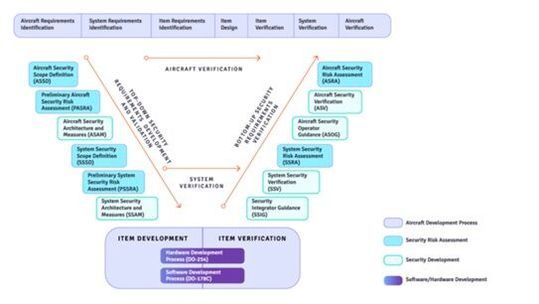
Security and software development process as part of the overall aircraft development process
The topic of cybersecurity has always been a moving target in the field of avionics systems, with serious implications for functional safety, making it a significant source of business risks and uncertainties. The recommended strategy here is to incorporate the security aspect directly into the design to minimize vulnerabilities during development. Subsequent testing of the completed software helps demonstrate the effectiveness of this concept before the product goes into operation. Once it does, a strategy becomes important to quickly and securely address newly emerging vulnerabilities.
To address this challenge, many teams rely on an integrated DevSecOps concept to reduce costs and improve efficiency. While it was traditionally common to hand over the completed software to security teams, this earlier integration allows software development and security teams to work efficiently and cost-effectively in parallel. Flexible and customizable software tools can easily adapt to the respective risk level and the required rigor of risk mitigation, while requirements traceability tools enable rapid responses to vulnerabilities even in systems that have not been updated for years.
Develop aircraft software efficiently
Problems should be solved and fundamental changes made as quickly as possible, rather than waiting for the launch of the next critical product. Equipped with a comprehensive package of verification tools, teams are well-supported with documentation and shared knowledge throughout the entire product development lifecycle. These new areas of avionics demand complex development and regular collaboration. By using integrated tools, teams are enabled to efficiently develop, verify, and certify new aircraft software. (se)
Date: 08.12.2025
Naturally, we always handle your personal data responsibly. Any personal data we receive from you is processed in accordance with applicable data protection legislation. For detailed information please see our privacy policy.
Consent to the use of data for promotional purposes
I hereby consent to Vogel Communications Group GmbH & Co. KG, Max-Planck-Str. 7-9, 97082 Würzburg including any affiliated companies according to §§ 15 et seq. AktG (hereafter: Vogel Communications Group) using my e-mail address to send editorial newsletters. A list of all affiliated companies can be found here
Newsletter content may include all products and services of any companies mentioned above, including for example specialist journals and books, events and fairs as well as event-related products and services, print and digital media offers and services such as additional (editorial) newsletters, raffles, lead campaigns, market research both online and offline, specialist webportals and e-learning offers. In case my personal telephone number has also been collected, it may be used for offers of aforementioned products, for services of the companies mentioned above, and market research purposes.
Additionally, my consent also includes the processing of my email address and telephone number for data matching for marketing purposes with select advertising partners such as LinkedIn, Google, and Meta. For this, Vogel Communications Group may transmit said data in hashed form to the advertising partners who then use said data to determine whether I am also a member of the mentioned advertising partner portals. Vogel Communications Group uses this feature for the purposes of re-targeting (up-selling, cross-selling, and customer loyalty), generating so-called look-alike audiences for acquisition of new customers, and as basis for exclusion for on-going advertising campaigns. Further information can be found in section “data matching for marketing purposes”.
In case I access protected data on Internet portals of Vogel Communications Group including any affiliated companies according to §§ 15 et seq. AktG, I need to provide further data in order to register for the access to such content. In return for this free access to editorial content, my data may be used in accordance with this consent for the purposes stated here. This does not apply to data matching for marketing purposes.
Right of revocation
I understand that I can revoke my consent at will. My revocation does not change the lawfulness of data processing that was conducted based on my consent leading up to my revocation. One option to declare my revocation is to use the contact form found at https://contact.vogel.de. In case I no longer wish to receive certain newsletters, I have subscribed to, I can also click on the unsubscribe link included at the end of a newsletter. Further information regarding my right of revocation and the implementation of it as well as the consequences of my revocation can be found in the data protection declaration, section editorial newsletter.


:quality(80)/p7i.vogel.de/wcms/f6/95/f6954fa7c09ba58863a3730f5e384a62/arek-socha-on-pixabay-1707x960v1.jpeg "A new national space strategy brings together UK’s plans for growth, defence, and national security to help reindustrialise the UK. (Source: Arek Socha on Pixabay)")
:quality(80)/p7i.vogel.de/wcms/63/0f/630f214fa760b8c7f7f7d6279d411fcf/d4ceed8f2f52-2026-08-30-hydef-06--msc4159-1200x675v1.webp "(Source: Diehl Defence)")
:quality(80)/p7i.vogel.de/wcms/4e/7d/4e7d38327c6c928b403249e3c24a2a7c/0132118791v1.jpeg "Porsche Holding SE announces that it is once again turning to rocket technology. Following its investment in Isar Aerospace, the company is now acquiring a stake in a U.S. firm ... (Source: Porsche)")
:quality(80)/p7i.vogel.de/wcms/1c/08/1c082bbd9d05b634168b617aa26fcdcf/safe-bg-lv-ro-v1-991x557v1.png "(Source: European Commission)")
:quality(80)/p7i.vogel.de/wcms/0a/14/0a1495d9b570ae32a5a7cc748b9a3c60/st-hannover-035-1920x1079v1-999x562v1.jpeg "Fastening technology you can experience first-hand—visitors to Schraubtec in Bochum (Germany) can see it for themselves at the Ruhr Congress on September 30, 2026. (Source: PHOTOVISION-DH GmbH)")
:quality(80)/p7i.vogel.de/wcms/cd/a9/cda92b173afa9d0b455d4f11b281c9ea/0094-to-image--capstone-cdr-1440x810v1.png "(Source: Terran Orbital)")
:quality(80)/p7i.vogel.de/wcms/e0/45/e045bc5414d7263fb308bdd501b5fcc1/0133113962v1.jpeg "The HSWL 354 is the transmission used, for example, in the Leopard 2 main battle tank. Renk manufactures this system and is now preparing to significantly increase its cycle time. As a result, Renk is placing greater emphasis on the military sector as a customer ... (Source: Renk)")
:quality(80)/p7i.vogel.de/wcms/a1/5c/a15c2aeba563d5bc3e11fb879b21eb2c/0132989650v1.jpeg "FSS, the flexible clamping system for varying free-form surfaces, is designed for the aerospace industry and other sectors. (Source: Römheld GmbH Friedrichshütte)")
:quality(80)/p7i.vogel.de/wcms/46/8e/468effa87546a2b036dc88ca40e2843e/129fbcac92ce7da872b13af0281b0799-l-png-1920x1079v1.webp "(Source: Arianespace)")
:quality(80)/p7i.vogel.de/wcms/8f/10/8f10697d4bfbd70edf615cca76eaedfd/pete-linforth-on-pixabay-1920x1080v1.jpeg "(Source: Pete Linforth on Pixabay / AI-generated)")
:quality(80)/p7i.vogel.de/wcms/0f/99/0f99561bf51818af92b2960656405aa5/roland-4d-pippes-on-pixabay-1460x820v1.jpeg "(Source: Roland 4D Pippes on Pixabay)")
:quality(80)/p7i.vogel.de/wcms/05/49/054906f874b94ef08b09d5920396e27d/airbus-h160-1920x1079v1.jpeg "Airbus H160 (Source: Airbus)")
:quality(80)/p7i.vogel.de/wcms/9d/8a/9d8addea8cc4e6f7a4793563ca397f2a/ai-im-milit-r-1672x940v1.png "(Source: KI-generiert / Gemini)")
:quality(80)/p7i.vogel.de/wcms/7f/5f/7f5fba2c729ec3aa256bf1a18d74529b/ai-chip-1672x940v1.png "(Source: KI-generiert / Gemini)")
:quality(80)/p7i.vogel.de/wcms/64/1b/641b6474b2a614cde7730c89ef2a3015/2026-09-09-rheinmetall-veroeffentlicht-battlesuite-schnittstellen-e8c18194-1225x690v1.jpeg "Rheinmetall’s Battlesuite provides a modular digital platform for connecting and integrating sensors, hardware and software components. (Source: Rheinmetall AG)")
:quality(80)/p7i.vogel.de/wcms/6f/fe/6ffef325e7f233cc3521943158eb1ebd/0132763535v1.jpeg "Two companies are planning to establish, for the first time in 2027, an optical laser communication link directly between a satellite in low Earth orbit (LEO) and a re-entering spacecraft. (Source: ATMOS Space Cargo)")
:quality(80)/p7i.vogel.de/wcms/8f/f9/8ff91b78b26cb5a2b8a29e39835005b1/2026-09-10-repmus-teaser-images-retouched-dsc01292-1024x683-1024x576v1.jpeg "(Source: Quantum Systems GmbH)")
:quality(80)/p7i.vogel.de/wcms/bf/4a/bf4a237e60d3d4bd1bbdbad918f3c697/airbus-defence-and-space-3-1280x720v1.jpeg "(Source: Airbus Defence and Space)")
:quality(80)/p7i.vogel.de/wcms/e0/d1/e0d112a0d54a4fa9603ec855f7d25b47/t-rex-content-photo-jpg-pc-adaptive-990-medium-988x556v1.jpeg "Swarm of UAVs conducting a fully autonomous collaborative swarm mission. (Source: Lockheed Martin)")
:quality(80)/p7i.vogel.de/wcms/79/fc/79fcaa7ca33e393b11a4740d7d8f3dbe/vilkasss-handshake-9459740-1911x1076v1.jpeg "(Source: Vilius Kukanauskas on Pixabay)")
:quality(80)/p7i.vogel.de/wcms/90/a8/90a849f0023f11d1eb642eb4751a0321/bild2-h-c3-a4nel-ict-20truck-20and-20trailer-20parts-4320x2429v1.jpeg "Product information is visible at all times and retrieval of items
is confirmed by employees directly on the display of the Hänel MP 14 N
controller. (Source: René Marks)")
:quality(80)/p7i.vogel.de/wcms/4e/ca/4ecaa39f247490eded591b652c33aee3/thilmann-hcp-web-20kleiner-20ausschnitt-1442x811v1.jpeg "Entering the defence market can be challenging for start-ups, says HCP Sense CEO Ansgar Thilmann. (Picture: HCP Sense)")
:quality(80)/p7i.vogel.de/wcms/7a/51/7a511b80041d3f1335f3a5aa56fe75da/delivery-7022432-1280-1280x720v1.png "(Source: Mohamed_hassan)")
:quality(80)/p7i.vogel.de/wcms/f9/2f/f92f1ef8c739c34c70d99f7b0997621b/stra007-20--20cover-20image-5472x3076v1.jpeg "(Source: Stratasys)")
:quality(80)/p7i.vogel.de/wcms/ec/a9/eca9062ccbe4b042f8515846340410d8/aerospace-and-defence-stairways-platforms-and-much-morev1.jpeg "Modular constructions enable flexible modification. That applies to larger structures such as stairways and platforms, too. And that means aerospace and defence companies can reconfigure their maintenance platforms fast (itemitem)")
:quality(80)/p7i.vogel.de/wcms/30/2a/302a7b5723ad38fbde812fd3a468ad04/safety-on-stairways-in-industry-key-considerationsv1.jpeg "Stairways and platforms are used widely in maintenance and assembly areas in the aerospace and defence sectors. (Source: item)")
:quality(80)/p7i.vogel.de/wcms/f3/4e/f34ed744bb30817d3432c7ad522e6f30/engine-1v1.jpeg "Engineering with aluminium profiles really can be this easy – the item Engineeringtool and its smart functions help you save valuable time. (Source: item)")
:fill(fff,0)/p7i.vogel.de/companies/69/6d/696de2483d115/logo--fastems-rgb-horizontal.jpeg "logo--fastems-rgb-horizontal (Fastems)")
:fill(fff,0)/images.vogel.de/vogelonline/companyimg/84700/84735/65.jpg "logo_item_rgb_neu.jpg ()")

:quality(80)/p7i.vogel.de/wcms/18/93/1893e15279d21545c626be732481a6db/pexels-ricardo-esquivel-1667499-2832x1593v1.jpeg "pexels-ricardo-esquivel-1667499-2832x1593v1 (Copyright: plc2)")
:quality(80)/p7i.vogel.de/wcms/d4/16/d4161b40236d9c6fb8d017d8df831e4d/0127104981v1.jpeg "By complying with laws, technical standards, and certification processes, FACE and MOSA drive the development of open, maintainable, cost-efficient, and secure avionics systems. In military and civilian aviation, FACE represents a modular, open, and future-proof system development paradigm. (Image:freely licensed)")