Ensuring robust, high-quality, mission-critical communications in the adverse environment of space places extremely demanding requirements on satellite system designers. Each gram of mass, milliwatt of energy consumption and cubic centimeter of occupied volume are scrutinized right down to the size, weight, and power (SWaP) implications of each constituent component.
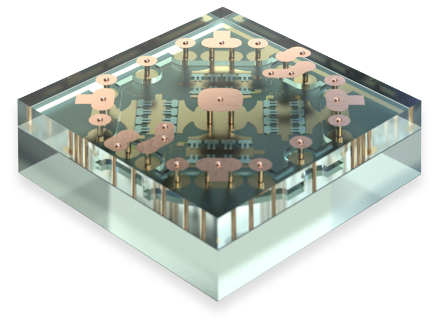
Over 400 independent unit cells to create a miniaturized 10A array package.
(Source: Menlo Micro)
The SWaP specifications of multitude of embedded switches have a fundamental impact on the operation of the beamformers and a significant influence on the overall performance of the satellite. The physical space occupied by switches affects the dimensions of the sub-system, their aggregated mass has launch and operational considerations, the electric power consumption places demand on the solar arrays and the heat generated needs to be managed and dissipated in an appropriate way.
Legacy systems and their limitations
Component life expectancy is of primary importance in a situation where failure could be fatal for the host device and issue resolution options are limited. Accordingly, a preference had emerged for solid state switches, capable of billions of operations. However, with insertion losses of up to 6 dB, significant passive power consumption, and maximum power handling capabilities of around 5 W, solid-state switches are not without their limitations. They dissipate significant heat waste, which requires substantial thermal management solutions such as large heat sinks to remain operational. The bulky, heavy, and power-hungry nature of solid-state switches is therefore impeding the development of mission-critical communications and limiting more rapid adoption of processor-hungry technologies such as AI that are capable of bringing more autonomy to space missions.
The role of RF switch technology
On satellites, switches fulfill the role of routing signals in the payload and control the operation of attenuators and phase shifters that feed phased-array antennas to manage the beamforming. Agile, efficient, and effective beamforming is critical to ensuring availability and quality-of-service of the communications link. However, system designers need to reconcile these requirements without burdening the satellite or tactical radio with an impractical demand for size, weight, and power.
Historically, system engineers have had to make difficult switch selection decisions, trading off specifications between electromechanical relays (EMRs) and solid-state switches, then taking the compromises associated with those choices. EMRs offer lower insertion loss over a broad spectrum with higher power handling but with limitations in size, weight, life expectancy, and speed. Whereas solid state switches are significantly faster, smaller, and have near infinite life with tradeoffs in insertion loss, spectral coverage, power handling and thermal management. Semiconductors, as the name implies, are inherently lossy and that impacts the efficiency and energy budget of the host device, consuming power and generating heat, even when in the off state. The compromises inherent in these traditional switch options create a bottleneck restricting the migration to faster data rate and higher quality-of-service applications.
The Ideal Switch concept – A technology shift
Significant research has been conducted in recent years to develop a new category of switch based on Micro-Electro-Mechanical Systems (MEMS), developed to address and resolve design compromises related to size, weight, power, frequency coverage, life expectancy and linearity all within a single chip technology. What has emerged is a MEMS switch with true DC to mmWave coverage with superior performance in a small chip-scale package. Based on proprietary manufacturing processes and innovative materials science originally developed at General Electric (GE), Menlo Microsystems is further advancing and commercializing the technology as the Ideal Switch.
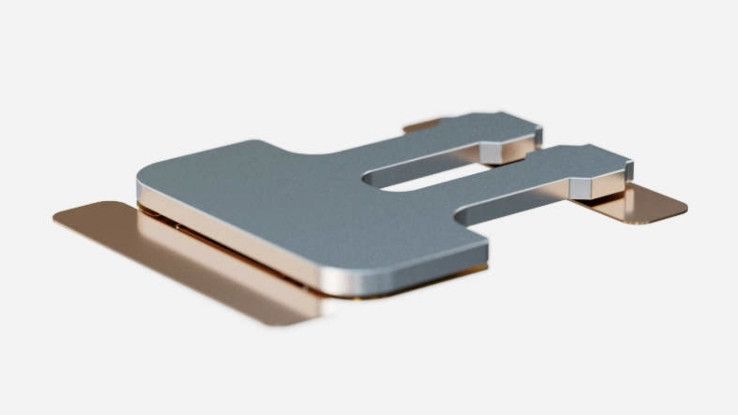
Combining semiconductor manufacturing techniques with a robust metallic micro-mechanical actuator, this new category of RF switch achieves microsecond switching speeds, stable ohmic performance over cycles, temperature insensitivity, along with air gap lever leakage and isolation. It consists of three fundamental parts: a durable beam made of proprietary alloys, a low resistance ohmic metal contact, and an ultra-low power consumption electrostatic gate. It has universal signal coverage, able to carry AC/DC and RF signals with linear performance from DC to > 50 GHz. The miniaturized, paired-back design utilizing innovative materials means it is extremely fast and durable, switching at <10μs, with a life expectancy in excess of three billion operations.
Impact on system-level design
When we examine the impact of adopting MEMS switches for mission-critical communications, we can see clear advantages. For example, a beamformer typically consumes up to 25% of a satellite’s energy budget. If you replace the beamformer’s solid-state switches with MEMS switches and take advantage of the favorable power consumption and insertion loss, the power budget can be reduced to less than 5% without compromising reliability in a form factor reduced by around 60%. Furthermore, the frequency range over which the switch can achieve low insertion loss is something solid-state switches cannot compete with, offering less than 1 dB of insertion loss from DC to 50 gigahertz in a single component. For passive components in particular, it forces a rethink of the traditional multi-band approach to payload design towards a unified ultra-broadband system.
Date: 08.12.2025
Naturally, we always handle your personal data responsibly. Any personal data we receive from you is processed in accordance with applicable data protection legislation. For detailed information please see our privacy policy.
Consent to the use of data for promotional purposes
I hereby consent to Vogel Communications Group GmbH & Co. KG, Max-Planck-Str. 7-9, 97082 Würzburg including any affiliated companies according to §§ 15 et seq. AktG (hereafter: Vogel Communications Group) using my e-mail address to send editorial newsletters. A list of all affiliated companies can be found here
Newsletter content may include all products and services of any companies mentioned above, including for example specialist journals and books, events and fairs as well as event-related products and services, print and digital media offers and services such as additional (editorial) newsletters, raffles, lead campaigns, market research both online and offline, specialist webportals and e-learning offers. In case my personal telephone number has also been collected, it may be used for offers of aforementioned products, for services of the companies mentioned above, and market research purposes.
Additionally, my consent also includes the processing of my email address and telephone number for data matching for marketing purposes with select advertising partners such as LinkedIn, Google, and Meta. For this, Vogel Communications Group may transmit said data in hashed form to the advertising partners who then use said data to determine whether I am also a member of the mentioned advertising partner portals. Vogel Communications Group uses this feature for the purposes of re-targeting (up-selling, cross-selling, and customer loyalty), generating so-called look-alike audiences for acquisition of new customers, and as basis for exclusion for on-going advertising campaigns. Further information can be found in section “data matching for marketing purposes”.
In case I access protected data on Internet portals of Vogel Communications Group including any affiliated companies according to §§ 15 et seq. AktG, I need to provide further data in order to register for the access to such content. In return for this free access to editorial content, my data may be used in accordance with this consent for the purposes stated here. This does not apply to data matching for marketing purposes.
Right of revocation
I understand that I can revoke my consent at will. My revocation does not change the lawfulness of data processing that was conducted based on my consent leading up to my revocation. One option to declare my revocation is to use the contact form found at https://contact.vogel.de. In case I no longer wish to receive certain newsletters, I have subscribed to, I can also click on the unsubscribe link included at the end of a newsletter. Further information regarding my right of revocation and the implementation of it as well as the consequences of my revocation can be found in the data protection declaration, section editorial newsletter.
The Ideal Switch has proven to be an ideal replacement for large high-power RF electromechanical relays, as well as RF/microwave solid-state switches.
(Source: Menlo Micro)
The small form-factor, fast switching speed and high power handling over a very broad frequency range, represents a near-universal component, able to address a wide range of applications. With due consideration to the capabilities of the other payload components, this opens the possibility to transition from dedicated, single-mission platforms to more agile, reconfigurable, multi-mission platforms. Either in a primary role as an upgradable communications satellite or serving as an in-orbit servicing platform (IOSP), able to inspect, repair, refuel, upgrade, or extend the life of other satellites while in orbit.
Linearity issues in the RF domain, even for passive components, degrade the spectral purity and give rise to unintentional modulation. This translates to incorrect functioning of the beamformer (beam squint) as well as a reduction in modulation quality and subsequent errors in the digital domain. Because the linearity of these new MEMS switches (IP3 > 90 dBm) can be several orders of magnitude superior to typical solid-state switches, the system can operate at higher powers without significant distortion, thus improving energy efficiency and the quality of the service delivered to end users.
Furthermore, the temperature range of this new category of switch is remarkable when compared with solid-state switches. With a near-zero temperature coefficient, these ohmic switches maintain consistent s-parameter performance throughout an operating temperature of -40 to 150 °C. They have even demonstrated consistent performance when tested to millikelvin temperatures. In effect, this minimizes an onerous satellite design consideration where thermal effects are particularly problematic.
The contribution of this category of switch to satellite design should not be considered in isolation, there are indirect implications which become apparent when integrating this new type of MEMS component. Lowering the power consumption of the switch impacts the entire RF power budget of the system or sub-system, meaning that designers can relax the requirements for other components, for example backing off the operation point of amplifiers and further decreasing power DC consumption and thereby significantly improving signal quality.
Outlook and industry implications
Space and military (MIL) grade components must meet extremely stringent reliability and environmental requirements. With this latest switch technology guaranteed for 3 billion cycles and with typical operation achieving more than 10 billion cycles, MEMS switches can meet the cycle life required for mission-critical communication systems. Designers can utilize the low overhead, easy integration capability of MEMS switches to upgrade existing satellite platforms and can address more ambitious applications such as digital beamforming and larger constellation, multi-mission communications systems.
Conclusion
As mission-critical communications develop to deliver new services which require higher frequency bands, wider bandwidths, more power, and demanding quality of service, against an overall trend towards miniaturization, we start to approach the limits of what can be fulfilled using traditional switch technologies. MEMS switches offer significant size, weight and power benefits and the possibility to significantly mitigate design compromises for applications ranging from satellite communications, and missile guidance to intelligence, surveillance, and reconnaissance. The adoption of this technology creates new possibilities for current and next-generation mission-critical satellite communications and because switches are the most fundamental building blocks in electronics, controlling the operation of every device you can imagine, the potential impact is extremely wide-ranging. (mr)




:quality(80)/p7i.vogel.de/wcms/5b/2c/5b2cceb9038883edfacb76a61fca350b/vw-os-4-25--28cropped-29-3136x1765v1.jpeg "VW Osnabrück: Following Rheinmetall, KNDS is now also interested in at least a partial takeover of the plant. One popular example for the shift from civilian to military production. (Picture: Wiki Commons)")
:quality(80)/p7i.vogel.de/wcms/ec/ee/ecee771dce48d9c693f8869da717ceeb/robertwaghorn-jet-2974131-4777x2687v1.jpeg "European allies intensify cooperation efforts to boost defence capabilities and ensure long-term security stability. (Source: Robert Waghorn on Pixabay)")
:quality(80)/p7i.vogel.de/wcms/be/0b/be0b550a4fc2724afeed0713f65e7675/spexer-anechoic-chamber-1280x720v1.png "(Source: Hensoldt AG)")
:quality(80)/p7i.vogel.de/wcms/6f/0f/6f0fc6e3348925946d77fa2339e53005/0130142731v1.jpeg "Heidelberger Druckmaschinen Aktiengesellschaft establishes a joint venture with Ondas. The aim is to provide and market effective drone defence systems in Europe and Ukraine. (Source: Ondas)")
:quality(80)/p7i.vogel.de/wcms/2e/15/2e15396bd28d5cc96f2c339a6b7bf1e8/l3harris-disco-1220-1217x684v1.jpeg "(Source: L3Harris Technologies)")
:quality(80)/p7i.vogel.de/wcms/0c/70/0c701a79c1f183921b8ee9341ef61db8/0129694966v1.jpeg "Robonode's DVK Development Kit: This is available through Codico's sample shop. (Image:8DEVICES)")
:quality(80)/p7i.vogel.de/wcms/7c/12/7c123d3888ed3a37a83b0793be569f00/hon-aero-hguide-i700-imu-comp-view-2880x1440-1024x576v1.webp "(Source: Honeywell)")
:quality(80)/p7i.vogel.de/wcms/62/06/6206d30afc9c4f286f4ecf4cedf575c5/stark-20virtus-20side-1920x1079v1.jpeg "To be introduced into service with the Bundeswehr: The “Virtus” developed by Stark has a range of up to 100 km and is designed to engage targets on the battlefield. (Picture: STARK Defence)")
:quality(80)/p7i.vogel.de/wcms/b4/ae/b4ae65d3fb3903a13571d9ea3e61da8a/mock-up-vleo-def-1920x1079v1.jpeg "Illustration of the VLEO-DEF satellite in orbit (Source: EDA)")
:quality(80)/p7i.vogel.de/wcms/11/c8/11c8d30d75151329d2700176eb7a0383/0130110840v1.jpeg "Zenadrone, a subsidiary of Zenatec, is working on developing an operational low-cost drone as a disposable concept (symbol image). The first prototype already exists. In the future, it is intended to counter increasing enemy drone attacks without significant financial effort... (Source: Zenadrone)")
:quality(80)/p7i.vogel.de/wcms/c8/4c/c84cef4bf459f1280823827c3e3615c2/7cf414af-d41d-46ac-b22b-890f9f32d24c-2048x1151v1.jpeg "In Manching, Germany, Airbus is currently preparing two Valkyries for their first flight with its European mission system. The picture shows one of them. (Source: Airbus)")
:quality(80)/p7i.vogel.de/wcms/e3/d7/e3d7de9cfaac27f48ee6e162f9b309e9/0128899731v1.jpeg "Here, Lufthansa's first anniversary aircraft lands in Frankfurt. (Image:Lufthansa)")
:quality(80)/p7i.vogel.de/wcms/06/37/0637c7dd3fab9b00a8e96f98133cd1dc/260304-d-d0477-1005-5892x3317v1.png "A B-52H Stratofortress idles prior to taking off in support of Operation Epic Fury in March 2026. (Source: U.S. Air Force)")
:quality(80)/p7i.vogel.de/wcms/13/2b/132bb2831ae98c4c3bdd0ee2990ba1eb/bareways-20deck-20--20crisis-20coordination-20platformv1.jpeg "(Source: Bareways)")
:quality(80)/p7i.vogel.de/wcms/93/f1/93f1e4dba53b2c9589fab17a525df55e/adobestock-163119218-2480x1394v1.jpeg "(Source: Kernkonzept GmbH)")
:quality(80)/p7i.vogel.de/wcms/8d/76/8d764c984e44153da8f0dfa88cd6d75e/0129843677v1.jpeg "A successful drone attack on two data centers of the Amazon subsidiary AWS shows that the danger of drones is virtually unavoidable in modern warfare ... (Source: Cerberus)")
:quality(80)/p7i.vogel.de/wcms/14/d3/14d3e0847d222af54aa5ab625480507f/0130015022v1.jpeg "A German-French battle tank project was approved some time ago (symbol image). But a modern drive system is also needed for it. This is now being developed by Rolls-Royce Power Systems and ZF in the coming years... (Image:Rheinmetall)")
:quality(80)/p7i.vogel.de/wcms/bd/21/bd2191aab59c430b3c74a2be07120333/image-196-1294x728v1.png "(Image:SkyDefender © Thales)")
:quality(80)/p7i.vogel.de/wcms/d4/dc/d4dc9a59e1698ae295b1e6e64a29a55b/geralt-handshake-5768632-1280-1280x720v1.jpeg "Rheinmetall and Nooteboom Trailers are collaborating on the development and marketing of heavy equipment trailer systems designed for transporting modern tracked and wheeled military vehicles. (Image:Gerd Altmann from Pixabay)")
:quality(80)/p7i.vogel.de/wcms/22/54/2254d1e2667aff755e7aba0bcaf2eb42/0130021093v1.jpeg "Daimler Truck and Quantum Systems are jointly developing unmanned military vehicles. (Image:Quantum Systems)")
:quality(80)/p7i.vogel.de/wcms/f9/2f/f92f1ef8c739c34c70d99f7b0997621b/stra007-20--20cover-20image-5472x3076v1.jpeg "(Source: Stratasys)")
:quality(80)/p7i.vogel.de/wcms/5e/18/5e184e4961f190c86a1ea3227104cab5/26pm03-20kompakte-20l-c3-b6sungen-20f-c3-bcr-20luft--20und-20raumfahrt-202-2362x1329v1.jpeg "(Picture: Keysight)")
:quality(80)/p7i.vogel.de/wcms/67/4c/674c54baa745be497cecb716826af339/stahlwille-hero-1807x1016v1.jpeg "A new modular tool solution designed for safety, precision, and mobility in aviation maintenance. (Source: STAHLWILLE)")
:quality(80)/p7i.vogel.de/wcms/0d/01/0d01a051ba894332a8091e3a3f9394e1/hytorc-defense-solutions-boxersatz-1899x1068v1.jpeg "HYTORC’s Defence Solutions toolkit, proven on the GTK Boxer, enables safe, traceable fastening of critical components across multiple Bundeswehr platforms. (Source: Image: HYTORC)")
:quality(80)/p7i.vogel.de/wcms/f3/4e/f34ed744bb30817d3432c7ad522e6f30/engine-1v1.jpeg "Engineering with aluminium profiles really can be this easy – the item Engineeringtool and its smart functions help you save valuable time. (Source: item)")
:quality(80)/p7i.vogel.de/wcms/fb/8e/fb8e5ae2aa27bcf3e466815505ca4ff2/alumin-1v1.jpeg "The aluminium profile technology of the item Building Kit System has been used to build a huge variety of structures for decades. (Source: item)")
:quality(80)/p7i.vogel.de/wcms/be/84/be84bbede3e40b1101cd3efa35a6ffa0/overview-of-20work-bench-design-in-productionv1.jpeg "With modular work bench design, you can convert or extend a work bench with ease by changing or adding accessories. This means changes can be implemented quickly and cost-effectively, thus boosting quality and productivity. (Source: item)")
:fill(fff,0)/p7i.vogel.de/companies/64/fe/64fec73b1a2fb/logo-master-ggbbytimken-286blue.jpeg "logo-master-ggbbytimken-286blue (GGB)")
:fill(fff,0)/p7i.vogel.de/companies/69/6d/696de2483d115/logo--fastems-rgb-horizontal.jpeg "logo--fastems-rgb-horizontal (Fastems)")
:fill(fff,0)/images.vogel.de/vogelonline/companyimg/84700/84735/65.jpg "logo_item_rgb_neu.jpg ()")
:quality(80)/p7i.vogel.de/wcms/a6/8f/a68fc9c6ad160b284b9951822639a2f5/0124050325v1.jpeg "Figure 1: ADAR3000/ADAR3001 block diagram. (Source: Analog Devices)")
:quality(80)/p7i.vogel.de/wcms/e4/9b/e49b68797f0853b3da11f020bc451baf/0124240663v1.jpeg "The Mars Perseverance Rover (Source: Image Courtesy of NASA/JPL – Cal Tech)")