Radioactive, chemical or biological substances are undetectable to humans in threatening situations and difficult to detect with remote sensing. Researchers at the Fraunhofer Institute for Communication, Information Processing and Ergonomics FKIE use specially equipped drones and robots to quickly and precisely localise radioactive sources.
(Copyright: Fraunhofer FKIE)
Chemical, biological, radiological, nuclear, and explosive substances (CBRNE) can pose significant risks to both the public and emergency services. A prime example is the 2023 incident in Australia, where a small cesium capsule lost from a truck prompted an extensive search. The rise in hybrid attacks and destabilisation efforts has intensified these threats. In response, two Fraunhofer FKIE research departments are exploring how drones (UAS) and robots (UGV) could aid in such situations. Systems' performances have been evaluated over the years at events like the European Robotics Hackathon (EnRicH) and the European Land Robot Trial (ELROB), organised by the Cognitive Mobile Systems department, to ensure practical effectiveness and continual enhancement.
Europe’s security landscape is changing rapidly
(Source: VCG)
As defence budgets rise and EU programmes expand, civil technology providers are becoming vital contributors to Europe’s strategic autonomy. The event will act as a neutral platform for dialogue between technology suppliers, integrators, and decision-makers shaping the next generation of European defence capabilities and aims to open doors between civil industry and defence procurement, providing practical insights.
Highly automated UAS for detecting radioactive sources
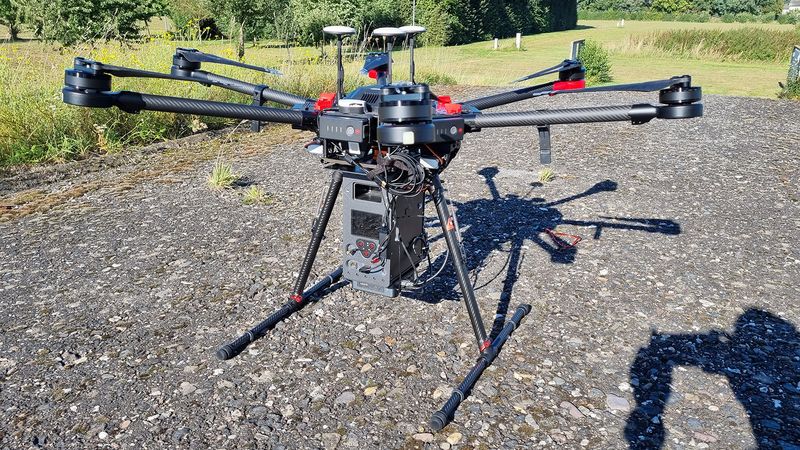
Under contract to the Bundeswehr Research Institute for Protective Technologies and CBRN Protection (WIS), researchers in the Sensor Data and Information Fusion department are developing an UAS that can quickly and precisely identify and localise radioactive sources. An technology demonstrator has already been tested in field trials at the WIS site in Munster. This system can precisely track down a radioactive source to within a few meters in only a few minutes. "The cesium capsule in Australia could only be found after days of searching with handheld detectors. We could have found the radioactive capsule much more quickly using our UAS," says Claudia Bender, a research scientist at Fraunhofer FKIE, who designed the technology demonstrator together with her colleague Torsten Fiolka.
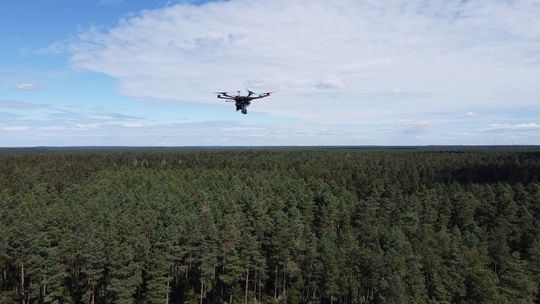
A first technology demonstrator has already been successfully tested. It can precisely detect a radioactive source to within a few meters in only a few minutes.
(Copyright: Fraunhofer FKIE)
Detection involves exploration and targeted searching
The researchers are particularly specialised in complex data processing, sensor data fusion and automation. The detection process is highly automated and consists of an exploration phase and a search phase. During the exploration phase, the UAS flies over the target area and continuously collects data from the surroundings. As soon as a deviation from the background radiation is detected, the system switches to search mode.
In this mode, the drone's flight path is dynamically adjusted based on pre-gathered environmental data and real-time sensor readings. Stochastic methods are employed to evaluate probable positions of the source. "After the drone is launched, it initially adheres to a predefined flight pattern. However, once it collects enough sensor information, the system transitions to an adaptive search mode, autonomously determining potential source locations," the researcher elaborates. It continues to devise waypoints until the hazardous material is pinpointed and its exact location is reported. Radiation levels in scanned zones are visualised through a spatial heat map, while a probability map highlights the cell most likely to contain the radioactive matter.
The drone is equipped with a gamma detector that measures radiation levels as well as additional sensors for the detection process. These are supported by electro-optical and infrared cameras, an Intel NUC computer for data processing, an inertial measurement unit (IMU) and a LTE comms module for monitoring the data from the ground. The cameras show the live image viewed by the drone. They can detect objects such as people, buildings and vehicles and can display these on a map with georeferencing. The IMU records the position and movement of the drone in 3D.
The technology demonstrator is the product of research under the HUGIYN project (Highly Automated UAS for Detecting and Identifying y-Emitting Nuclides). In the SLEIPNIR follow-up project (Automated Airborne Detection and Identification Platform for Nuclides and Isotopes from Radioactive Sources), the researchers' goals include increasing the airspeed of the UAS and simultaneously localising multiple as well as moving nuclides.
CBRNE Robots Aid in Radioactive Detection and Recovery
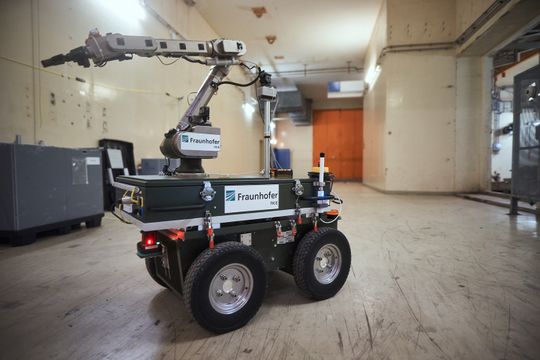
In situations that are too hazardous for humans, uncrewed ground vehicles provide support along with drones. Robots equipped with CBRNE sensors and autonomous assistance functions then take over the detection process. The intelligent combination of CBRNE detection sensors, navigation strategies and geodata processing with uncrewed ground vehicles is a key research area for Frank E. Schneider, Deputy Head of the Cognitive Mobile Systems department at Fraunhofer FKIE.
The innovative "Click & Grasp" system enables the robotic arm to perform complex movements.
(Copyright: Fraunhofer FKIE/Fabian Vogl)
“An official radioactivity monitoring system (1) was installed in Germany in preparation for events like Chernobyl involving radioactive material. A grid of sensors at intervals of several kilometers are distributed throughout Germany. These continuously report current radioactive emissions levels to the German Federal Office for Radiation Protection (BfS). We compare the radiation intensity detected by the robot in preliminary reconnaissance in a potentially hazardous area with the normal level reported by the radioactivity monitoring system for this area. We use data fusion to combine the results in a radiation map, the heat map, in order to confirm or rule out a potential threat," Schneider explains the deployment scenario.
Date: 08.12.2025
Naturally, we always handle your personal data responsibly. Any personal data we receive from you is processed in accordance with applicable data protection legislation. For detailed information please see our privacy policy.
Consent to the use of data for promotional purposes
I hereby consent to Vogel Communications Group GmbH & Co. KG, Max-Planck-Str. 7-9, 97082 Würzburg including any affiliated companies according to §§ 15 et seq. AktG (hereafter: Vogel Communications Group) using my e-mail address to send editorial newsletters. A list of all affiliated companies can be found here
Newsletter content may include all products and services of any companies mentioned above, including for example specialist journals and books, events and fairs as well as event-related products and services, print and digital media offers and services such as additional (editorial) newsletters, raffles, lead campaigns, market research both online and offline, specialist webportals and e-learning offers. In case my personal telephone number has also been collected, it may be used for offers of aforementioned products, for services of the companies mentioned above, and market research purposes.
Additionally, my consent also includes the processing of my email address and telephone number for data matching for marketing purposes with select advertising partners such as LinkedIn, Google, and Meta. For this, Vogel Communications Group may transmit said data in hashed form to the advertising partners who then use said data to determine whether I am also a member of the mentioned advertising partner portals. Vogel Communications Group uses this feature for the purposes of re-targeting (up-selling, cross-selling, and customer loyalty), generating so-called look-alike audiences for acquisition of new customers, and as basis for exclusion for on-going advertising campaigns. Further information can be found in section “data matching for marketing purposes”.
In case I access protected data on Internet portals of Vogel Communications Group including any affiliated companies according to §§ 15 et seq. AktG, I need to provide further data in order to register for the access to such content. In return for this free access to editorial content, my data may be used in accordance with this consent for the purposes stated here. This does not apply to data matching for marketing purposes.
Right of revocation
I understand that I can revoke my consent at will. My revocation does not change the lawfulness of data processing that was conducted based on my consent leading up to my revocation. One option to declare my revocation is to use the contact form found at https://contact.vogel.de. In case I no longer wish to receive certain newsletters, I have subscribed to, I can also click on the unsubscribe link included at the end of a newsletter. Further information regarding my right of revocation and the implementation of it as well as the consequences of my revocation can be found in the data protection declaration, section editorial newsletter.
The Cognitive Mobile Systems department also emphasises creating intelligent navigation and assistive features to enhance CBRNE robot control. These features ensure comprehensive coverage of the hazard area, allowing accurate localisation of radiation sources. Further measurements taken by the robot provide the control center with detailed information about the hazardous area's size, the type of radioactive material present, and the coordinates for establishing a safe pathway. This data enables experts and emergency services to plan subsequent actions effectively.
Gripper Arm Enables Complex Movements
Triggered by a mouse click on a live video image, a smart click and grasp system enables the robot's gripper arm to automatically pick up objects and place them in a different location that is also designated by a mouse click. In practical tests, the system was able to autonomously grasp spilled material, check it for radiation, transport it away and place it in a special container. The innovative assistive function even enables complex movements such as opening car doors, meaning that it can even access radioactive material in closed spaces.
Schneider's team is also developing new operating concepts that use special sensors to generate a photorealistic 3D model and a virtual reality environment. This enables the operator to view objects from different angles without having to move the robot. “This essentially gives the operator enhanced situational awareness,” the researcher says. Furthermore, sensors attached to the human hand and arm can transfer the operator's arm movements to the robot. The manipulator can thus be controlled intuitively. "We call this new support function “jacket control.” This also enables emergency personnel who are not trained specialists to control the robot intuitively.”
(1) The BfS ambient gamma dose rate monitoring network includes roughly 1,700 measuring points distributed throughout German




:quality(80)/p7i.vogel.de/wcms/5b/2c/5b2cceb9038883edfacb76a61fca350b/vw-os-4-25--28cropped-29-3136x1765v1.jpeg "VW Osnabrück: Following Rheinmetall, KNDS is now also interested in at least a partial takeover of the plant. One popular example for the shift from civilian to military production. (Picture: Wiki Commons)")
:quality(80)/p7i.vogel.de/wcms/ec/ee/ecee771dce48d9c693f8869da717ceeb/robertwaghorn-jet-2974131-4777x2687v1.jpeg "European allies intensify cooperation efforts to boost defence capabilities and ensure long-term security stability. (Source: Robert Waghorn on Pixabay)")
:quality(80)/p7i.vogel.de/wcms/be/0b/be0b550a4fc2724afeed0713f65e7675/spexer-anechoic-chamber-1280x720v1.png "(Source: Hensoldt AG)")
:quality(80)/p7i.vogel.de/wcms/6f/0f/6f0fc6e3348925946d77fa2339e53005/0130142731v1.jpeg "Heidelberger Druckmaschinen Aktiengesellschaft establishes a joint venture with Ondas. The aim is to provide and market effective drone defence systems in Europe and Ukraine. (Source: Ondas)")
:quality(80)/p7i.vogel.de/wcms/a2/66/a266453da44556de3d18a0976597a605/sintavia-press-release-image-31726-1333x750v1.jpeg "Scooped version of representative heat exchanger. (Source: Sintavia)")
:quality(80)/p7i.vogel.de/wcms/2e/15/2e15396bd28d5cc96f2c339a6b7bf1e8/l3harris-disco-1220-1217x684v1.jpeg "(Source: L3Harris Technologies)")
:quality(80)/p7i.vogel.de/wcms/0c/70/0c701a79c1f183921b8ee9341ef61db8/0129694966v1.jpeg "Robonode's DVK Development Kit: This is available through Codico's sample shop. (Image:8DEVICES)")
:quality(80)/p7i.vogel.de/wcms/7c/12/7c123d3888ed3a37a83b0793be569f00/hon-aero-hguide-i700-imu-comp-view-2880x1440-1024x576v1.webp "(Source: Honeywell)")
:quality(80)/p7i.vogel.de/wcms/b4/ae/b4ae65d3fb3903a13571d9ea3e61da8a/mock-up-vleo-def-1920x1079v1.jpeg "Illustration of the VLEO-DEF satellite in orbit (Source: EDA)")
:quality(80)/p7i.vogel.de/wcms/11/c8/11c8d30d75151329d2700176eb7a0383/0130110840v1.jpeg "Zenadrone, a subsidiary of Zenatec, is working on developing an operational low-cost drone as a disposable concept (symbol image). The first prototype already exists. In the future, it is intended to counter increasing enemy drone attacks without significant financial effort... (Source: Zenadrone)")
:quality(80)/p7i.vogel.de/wcms/c8/4c/c84cef4bf459f1280823827c3e3615c2/7cf414af-d41d-46ac-b22b-890f9f32d24c-2048x1151v1.jpeg "In Manching, Germany, Airbus is currently preparing two Valkyries for their first flight with its European mission system. The picture shows one of them. (Source: Airbus)")
:quality(80)/p7i.vogel.de/wcms/e3/d7/e3d7de9cfaac27f48ee6e162f9b309e9/0128899731v1.jpeg "Here, Lufthansa's first anniversary aircraft lands in Frankfurt. (Image:Lufthansa)")
:quality(80)/p7i.vogel.de/wcms/06/37/0637c7dd3fab9b00a8e96f98133cd1dc/260304-d-d0477-1005-5892x3317v1.png "A B-52H Stratofortress idles prior to taking off in support of Operation Epic Fury in March 2026. (Source: U.S. Air Force)")
:quality(80)/p7i.vogel.de/wcms/13/2b/132bb2831ae98c4c3bdd0ee2990ba1eb/bareways-20deck-20--20crisis-20coordination-20platformv1.jpeg "(Source: Bareways)")
:quality(80)/p7i.vogel.de/wcms/93/f1/93f1e4dba53b2c9589fab17a525df55e/adobestock-163119218-2480x1394v1.jpeg "(Source: Kernkonzept GmbH)")
:quality(80)/p7i.vogel.de/wcms/8d/76/8d764c984e44153da8f0dfa88cd6d75e/0129843677v1.jpeg "A successful drone attack on two data centers of the Amazon subsidiary AWS shows that the danger of drones is virtually unavoidable in modern warfare ... (Source: Cerberus)")
:quality(80)/p7i.vogel.de/wcms/14/d3/14d3e0847d222af54aa5ab625480507f/0130015022v1.jpeg "A German-French battle tank project was approved some time ago (symbol image). But a modern drive system is also needed for it. This is now being developed by Rolls-Royce Power Systems and ZF in the coming years... (Image:Rheinmetall)")
:quality(80)/p7i.vogel.de/wcms/bd/21/bd2191aab59c430b3c74a2be07120333/image-196-1294x728v1.png "(Image:SkyDefender © Thales)")
:quality(80)/p7i.vogel.de/wcms/d4/dc/d4dc9a59e1698ae295b1e6e64a29a55b/geralt-handshake-5768632-1280-1280x720v1.jpeg "Rheinmetall and Nooteboom Trailers are collaborating on the development and marketing of heavy equipment trailer systems designed for transporting modern tracked and wheeled military vehicles. (Image:Gerd Altmann from Pixabay)")
:quality(80)/p7i.vogel.de/wcms/22/54/2254d1e2667aff755e7aba0bcaf2eb42/0130021093v1.jpeg "Daimler Truck and Quantum Systems are jointly developing unmanned military vehicles. (Image:Quantum Systems)")
:quality(80)/p7i.vogel.de/wcms/f9/2f/f92f1ef8c739c34c70d99f7b0997621b/stra007-20--20cover-20image-5472x3076v1.jpeg "(Source: Stratasys)")
:quality(80)/p7i.vogel.de/wcms/5e/18/5e184e4961f190c86a1ea3227104cab5/26pm03-20kompakte-20l-c3-b6sungen-20f-c3-bcr-20luft--20und-20raumfahrt-202-2362x1329v1.jpeg "(Picture: Keysight)")
:quality(80)/p7i.vogel.de/wcms/67/4c/674c54baa745be497cecb716826af339/stahlwille-hero-1807x1016v1.jpeg "A new modular tool solution designed for safety, precision, and mobility in aviation maintenance. (Source: STAHLWILLE)")
:quality(80)/p7i.vogel.de/wcms/0d/01/0d01a051ba894332a8091e3a3f9394e1/hytorc-defense-solutions-boxersatz-1899x1068v1.jpeg "HYTORC’s Defence Solutions toolkit, proven on the GTK Boxer, enables safe, traceable fastening of critical components across multiple Bundeswehr platforms. (Source: Image: HYTORC)")
:quality(80)/p7i.vogel.de/wcms/f3/4e/f34ed744bb30817d3432c7ad522e6f30/engine-1v1.jpeg "Engineering with aluminium profiles really can be this easy – the item Engineeringtool and its smart functions help you save valuable time. (Source: item)")
:quality(80)/p7i.vogel.de/wcms/fb/8e/fb8e5ae2aa27bcf3e466815505ca4ff2/alumin-1v1.jpeg "The aluminium profile technology of the item Building Kit System has been used to build a huge variety of structures for decades. (Source: item)")
:quality(80)/p7i.vogel.de/wcms/be/84/be84bbede3e40b1101cd3efa35a6ffa0/overview-of-20work-bench-design-in-productionv1.jpeg "With modular work bench design, you can convert or extend a work bench with ease by changing or adding accessories. This means changes can be implemented quickly and cost-effectively, thus boosting quality and productivity. (Source: item)")
:fill(fff,0)/p7i.vogel.de/companies/64/fe/64fec73b1a2fb/logo-master-ggbbytimken-286blue.jpeg "logo-master-ggbbytimken-286blue (GGB)")
:fill(fff,0)/p7i.vogel.de/companies/69/6d/696de2483d115/logo--fastems-rgb-horizontal.jpeg "logo--fastems-rgb-horizontal (Fastems)")
:fill(fff,0)/images.vogel.de/vogelonline/companyimg/84700/84735/65.jpg "logo_item_rgb_neu.jpg ()")

:quality(80):fill(efefef,0)/p7i.vogel.de/wcms/69/2e/692efea0af28e/header-wp-thws-405302.png "Header_WP_THWS_405302")
:quality(80)/p7i.vogel.de/wcms/eb/ef/ebef7eadac9d46e8bac69abeff423c38/rheinmetall-luna-ng-a30822de-850x478v1.png "rheinmetall-luna-ng-a30822de-850x478v1 (Picture: Rheinmetall)")
:quality(80)/p7i.vogel.de/wcms/12/a7/12a7fef4425909f1be34dab62f1b373e/scenario-hot-spot-detection-ai-generated-spinverse-20oy-1291x727v1.png "The autonomous drone is intended to provide information about smouldering hotspots even before the fire brigade arrives, thereby significantly easing the work of the emergency services. (Image: © Spinver)")
:quality(80)/p7i.vogel.de/wcms/6f/31/6f313e31bc1133fff8f36d20e190d411/20251126-pm-luchs-2-hensoldt-erhalt-hohen-dreistelligen-millionenauftrag-fur-luchs-2-685x385v1.webp "At the signing of the contract: Back row, from left: Oliver Dörre (CEO of HENSOLDT), Antonio Bueno (President of General Dynamics European Land Systems). Front row, from left: Dr Thomas Kauffmann (Managing Director of General Dynamics European Land Systems Deutschland GmbH and Vice President GDELS International Business & Services), Christina Canitz (Head of Optronics Division at HENSOLDT) and Mathias Laich (Head of ISTAR at HENSOLDT) (Source: HENSOLDT AG)")