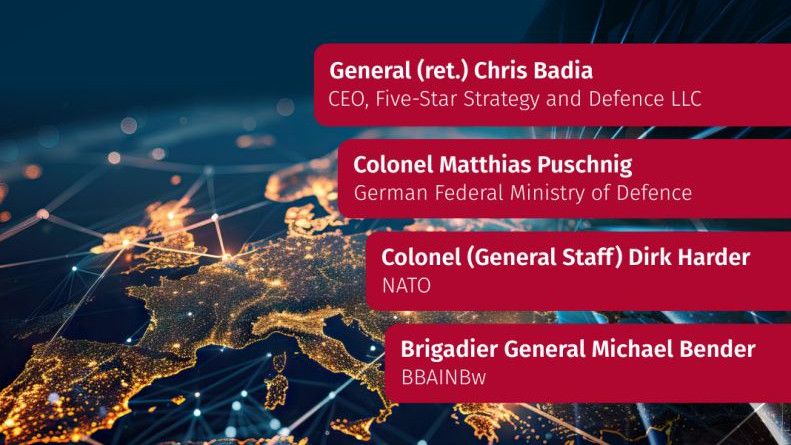
The European Defence Supply invites you to Munich on 28 and 29 April. We would like to give our readers a preview of our programme. In the following, each speaker will be introduced along with their individual topics.
(Source: VCG)
General (ret.) Chris Badia
Chris Badia was in his last military assignment Deputy Commander of NATO's Allied Command Transformation in Norfolk, Virginia, making him the highest-ranking German soldier in the Alliance. The four-star general has left the Bundeswehr after more than 40 years of service and is now the owner of his own strategy consultancy. He is a military strategist, passionate NATO enthusiast and experienced change manager.
Christian Badia (*1963) joined the Bundeswehr after graduating from high school in 1984 and completed his training as an Air Force Officer. He began his flight training in the USA in 1986 as a jet pilot on F-4 Phantoms. From 1988 to 1996, Badia was deployed in various roles in Fighter Wing 71 “Richthofen” in Wittmund. From 1996 to 1998 he was Commander of the 1st Fighter Squadron. From 1998 to 2000, he completed the 43rd General Staff Course at the German Armed Forces Command and Staff College. Badia then served as Personal Staff Officer to the Commander/Deputy Commander at the Allied Air Forces Northern Europe Headquarters in Ramstein and as Head of the Operations Department at the 4th Air Force Division Command in Aurich. From 2003 to 2006, he worked at the Federal Ministry of Defence in Berlin, first as a desk officer in the Armed Forces Joint Staff (FüS III 6), then as military policy advisor to Parliamentary State Secretary Walter Kolbow and finally as office manager to State Secretaries Kolbow and Friedbert Pflüger. From 2006 to 2009, he was Commander of the Fighter Wing 71 “Richthofen” in Wittmund. During this time, he also served in Kabul/Afghanistan from February 2008 to August 2008.
From 2009, he took over as Branch Head FüL III 1 (Conceptual Development of the Air Force) at the Air Force Joint Staff in Bonn. In 2012, Badia became Head of Department 1 (Future Development, Air Force Planning) at the newly established Air Force Command in Berlin / Gatow and moved back to the Federal Ministry of Defence in Bonn a year later, where he took over as Head of Subdivision I in the Planning Department. From 2014 to 2017, Badia headed the European Air Transport Command (EATC) in Eindhoven (Netherlands) before taking over as Head of the Military Aviation Authority. In 2018, Badia became Head of Planning at the Federal Ministry of Defence and was promoted to General and Deputy Supreme Allied Commander Transformation in 2022. Chris Badia is an expert in military strategy, defence planning and civil-military cooperation. At NATO, he shaped the transformation of the Alliance and developed strategies for future warfare.
How is NATO maintaining the Advantage in an ever-changing Multifaceted Security Environment?
Deriving from a short Geo-Political analysis the presentation will focus on what NATO’s strategy for success in an ever changing multifaceted security environment will be. Spanning from dominance aspects, the necessity of Multi Domain Operations and the innovation requirements with regard to future warfare in order to strengthen NATO's combat power. Innovation at speed is a key enabler while more of the same will not be the solution for future conflicts.
Colonel (General Staff) Dirk Harder
Colonel (General Staff) Dirk Harder is a German Army officer with extensive experience in logistics, joint operations, and defence and security policy. Since the beginning of his career in 1991, he has held numerous command and staff positions, including Chief Logistics Plans at HQ Eurocorps and senior logistics roles in NATO missions such as KFOR and ISAF. From 2017 to 2022, he served as Deputy Head of the NATO and EU Branch in the German Federal Ministry of Defence. A graduate of the German General Staff Course and the Canadian Forces College National Security Programme, he has been serving since July 2023 as Branch Head Logistics and Medical at NATO HQ International Military Staff. In this position he also chairs the Military Working Group on Logistics and co-chairs several key NATO committees focusing on resilience and enablement.
Enabling NATO Warfighting Readiness through Host Nation Support
This presentation outlines current developments within NATO with a particular focus on logistics and enablement. It highlights the shift from out of area crisis response operations to collective defence and examines the implications for reinforcement, sustainment and Host Nation Support. The briefing provides insights from NATO Headquarters on the Reinforcement and Sustainment Network, and the implementation of the HNS concept, and the Logistics and Medical Action Plans. Special attention is given to the growing importance of civil-military integration and resilience as prerequisites for credible deterrence and warfighting readiness. The presentation argues that a significant mindset shift is underway across the Alliance—moving from efficiency-driven structures towards preparedness, scalability and societal resilience.
Brigadier General Michael Bender has over 30 years of experience in ministerial, leadership, staff, and international assignments. After training as a mountain infantry officer and studying mechanical engineering at the University of the Federal Armed Forces in Munich, he held numerous leadership positions, from platoon leader and company commander to commander of a mountain infantry battalion and Mountain Infantry Brigade 23. He gained international expertise at NATO's International Military Staff in Brussels and at the NATO Defence College in Rome. At the Federal Ministry of Defence, he held key positions in both the policy area and in the immediate vicinity of political leadership, including as office manager for the State Secretary for Armaments. With his broad experience in troop leadership, strategic planning, armament and procurement, and international cooperation, General Bender is one of the most prominent young leaders in the German Armed Forces. He is currently the managing director of the BAAINBw and head of the management staff, and has also led the establishment of the German Armed Forces Innovation Center in Erding.
Date: 08.12.2025
Naturally, we always handle your personal data responsibly. Any personal data we receive from you is processed in accordance with applicable data protection legislation. For detailed information please see our privacy policy.
Consent to the use of data for promotional purposes
I hereby consent to Vogel Communications Group GmbH & Co. KG, Max-Planck-Str. 7-9, 97082 Würzburg including any affiliated companies according to §§ 15 et seq. AktG (hereafter: Vogel Communications Group) using my e-mail address to send editorial newsletters. A list of all affiliated companies can be found here
Newsletter content may include all products and services of any companies mentioned above, including for example specialist journals and books, events and fairs as well as event-related products and services, print and digital media offers and services such as additional (editorial) newsletters, raffles, lead campaigns, market research both online and offline, specialist webportals and e-learning offers. In case my personal telephone number has also been collected, it may be used for offers of aforementioned products, for services of the companies mentioned above, and market research purposes.
Additionally, my consent also includes the processing of my email address and telephone number for data matching for marketing purposes with select advertising partners such as LinkedIn, Google, and Meta. For this, Vogel Communications Group may transmit said data in hashed form to the advertising partners who then use said data to determine whether I am also a member of the mentioned advertising partner portals. Vogel Communications Group uses this feature for the purposes of re-targeting (up-selling, cross-selling, and customer loyalty), generating so-called look-alike audiences for acquisition of new customers, and as basis for exclusion for on-going advertising campaigns. Further information can be found in section “data matching for marketing purposes”.
In case I access protected data on Internet portals of Vogel Communications Group including any affiliated companies according to §§ 15 et seq. AktG, I need to provide further data in order to register for the access to such content. In return for this free access to editorial content, my data may be used in accordance with this consent for the purposes stated here. This does not apply to data matching for marketing purposes.
Right of revocation
I understand that I can revoke my consent at will. My revocation does not change the lawfulness of data processing that was conducted based on my consent leading up to my revocation. One option to declare my revocation is to use the contact form found at https://contact.vogel.de. In case I no longer wish to receive certain newsletters, I have subscribed to, I can also click on the unsubscribe link included at the end of a newsletter. Further information regarding my right of revocation and the implementation of it as well as the consequences of my revocation can be found in the data protection declaration, section editorial newsletter.
BAAINBw in the European Defence Ecosystem—Procurement Processes, Roles and Industry Engagement
As Europe seeks to strengthen defence capabilities and resilient supply chains, understanding national procurement structures remains essential. This presentation introduces the German defence procurement system and explains the role of BAAINBw within the broader European defence ecosystem. It will address how procurement processes are structured, how national and European frameworks interact, and what this means for companies aiming to participate as suppliers or partners. By outlining access routes, expectations and basic prerequisites, the presentation aims to contribute to a shared understanding between public procurement authorities and industry stakeholders across Europe.
After a long management career in the IT industry, Colonel Puschnig (born in 1968) returned from the reserves to active duty in the German Armed Forces in 2015, specifically to the Federal Ministry of Defence. After several military policy and defence planning assignments, he is in the management of Special Staff Ukraine since 2023 and, since the beginning of this year, Chairman of the Joint Working Group for Defence Industry Cooperation of the German and Ukrainian Ministries of Defence. He is an advisor to an M&A company, publishes in military science journals and gives lectures in Germany and abroad.
Expert Talk: Ukraine—a Shortcut into Defence Industry
Like every war, the one in Ukraine is also an innovation engine—one that is currently running at full speed. The short innovation cycles favour small and medium-sized enterprises, which can flexibly bring the necessary innovations from prototype to series production in the shortest possible time. These opportunities are facilitated by the exceptionally low barriers to market entry that otherwise characterise the defence industry. With the right strategy, this is the first step into the defence industry. At the same time, the second step must be prepared: establishing oneself as a supplier to the established government procurement structures.
Europe’s security landscape is changing rapidly
(Source: VCG)
As defence budgets rise and EU programmes expand, civil technology providers are becoming vital contributors to Europe’s strategic autonomy. The event will act as a neutral platform for dialogue between technology suppliers, integrators, and decision-makers shaping the next generation of European defence capabilities and aims to open doors between civil industry and defence procurement, providing practical insights.
The European Defence Supply is a key event for the European defence industry. It offers a neutral platform to facilitate the entry of civilian technology providers into the defence industry. The EDS aims to foster new partnerships, provide answers to questions, and ease market access. Discussions will cover NATO strategies and the challenges faced by new market entrants, addressed through practical presentations and discussions.
The event will take place at the Design Offices Munich Macherei, featuring a networking event on 28 April at 19:00 and the conference on 29 April starting at 8:45. Further information and registration are available on the event's website.




:quality(80)/p7i.vogel.de/wcms/da/a4/daa4f6ba200235872ead95bbeb2f4fd9/1773731073623-791x445v1.jpeg "(Source: VCG)")
:quality(80)/p7i.vogel.de/wcms/dd/14/dd14f348f529b5b46dab6c26ff9c133c/0130511650v1.jpeg "Opportunities for balance? Armaments are currently in high demand. At the same time, previously lucrative civilian industrial sectors are weakening. This virtually compels German companies to try their hand at armaments, according to a DIHK survey ... (Source: Bundeswehr)")
:quality(80)/p7i.vogel.de/wcms/95/d9/95d9c3cc05b5c405760b69d13b536fc9/euspa-20hq-20prague-1984x1116v1.jpeg "(Source: EUSPA)")
:quality(80)/p7i.vogel.de/wcms/85/49/85490f8158575e4adcf1d7ac909b8fb2/ck-image-1920w-1920x1080v1.webp "Christoph Ketterle,Principle at Horváth AG. (Source: Horváth AG)")
:quality(80)/p7i.vogel.de/wcms/94/de/94dea9b2591234e537115051516e5f7e/ea-deepx-som-2100x1182v1.jpeg "(Source: Virtium)")
:quality(80)/p7i.vogel.de/wcms/9e/5c/9e5cc6535fddf2f34dc58a238627face/493-403-32-2920x1643v1v1.jpeg "During the development of the N40 MC machining centre, NILES-SIMMONS collaborated with a jet engine manufacturer. However, the machines are also used outside the aerospace industry. (Source: NILES-SIMMONS)")
:quality(80)/p7i.vogel.de/wcms/a5/66/a56647bb7027b0e55a907fb2abf5f0cc/bba300-broadband-amplifier-hero-view-rohde-schwarz-200-56753-2880-1620-9-2880x1619v1.jpeg "Rohde & Schwarz amplifiers optimise high-field immunity testing at IBL Lab. (Source: Rohde & Schwarz GmbH & Co. KG)")
:quality(80)/p7i.vogel.de/wcms/08/2e/082e7ee4fff00331de609913c1c062f9/afc-0326-1-2480x1395v1.jpeg "Smalley wave springs offered by AFC Europe are also used in the design of defence and security systems. Here, they often replace springs made from stamped sheet metal. (Source: AFC/ Smalley)")
:quality(80)/p7i.vogel.de/wcms/48/27/48278b02e8599f7429590ce118365ced/0130582855v1.jpeg "From tool to independent provider: With the new subsidiary Skywise, Airbus combines the cloud-based platform with the expertise of Navblue. (Source: Airbus)")
:quality(80)/p7i.vogel.de/wcms/11/ba/11ba37700e86cf82123a425977c9562c/air-20freight-5988x3366v1.jpeg "(Source: Wiremasters)")
:quality(80)/p7i.vogel.de/wcms/ef/90/ef907701c0f7d7726221c9d39683ee8b/g028-cca-iss-7500x4217v1.jpeg "The G028 CPU board from duagon is part of the CCA developed by duagon for use on the ISS. (Source: © Knorr-Bremse, duagon, shutterstock/Paopano)")
:quality(80)/p7i.vogel.de/wcms/fb/39/fb39078c72b79ac9210eb6bfd91391d6/isar-aerospace-launch-pad-at-andoya-space-c-isar-aerospace-2026-03-16-103348-wdvt-5322x2996v1.jpeg "(Source: Isar Aerospace)")
:quality(80)/p7i.vogel.de/wcms/fa/8f/fa8f745e2f507b61102cfc0589305b80/0130522052v1.jpeg "What you see here is the successful combination of the Lars UPS system from Kraken Robotics and the RD-22 from Sefine. Added to this is the Katfish towed sonar system from Kraken. All in all, this robotic mix is intended to strengthen mine defence. Initial demonstrations have been successful. (Source: Octopus Robotics)")
:quality(80)/p7i.vogel.de/wcms/a7/63/a763e019287f1099bc7b94c26a93b942/1544532155-winmate-remote-20control-20drone-s101tg-gcs-8000x4496v1.jpeg "The effectiveness of military drone operations depends crucially on ground control stations. NATO defines standards for technology and architecture. (Source: TL Electronic GmbH)")
:quality(80)/p7i.vogel.de/wcms/7c/26/7c26c3ee1cffa5264a644a4da4767e40/ew-2026-gateworks-nxp-400x225v1.jpeg "Gateworks joins forces with NXP to unveil new USA-made M.2 AI acceleration card, featuring decoupled AI architecture. (Source: Gateworks)")
:quality(80)/p7i.vogel.de/wcms/02/d9/02d94d8620db048306aa73030b138865/arian-20van-20huelsen-203-1600x900v1.jpeg "Arian van Hülsen, Director Solutions Consulting & Global AI Champion at PTC (Source: PTC)")
:quality(80)/p7i.vogel.de/wcms/7e/5e/7e5ecad745e0aa3c3c92dea383682ac5/0130570251v1.jpeg "This is what happens when old ammunition is disarmed in bodies of water in the usual way: Pressure, sound and environmental pollution, as you can see from the fountain. Then it is also expensive. But know-how from the LZH can prevent this as far as possible ... (Image:LZH)")
:quality(80)/p7i.vogel.de/wcms/bb/5b/bb5bdac9050e0187246e75f938aa685d/0130412089v1.jpeg "A new decision by the EU Commission will also please the soldiers in Ukraine. A large sum is now being allocated to further support Ukraine with armaments while also upgrading the EU itself in terms of defence technology ... (Image:D. Boschkowitsch)")
:quality(80)/p7i.vogel.de/wcms/4b/44/4b447d9e30b31f8b164ad52deb283d92/uxv-concept-u5-kestrel-1000px-980x551v1.jpeg "(Source: Kymeta)")
:quality(80)/p7i.vogel.de/wcms/16/92/1692aa170ee108e81daa3408fc6c7562/foto-50-1-scaled-2560x1441v1.jpeg "(Source: Quantum-Systems GmbH)")
:quality(80)/p7i.vogel.de/wcms/f9/2f/f92f1ef8c739c34c70d99f7b0997621b/stra007-20--20cover-20image-5472x3076v1.jpeg "(Source: Stratasys)")
:quality(80)/p7i.vogel.de/wcms/5e/18/5e184e4961f190c86a1ea3227104cab5/26pm03-20kompakte-20l-c3-b6sungen-20f-c3-bcr-20luft--20und-20raumfahrt-202-2362x1329v1.jpeg "(Picture: Keysight)")
:quality(80)/p7i.vogel.de/wcms/67/4c/674c54baa745be497cecb716826af339/stahlwille-hero-1807x1016v1.jpeg "A new modular tool solution designed for safety, precision, and mobility in aviation maintenance. (Source: STAHLWILLE)")
:quality(80)/p7i.vogel.de/wcms/0d/01/0d01a051ba894332a8091e3a3f9394e1/hytorc-defense-solutions-boxersatz-1899x1068v1.jpeg "HYTORC’s Defence Solutions toolkit, proven on the GTK Boxer, enables safe, traceable fastening of critical components across multiple Bundeswehr platforms. (Source: Image: HYTORC)")
:quality(80)/p7i.vogel.de/wcms/f3/4e/f34ed744bb30817d3432c7ad522e6f30/engine-1v1.jpeg "Engineering with aluminium profiles really can be this easy – the item Engineeringtool and its smart functions help you save valuable time. (Source: item)")
:quality(80)/p7i.vogel.de/wcms/fb/8e/fb8e5ae2aa27bcf3e466815505ca4ff2/alumin-1v1.jpeg "The aluminium profile technology of the item Building Kit System has been used to build a huge variety of structures for decades. (Source: item)")
:quality(80)/p7i.vogel.de/wcms/be/84/be84bbede3e40b1101cd3efa35a6ffa0/overview-of-20work-bench-design-in-productionv1.jpeg "With modular work bench design, you can convert or extend a work bench with ease by changing or adding accessories. This means changes can be implemented quickly and cost-effectively, thus boosting quality and productivity. (Source: item)")
:fill(fff,0)/images.vogel.de/vogelonline/companyimg/84700/84735/65.jpg "logo_item_rgb_neu.jpg ()")
:quality(80)/p7i.vogel.de/wcms/85/49/85490f8158575e4adcf1d7ac909b8fb2/ck-image-1920w-1920x1080v1.webp "Christoph Ketterle,Principle at Horváth AG. (Source: Horváth AG)")
:quality(80)/p7i.vogel.de/wcms/d6/a0/d6a0c8483432a3d4c4bbbb94e925cdf6/alexander-2bostermeier-1920w-800x450v1.webp "Alexander Ostermeier, Business Development Manager Defence at Incap Electronics Germany GmbH. (Source: Incap Electronics Germany GmbH)")

:quality(80)/p7i.vogel.de/wcms/f5/7e/f57ef535ee35e7b3b7ff15a8a63cef10/eds-keyvisual-8000x4496v1.jpeg "eds-keyvisual-8000x4496v1 (Source: European Defence Supply)")
:quality(80)/p7i.vogel.de/wcms/40/a2/40a25e5103d77216755694930fdfb237/screenshot-202026-03-02-20125314-791x445v1.png "screenshot-202026-03-02-20125314-791x445v1 (Source: SOFF/BDSV)")