Super light, super flexible, super insulating: To protect satellites from extreme temperatures, an aluminum-coated polymer film is used. Researchers at Empa Thun have made the material even more durable by using an ultra-thin intermediate layer.
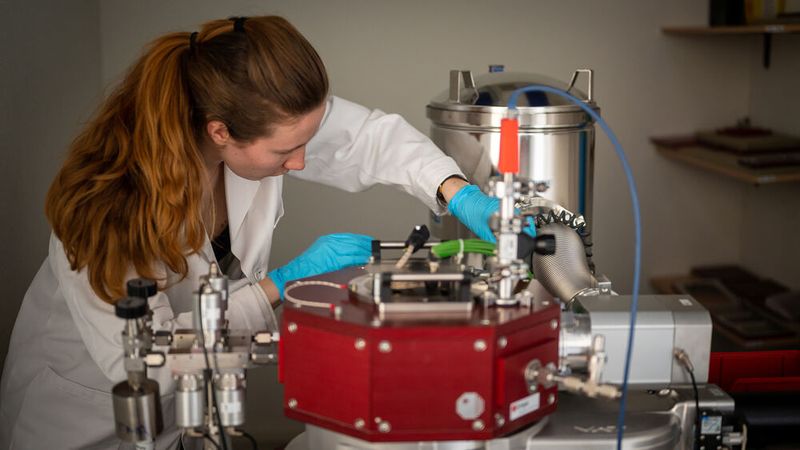
Johanna Byloff analyzes the samples on the coating machine of the Empa spin-off Swiss Cluster.
(Image: Empa)
Who doesn't know the archetypal image of a satellite: two extended solar "wings" and a compact body wrapped in golden or silver shimmering foil. It is precisely this foil that researchers from the "Mechanics of Materials and Nanostructures" lab at Empa in Thun are working on.
The foil is so-called "Multilayer Insulation," also known as super insulation in German. It consists of multiple layers of a durable polymer coated with a thin metal layer, typically aluminum. On Earth, this coated foil is encountered in the form of emergency blankets. On spacecraft, the super insulation protects electronics from temperature fluctuations. "For satellites in low Earth orbit, the temperature difference between the sun-facing and the sun-shaded side is about 150 degrees (approx. 302°F)," says Empa researcher Barbara Putz. "However, electronics function best at room temperature of 25 degrees Celsius (approx. 77°F)." Since it is directly exposed to space conditions, the super insulation needs to withstand quite a bit.
Accelerating the development of flexible electronics on Earth
The durable polyimide is typically used as the polymer base for the thin-film structure. In addition to its temperature and vacuum resistance, it is also characterized by the fact that the aluminum layer adheres particularly well to it. "The reason for this is an intermediate layer just a few nanometers thick, which forms between the polymer and the aluminum during coating," explains Putz. The researcher now aims to study this intermediate layer in more detail—and use it purposefully. The layer is intended not only to enable improved super insulation for future satellites but also to accelerate the development of flexible electronics on Earth. For this research project, she received the "Ambizione Grant" from the Swiss National Science Foundation (SNSF) in 2020.
Europe’s security landscape is changing rapidly
(Source: VCG)
As defence budgets rise and EU programmes expand, civil technology providers are becoming vital contributors to Europe’s strategic autonomy. The event will act as a neutral platform for dialogue between technology suppliers, integrators, and decision-makers shaping the next generation of European defence capabilities and aims to open doors between civil industry and defence procurement, providing practical insights.
To precisely understand the intermediate layer and its effects on material properties, Barbara Putz and her doctoral student Johanna Byloff chose a simple model system: a 50-micrometer-thick polyimide film coated with 150 nanometers of aluminum. Between the metal and the plastic, the researchers apply an aluminum oxide coating only five nanometers thick. Working with such a thin intermediate layer is demanding. To ensure clean processing, the researchers use a coating machine from the Empa spin-off Swiss Cluster AG, founded in 2020 by researchers from the "Mechanics of Materials and Nanostructures" laboratory. The device enables multiple coating processes to be applied sequentially to the same workpiece without removing it from the vacuum chamber.
"Our material combination corresponds to that used for space applications, for example, in the European Mercury probe BepiColombo or the sun shield of NASA's James Webb Space Telescope," says Byloff. "The oxide intermediate layer forms naturally there, while we produce it deliberately, allowing the properties to be controlled."
The 21 by 14-meter sunshield of the space telescope also illustrates the demands placed on materials in space. In addition to the large temperature differences, the insulating layers are also subjected to mechanical stress. "On the one hand, the sunshield was stowed during the launch of the telescope and had to unfold at its destination without the layers tearing or separating from each other," explains Byloff. "On the other hand, particles and space debris can damage the foil. It is important that the damage remains localized and does not spread as long cracks across the entire surface."
From satellites to medical sensors
The researchers thoroughly tested their model foil, subjecting it to tensile tests, temperature shocks, and chemical and physical characterization. The result: the intermediate layer makes the material more stretchable and significantly more resistant to cracks and shear forces. Next, the researchers want to vary the thickness of the layer and apply it to other polymer substrates. "The natural intermediate layer forms only on polyimide and only at a thickness of five nanometers, which limits its usefulness," says Barbara Putz. "We expect that our artificial intermediate layer will enable multilayer systems on other polymers that previously were not viable due to poor adhesion of the coating."
Date: 08.12.2025
Naturally, we always handle your personal data responsibly. Any personal data we receive from you is processed in accordance with applicable data protection legislation. For detailed information please see our privacy policy.
Consent to the use of data for promotional purposes
I hereby consent to Vogel Communications Group GmbH & Co. KG, Max-Planck-Str. 7-9, 97082 Würzburg including any affiliated companies according to §§ 15 et seq. AktG (hereafter: Vogel Communications Group) using my e-mail address to send editorial newsletters. A list of all affiliated companies can be found here
Newsletter content may include all products and services of any companies mentioned above, including for example specialist journals and books, events and fairs as well as event-related products and services, print and digital media offers and services such as additional (editorial) newsletters, raffles, lead campaigns, market research both online and offline, specialist webportals and e-learning offers. In case my personal telephone number has also been collected, it may be used for offers of aforementioned products, for services of the companies mentioned above, and market research purposes.
Additionally, my consent also includes the processing of my email address and telephone number for data matching for marketing purposes with select advertising partners such as LinkedIn, Google, and Meta. For this, Vogel Communications Group may transmit said data in hashed form to the advertising partners who then use said data to determine whether I am also a member of the mentioned advertising partner portals. Vogel Communications Group uses this feature for the purposes of re-targeting (up-selling, cross-selling, and customer loyalty), generating so-called look-alike audiences for acquisition of new customers, and as basis for exclusion for on-going advertising campaigns. Further information can be found in section “data matching for marketing purposes”.
In case I access protected data on Internet portals of Vogel Communications Group including any affiliated companies according to §§ 15 et seq. AktG, I need to provide further data in order to register for the access to such content. In return for this free access to editorial content, my data may be used in accordance with this consent for the purposes stated here. This does not apply to data matching for marketing purposes.
Right of revocation
I understand that I can revoke my consent at will. My revocation does not change the lawfulness of data processing that was conducted based on my consent leading up to my revocation. One option to declare my revocation is to use the contact form found at https://contact.vogel.de. In case I no longer wish to receive certain newsletters, I have subscribed to, I can also click on the unsubscribe link included at the end of a newsletter. Further information regarding my right of revocation and the implementation of it as well as the consequences of my revocation can be found in the data protection declaration, section editorial newsletter.
Satellite insulation is not the only area where flexible multilayer systems are in demand. Putz and Byloff also see a major application for their research in the field of flexible electronics, which also relies on metal-coated polymer substrates. Thin-film components for electronic devices typically consist of multiple layers made from different materials. However, mechanical properties could also be improved there through the targeted use of thin intermediate layers. This could enable foldable or rollable devices, smart textiles, and flexible medical sensors.



:quality(80)/p7i.vogel.de/wcms/95/d9/95d9c3cc05b5c405760b69d13b536fc9/euspa-20hq-20prague-1984x1116v1.jpeg "(Source: EUSPA)")
:quality(80)/p7i.vogel.de/wcms/85/49/85490f8158575e4adcf1d7ac909b8fb2/ck-image-1920w-1920x1080v1.webp "Christoph Ketterle,Principle at Horváth AG. (Source: Horváth AG)")
:quality(80)/p7i.vogel.de/wcms/3c/dc/3cdc7e8f8b267ebb9a2242c5823932b2/leopard-2-a5-der-bundeswehr-2646x1489v1.jpeg "Will successors be ready quickly? Plans are also under way for a future replacement for the Leopard tank. (Photo: Bundeswehr)")
:quality(80)/p7i.vogel.de/wcms/ce/ab/ceabc9d507f819c1da8c5a7d77673a72/freisteller-flugabwehrraketensystem-patriot-1244x700v1.png "(Source: Bundeswehr)")
:quality(80)/p7i.vogel.de/wcms/94/de/94dea9b2591234e537115051516e5f7e/ea-deepx-som-2100x1182v1.jpeg "(Source: Virtium)")
:quality(80)/p7i.vogel.de/wcms/9e/5c/9e5cc6535fddf2f34dc58a238627face/493-403-32-2920x1643v1v1.jpeg "During the development of the N40 MC machining centre, NILES-SIMMONS collaborated with a jet engine manufacturer. However, the machines are also used outside the aerospace industry. (Source: NILES-SIMMONS)")
:quality(80)/p7i.vogel.de/wcms/a5/66/a56647bb7027b0e55a907fb2abf5f0cc/bba300-broadband-amplifier-hero-view-rohde-schwarz-200-56753-2880-1620-9-2880x1619v1.jpeg "Rohde & Schwarz amplifiers optimise high-field immunity testing at IBL Lab. (Source: Rohde & Schwarz GmbH & Co. KG)")
:quality(80)/p7i.vogel.de/wcms/08/2e/082e7ee4fff00331de609913c1c062f9/afc-0326-1-2480x1395v1.jpeg "Smalley wave springs offered by AFC Europe are also used in the design of defence and security systems. Here, they often replace springs made from stamped sheet metal. (Source: AFC/ Smalley)")
:quality(80)/p7i.vogel.de/wcms/ef/90/ef907701c0f7d7726221c9d39683ee8b/g028-cca-iss-7500x4217v1.jpeg "The G028 CPU board from duagon is part of the CCA developed by duagon for use on the ISS. (Source: © Knorr-Bremse, duagon, shutterstock/Paopano)")
:quality(80)/p7i.vogel.de/wcms/fb/39/fb39078c72b79ac9210eb6bfd91391d6/isar-aerospace-launch-pad-at-andoya-space-c-isar-aerospace-2026-03-16-103348-wdvt-5322x2996v1.jpeg "(Source: Isar Aerospace)")
:quality(80)/p7i.vogel.de/wcms/0e/ed/0eed09669b79e3f05af297b580e18844/launch-vehicle-spectrum-at-andoya-space-c-isar-aerospace-2026-01-30-083741-ruml-4007x2254v1.jpeg "(Source: Isar Aerospace)")
:quality(80)/p7i.vogel.de/wcms/96/18/961852680c343ab9f3fe29780e33a503/rad-hard-ic-artemis-ii-en-20-281-29-1920x1079v1.jpeg "(Source: Renesas)")
:quality(80)/p7i.vogel.de/wcms/fa/8f/fa8f745e2f507b61102cfc0589305b80/0130522052v1.jpeg "What you see here is the successful combination of the Lars UPS system from Kraken Robotics and the RD-22 from Sefine. Added to this is the Katfish towed sonar system from Kraken. All in all, this robotic mix is intended to strengthen mine defence. Initial demonstrations have been successful. (Source: Octopus Robotics)")
:quality(80)/p7i.vogel.de/wcms/a7/63/a763e019287f1099bc7b94c26a93b942/1544532155-winmate-remote-20control-20drone-s101tg-gcs-8000x4496v1.jpeg "The effectiveness of military drone operations depends crucially on ground control stations. NATO defines standards for technology and architecture. (Source: TL Electronic GmbH)")
:quality(80)/p7i.vogel.de/wcms/7c/26/7c26c3ee1cffa5264a644a4da4767e40/ew-2026-gateworks-nxp-400x225v1.jpeg "Gateworks joins forces with NXP to unveil new USA-made M.2 AI acceleration card, featuring decoupled AI architecture. (Source: Gateworks)")
:quality(80)/p7i.vogel.de/wcms/02/d9/02d94d8620db048306aa73030b138865/arian-20van-20huelsen-203-1600x900v1.jpeg "Arian van Hülsen, Director Solutions Consulting & Global AI Champion at PTC (Source: PTC)")
:quality(80)/p7i.vogel.de/wcms/7e/5e/7e5ecad745e0aa3c3c92dea383682ac5/0130570251v1.jpeg "This is what happens when old ammunition is disarmed in bodies of water in the usual way: Pressure, sound and environmental pollution, as you can see from the fountain. Then it is also expensive. But know-how from the LZH can prevent this as far as possible ... (Image:LZH)")
:quality(80)/p7i.vogel.de/wcms/bb/5b/bb5bdac9050e0187246e75f938aa685d/0130412089v1.jpeg "A new decision by the EU Commission will also please the soldiers in Ukraine. A large sum is now being allocated to further support Ukraine with armaments while also upgrading the EU itself in terms of defence technology ... (Image:D. Boschkowitsch)")
:quality(80)/p7i.vogel.de/wcms/4b/44/4b447d9e30b31f8b164ad52deb283d92/uxv-concept-u5-kestrel-1000px-980x551v1.jpeg "(Source: Kymeta)")
:quality(80)/p7i.vogel.de/wcms/16/92/1692aa170ee108e81daa3408fc6c7562/foto-50-1-scaled-2560x1441v1.jpeg "(Source: Quantum-Systems GmbH)")
:quality(80)/p7i.vogel.de/wcms/f9/2f/f92f1ef8c739c34c70d99f7b0997621b/stra007-20--20cover-20image-5472x3076v1.jpeg "(Source: Stratasys)")
:quality(80)/p7i.vogel.de/wcms/5e/18/5e184e4961f190c86a1ea3227104cab5/26pm03-20kompakte-20l-c3-b6sungen-20f-c3-bcr-20luft--20und-20raumfahrt-202-2362x1329v1.jpeg "(Picture: Keysight)")
:quality(80)/p7i.vogel.de/wcms/67/4c/674c54baa745be497cecb716826af339/stahlwille-hero-1807x1016v1.jpeg "A new modular tool solution designed for safety, precision, and mobility in aviation maintenance. (Source: STAHLWILLE)")
:quality(80)/p7i.vogel.de/wcms/0d/01/0d01a051ba894332a8091e3a3f9394e1/hytorc-defense-solutions-boxersatz-1899x1068v1.jpeg "HYTORC’s Defence Solutions toolkit, proven on the GTK Boxer, enables safe, traceable fastening of critical components across multiple Bundeswehr platforms. (Source: Image: HYTORC)")
:quality(80)/p7i.vogel.de/wcms/f3/4e/f34ed744bb30817d3432c7ad522e6f30/engine-1v1.jpeg "Engineering with aluminium profiles really can be this easy – the item Engineeringtool and its smart functions help you save valuable time. (Source: item)")
:quality(80)/p7i.vogel.de/wcms/fb/8e/fb8e5ae2aa27bcf3e466815505ca4ff2/alumin-1v1.jpeg "The aluminium profile technology of the item Building Kit System has been used to build a huge variety of structures for decades. (Source: item)")
:quality(80)/p7i.vogel.de/wcms/be/84/be84bbede3e40b1101cd3efa35a6ffa0/overview-of-20work-bench-design-in-productionv1.jpeg "With modular work bench design, you can convert or extend a work bench with ease by changing or adding accessories. This means changes can be implemented quickly and cost-effectively, thus boosting quality and productivity. (Source: item)")
:fill(fff,0)/p7i.vogel.de/companies/64/fe/64fec73b1a2fb/logo-master-ggbbytimken-286blue.jpeg "logo-master-ggbbytimken-286blue (GGB)")
:fill(fff,0)/p7i.vogel.de/companies/69/6d/696de2483d115/logo--fastems-rgb-horizontal.jpeg "logo--fastems-rgb-horizontal (Fastems)")
:fill(fff,0)/images.vogel.de/vogelonline/companyimg/84700/84735/65.jpg "logo_item_rgb_neu.jpg ()")

:quality(80)/p7i.vogel.de/wcms/c5/ae/c5ae900d260c64049119f9027cac5c2e/0128777874v1.jpeg "The aerospace industry is one of the beneficiaries of current developments in metallic 3D printing. Small quantities and the high complexity of lightweight, high-performance components are already among the strengths of additive manufacturing. (Image:Fraunhofer-ILT)")
:quality(80)/p7i.vogel.de/wcms/15/20/1520c33f7bd9869c34a73242f18483a4/f-16-20aircraft-2000x1124v1.jpeg "WireMasters is a global provider of high performance connectivity solutions specializing in Mil-Spec and EN cables, connectors, harness management products and value-added services. (Image:Wiremasters)")