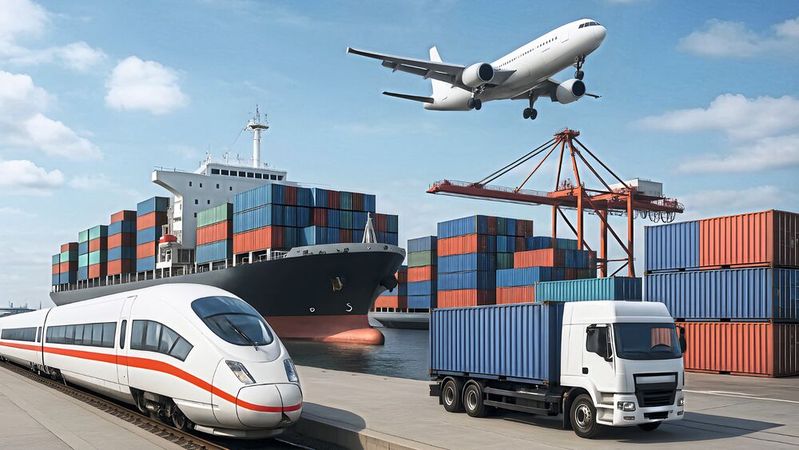
Power converters are used in applications on land, at sea and in the air. They have to work reliably even under extreme conditions: wide temperature ranges, shock and vibration, electrical interference, electromagnetic compatibility (EMC) and sudden load peaks (load dump).
For every application: whether in the air, on the road, rail or water. Power electronics are needed everywhere.
(Image: Dall-E / AI-generated)
Reinhard Kalfhaus is the founder and managing director of SYKO
Power converters have been continuously developed for several decades. Experience gained from different circuit topologies and modifications is incorporated into new generations. Today, components up to the power range of around 10 kW can be produced in series, often with certifications according to common standards such as EN, MIL or VG, so that they can also be used reliably in safety-critical applications or under extreme environmental conditions.
Meeting the functionality needs of the consumer
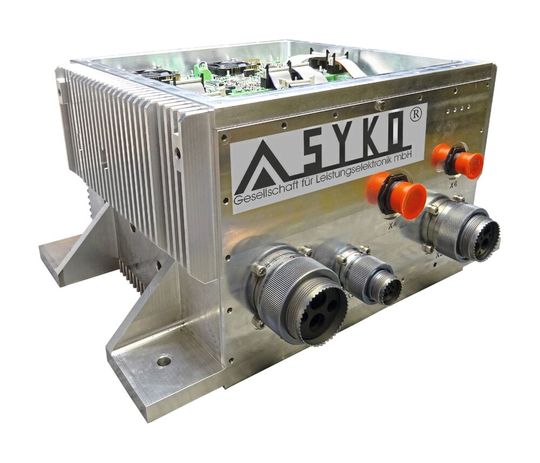
Figure 1: The short-circuit-proof buck/boost converters of the PSU 3000 series operate in the dynamic input voltage range (15 to 151 V).
(Image: SYKO)
In public transportation, power converters are used to provide an insulation-monitored supply of 230 V/50 Hz or DC voltage from the contact wire voltage of around 750 V. This can be used to supply charging stations for mobile devices, tools for service personnel or lighting and data transmission at remote stops. At the same time, they help to increase comfort and safety for passengers, avoid breakdowns during operation and reliably support the increasing number of additional electrical systems. Modern concepts also take into account aspects such as energy efficiency, small size and easy maintenance, so that the devices can be flexibly integrated into existing vehicles. With a view to future requirements, power converters therefore play a central role in the sustainable and safe operation of modern transportation systems.
Transmitting high power over long distances
Figure 2: The 1,000-watt CLW buck-boost converter can be used to charge capacitor batteries on vehicle electrical systems in the 9 to 36 V voltage range.
(Image: SYKO)
The manufacturer Syko has recently had a system component certified that can transmit a potential-separated power of 3.3 kW over a distance of 3.3 km. The output side supplies a residual current and insulation-monitored voltage of 230 VAC; optional variants for 28 V battery charging or three-phase 400/460 V connections are also possible. Such systems make it possible to disconnect platforms - even under water, for example - from the operator over longer distances with reduced power and still supply them with energy and communication. In another project, Syko processes a reverse-polarity protected 28 V on-board power supply voltage (16 to 34 V) and intercepts load-dump pulses of up to 100 V/50 to 280 ms without current reflection. This provides a battery or high-cap-supported voltage of 56 V/3.6 kW. Topologies such as the totem pole circuit for AC inputs, voltage-cascaded high-voltage regenerators for DC inputs, high-current synchronous rectifiers and combined buck-boost variants are used. The systems are controlled and regulated on a processor basis, which enables flexible interface adaptation.
Stability as a central goal in most projects
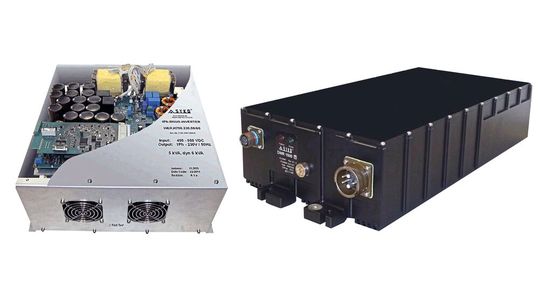
Figure 3: The WER H750 railway inverter (left) and the PWR 1500 for use in vehicles.
(Image: SYKO)
In the market for robust power electronics, the challenge lies less in completely new circuit concepts and more in the precise adaptation and combination of existing topologies. The requirements are particularly high in mobile environments - for example in railroad, defense or offshore applications: extreme temperature ranges from -45 to 85 °C, strong vibrations and short-term current jumps in the range of several thousand amperes put additional strain on the systems.
Suppliers in this segment often work with comparatively small to medium quantities. This makes production complex and increases the economic pressure, especially as development and certification processes are time-consuming and cost-intensive. To ensure reliability, extensive quality assurance measures are standard: temperature tests over several hours, dynamic cycle tests between -40 and 85 °C and documented functional tests from the prototype phase onwards. This practice ensures that new systems can go into series production with a high level of stability - even if this significantly extends the development time. Specific projects show how broad the range of applications for such power converters is. A high-cap charger, for example, charges a 55-farad/550-volt capacitor from 0 volts with an output of 3.6 kW, based on on-board supply voltages of 24 or 72 V. Communication takes place via bus structures so that the system can be integrated into complex applications.
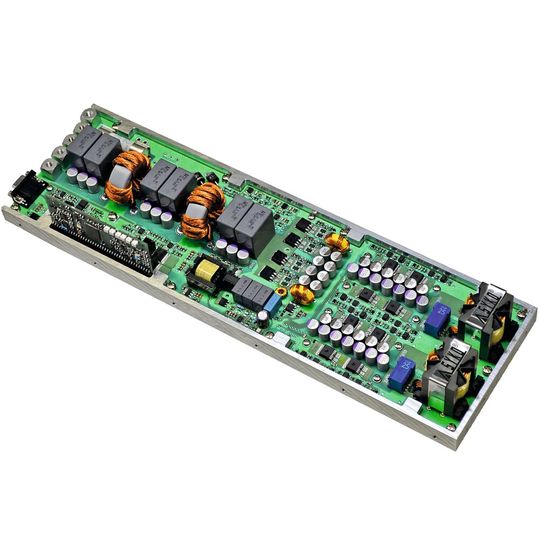
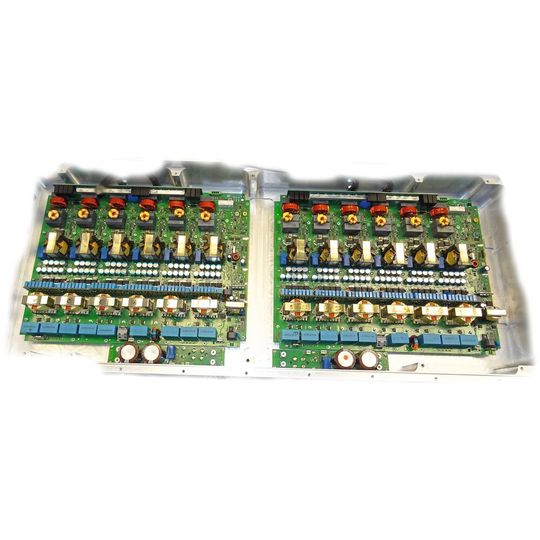
Figure 4: These six-way controlled, current-cascaded front-end stages are connected in parallel via a processor unit in any controlled manner for n x 3 kW/5 kW dynamic.
(Image: SYKO)
Another example is a specific excitation device that generates a three-phase output voltage of 3.6 kW from a 110-volt on-board power supply voltage in an isolated manner in order to drive a synchronous motor via f/u control. During operation, the device can switch to a regulated DC excitation voltage.
The power supply from the 750 V contact wire is also one of the typical tasks. Here, a 28-volt battery charge with up to 2 kW is provided in an isolated manner. This includes the ability to absorb dynamic voltage peaks of more than 1,000 V in the millisecond range. In addition, a three-phase 400-volt output voltage of 500 W can be generated from the same source.
Date: 08.12.2025
Naturally, we always handle your personal data responsibly. Any personal data we receive from you is processed in accordance with applicable data protection legislation. For detailed information please see our privacy policy.
Consent to the use of data for promotional purposes
I hereby consent to Vogel Communications Group GmbH & Co. KG, Max-Planck-Str. 7-9, 97082 Würzburg including any affiliated companies according to §§ 15 et seq. AktG (hereafter: Vogel Communications Group) using my e-mail address to send editorial newsletters. A list of all affiliated companies can be found here
Newsletter content may include all products and services of any companies mentioned above, including for example specialist journals and books, events and fairs as well as event-related products and services, print and digital media offers and services such as additional (editorial) newsletters, raffles, lead campaigns, market research both online and offline, specialist webportals and e-learning offers. In case my personal telephone number has also been collected, it may be used for offers of aforementioned products, for services of the companies mentioned above, and market research purposes.
Additionally, my consent also includes the processing of my email address and telephone number for data matching for marketing purposes with select advertising partners such as LinkedIn, Google, and Meta. For this, Vogel Communications Group may transmit said data in hashed form to the advertising partners who then use said data to determine whether I am also a member of the mentioned advertising partner portals. Vogel Communications Group uses this feature for the purposes of re-targeting (up-selling, cross-selling, and customer loyalty), generating so-called look-alike audiences for acquisition of new customers, and as basis for exclusion for on-going advertising campaigns. Further information can be found in section “data matching for marketing purposes”.
In case I access protected data on Internet portals of Vogel Communications Group including any affiliated companies according to §§ 15 et seq. AktG, I need to provide further data in order to register for the access to such content. In return for this free access to editorial content, my data may be used in accordance with this consent for the purposes stated here. This does not apply to data matching for marketing purposes.
Right of revocation
I understand that I can revoke my consent at will. My revocation does not change the lawfulness of data processing that was conducted based on my consent leading up to my revocation. One option to declare my revocation is to use the contact form found at https://contact.vogel.de. In case I no longer wish to receive certain newsletters, I have subscribed to, I can also click on the unsubscribe link included at the end of a newsletter. Further information regarding my right of revocation and the implementation of it as well as the consequences of my revocation can be found in the data protection declaration, section editorial newsletter.
From modular system to customized solution
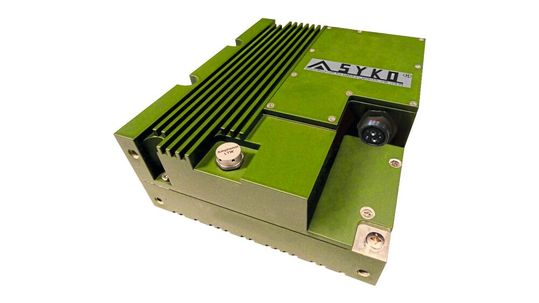
Figure 5: The RV model with improved control speed and zero load capability.
(Image: SYKO)
Other applications include submarine on-board electrical systems with static high-voltage voltages of 220 to 440 VDC, which are sometimes subject to severe dynamic fluctuations of up to 1,600 V. Converters with outputs of up to 5 kW are used here, which can switch between current and voltage operation. Smaller systems - such as a 24 V/500 W converter with IP67 protection - can also be cascaded to achieve higher outputs if required.
Such examples illustrate that development does not rely solely on standard solutions, but often requires customer-specific modifications. Digital control concepts and flexible interfaces help to implement requirements from specifications in a short space of time, while at the same time leaving scope for later adaptations, extensions and integration into complex overall systems.
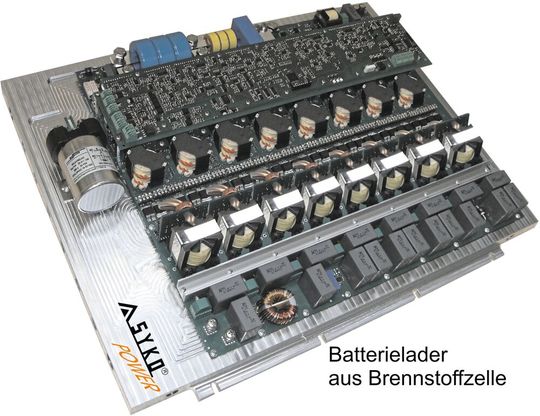
Figure 6: A powerful battery charger. Powered by a fuel cell with 50 to 100 Vthi, it supplies a direct voltage of between 200 and 600 V for charging high-voltage lithium-ion batteries.
(Image: SYKO)
In practice, the wide range of system components available means that project engineers can often fall back on existing solutions that only need to be adapted electrically or mechanically. This approach enables manufacturers such as Syko to implement even complex specifications in a comparatively short time.
In 2024, however, the downside of high demand also became apparent: the order backlog doubled, which placed a heavy burden on the organization. From purchasing materials to hiring staff and investing in infrastructure. Stocks and semi-finished products increased significantly, tying up capital in the short term. This phenomenon illustrates a challenge that many medium-sized companies are currently facing: They are considered economically sound, but can become temporarily illiquid due to sudden peaks in orders. There are also structural factors. Since the coronavirus pandemic, for example, changes in working habits, higher sickness rates and increased production costs have had a dampening effect. At the same time, investments in new capacities, such as the planned construction of a three-storey production building, are continuing. The balancing act between expansion and cost pressure is therefore becoming particularly acute. (mr)



:quality(80)/p7i.vogel.de/wcms/b2/db/b2db599d38480ee76cb0632c3c5ac968/sentinel3c-sadeploymentthalesaleniaspace-alban-pichon-3-1680x944v1.jpeg "(Source: Thales Alenia Space, A. Pichon)")
:quality(80)/p7i.vogel.de/wcms/82/79/8279289d94e17b34c49f305ef1421161/flight-2-liftoff-wide-c-isar-aerospace-1920x1079v1.jpeg "(Source: Isar Aerospace)")
:quality(80)/p7i.vogel.de/wcms/0b/46/0b46eaee6945014e71a15a3fa7340000/nigcomsat-2acthales-alenia-space-briot-0-1680x944v1.jpeg "(Source: Thales Alenia Space, E. Briot)")
:quality(80)/p7i.vogel.de/wcms/08/e7/08e7c441560d9a9662adf2aec7b564f3/0133497578v1.jpeg "A Virtus drone from Stark Defence is being deployed in the war in Ukraine. Now the Berlin-based company reports that it has secured a major contract from the German Armed Forces. (Image:S. Sorjevsky)")
:quality(80)/p7i.vogel.de/wcms/13/12/1312059ec82b1ed9e3df080350b29dc4/f46335bf-a581-4786-959f-4a0e9a74aed1-1671x940v1.png "Military radar architecture using distributed RF sensor nodes connected through optical fibre to central processing. (Source: KI-generiert / Gemini)")
:quality(80)/p7i.vogel.de/wcms/0a/14/0a1495d9b570ae32a5a7cc748b9a3c60/st-hannover-035-1920x1079v1-999x562v1.jpeg "Fastening technology you can experience first-hand—visitors to Schraubtec in Bochum (Germany) can see it for themselves at the Ruhr Congress on September 30, 2026. (Source: PHOTOVISION-DH GmbH)")
:quality(80)/p7i.vogel.de/wcms/cd/a9/cda92b173afa9d0b455d4f11b281c9ea/0094-to-image--capstone-cdr-1440x810v1.png "(Source: Terran Orbital)")
:quality(80)/p7i.vogel.de/wcms/e0/45/e045bc5414d7263fb308bdd501b5fcc1/0133113962v1.jpeg "The HSWL 354 is the transmission used, for example, in the Leopard 2 main battle tank. Renk manufactures this system and is now preparing to significantly increase its cycle time. As a result, Renk is placing greater emphasis on the military sector as a customer ... (Source: Renk)")
:quality(80)/p7i.vogel.de/wcms/1f/c2/1fc25ec2bd47a47b4617766e40033de2/image-2000-74f03b8e935a22580e24d2b05fe5ca3c-1920x1079v1.jpeg "The Airbus A310 ZERO-G stands ready for the 47th DLR parabolic flight campaign. It took place in Bordeaux from 7 to 18 September 2026. A total of twelve experiments from the fields of biology, physics, technology and materials science were on board. (Source: DLR (CC BY-NC-ND 3.0))")
:quality(80)/p7i.vogel.de/wcms/22/81/22812f686fd6ec1235f02392a3df56b9/34370ad9-163a-5941-9825-9c87a0e50000-1920x1079v1.png "Ariane 6 A64 flight VA267 with 32 satellites for Amazon LEO constellation, ready for launch at Europe's Spaceport in Kourou, French Guiana on 12 February 2026. (Source: ESA—M. Pédoussaut)")
:quality(80)/p7i.vogel.de/wcms/04/6b/046bda5de33193b13ebda873c3372868/iris2-1ceuropean-commission-1-1680x944v1.jpeg "(Source: European Commission)")
:quality(80)/p7i.vogel.de/wcms/d9/3c/d93c89ab8ed08d673065e1eac2e85aea/8cc82e51-a188-4e50-9432-ee715ab25586-1672x940v1.png "At Mach 10, Aerodynamics Becomes Materials Science (Source: )")
:quality(80)/p7i.vogel.de/wcms/cb/a2/cba2ecda891b2874327a30f69f773bdb/hexaforce-15-1920x1079v1.jpeg "(Source: Thales/Gauthier Chauffrut)")
:quality(80)/p7i.vogel.de/wcms/9d/8a/9d8addea8cc4e6f7a4793563ca397f2a/ai-im-milit-r-1672x940v1.png "(Source: KI-generiert / Gemini)")
:quality(80)/p7i.vogel.de/wcms/7f/5f/7f5fba2c729ec3aa256bf1a18d74529b/ai-chip-1672x940v1.png "(Source: KI-generiert / Gemini)")
:quality(80)/p7i.vogel.de/wcms/64/1b/641b6474b2a614cde7730c89ef2a3015/2026-09-09-rheinmetall-veroeffentlicht-battlesuite-schnittstellen-e8c18194-1225x690v1.jpeg "Rheinmetall’s Battlesuite provides a modular digital platform for connecting and integrating sensors, hardware and software components. (Source: Rheinmetall AG)")
:quality(80)/p7i.vogel.de/wcms/f1/c8/f1c88c768ba87dd2d71c708945c7df78/s960-applied-intuition04-960x640-960x540v1.jpeg "(Source: UK Government)")
:quality(80)/p7i.vogel.de/wcms/ef/1e/ef1eaddf8243b9c30cbfef17a4151def/aufmacherv1.jpeg "What works against drones—and what should be kept in mind when it comes to chain-based defence strategies? (Source: Mattheck)")
:quality(80)/p7i.vogel.de/wcms/b1/f0/b1f00d146f272acbef15ea82996259de/s960-halo-shield-2-960x540v1.png "Quell’s SkySpyke system in action (Source: UK Government)")
:quality(80)/p7i.vogel.de/wcms/2b/3d/2b3d42b7dc255aaaf5cadf57dab47d3b/43907b28dda9-sky-striker-demo-2-1600x899v1.webp "Diehl Defence and Elbit Systems demonstrate the capabilities of the SkyStriker loitering munition during a live demonstration. (Source: Diehl Defence)")
:quality(80)/p7i.vogel.de/wcms/90/a8/90a849f0023f11d1eb642eb4751a0321/bild2-h-c3-a4nel-ict-20truck-20and-20trailer-20parts-4320x2429v1.jpeg "Product information is visible at all times and retrieval of items
is confirmed by employees directly on the display of the Hänel MP 14 N
controller. (Source: René Marks)")
:quality(80)/p7i.vogel.de/wcms/4e/ca/4ecaa39f247490eded591b652c33aee3/thilmann-hcp-web-20kleiner-20ausschnitt-1442x811v1.jpeg "Entering the defence market can be challenging for start-ups, says HCP Sense CEO Ansgar Thilmann. (Picture: HCP Sense)")
:quality(80)/p7i.vogel.de/wcms/7a/51/7a511b80041d3f1335f3a5aa56fe75da/delivery-7022432-1280-1280x720v1.png "(Source: Mohamed_hassan)")
:quality(80)/p7i.vogel.de/wcms/f9/2f/f92f1ef8c739c34c70d99f7b0997621b/stra007-20--20cover-20image-5472x3076v1.jpeg "(Source: Stratasys)")
:quality(80)/p7i.vogel.de/wcms/ec/a9/eca9062ccbe4b042f8515846340410d8/aerospace-and-defence-stairways-platforms-and-much-morev1.jpeg "Modular constructions enable flexible modification. That applies to larger structures such as stairways and platforms, too. And that means aerospace and defence companies can reconfigure their maintenance platforms fast (itemitem)")
:quality(80)/p7i.vogel.de/wcms/30/2a/302a7b5723ad38fbde812fd3a468ad04/safety-on-stairways-in-industry-key-considerationsv1.jpeg "Stairways and platforms are used widely in maintenance and assembly areas in the aerospace and defence sectors. (Source: item)")
:quality(80)/p7i.vogel.de/wcms/f3/4e/f34ed744bb30817d3432c7ad522e6f30/engine-1v1.jpeg "Engineering with aluminium profiles really can be this easy – the item Engineeringtool and its smart functions help you save valuable time. (Source: item)")
:fill(fff,0)/p7i.vogel.de/companies/69/6d/696de2483d115/logo--fastems-rgb-horizontal.jpeg "logo--fastems-rgb-horizontal (Fastems)")
:fill(fff,0)/images.vogel.de/vogelonline/companyimg/84700/84735/65.jpg "logo_item_rgb_neu.jpg ()")
:quality(80)/p7i.vogel.de/wcms/da/1e/da1e41c3f300922704eb81704996c154/0129293948v1.jpeg "The EPC2366 (Image:Efficient Power Conversion)")
:quality(80)/p7i.vogel.de/wcms/7a/88/7a88fbc5900b17c847ba874496571439/0127804057v1.jpeg "Gallium nitride (GaN) solutions offer significant advantages for critical applications. (Image:EPC Space)")