Since the outbreak of the war in Ukraine—and even more so following China’s export restrictions in the context of its trade dispute with the United States—rare earths and Germany’s dependence on so-called “critical raw materials” have been the subject of intense debate. But what is actually being done to secure independent supply routes for these elements, which are not particularly rare and carry names such as lutetium, dysprosium, or europium, and of which Germany consumes around 5,000 tonnes per year? Not enough, says Bremen-based geoscientist Michael Bau, who has been researching the topic for decades.
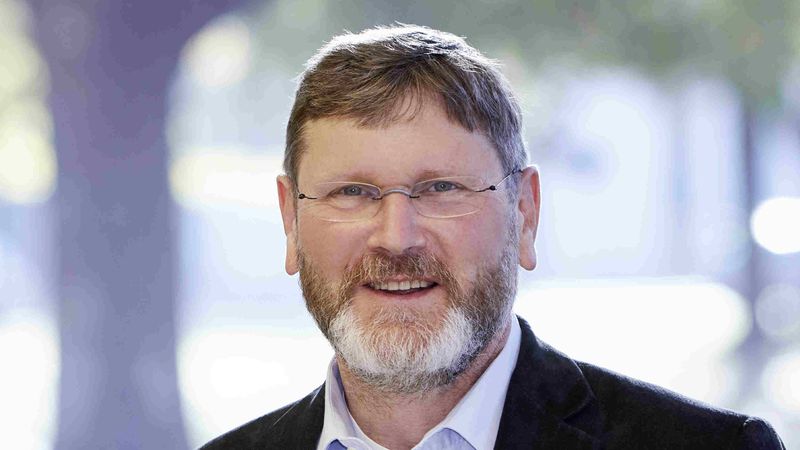
Professor Michael Bau conducts research and teaches at Constructor University in Bremen (Germany).
(Picture: Constructor University)
The 16 naturally occurring rare earth elements appear in various compounds and are usually found together in specific minerals. Promethium is considered the 17th element, but due to its rapid radioactive decay, it can only be produced artificially and does not occur in nature. Rare earths are used in a variety of applications in the defense industry, including lasers, night-vision equipment, and specialized steels.
Professor Bau, is Germany really as dependent on China as is often claimed?
“That depends on the raw material. China is not always the country we rely on. But when it comes to rare earths—and also other critical raw materials such as gallium, magnesium, or graphite—yes, we are almost completely dependent on China. Interestingly, since the war began and sanctions were imposed on Russia, hardly anyone talks about platinum group metals like palladium, which used to be supplied to us in large quantities from Russian mines. One can only speculate whether deliveries are still continuing. I would be surprised if South Africa, our main supplier of platinum group elements, had been able to replace Russia’s 40 percent share of palladium at short notice.”
Prices for many rare earth metals have risen sharply in recent years. Is that a cause for concern?
“For industry, this is usually not a dramatic issue. Even though prices have increased significantly, the quantities required are so small that they rarely play a decisive role in overall production costs.”
Where do rare earths play a role in the defense sector?
“Many applications are not publicly known. Access to information is limited. Germanium, for example, is needed for infrared technologies such as night-vision devices; gallium is essential for chip manufacturing. Permanent magnets—used in electric motors and generators—are the most frequently cited example. Some rare earths are also used in laser systems, an area in which the defense industry is developing alternatives to conventional artillery. But details are rarely disclosed. These materials are critical, yet the quantities involved are small—often just 50, 90, or 150 kilograms per order. And they are not always traded on the London Metal Exchange; sometimes procurement still takes place via personal networks, phone calls, and even faxes.”
Why is Germany 90 percent dependant on China?
“Raw materials simply aren’t a popular topic in Germany. Public interest focuses more on environmental damage linked to extraction than on exploration and production. This starts at school, where geography has largely shifted toward social sciences and chemistry teaching is declining. At universities, student numbers in the geosciences are falling sharply—despite climate change and the raw materials crisis. For a long time, the media covered raw materials mainly in connection with accidents or environmental disasters. As a result, there is little public awareness.
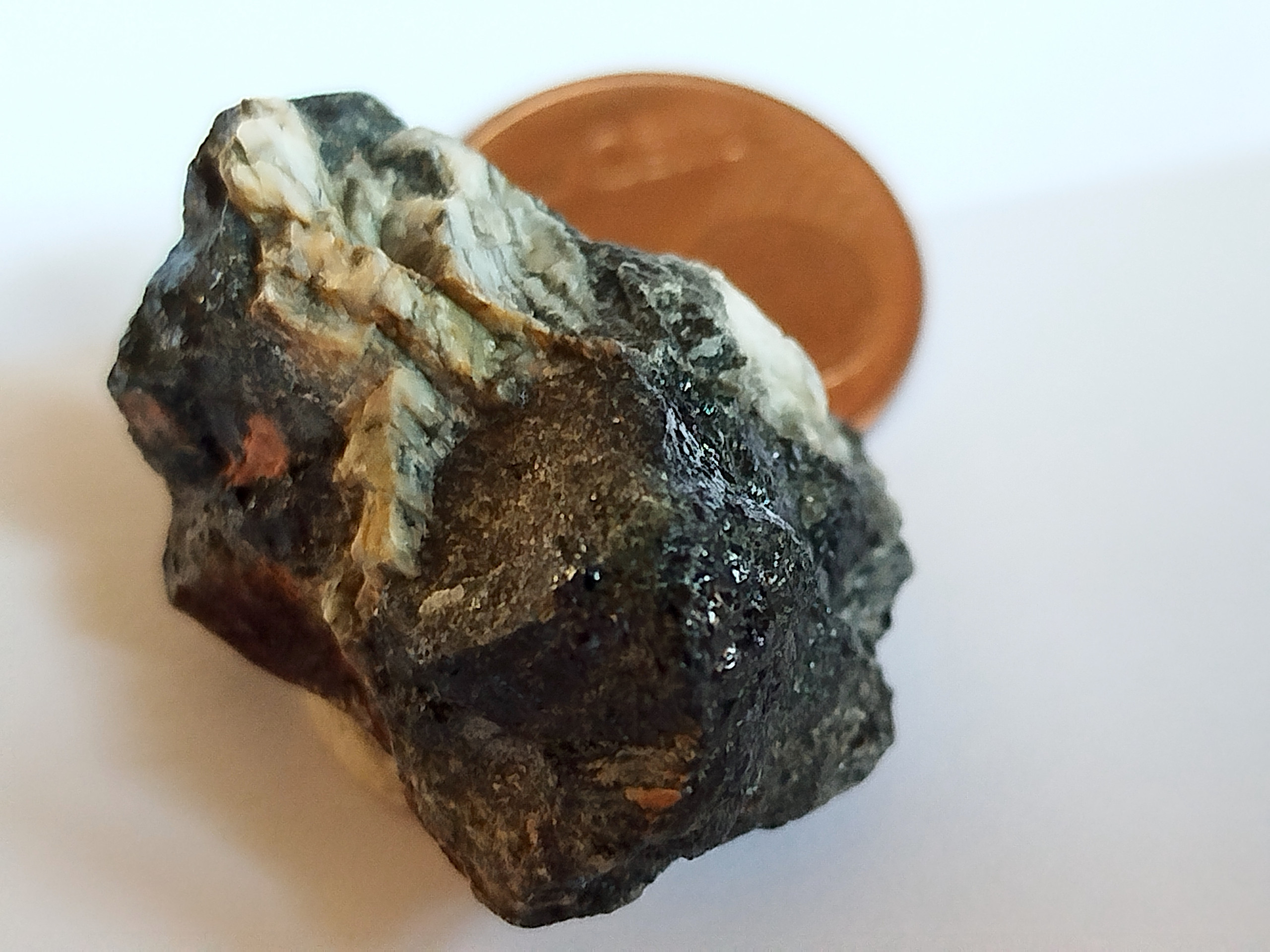
The black material in the photo shows the mineral gadolinite from a quarry in Ytterby, Sweden. The white mineral is feldspar. Gadolinite contains all 16 naturally occurring rare earth elements. Ytterby gave its name to ytterbium, yttrium and erbium, all rare earths. Gadolinite was first described in 1800 by the German chemist Martin Heinrich Klaproth.
(Picture: Michael Bau)
Can you specify this?
„Take fluorspar, for example, which is essential for fluorine production. Public debate tends to focus almost exclusively on PFAS chemicals and their harmful effects, even though these represent only a small fraction of fluorine-based production. Hardly anyone asks where the enormous amounts of copper needed for the energy transition are supposed to come from. We prefer to leave exploration and mining to others and keep our own hands clean. To put it bluntly: convenience and hypocrisy are the real problems. Producing raw materials under our environmental standards would be far better for the planet than what happens in many supplier countries. But industry, too, relied entirely on the market and was unwilling to invest in developing new sources. That should have been part of German foreign policy. Otherwise, sooner or later, you pay the price—as we are now.”
What does that look like in practice?
“There are many potential deposits around the world that have been explored with German involvement. Reports are written—but nothing follows. Other countries take a different approach. France, the UK, and the Netherlands actively use their ties to former colonies. Students from those countries study geosciences, chemistry, or metallurgy at European universities on scholarships. When they later return home and build careers, those academic networks facilitate cooperation, mine development, and raw material production.”
What should German policymakers do differently?
“It’s clear that German foreign policy has failed to secure a diversified and resilient raw materials supply. Lessons must be learned. Germany should leverage its strong ties with Latin America and Africa—countries such as Namibia or Tanzania, for example. Today, engaging in raw material projects has nothing to do with colonialism. We should be aware of our history, but constant self-reproach doesn’t help. What’s needed is realism and long-term planning. Instead, policymaking is often dominated by bureaucratic thinking rather than a pragmatic, science-based strategy for securing resources.”
If countries like France and the UK are more proactive, isn’t there a risk Germany will simply rely on them instead?
“That risk certainly exists. If the European Union functioned as a fully integrated federal state, this might even be reasonable. But as national interests have regained prominence in many EU countries, it is questionable whether it is wise to rely entirely on others when it comes to something as sensitive as raw material security.”
Rare earths aren’t rare in geological terms. Where do we find them?
“They occur in virtually all natural materials. The problem is that economically viable concentrations are usually associated with rock types that we simply don’t have in Germany. That means we need to think creatively: In phosphate fertilizer production, large quantities of phosphogypsum are generated as a by-product and stored in waste heaps that cause environmental problems in some regions. This phosphogypsum is a secondary raw material rich in rare earths and could be exploited under a minimum-waste approach. Alternatively, we could cooperate more closely with phosphate-producing countries such as Morocco, which also has conventional rare earth deposits that have already been explored with German support. Expanding those projects would benefit both sides.”
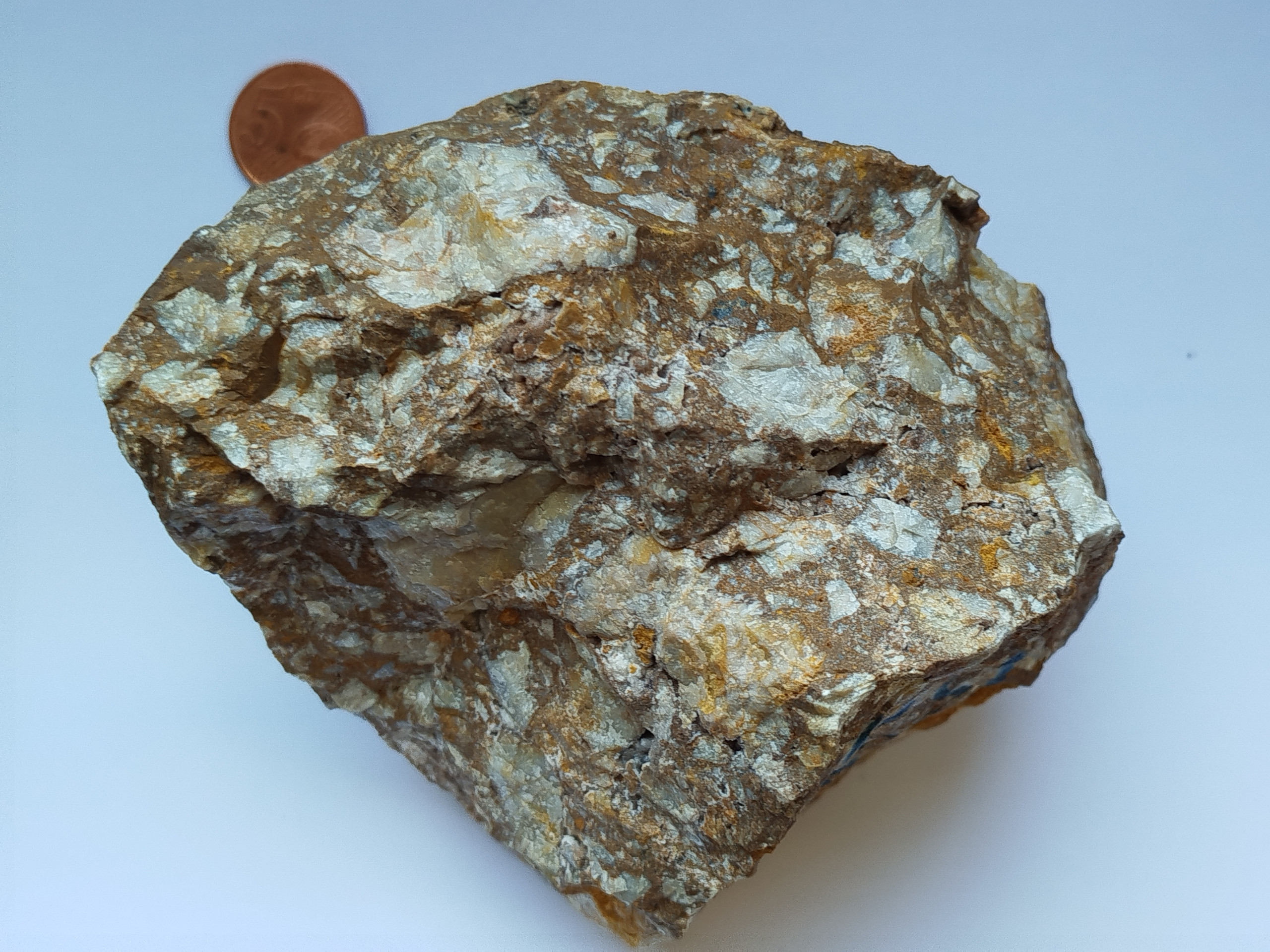
Rare earth ore from the mentioned deposit at Gleibat Lafhouda in southern Morocco: white Apatite in grey-brown Iron oxide.
(Picture: Michael Bau)
In 2022, a major rare earth deposit was reported in Sweden. Is that good news for Europe?
“The deposit near Kiruna is not really new—high rare earth concentrations there have been known for a long time. Kiruna is primarily important because of its vast iron ore deposits, which will require expansion in the near future. Highlighting rare earths certainly helps generate public support for continued mining. Sweden also invests heavily in research on critical raw materials, with a dedicated focus at Luleå University of Technology. The UK, the US, Canada, and Australia have been doing the same for years. That is exactly what Germany needs to do as well. And even if we never mine rare earths domestically, these metals enter our environment through products and can even end up in drinking water. We need the expertise to identify and manage these risks.”
How complex is rare earth extraction?
“Rare earths always occur as mixtures of minerals. Those richest in rare earths are separated first, followed by chemical processing to dissolve the metals from the ore. Because each deposit has a different mineral composition, there are no standard solutions. Some of the chemicals used are environmentally hazardous and must be handled carefully. In China, this has often been neglected, resulting in large contaminated waste ponds. That happened far from Germany and didn’t concern buyers here. If we want to do this ourselves, much higher standards would apply—which means more research and, of course, investors.”
How long would it take to reduce dependence on China?
“At the moment, I don’t even see sufficient momentum. Rare earth deposits in Morocco were identified years ago, and Morocco wanted to develop them jointly with Germany. But nothing has happened. We have known about our dependence on China for a long time. The previous government talked about ‘de-risking,’ but little followed.We need partnerships where both sides benefit economically. Africa offers real opportunities here. We can no longer assume unlimited access to global markets. Germany’s image abroad has also changed; it is no longer universally seen as a role model. If we truly believe in our innovative capacity, we must allow experts in the raw materials sector to put their ideas into practice—just as has happened in oil and gas, where unconventional deposits are now crucial. We need the courage to think differently about rare earths and other critical raw materials—and, above all, to finally act.”
Date: 08.12.2025
Naturally, we always handle your personal data responsibly. Any personal data we receive from you is processed in accordance with applicable data protection legislation. For detailed information please see our privacy policy.
Consent to the use of data for promotional purposes
I hereby consent to Vogel Communications Group GmbH & Co. KG, Max-Planck-Str. 7-9, 97082 Würzburg including any affiliated companies according to §§ 15 et seq. AktG (hereafter: Vogel Communications Group) using my e-mail address to send editorial newsletters. A list of all affiliated companies can be found here
Newsletter content may include all products and services of any companies mentioned above, including for example specialist journals and books, events and fairs as well as event-related products and services, print and digital media offers and services such as additional (editorial) newsletters, raffles, lead campaigns, market research both online and offline, specialist webportals and e-learning offers. In case my personal telephone number has also been collected, it may be used for offers of aforementioned products, for services of the companies mentioned above, and market research purposes.
Additionally, my consent also includes the processing of my email address and telephone number for data matching for marketing purposes with select advertising partners such as LinkedIn, Google, and Meta. For this, Vogel Communications Group may transmit said data in hashed form to the advertising partners who then use said data to determine whether I am also a member of the mentioned advertising partner portals. Vogel Communications Group uses this feature for the purposes of re-targeting (up-selling, cross-selling, and customer loyalty), generating so-called look-alike audiences for acquisition of new customers, and as basis for exclusion for on-going advertising campaigns. Further information can be found in section “data matching for marketing purposes”.
In case I access protected data on Internet portals of Vogel Communications Group including any affiliated companies according to §§ 15 et seq. AktG, I need to provide further data in order to register for the access to such content. In return for this free access to editorial content, my data may be used in accordance with this consent for the purposes stated here. This does not apply to data matching for marketing purposes.
Right of revocation
I understand that I can revoke my consent at will. My revocation does not change the lawfulness of data processing that was conducted based on my consent leading up to my revocation. One option to declare my revocation is to use the contact form found at https://contact.vogel.de. In case I no longer wish to receive certain newsletters, I have subscribed to, I can also click on the unsubscribe link included at the end of a newsletter. Further information regarding my right of revocation and the implementation of it as well as the consequences of my revocation can be found in the data protection declaration, section editorial newsletter.




:quality(80)/p7i.vogel.de/wcms/73/f3/73f3f51b62dce2ec1d5e176de332cd75/0130065977v1.jpeg "Out of focus? In Germany, the chimneys of the armaments companies are smoking because of the crises in the world, which are creating new threats that need to be guarded against. Billions are flowing. But eastern Germany feels neglected ... (Source: dpa)")
:quality(80)/p7i.vogel.de/wcms/f0/8f/f08f18ee2b837f61a6eb7e9f40555503/full-stack-alignment-1-1536x1151-1536x864v1.jpeg "(Image:Rocket Factory Augsburg)")
:quality(80)/p7i.vogel.de/wcms/59/e6/59e67b22da7931674b726eafc36381f8/elsa-m-including-astra-carta-seal-1920x1079v1.webp "(Image:Astroscale )")
:quality(80)/p7i.vogel.de/wcms/09/eb/09eb390bca7e654430ac8f81ac5b6bf6/0129830738v1.jpeg "Data centers in orbit are indeed a vision of the future, while underwater data centers are already being tested. (Image:Dall-E / AI-generated)")
:quality(80)/p7i.vogel.de/wcms/0c/70/0c701a79c1f183921b8ee9341ef61db8/0129694966v1.jpeg "Robonode's DVK Development Kit: This is available through Codico's sample shop. (Image:8DEVICES)")
:quality(80)/p7i.vogel.de/wcms/7c/12/7c123d3888ed3a37a83b0793be569f00/hon-aero-hguide-i700-imu-comp-view-2880x1440-1024x576v1.webp "(Source: Honeywell)")
:quality(80)/p7i.vogel.de/wcms/62/06/6206d30afc9c4f286f4ecf4cedf575c5/stark-20virtus-20side-1920x1079v1.jpeg "To be introduced into service with the Bundeswehr: The “Virtus” developed by Stark has a range of up to 100 km and is designed to engage targets on the battlefield. (Picture: STARK Defence)")
:quality(80)/p7i.vogel.de/wcms/4b/a3/4ba36ed2a3bbc5632aa56344ed9e9012/design-20ohne-20titel-1795x1009v1.png "High-performance ceramic components demonstrate the potential of advanced materials and additive manufacturing for precision industrial and aerospace applications. (Images:KYOCERA Europe GmbH)")
:quality(80)/p7i.vogel.de/wcms/c8/4c/c84cef4bf459f1280823827c3e3615c2/7cf414af-d41d-46ac-b22b-890f9f32d24c-2048x1151v1.jpeg "In Manching, Germany, Airbus is currently preparing two Valkyries for their first flight with its European mission system. The picture shows one of them. (Source: Airbus)")
:quality(80)/p7i.vogel.de/wcms/e3/d7/e3d7de9cfaac27f48ee6e162f9b309e9/0128899731v1.jpeg "Here, Lufthansa's first anniversary aircraft lands in Frankfurt. (Image:Lufthansa)")
:quality(80)/p7i.vogel.de/wcms/9b/18/9b180fe46f3a74b760711f65e4a647ac/0129936692v1.jpeg "Contrails mark the position of the wake vortex and enable targeted entry for scientific purposes. (Image:DLR)")
:quality(80)/p7i.vogel.de/wcms/5b/44/5b44acf63074c37ab8daaf1225a265cf/launch-vehicle-spectrum-at-andoya-space-c-isar-aerospace-2026-01-30-083741-ruml-4007x2254v1.jpeg "(Source: Isar Aerospace)")
:quality(80)/p7i.vogel.de/wcms/13/2b/132bb2831ae98c4c3bdd0ee2990ba1eb/bareways-20deck-20--20crisis-20coordination-20platformv1.jpeg "(Source: Bareways)")
:quality(80)/p7i.vogel.de/wcms/93/f1/93f1e4dba53b2c9589fab17a525df55e/adobestock-163119218-2480x1394v1.jpeg "(Source: Kernkonzept GmbH)")
:quality(80)/p7i.vogel.de/wcms/8d/76/8d764c984e44153da8f0dfa88cd6d75e/0129843677v1.jpeg "A successful drone attack on two data centers of the Amazon subsidiary AWS shows that the danger of drones is virtually unavoidable in modern warfare ... (Source: Cerberus)")
:quality(80)/p7i.vogel.de/wcms/6f/a7/6fa76be29e77ecb487a2dbbda36fc514/ki-generiert3a35a036-d062-432c-914c-d4fa050cf58f-1536x864v1.png "(Source: AI-generated)")
:quality(80)/p7i.vogel.de/wcms/d4/dc/d4dc9a59e1698ae295b1e6e64a29a55b/geralt-handshake-5768632-1280-1280x720v1.jpeg "Rheinmetall and Nooteboom Trailers are collaborating on the development and marketing of heavy equipment trailer systems designed for transporting modern tracked and wheeled military vehicles. (Image:Gerd Altmann from Pixabay)")
:quality(80)/p7i.vogel.de/wcms/22/54/2254d1e2667aff755e7aba0bcaf2eb42/0130021093v1.jpeg "Daimler Truck and Quantum Systems are jointly developing unmanned military vehicles. (Image:Quantum Systems)")
:quality(80)/p7i.vogel.de/wcms/0b/ba/0bbad1438344133fa65cdb70ac833967/2026-03-04-rheinmetall-steigt-bei-kroatischer-dok-ing-ein---media--06a35258--query-402x-114e90d2-1910x1075v1.jpeg "Through the majority acquisition of DOK-ING, Rheinmetall expands its expertise in unmanned ground systems and autonomous military support vehicles. (Image:Rheinmetall AG)")
:quality(80)/p7i.vogel.de/wcms/f9/2f/f92f1ef8c739c34c70d99f7b0997621b/stra007-20--20cover-20image-5472x3076v1.jpeg "(Source: Stratasys)")
:quality(80)/p7i.vogel.de/wcms/5e/18/5e184e4961f190c86a1ea3227104cab5/26pm03-20kompakte-20l-c3-b6sungen-20f-c3-bcr-20luft--20und-20raumfahrt-202-2362x1329v1.jpeg "(Picture: Keysight)")
:quality(80)/p7i.vogel.de/wcms/67/4c/674c54baa745be497cecb716826af339/stahlwille-hero-1807x1016v1.jpeg "A new modular tool solution designed for safety, precision, and mobility in aviation maintenance. (Source: STAHLWILLE)")
:quality(80)/p7i.vogel.de/wcms/0d/01/0d01a051ba894332a8091e3a3f9394e1/hytorc-defense-solutions-boxersatz-1899x1068v1.jpeg "HYTORC’s Defence Solutions toolkit, proven on the GTK Boxer, enables safe, traceable fastening of critical components across multiple Bundeswehr platforms. (Source: Image: HYTORC)")
:fill(fff,0)/p7i.vogel.de/companies/69/6d/696de2483d115/logo--fastems-rgb-horizontal.jpeg "logo--fastems-rgb-horizontal (Fastems)")
:fill(fff,0)/images.vogel.de/vogelonline/companyimg/84700/84735/65.jpg "logo_item_rgb_neu.jpg ()")
:quality(80)/p7i.vogel.de/wcms/2a/19/2a197f1fff4b1f93cf3d670e54701dea/0128524691v1.jpeg "A prerequisite for the challenge was a robot that can process at least 15 kg of lunar rock, weighs a maximum of 60 kg, and kicks up as little dust as possible during operation. (Image:FZI)")
:quality(80)/p7i.vogel.de/wcms/7a/8b/7a8bb2bd0b936077fab324ff13ff9322/just-20imagine-20--20thomas-20benz-3648x2053v1.jpeg "At the Bundeswehr University Munich, Prof. Dieter Gerling researches and teaches in the field of alternative electric powertrains. (Source: just imagine - Thomas Benz)")