In an era of rapidly changing geopolitical conditions, supply chain resilience has become a decisive factor in system design.
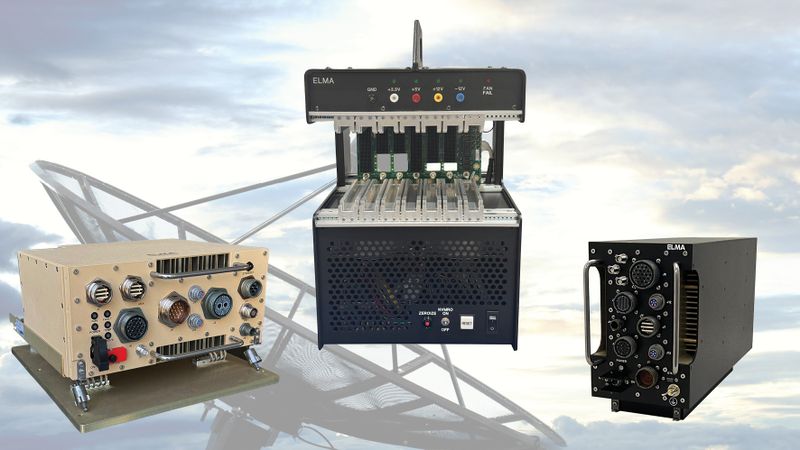
SOSA systems ‘Made by Elma’—With a high proportion of in-house design and manufacturing, Elma Electronic makes a key contribution to the physical and technological resilience of Europe’s supply chains.
(Image: Elma Electronic GmbH)
The defence industry faces a particular challenge when planning new applications: in a world where geopolitical conditions change in ever shorter cycles, the question of supply security becomes the key factor behind every technical decision. Yet projects often span a decade or more from initial concept to full production readiness. This makes the choice of system architecture especially critical.Today, two standards dominate the discussion: OpenVPX, which has been established for more than a decade, and the Sensor Open Systems Architecture (SOSA)—a comparatively young standard with strong ambitions.
At the core, two key dimensions must be considered: a physical dimension, which concerns the stability of supply chains, and a regulatory dimension, which determines sovereignty over standards and export regulations.
Physical Security: Supply Chains as the Foundation
OpenVPX is firmly established in the market and is regarded as the benchmark when hardware is required to offer maximum robustness. Over the years, it has evolved into a mature architecture whose entire chain can be covered by European suppliers—from the enclosure and backplane to the connectors. Even complex components such as processors or memory may originate from international manufacturers, yet multiple sourcing options across different world regions typically ensure availability, even under challenging scenarios. This reduces the risk of project standstills due to single-point bottlenecks. For engineers, OpenVPX already offers a high degree of planning reliability.
The situation with SOSA is somewhat different. While the architecture is based on VPX, it introduces its own interfaces and profiles, which are only gradually becoming widely available in European manufacturing. Although the key components are technically in place, a fully developed value chain within Europe has yet to be established. Nevertheless, European manufacturers are showing confidence: the experience gained with OpenVPX has demonstrated that complex architectures can be built up and secured sustainably under European control. It is therefore likely that SOSA, too, will develop robust European supply chains in the medium term – though at present, this process remains in progress.
Regulatory Security: Sovereignty Over Standards
Another decisive distinction lies in the origin of the standards themselves. OpenVPX was developed from the outset as an international standard, with both European and American companies actively participating. The specifications are defined under the VITA organisation, which has long benefited from European contributions. In countries such as France, the United Kingdom, and Germany, specific interpretations have been established that make it possible to distinguish VPX-based systems clearly from US export controls. This ITAR-free status allows components and systems to move freely within Europe and to be integrated into international programmes without licensing obligations.
SOSA, on the other hand, originated as an American initiative and follows specifications strongly influenced by the US Department of Defence. For the European defence industry, this means that projects can only be planned independently and over the long term if a clearly ITAR-free interpretation of SOSA is also developed. Initial approaches to this are emerging: European manufacturers are working to define profiles that remain SOSA-compliant while being independent of US export control. However, this process is still in its early stages.
Conclusion: Balancing Opportunities and Risks
When planning new applications, engineers must weigh the risks associated with both dimensions. OpenVPX today offers a proven architecture that is fully supported by European supply chains and backed by an established regulatory framework ensuring ITAR-free operation. Those who choose OpenVPX can plan with a high level of confidence.
SOSA, meanwhile, offers the prospect of a modern, profile-based architecture but comes with greater uncertainty. Its physical supply chain is still being developed, and on the regulatory side, European interpretations are yet to be fully defined. For engineers, adopting SOSA therefore entails both opportunities and risks—opportunities in shaping a rising standard early on, and risks that call for active management through multi-sourcing strategies, close coordination with European partners, and continuous monitoring of regulatory developments.
Those who adopt SOSA today are also investing in the future viability of the European defence electronics industry—while accepting that the path towards full security is still being built. Over time, these risks will continue to diminish, especially since SOSA’s very goal is to promote the interchangeability of modules. Confidence in the European electronics sector is therefore well justified.
Date: 08.12.2025
Naturally, we always handle your personal data responsibly. Any personal data we receive from you is processed in accordance with applicable data protection legislation. For detailed information please see our privacy policy.
Consent to the use of data for promotional purposes
I hereby consent to Vogel Communications Group GmbH & Co. KG, Max-Planck-Str. 7-9, 97082 Würzburg including any affiliated companies according to §§ 15 et seq. AktG (hereafter: Vogel Communications Group) using my e-mail address to send editorial newsletters. A list of all affiliated companies can be found here
Newsletter content may include all products and services of any companies mentioned above, including for example specialist journals and books, events and fairs as well as event-related products and services, print and digital media offers and services such as additional (editorial) newsletters, raffles, lead campaigns, market research both online and offline, specialist webportals and e-learning offers. In case my personal telephone number has also been collected, it may be used for offers of aforementioned products, for services of the companies mentioned above, and market research purposes.
Additionally, my consent also includes the processing of my email address and telephone number for data matching for marketing purposes with select advertising partners such as LinkedIn, Google, and Meta. For this, Vogel Communications Group may transmit said data in hashed form to the advertising partners who then use said data to determine whether I am also a member of the mentioned advertising partner portals. Vogel Communications Group uses this feature for the purposes of re-targeting (up-selling, cross-selling, and customer loyalty), generating so-called look-alike audiences for acquisition of new customers, and as basis for exclusion for on-going advertising campaigns. Further information can be found in section “data matching for marketing purposes”.
In case I access protected data on Internet portals of Vogel Communications Group including any affiliated companies according to §§ 15 et seq. AktG, I need to provide further data in order to register for the access to such content. In return for this free access to editorial content, my data may be used in accordance with this consent for the purposes stated here. This does not apply to data matching for marketing purposes.
Right of revocation
I understand that I can revoke my consent at will. My revocation does not change the lawfulness of data processing that was conducted based on my consent leading up to my revocation. One option to declare my revocation is to use the contact form found at https://contact.vogel.de. In case I no longer wish to receive certain newsletters, I have subscribed to, I can also click on the unsubscribe link included at the end of a newsletter. Further information regarding my right of revocation and the implementation of it as well as the consequences of my revocation can be found in the data protection declaration, section editorial newsletter.



:quality(80)/p7i.vogel.de/wcms/5b/2c/5b2cceb9038883edfacb76a61fca350b/vw-os-4-25--28cropped-29-3136x1765v1.jpeg "VW Osnabrück: Following Rheinmetall, KNDS is now also interested in at least a partial takeover of the plant. One popular example for the shift from civilian to military production. (Picture: Wiki Commons)")
:quality(80)/p7i.vogel.de/wcms/ec/ee/ecee771dce48d9c693f8869da717ceeb/robertwaghorn-jet-2974131-4777x2687v1.jpeg "European allies intensify cooperation efforts to boost defence capabilities and ensure long-term security stability. (Source: Robert Waghorn on Pixabay)")
:quality(80)/p7i.vogel.de/wcms/be/0b/be0b550a4fc2724afeed0713f65e7675/spexer-anechoic-chamber-1280x720v1.png "(Source: Hensoldt AG)")
:quality(80)/p7i.vogel.de/wcms/6f/0f/6f0fc6e3348925946d77fa2339e53005/0130142731v1.jpeg "Heidelberger Druckmaschinen Aktiengesellschaft establishes a joint venture with Ondas. The aim is to provide and market effective drone defence systems in Europe and Ukraine. (Source: Ondas)")
:quality(80)/p7i.vogel.de/wcms/a2/66/a266453da44556de3d18a0976597a605/sintavia-press-release-image-31726-1333x750v1.jpeg "Scooped version of representative heat exchanger. (Source: Sintavia)")
:quality(80)/p7i.vogel.de/wcms/2e/15/2e15396bd28d5cc96f2c339a6b7bf1e8/l3harris-disco-1220-1217x684v1.jpeg "(Source: L3Harris Technologies)")
:quality(80)/p7i.vogel.de/wcms/0c/70/0c701a79c1f183921b8ee9341ef61db8/0129694966v1.jpeg "Robonode's DVK Development Kit: This is available through Codico's sample shop. (Image:8DEVICES)")
:quality(80)/p7i.vogel.de/wcms/7c/12/7c123d3888ed3a37a83b0793be569f00/hon-aero-hguide-i700-imu-comp-view-2880x1440-1024x576v1.webp "(Source: Honeywell)")
:quality(80)/p7i.vogel.de/wcms/b4/ae/b4ae65d3fb3903a13571d9ea3e61da8a/mock-up-vleo-def-1920x1079v1.jpeg "Illustration of the VLEO-DEF satellite in orbit (Source: EDA)")
:quality(80)/p7i.vogel.de/wcms/11/c8/11c8d30d75151329d2700176eb7a0383/0130110840v1.jpeg "Zenadrone, a subsidiary of Zenatec, is working on developing an operational low-cost drone as a disposable concept (symbol image). The first prototype already exists. In the future, it is intended to counter increasing enemy drone attacks without significant financial effort... (Source: Zenadrone)")
:quality(80)/p7i.vogel.de/wcms/c8/4c/c84cef4bf459f1280823827c3e3615c2/7cf414af-d41d-46ac-b22b-890f9f32d24c-2048x1151v1.jpeg "In Manching, Germany, Airbus is currently preparing two Valkyries for their first flight with its European mission system. The picture shows one of them. (Source: Airbus)")
:quality(80)/p7i.vogel.de/wcms/e3/d7/e3d7de9cfaac27f48ee6e162f9b309e9/0128899731v1.jpeg "Here, Lufthansa's first anniversary aircraft lands in Frankfurt. (Image:Lufthansa)")
:quality(80)/p7i.vogel.de/wcms/06/37/0637c7dd3fab9b00a8e96f98133cd1dc/260304-d-d0477-1005-5892x3317v1.png "A B-52H Stratofortress idles prior to taking off in support of Operation Epic Fury in March 2026. (Source: U.S. Air Force)")
:quality(80)/p7i.vogel.de/wcms/13/2b/132bb2831ae98c4c3bdd0ee2990ba1eb/bareways-20deck-20--20crisis-20coordination-20platformv1.jpeg "(Source: Bareways)")
:quality(80)/p7i.vogel.de/wcms/93/f1/93f1e4dba53b2c9589fab17a525df55e/adobestock-163119218-2480x1394v1.jpeg "(Source: Kernkonzept GmbH)")
:quality(80)/p7i.vogel.de/wcms/8d/76/8d764c984e44153da8f0dfa88cd6d75e/0129843677v1.jpeg "A successful drone attack on two data centers of the Amazon subsidiary AWS shows that the danger of drones is virtually unavoidable in modern warfare ... (Source: Cerberus)")
:quality(80)/p7i.vogel.de/wcms/14/d3/14d3e0847d222af54aa5ab625480507f/0130015022v1.jpeg "A German-French battle tank project was approved some time ago (symbol image). But a modern drive system is also needed for it. This is now being developed by Rolls-Royce Power Systems and ZF in the coming years... (Image:Rheinmetall)")
:quality(80)/p7i.vogel.de/wcms/bd/21/bd2191aab59c430b3c74a2be07120333/image-196-1294x728v1.png "(Image:SkyDefender © Thales)")
:quality(80)/p7i.vogel.de/wcms/d4/dc/d4dc9a59e1698ae295b1e6e64a29a55b/geralt-handshake-5768632-1280-1280x720v1.jpeg "Rheinmetall and Nooteboom Trailers are collaborating on the development and marketing of heavy equipment trailer systems designed for transporting modern tracked and wheeled military vehicles. (Image:Gerd Altmann from Pixabay)")
:quality(80)/p7i.vogel.de/wcms/22/54/2254d1e2667aff755e7aba0bcaf2eb42/0130021093v1.jpeg "Daimler Truck and Quantum Systems are jointly developing unmanned military vehicles. (Image:Quantum Systems)")
:quality(80)/p7i.vogel.de/wcms/f9/2f/f92f1ef8c739c34c70d99f7b0997621b/stra007-20--20cover-20image-5472x3076v1.jpeg "(Source: Stratasys)")
:quality(80)/p7i.vogel.de/wcms/5e/18/5e184e4961f190c86a1ea3227104cab5/26pm03-20kompakte-20l-c3-b6sungen-20f-c3-bcr-20luft--20und-20raumfahrt-202-2362x1329v1.jpeg "(Picture: Keysight)")
:quality(80)/p7i.vogel.de/wcms/67/4c/674c54baa745be497cecb716826af339/stahlwille-hero-1807x1016v1.jpeg "A new modular tool solution designed for safety, precision, and mobility in aviation maintenance. (Source: STAHLWILLE)")
:quality(80)/p7i.vogel.de/wcms/0d/01/0d01a051ba894332a8091e3a3f9394e1/hytorc-defense-solutions-boxersatz-1899x1068v1.jpeg "HYTORC’s Defence Solutions toolkit, proven on the GTK Boxer, enables safe, traceable fastening of critical components across multiple Bundeswehr platforms. (Source: Image: HYTORC)")
:quality(80)/p7i.vogel.de/wcms/f3/4e/f34ed744bb30817d3432c7ad522e6f30/engine-1v1.jpeg "Engineering with aluminium profiles really can be this easy – the item Engineeringtool and its smart functions help you save valuable time. (Source: item)")
:quality(80)/p7i.vogel.de/wcms/fb/8e/fb8e5ae2aa27bcf3e466815505ca4ff2/alumin-1v1.jpeg "The aluminium profile technology of the item Building Kit System has been used to build a huge variety of structures for decades. (Source: item)")
:quality(80)/p7i.vogel.de/wcms/be/84/be84bbede3e40b1101cd3efa35a6ffa0/overview-of-20work-bench-design-in-productionv1.jpeg "With modular work bench design, you can convert or extend a work bench with ease by changing or adding accessories. This means changes can be implemented quickly and cost-effectively, thus boosting quality and productivity. (Source: item)")
:fill(fff,0)/p7i.vogel.de/companies/64/fe/64fec73b1a2fb/logo-master-ggbbytimken-286blue.jpeg "logo-master-ggbbytimken-286blue (GGB)")
:fill(fff,0)/p7i.vogel.de/companies/69/6d/696de2483d115/logo--fastems-rgb-horizontal.jpeg "logo--fastems-rgb-horizontal (Fastems)")
:fill(fff,0)/images.vogel.de/vogelonline/companyimg/84700/84735/65.jpg "logo_item_rgb_neu.jpg ()")
:quality(80)/p7i.vogel.de/wcms/a6/fb/a6fbbe0699ae19b87d8585bcdd74e0be/0128919858v1.jpeg "A stunning view of a sleek airplane positioned in a modern hangar, illuminated by bright artificial lights, showcasing intricate details and the grandeur of aviation technology (Bild: © Adobe, Narongsak, KI-generiert / KI-generiert)")
:quality(80)/p7i.vogel.de/wcms/d4/16/d4161b40236d9c6fb8d017d8df831e4d/0127104981v1.jpeg "By complying with laws, technical standards, and certification processes, FACE and MOSA drive the development of open, maintainable, cost-efficient, and secure avionics systems. In military and civilian aviation, FACE represents a modular, open, and future-proof system development paradigm. (Image:freely licensed)")