How can current and power be measured precisely under extreme conditions? Discover why low-ohmic precision resistors with DLA and ESCC approval are indispensable in aerospace—and what innovations make the difference.
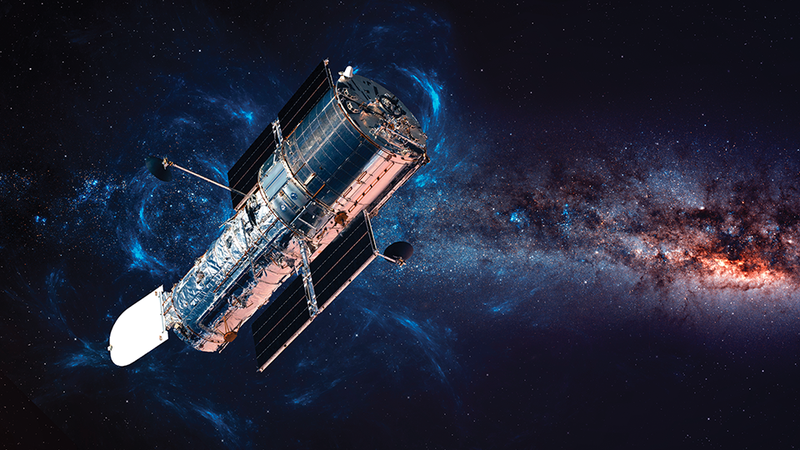
A space telescope in front of a cosmic nebula – over several years to decades, it provides groundbreaking insights into space. Measuring resistors from Isabellenhütte monitor the most important supply assemblies and ensure trouble-free operation under the most difficult conditions.
(Source: Isabellenhütte)
The DLA-approved series of precision power resistors
In aerospace and defense, reliability is non-negotiable—and it all starts with precise current measurement. Low-ohmic precision resistors are essential components for accurate current and power measurement, especially in battery-powered systems and motor drives. To ensure precise results, these resistors must be optimized not only for their electrical properties but also for the specific requirements of each end application.
Aerospace and defense-related standards and regulations for these components present unique challenges to their design and development. With these challenges of implementing current-sense resistors in aerospace applications, though, come opportunities for manufacturers of thermal alloys as well as power and precision resistors to innovate and solve.
Resistors can technically be used to measure current and, therefore, power by means of Ohm’s law. However, these current-sensing components will inevitably heat up as current passes through them. Supporting low resistance values will help with this self-heating issue, but there are far more considerations for these specialized components over standard, run-of-the-mill resistors.
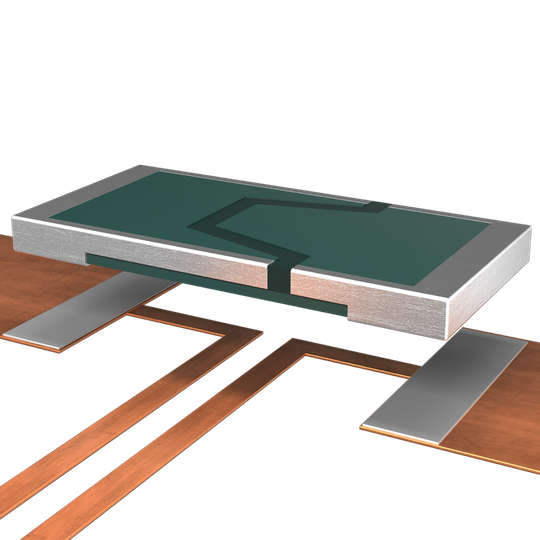
Low-ohmic chip shunt resistors offer a platform for current sensing when integrated in a circuit.
(Source: Isabellenhütte)
For one, precision is paramount. This means that the resistance value should not deviate significantly from the specified value over temperature and aging. The materials used in the low-ohmic precision resistors and the integrity of their overall construction should be optimized. Employing alloys with a low temperature coefficient of resistance (TCR) ensures that the natural expansion of their internal materials in the presence of heat is minimal, thereby maintaining a consistent resistance value and a high level of long-term stability.
Aerospace and defense considerations
The demands of the aerospace environment diverge significantly from those of terrestrial equipment. The radiation environment is entirely different because climbing to higher altitudes out of the Earth’s atmosphere leaves equipment susceptible to a spectrum of radiation, ranging from ultraviolet (UV) to electromagnetic (EM) radiation.
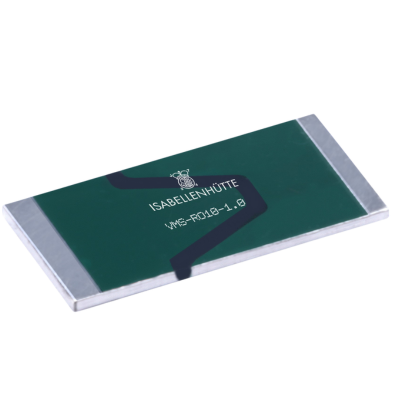
The 0.005 Ω to 1 Ω VMS precision and power resistor with a tin-lead contact plating for applicability in aerospace and defense.
(Source: Isabellenhütte)
The various orbits in which spacecraft are deployed also present their own unique radiation environments. The level of exposure will also vary based on mission life, time of deployment (for example, during a solar maximum or minimum), and the subsystems that must remain functional at different points during the mission.
For these reasons, and many others, designing space electronics or any non-terrestrial aircraft was often viewed as a niche field, relegated to state agencies and large corporations. NewSpace has redefined this trend, with smaller companies and research organizations launching small satellites with a limited mission life or developing drone technologies, which have more relaxed requirements for aerospace equipment in the quest for shorter lead times and cost-effectiveness. It is more common for radiation-tolerant components to be leveraged instead of their fully radiation-hardened counterparts.
The DLA and ESCC
The Defense and Logistics Agency (DLA) has long been the de facto organization in the United States for procuring space-grade components. Electronics components of specific manufacturers that have been audited by the DLA can then appear on their Qualified Products List (QPL), ensuring that the products have been pre-tested and meet all the qualification parameters required.
On the European side, the European Space Agency (ESA) has a subcommittee dedicated to qualifying space components known as European Space Components Coordination (ESCC). The agencies within ESCC will coordinate between space component vendors, procurement professionals, and international space agencies to formalize the standards for electrical, electronic and electro-mechanical (EEE) space components.
The VMx series of low-ohmic precision and power resistors has recently been DLA-approved and has already been deployed in an array of aerospace applications from spacecraft to commercial and military aircraft. Similarly, the SMx series is certified by the ESCC program. Both of these precision resistors feature tin-leaded terminals and undergo extensive additional testing, accompanied by qualifications that are reciprocal between space agencies, which enable customers to streamline their design and certification processes. As shown in Table 1, the VMx and SMx series are available in four footprints, with a continuous power rating of up to 3 W and a resistance as low as 3.3 mΩ.
Series
Wattage
Package size
Resistance range (mΩ)
TCR (ppm/K)
Specification
SMP-PW
1
2010
5 to 1K
50 to 100
ESCC 4001/027
SMS-PW
2
2512
5 to 1K
50 to 100
ESCC 4001/027
SMT-PW
3
2817
4 to 4.7K
50 to 100
ESCC 4001/027
SMV-PW
3
4723
3.3 to 1K
30 to 50
ESCC 4001/028
VMI-M
0.5
0805
10 to 50
30 to 50
DLA 25003
VMK-M
0.75
1206
10 to 470
20
DLA 25004
VMP-M
1.5
2010
5 to 1K
20
DLA 25005
VMS-M
2
2512
5 to 1K
20
DLA 25006
Specification of low-ohmic precision and power resistors approved for aerospace and military use. (Source: Isabellenhütte)
Space-specific failure mode for current sense resistors
Tin whiskering poses a serious problem in space applications, where pure tin parts and components made from tin alloys, such as those containing cadmium and zinc, will grow whisker-like tin tendrils. According to the DLA, tin whiskers tend to grow from alloys with a tin content of greater than 97% and can occur anytime from one day to years after manufacture, where conformal coatings will not prevent their formation.
While this phenomenon is not exclusive to space, it tends to form more rapidly at higher altitudes. The vacuum of space presents a potentially catastrophic failure: the current required to open a short circuit caused by a tin whisker fuse is on the order of a few amps, but the vaporized tin can initiate a plasma that can conduct hundreds of amps, causing metal vapor arcs. In current-sense applications, a tin whisker is another potentially lossy electrical path that could lead to inaccurate measurements or no measurement at all.
Tin whiskers tend to grow more rapidly in aircraft and spacecraft that operate at higher altitudes.
(Source: Isabellenhütte)
According to NASA, “there are reports of at least three tin-whisker-induced short circuits that resulted in complete failure of on-orbit commercial satellites.” Unfortunately, the role this conductor plays in modern electronics cannot be understated. Tin is a vital material for manufacturing solder, connectors, and plating all types of electronics equipment, so feasible solutions to this problem are necessary.
The DLA states, “alloys of 3% lead, by mass, have shown to inhibit the growth of tin whiskers.” For low-ohmic precision resistors, using a tin-lead (SnPb) plating on the contacts can effectively mitigate the formation of tin whiskers and maintain the reliability of the component in space applications.
Applications
The applications for precision current-sense resistors are numerous in the aerospace industry. A battery management system (BMS) utilizes low-ohmic precision resistors to monitor battery current accurately. In motor drives, drive inverters will convert the main DC rail to multi-phase AC to drive the motor. Precision resistors are necessary to measure the current directly in each phase.
Aerospace and defense equipment utilizes both batteries and motors extensively, calling for high reliability current-sense solutions. Satellites can typically come equipped with tens to hundreds of actuators and will invariably have battery packs to harness the abundant solar energy available in space. Manned drones, including eVTOLs, is a prolific technology that demands compact and lightweight solutions to maximize size, weight and power (SWaP).
The Isabellenhütte advantage
Space-grade components used in electronic equipment come with their own specific environmental and regulatory considerations. Manufacturers that undergo the relevant audits and approvals can be relied upon to function in aerospace applications. The VMx and SMx series of precision and power resistors offers a good long-term stability in aerospace use cases due to its low TCR and SnPb-plated contacts for higher reliability in aerospace and defense applications. To learn more about the VMx series of low-ohmic precision and power resistors, contact the experts at Isabellenhütte.
Date: 08.12.2025
Naturally, we always handle your personal data responsibly. Any personal data we receive from you is processed in accordance with applicable data protection legislation. For detailed information please see our privacy policy.
Consent to the use of data for promotional purposes
I hereby consent to Vogel Communications Group GmbH & Co. KG, Max-Planck-Str. 7-9, 97082 Würzburg including any affiliated companies according to §§ 15 et seq. AktG (hereafter: Vogel Communications Group) using my e-mail address to send editorial newsletters. A list of all affiliated companies can be found here
Newsletter content may include all products and services of any companies mentioned above, including for example specialist journals and books, events and fairs as well as event-related products and services, print and digital media offers and services such as additional (editorial) newsletters, raffles, lead campaigns, market research both online and offline, specialist webportals and e-learning offers. In case my personal telephone number has also been collected, it may be used for offers of aforementioned products, for services of the companies mentioned above, and market research purposes.
Additionally, my consent also includes the processing of my email address and telephone number for data matching for marketing purposes with select advertising partners such as LinkedIn, Google, and Meta. For this, Vogel Communications Group may transmit said data in hashed form to the advertising partners who then use said data to determine whether I am also a member of the mentioned advertising partner portals. Vogel Communications Group uses this feature for the purposes of re-targeting (up-selling, cross-selling, and customer loyalty), generating so-called look-alike audiences for acquisition of new customers, and as basis for exclusion for on-going advertising campaigns. Further information can be found in section “data matching for marketing purposes”.
In case I access protected data on Internet portals of Vogel Communications Group including any affiliated companies according to §§ 15 et seq. AktG, I need to provide further data in order to register for the access to such content. In return for this free access to editorial content, my data may be used in accordance with this consent for the purposes stated here. This does not apply to data matching for marketing purposes.
Right of revocation
I understand that I can revoke my consent at will. My revocation does not change the lawfulness of data processing that was conducted based on my consent leading up to my revocation. One option to declare my revocation is to use the contact form found at https://contact.vogel.de. In case I no longer wish to receive certain newsletters, I have subscribed to, I can also click on the unsubscribe link included at the end of a newsletter. Further information regarding my right of revocation and the implementation of it as well as the consequences of my revocation can be found in the data protection declaration, section editorial newsletter.




:quality(80)/p7i.vogel.de/wcms/be/0b/be0b550a4fc2724afeed0713f65e7675/spexer-anechoic-chamber-1280x720v1.png "(Source: Hensoldt AG)")
:quality(80)/p7i.vogel.de/wcms/6f/0f/6f0fc6e3348925946d77fa2339e53005/0130142731v1.jpeg "Heidelberger Druckmaschinen Aktiengesellschaft establishes a joint venture with Ondas. The aim is to provide and market effective drone defence systems in Europe and Ukraine. (Source: Ondas)")
:quality(80)/p7i.vogel.de/wcms/05/29/05295a4f758848ae6c027cc78947453c/17818f1a7b12-banner-format-970x546v1.jpeg "(Source: Diehl Defence)")
:quality(80)/p7i.vogel.de/wcms/44/2f/442f8206549c08b8fd79666b1e2c1096/suv-20wald-1536x864v1.png "(Source: AI-generated)")
:quality(80)/p7i.vogel.de/wcms/2e/15/2e15396bd28d5cc96f2c339a6b7bf1e8/l3harris-disco-1220-1217x684v1.jpeg "(Source: L3Harris Technologies)")
:quality(80)/p7i.vogel.de/wcms/0c/70/0c701a79c1f183921b8ee9341ef61db8/0129694966v1.jpeg "Robonode's DVK Development Kit: This is available through Codico's sample shop. (Image:8DEVICES)")
:quality(80)/p7i.vogel.de/wcms/7c/12/7c123d3888ed3a37a83b0793be569f00/hon-aero-hguide-i700-imu-comp-view-2880x1440-1024x576v1.webp "(Source: Honeywell)")
:quality(80)/p7i.vogel.de/wcms/62/06/6206d30afc9c4f286f4ecf4cedf575c5/stark-20virtus-20side-1920x1079v1.jpeg "To be introduced into service with the Bundeswehr: The “Virtus” developed by Stark has a range of up to 100 km and is designed to engage targets on the battlefield. (Picture: STARK Defence)")
:quality(80)/p7i.vogel.de/wcms/b4/ae/b4ae65d3fb3903a13571d9ea3e61da8a/mock-up-vleo-def-1920x1079v1.jpeg "Illustration of the VLEO-DEF satellite in orbit (Source: EDA)")
:quality(80)/p7i.vogel.de/wcms/11/c8/11c8d30d75151329d2700176eb7a0383/0130110840v1.jpeg "Zenadrone, a subsidiary of Zenatec, is working on developing an operational low-cost drone as a disposable concept (symbol image). The first prototype already exists. In the future, it is intended to counter increasing enemy drone attacks without significant financial effort... (Source: Zenadrone)")
:quality(80)/p7i.vogel.de/wcms/c8/4c/c84cef4bf459f1280823827c3e3615c2/7cf414af-d41d-46ac-b22b-890f9f32d24c-2048x1151v1.jpeg "In Manching, Germany, Airbus is currently preparing two Valkyries for their first flight with its European mission system. The picture shows one of them. (Source: Airbus)")
:quality(80)/p7i.vogel.de/wcms/e3/d7/e3d7de9cfaac27f48ee6e162f9b309e9/0128899731v1.jpeg "Here, Lufthansa's first anniversary aircraft lands in Frankfurt. (Image:Lufthansa)")
:quality(80)/p7i.vogel.de/wcms/06/37/0637c7dd3fab9b00a8e96f98133cd1dc/260304-d-d0477-1005-5892x3317v1.png "A B-52H Stratofortress idles prior to taking off in support of Operation Epic Fury in March 2026. (Source: U.S. Air Force)")
:quality(80)/p7i.vogel.de/wcms/13/2b/132bb2831ae98c4c3bdd0ee2990ba1eb/bareways-20deck-20--20crisis-20coordination-20platformv1.jpeg "(Source: Bareways)")
:quality(80)/p7i.vogel.de/wcms/93/f1/93f1e4dba53b2c9589fab17a525df55e/adobestock-163119218-2480x1394v1.jpeg "(Source: Kernkonzept GmbH)")
:quality(80)/p7i.vogel.de/wcms/8d/76/8d764c984e44153da8f0dfa88cd6d75e/0129843677v1.jpeg "A successful drone attack on two data centers of the Amazon subsidiary AWS shows that the danger of drones is virtually unavoidable in modern warfare ... (Source: Cerberus)")
:quality(80)/p7i.vogel.de/wcms/14/d3/14d3e0847d222af54aa5ab625480507f/0130015022v1.jpeg "A German-French battle tank project was approved some time ago (symbol image). But a modern drive system is also needed for it. This is now being developed by Rolls-Royce Power Systems and ZF in the coming years... (Image:Rheinmetall)")
:quality(80)/p7i.vogel.de/wcms/bd/21/bd2191aab59c430b3c74a2be07120333/image-196-1294x728v1.png "(Image:SkyDefender © Thales)")
:quality(80)/p7i.vogel.de/wcms/d4/dc/d4dc9a59e1698ae295b1e6e64a29a55b/geralt-handshake-5768632-1280-1280x720v1.jpeg "Rheinmetall and Nooteboom Trailers are collaborating on the development and marketing of heavy equipment trailer systems designed for transporting modern tracked and wheeled military vehicles. (Image:Gerd Altmann from Pixabay)")
:quality(80)/p7i.vogel.de/wcms/22/54/2254d1e2667aff755e7aba0bcaf2eb42/0130021093v1.jpeg "Daimler Truck and Quantum Systems are jointly developing unmanned military vehicles. (Image:Quantum Systems)")
:quality(80)/p7i.vogel.de/wcms/f9/2f/f92f1ef8c739c34c70d99f7b0997621b/stra007-20--20cover-20image-5472x3076v1.jpeg "(Source: Stratasys)")
:quality(80)/p7i.vogel.de/wcms/5e/18/5e184e4961f190c86a1ea3227104cab5/26pm03-20kompakte-20l-c3-b6sungen-20f-c3-bcr-20luft--20und-20raumfahrt-202-2362x1329v1.jpeg "(Picture: Keysight)")
:quality(80)/p7i.vogel.de/wcms/67/4c/674c54baa745be497cecb716826af339/stahlwille-hero-1807x1016v1.jpeg "A new modular tool solution designed for safety, precision, and mobility in aviation maintenance. (Source: STAHLWILLE)")
:quality(80)/p7i.vogel.de/wcms/0d/01/0d01a051ba894332a8091e3a3f9394e1/hytorc-defense-solutions-boxersatz-1899x1068v1.jpeg "HYTORC’s Defence Solutions toolkit, proven on the GTK Boxer, enables safe, traceable fastening of critical components across multiple Bundeswehr platforms. (Source: Image: HYTORC)")
:quality(80)/p7i.vogel.de/wcms/f3/4e/f34ed744bb30817d3432c7ad522e6f30/engine-1v1.jpeg "Engineering with aluminium profiles really can be this easy – the item Engineeringtool and its smart functions help you save valuable time. (Source: item)")
:quality(80)/p7i.vogel.de/wcms/fb/8e/fb8e5ae2aa27bcf3e466815505ca4ff2/alumin-1v1.jpeg "The aluminium profile technology of the item Building Kit System has been used to build a huge variety of structures for decades. (Source: item)")
:quality(80)/p7i.vogel.de/wcms/be/84/be84bbede3e40b1101cd3efa35a6ffa0/overview-of-20work-bench-design-in-productionv1.jpeg "With modular work bench design, you can convert or extend a work bench with ease by changing or adding accessories. This means changes can be implemented quickly and cost-effectively, thus boosting quality and productivity. (Source: item)")
:fill(fff,0)/p7i.vogel.de/companies/68/11/6811d429f1770/ihh-logo-2023-4c-nebeneinander.png "ihh-logo-2023-4c-nebeneinander (Isabellenhütte Heusler GmbH & Co. KG)")

:quality(80)/p7i.vogel.de/wcms/e2/34/e234e56f31ce44de622fb7ee925a904c/bild1-urheber-20kongsberg-1598x899v1.jpeg "bild1-urheber-20kongsberg-1598x899v1 (Source: Kongsberg)")
:quality(80)/p7i.vogel.de/wcms/bd/c5/bdc585ad8e8f17cc17231a22f1732a22/satellite-67718-1280-1280x719v1.jpeg "Connectors for space applications face their challenges, including shock loads and outgassing. (Bild: WikiImages // https://pixabay.com/photos/satellite-spacecraft-space-67718/)")