In a joint project, Mapal and the machine manufacturer Bavius developed and produced a prototype component for the aviation industry.
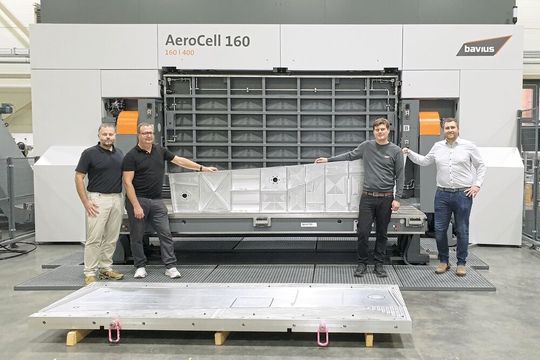
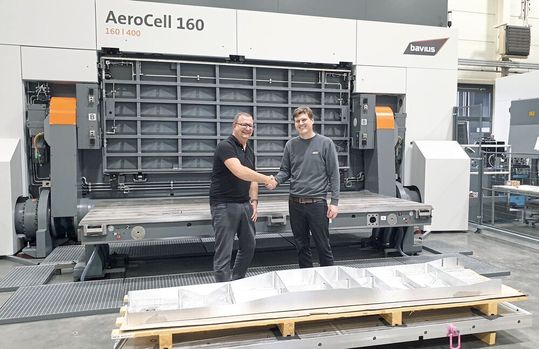
Proudly presenting the finished sample component in front of the "AeroCell 160 | 400" (from left): Jens Ilg (Business Development, Aerospace & Composites Mapal), Alexander Follenweider (Component Manager Aerospace & Composites Mapal), Stefan Diem (Application Technician Bavius), and Dominik Merz (Director Global Sales Bavius). In the foreground, the fixture used for clamping.
(Source: Mapal)
The roughly three by one meter aluminum component is modeled after a real rear spar from aircraft construction but has also been enhanced with numerous additional demanding applications. Alongside its complexity, the short machining time of ten hours is impressive, achieved through the productivity of the "Bavius AeroCell" and the specialised tools for aluminum machining from Mapal.
Bavius Technologie GmbH in Baienfurt (Germany) has specialised in high-speed volume machining of structural aluminum components, typically required in aerospace for wings and fuselage.
Components for satellites and rockets like the Ariane 6
Bavius (formerly Handtmann A-Punkt Automation) has been operating as an independent, family-run company since 2017 and focuses on two product lines: Profile machining centers (PBZ) and horizontal machining centers (HBZ) with the "AeroCell" series.
With approximately 120 employees, Bavius generates more than 80 percent of its revenue in the aerospace industry. As OEMs or suppliers, their customers manufacture components for commercial and military applications. Components for satellites or rockets like the Ariane 6 are also produced on the machines.
Everything made in Germany
Most of Bavius' machines are located in Europe, with other strong markets being North America and Asia. In the USA, the machine manufacturer operates its own subsidiary, but production for the global market takes place exclusively in Baienfurt, in two air-conditioned halls with a production area of around 10,000 square meters (approx. 107,600 sq ft).
140 kW spindle power and 30,000 rpm
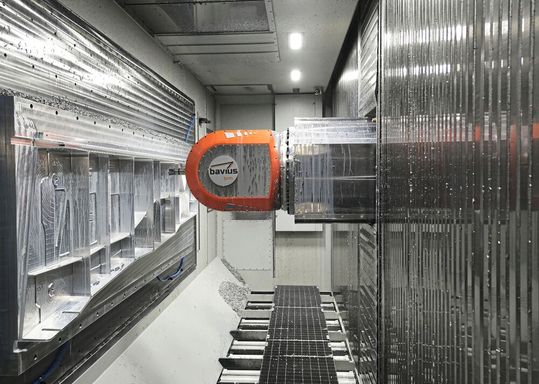
A look into the work area of the "Bavius AeroCell 160 | 400." Here, in the second clamping, the pockets are milled, and additional features are worked out.
(Source: Mapal)
A key strength of Bavius' five-axis machining centers is their exceptional dynamics, enabling high productivity during high-speed machining. To extract the maximum performance from the machines, Bavius manufactures its milling heads in-house. The flagship of the product line is the Bavius "AeroCell 160 I 400," featuring a spindle power of 140 kW and a maximum speed of 30,000 revolutions per minute. The 140 kW is already achieved at 18,000 revolutions, meaning the maximum power is available over a wide speed range.
"When we do something, we want to do it excellently, and with our 'AeroCell 160 | 400,' we are technologically leading worldwide," assures Dominik Merz, Director Global Sales at Bavius.
1 ton raw part—71 kg finished part
The rear spar was chosen as the prototype component because it fits perfectly on the machine, with its 1.6-meter table height and 4-meter width (approx. 13 ft). This rear spar is a typical structural component in the wings. Ribs run between the rear spar and the front spar, arranged perpendicular to the spars. The structural components define the geometry of the wing, with the outer skin riveted onto them. The finished component, made of aircraft-grade aluminum 7075, measures exactly 2977 x 748 mm (approx. 117 x 30 inches). Typical for aircraft parts is its flat shape, with a height of 138 mm (approx. 5 inches). From an initial weight of just over one ton, only 70.61 kg remains after machining—a ratio that is also common in the aerospace sector.
Variety of different applications integrated
For legal reasons alone, Bavius and Mapal could not use a real component from an aircraft manufacturer for machining. However, this simultaneously gave the team the freedom to use the design for a variety of other applications.
This demonstration object is far more complex than any real rear spar and also includes applications that may not necessarily be associated with this component but could be required in other parts. "A customer familiar with structural components who sees our part will recognise it and find features that are also present in their own components," explains Dominik Merz regarding this approach.
Five-axis machining: Convex radius of 9.5 meters
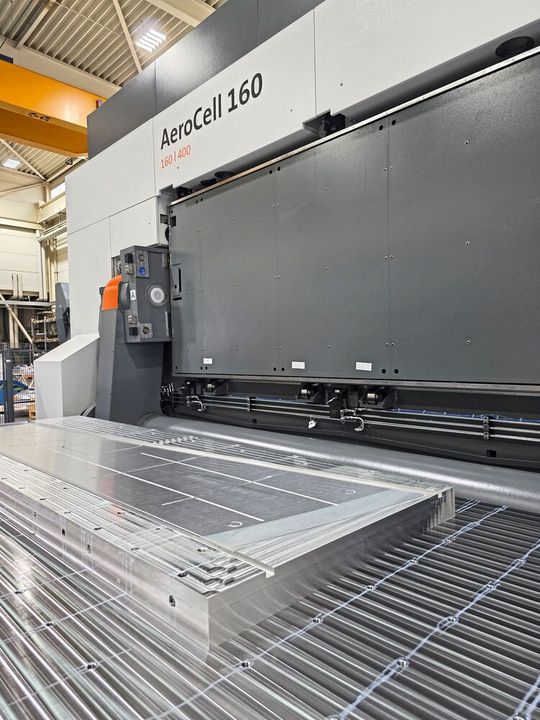
A special fixture was used for machining the rear spar in two clamping operations. Setup 1 was performed with low-clamping tension, while in Setup 2, vacuum technology ensured a secure hold.
(Source: Mapal)
The machining took place in Baienfurt in two clamping operations. Setup 1 was performed with low-clamping tension, while in Setup 2, vacuum technology ensured a secure hold. At first glance, the front side looks simpler than it actually is. The surface is not flat but bends slightly convex over a radius of 9.5 m (approx. 30 ft).
This means the component cannot simply be plan-milled but requires five-axis machining. For roughing and finishing, Mapal used the "NeoMill-Alu-QBig" with a 50 mm (approx. 1 inch) diameter and the "OptiMill-Alu-Wave" with a 25 mm (approx. 0.9 inches) diameter. The surface finish was completed with a custom PCD milling cutter.
Pockets in all shapes
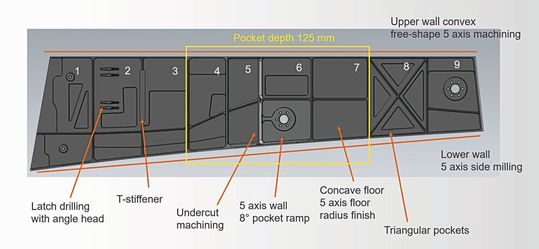
The machining of the backside was particularly challenging, as it is divided into nine different sections, each with specific applications.
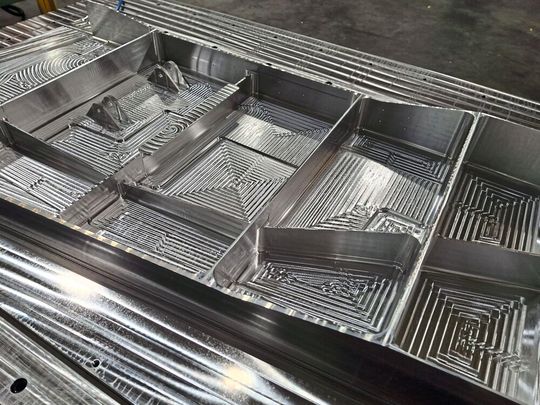
The challenges of the sample component primarily include pockets in various shapes. Some special features were also incorporated, such as brackets with holes or a T-stiffener (top left in the image).
(Source: Mapal)
Like every rear spar, the sample component features many pockets, but here designed in all conceivable shapes: rectangular, triangular, round, open, closed, some with slanted or curved bottoms. The ribs are very thin, and the walls are mostly slanted. The pockets are up to 137 mm (approx. 5 inches) deep.
Date: 08.12.2025
Naturally, we always handle your personal data responsibly. Any personal data we receive from you is processed in accordance with applicable data protection legislation. For detailed information please see our privacy policy.
Consent to the use of data for promotional purposes
I hereby consent to Vogel Communications Group GmbH & Co. KG, Max-Planck-Str. 7-9, 97082 Würzburg including any affiliated companies according to §§ 15 et seq. AktG (hereafter: Vogel Communications Group) using my e-mail address to send editorial newsletters. A list of all affiliated companies can be found here
Newsletter content may include all products and services of any companies mentioned above, including for example specialist journals and books, events and fairs as well as event-related products and services, print and digital media offers and services such as additional (editorial) newsletters, raffles, lead campaigns, market research both online and offline, specialist webportals and e-learning offers. In case my personal telephone number has also been collected, it may be used for offers of aforementioned products, for services of the companies mentioned above, and market research purposes.
Additionally, my consent also includes the processing of my email address and telephone number for data matching for marketing purposes with select advertising partners such as LinkedIn, Google, and Meta. For this, Vogel Communications Group may transmit said data in hashed form to the advertising partners who then use said data to determine whether I am also a member of the mentioned advertising partner portals. Vogel Communications Group uses this feature for the purposes of re-targeting (up-selling, cross-selling, and customer loyalty), generating so-called look-alike audiences for acquisition of new customers, and as basis for exclusion for on-going advertising campaigns. Further information can be found in section “data matching for marketing purposes”.
In case I access protected data on Internet portals of Vogel Communications Group including any affiliated companies according to §§ 15 et seq. AktG, I need to provide further data in order to register for the access to such content. In return for this free access to editorial content, my data may be used in accordance with this consent for the purposes stated here. This does not apply to data matching for marketing purposes.
Right of revocation
I understand that I can revoke my consent at will. My revocation does not change the lawfulness of data processing that was conducted based on my consent leading up to my revocation. One option to declare my revocation is to use the contact form found at https://contact.vogel.de. In case I no longer wish to receive certain newsletters, I have subscribed to, I can also click on the unsubscribe link included at the end of a newsletter. Further information regarding my right of revocation and the implementation of it as well as the consequences of my revocation can be found in the data protection declaration, section editorial newsletter.
After the preliminary machining by the "NeoMill-Alu-QBig," an "OptiMill-Alu-Wave" in various lengths was used for clearing the pockets. The semi-finishing was performed by a corner milling cutter specifically modified for aerospace applications. Thanks to its special geometry, the tool is particularly suitable for residual material machining in corners as well as for the subsequent finishing of floors and walls. The special core rise ensures optimal stability during the machining process. To efficiently machine all areas, the Mapal specialists used the modified corner milling cutter in various diameters and lengths.
Zigzag strategy in climb milling and conventional milling
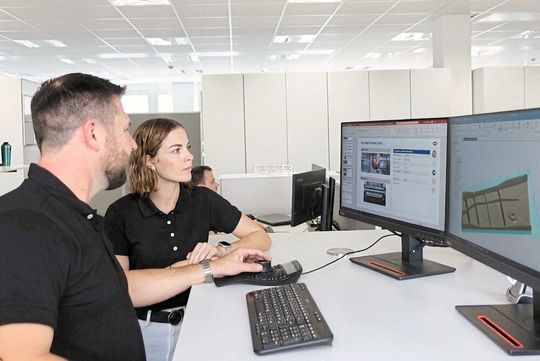
The starting point for the project was the customised programming and CAM simulation. The basis for a powerful and robust complete solution is the perfect interaction of machine, tool, and process. This ensures that every detail is optimised for performance and reliability, and the machining is designed for maximum productivity.
(Source: Mapal)
As efficiency was also considered in Mapal's programming, Components Manager Alexander Follenweider explains: "We work with a zigzag strategy in climb milling and conventional milling to save travel paths. This means the strategy is constantly switched during machining."
Despite high machining speeds, the aluminum must not be damaged as it changes its properties when overheated.
425 kg of aluminum chips in 55 minutes
The "OptiMill-Alu-Wave" was operated at 29,000 revolutions, a cutting depth of 48 mm (approx. 1.9 inches), and a feed rate of 12 m/min (approx. 40 ft/min) at its peak. The larger "NeoMill-Alu-QBig" achieved a feed rate of over 25 m/min (approx. 80 ft/min) at a cutting depth of 10 mm (approx. 0.4 inches).
In the first 55 minutes of machining the second clamping alone, 425 kg of aluminum was machined, with a peak chip volume of more than 14 l/min. "These are excellent values that we were able to achieve here—and we also produced very good surfaces," praises Stefan Diem, application technician at Bavius, regarding the results.
Nothing is standard
The various pockets are not the only challenges of the component: The holes on four brackets are only accessible with an angled head. Undercuts are also required in other areas. A typical T-stiffener for structural components is also present on the sample part and is machined with a custom PCD tool.
The various manufacturing operations that were integrated into the sample component from a machining perspective.
(Source: Mapal)
Drilling and reaming operations are also required in certain areas. "Nothing about our component is normal," comments Dominik Merz on the fact that hardly any right angles can be found. Such slanted designs, however, are quite typical for the aerospace sector.
A component manufactured in ten hours
For customer presentations at the involved partners and as an eye-catcher at trade fairs, five of these rear spars were manufactured in Baienfurt. The machining of one part takes a total of exactly 10 hours, with which the project participants are highly satisfied. "On other machines, such a component typically takes 20 to 30 hours," estimates Merz.
Advantages of horizontal machining
Traditionally, structural components are machined on vertical gantry machines with large tools, typically cutter heads with diameters of 125 mm. Feed rates and speeds remain low. A disadvantage of this method is that chips can accumulate and cause scratches. Additionally, heat is introduced into the component. Horizontal machining eliminates these issues. Combined with high-performance tools that allow for high cutting values, the dynamic "AeroCell 160 I 400" with its extreme acceleration opens up entirely new possibilities.
Close collaboration
Worked closely together as technicians from the two involved companies (from left): Alexander Follenweider (Component Manager Aerospace & Composites Mapal) and Stefan Diem (Application Technician Bavius).
(Source: Mapal)
Mapal and Bavius have maintained a very intensive collaboration for many years, benefiting both sides. When Mapal developed the "NeoMill-Alu-QBig" and the "OptiMill-Alu-Wave," prototypes of the new tools were already tested and further optimised in Baienfurt.
Require tools that push the machine to its limits
The tool manufacturer in Aalen does not have similarly powerful machines itself. On the other hand, Bavius also relies on innovative tools, as Stefan Diem explains: "For our premium machine, we need top tools from a provider like Mapal with its high-volume milling cutters that push our machine to its limits. Universal tools don't work for this; we don't gain any insights from them."
Two years ago, the partners demonstrated what the "AeroCell 160" can do in collaboration. During test operations under overload, the solid carbide cutter "OptiMill-Alu-Wave" achieved a chip volume of up to 20 l/min in full slot milling in standard aluminum. The currently achieved peak value of 12 l/min on a component made from the more tensile AL 7075 is equally impressive.
"I greatly value the collaboration with Mapal because we communicate openly and fairly, and we always get a solution presented," emphasises Stefan Diem. For Jens Ilg, Business Development Aerospace & Composites at Mapal, the joint success also has a personal aspect: "I also gain an optimal understanding of our own products when I have used them under real, required conditions. And I can then offer them to a customer with the corresponding recommendations."




:quality(80)/p7i.vogel.de/wcms/09/b2/09b28f3d5d213d97aaaf09d03b916cb2/0130239643v1.jpeg "Salzgitter intends to enter the armaments sector in a few months' time just as surely as this steel plate made of Secure 500 steel grade has passed the ballistic test - and is therefore also accepted by the Bundeswehr. (Source: Salzgitter)")
:quality(80)/p7i.vogel.de/wcms/51/60/51607c8acd8f35e6a09ca1e097811c30/design-20ohne-20titel-20-281-29-2000x1124v1.png "The MARTE programme brings together European industry and defence ministries to develop the next generation of main battle tank systems. (Source: Rheinmetall AG )")
:quality(80)/p7i.vogel.de/wcms/27/29/2729da9d77bbe3a97ef364594a4d7fa5/screenshot-202026-03-23-20134204-932x524v1.png "(Source: AI-generated)")
:quality(80)/p7i.vogel.de/wcms/d6/0d/d60dbd35064daafce089426fa50a27e2/0130207422v1.jpeg "The largest new construction project for the German Navy is stalling. It is years behind schedule. It involves several F126 frigates. Now the armaments group Rheinmetall is counting on taking over the project in order to finish it quickly ... (Source: Ladies Naval)")
:quality(80)/p7i.vogel.de/wcms/c7/82/c782ccb3861b875c55e3fd8aabb83a8e/0130228350v1.jpeg "Proudly presenting the finished sample component in front of the \"AeroCell 160 | 400\" (from left): Jens Ilg (Business Development, Aerospace & Composites Mapal), Alexander Follenweider (Component Manager Aerospace & Composites Mapal), Stefan Diem (Application Technician Bavius), and Dominik Merz (Director Global Sales Bavius). In the foreground, the fixture used for clamping. (Image:Mapal)")
:quality(80)/p7i.vogel.de/wcms/a3/66/a3666c01ec1a8b58da812faa80ab9f31/0130225449v1.jpeg "In 2004, the decision was made for the first \"Droop+Rein FOGS M40,\" a machine characterized by stability, precision, and flexibility. (Image:Starrag / Ralf Baumgarten)")
:quality(80)/p7i.vogel.de/wcms/b1/58/b158a5cc771fac7941d6bc3414becb5a/zeroe-20fully-20electric-20hydrogen-powered-20four-20pod-20aircraft-zeroe-turboprop-aib-vcity-16-9-5000x2811v1-999x562v1.jpeg "Airbus is working on the propulsion of short-haul aircraft using hydrogen and fuel cells as part of the “GENtwoPRO” project. (Source: Airbus SAS 2025)")
:quality(80)/p7i.vogel.de/wcms/2c/2c/2c2c63c23a1be1fe8259e3da28ebaff2/figure3-3864x2172v1.jpeg "(Source: AI-generated)")
:quality(80)/p7i.vogel.de/wcms/c2/5e/c25e38d6d559fc809a10bdceb15ebced/0129879115v1.jpeg "The twin of this sample is located on the outside of the ISS as part of the \"SESAME\" experiment. (Image:Empa)")
:quality(80)/p7i.vogel.de/wcms/3a/da/3adad9cc561900df0446f19c74a4d4df/0129938355v1.jpeg "Ganfeng Lithium, together with Geely subsidiary Aerofugia, has developed semi-solid batteries for eVTOLs. (Image:Aerofugia)")
:quality(80)/p7i.vogel.de/wcms/b4/ae/b4ae65d3fb3903a13571d9ea3e61da8a/mock-up-vleo-def-1920x1079v1.jpeg "Illustration of the VLEO-DEF satellite in orbit (Source: EDA)")
:quality(80)/p7i.vogel.de/wcms/74/81/748181a9121c4b65450f978e0e360950/comsol-astronauten-nasa--20-28cc-29-20image-20by-20nasa-20and-20in-20the-20public-20domain-20via-20wikimedia-20commons-4928x2770v1.jpeg "Astronauts working on the CDRA. (Source: NASA)")
:quality(80)/p7i.vogel.de/wcms/06/37/0637c7dd3fab9b00a8e96f98133cd1dc/260304-d-d0477-1005-5892x3317v1.png "A B-52H Stratofortress idles prior to taking off in support of Operation Epic Fury in March 2026. (Source: U.S. Air Force)")
:quality(80)/p7i.vogel.de/wcms/13/2b/132bb2831ae98c4c3bdd0ee2990ba1eb/bareways-20deck-20--20crisis-20coordination-20platformv1.jpeg "(Source: Bareways)")
:quality(80)/p7i.vogel.de/wcms/93/f1/93f1e4dba53b2c9589fab17a525df55e/adobestock-163119218-2480x1394v1.jpeg "(Source: Kernkonzept GmbH)")
:quality(80)/p7i.vogel.de/wcms/8d/76/8d764c984e44153da8f0dfa88cd6d75e/0129843677v1.jpeg "A successful drone attack on two data centers of the Amazon subsidiary AWS shows that the danger of drones is virtually unavoidable in modern warfare ... (Source: Cerberus)")
:quality(80)/p7i.vogel.de/wcms/84/63/8463d680832f3be7e5b3b5a189a0cac7/drohnen-1536x864v1.png "(Source: Elbit Systems Deutschland GmbH & Co. KG)")
:quality(80)/p7i.vogel.de/wcms/14/d3/14d3e0847d222af54aa5ab625480507f/0130015022v1.jpeg "A German-French battle tank project was approved some time ago (symbol image). But a modern drive system is also needed for it. This is now being developed by Rolls-Royce Power Systems and ZF in the coming years... (Image:Rheinmetall)")
:quality(80)/p7i.vogel.de/wcms/bd/21/bd2191aab59c430b3c74a2be07120333/image-196-1294x728v1.png "(Image:SkyDefender © Thales)")
:quality(80)/p7i.vogel.de/wcms/d4/dc/d4dc9a59e1698ae295b1e6e64a29a55b/geralt-handshake-5768632-1280-1280x720v1.jpeg "Rheinmetall and Nooteboom Trailers are collaborating on the development and marketing of heavy equipment trailer systems designed for transporting modern tracked and wheeled military vehicles. (Image:Gerd Altmann from Pixabay)")
:quality(80)/p7i.vogel.de/wcms/f9/2f/f92f1ef8c739c34c70d99f7b0997621b/stra007-20--20cover-20image-5472x3076v1.jpeg "(Source: Stratasys)")
:quality(80)/p7i.vogel.de/wcms/5e/18/5e184e4961f190c86a1ea3227104cab5/26pm03-20kompakte-20l-c3-b6sungen-20f-c3-bcr-20luft--20und-20raumfahrt-202-2362x1329v1.jpeg "(Picture: Keysight)")
:quality(80)/p7i.vogel.de/wcms/67/4c/674c54baa745be497cecb716826af339/stahlwille-hero-1807x1016v1.jpeg "A new modular tool solution designed for safety, precision, and mobility in aviation maintenance. (Source: STAHLWILLE)")
:quality(80)/p7i.vogel.de/wcms/0d/01/0d01a051ba894332a8091e3a3f9394e1/hytorc-defense-solutions-boxersatz-1899x1068v1.jpeg "HYTORC’s Defence Solutions toolkit, proven on the GTK Boxer, enables safe, traceable fastening of critical components across multiple Bundeswehr platforms. (Source: Image: HYTORC)")
:quality(80)/p7i.vogel.de/wcms/f3/4e/f34ed744bb30817d3432c7ad522e6f30/engine-1v1.jpeg "Engineering with aluminium profiles really can be this easy – the item Engineeringtool and its smart functions help you save valuable time. (Source: item)")
:quality(80)/p7i.vogel.de/wcms/fb/8e/fb8e5ae2aa27bcf3e466815505ca4ff2/alumin-1v1.jpeg "The aluminium profile technology of the item Building Kit System has been used to build a huge variety of structures for decades. (Source: item)")
:quality(80)/p7i.vogel.de/wcms/be/84/be84bbede3e40b1101cd3efa35a6ffa0/overview-of-20work-bench-design-in-productionv1.jpeg "With modular work bench design, you can convert or extend a work bench with ease by changing or adding accessories. This means changes can be implemented quickly and cost-effectively, thus boosting quality and productivity. (Source: item)")
:fill(fff,0)/p7i.vogel.de/companies/69/6d/696de2483d115/logo--fastems-rgb-horizontal.jpeg "logo--fastems-rgb-horizontal (Fastems)")
:fill(fff,0)/images.vogel.de/vogelonline/companyimg/84700/84735/65.jpg "logo_item_rgb_neu.jpg ()")
:quality(80)/p7i.vogel.de/wcms/13/59/1359dda7ea0184fb5c7903430eb55e17/0129708854v1.jpeg "A modified corner milling cutter from Mapal handles the fine work in the pockets.(Source: Mapal)")
:quality(80)/p7i.vogel.de/wcms/20/2b/202b2b699c1fcf672c719f8f6eff14e9/0129781067v1.jpeg "Proudly presenting the finished sample component in front of the \"AeroCell 160 | 400\" (from left): Jens Ilg (Business Development, Aerospace & Composites Mapal), Alexander Follenweider (Component Manager Aerospace & Composites Mapal), Stefan Diem (Application Technician Bavius), and Dominik Merz (Director Global Sales Bavius). In the foreground, the fixture used for clamping.(Source: Mapal)")
:quality(80)/p7i.vogel.de/wcms/bc/5c/bc5c442f55a3355fa0cecc1b869f6664/0129708873v1.jpeg "An HPR multi-flute reamer with a diameter of 40 H7 machines the 47 mm deep fitting bore. It operates with a cutting speed of 120 m/min and a feed rate of 0.2 mm per revolution.(Source: Mapal)")
:quality(80)/p7i.vogel.de/wcms/d1/fd/d1fd671390c3378778c010bbd426668f/0129709028v1.jpeg "A right-angle head is used for the holes in the brackets. A solid carbide step drill bores the brackets with diameters of 16 and 12 mm.(Source: Mapal)")
:quality(80)/p7i.vogel.de/wcms/d5/8a/d58aa4c789d793f59768eeab5a523dd6/0116023398v1.jpeg "For testing purposes, bavius has clamped a large aluminum plate in the machine. The milling of full slots determines the maximum possible cutting parameters. (Image:bavius)")
:quality(80)/p7i.vogel.de/wcms/a6/3f/a63f330d39ee8cc7757dd70474547808/img-1101-4032x2268v1.jpeg "Moyola Precision Engineering expands production with the first HBZ AeroCell 160 | 400 in the UK, enabling high-speed five-axis machining of large aluminium aerospace components. (Source: Moyola Precision Engineering, bavius technologie gmbh.)")