Metallic glasses are novel materials for applications in space, but also in medicine and the watch industry. In order to better understand their properties and facilitate their production, Empa researchers are conducting several experiments on board the International Space Station (ISS) in collaboration with the European Space Agency (ESA).
The twin of this sample is located on the outside of the ISS as part of the "SESAME" experiment.
(Image: Empa)
Metals are versatile materials and accompany us throughout our everyday lives, whether as large components or tiny parts in our electronic devices, as robust tools or as elegant jewelry. In most applications, metals have an ordered crystalline structure, which they almost always adopt when they solidify from the melt. But what happens when metal atoms do not arrange themselves in clear patterns? If certain alloys are cooled very quickly from the melt, they solidify in a "disordered" - amorphous - structure similar to that of glass. This is why such amorphous metals are also referred to as "metallic glasses".
Metallic glasses are something like the holy grail of metallurgy. They are as hard as quartz glass and their smooth surface is particularly resistant to scratches and corrosion. Unlike glass, however, metallic glasses are elastic and tend to return to their original shape after deformation more easily than ordinary metals. This makes them a sought-after material for applications in medicine and space technology.
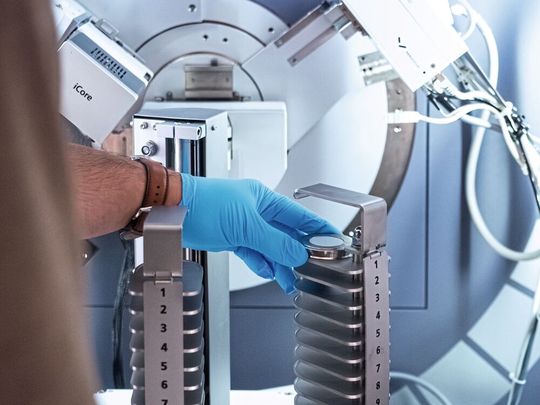
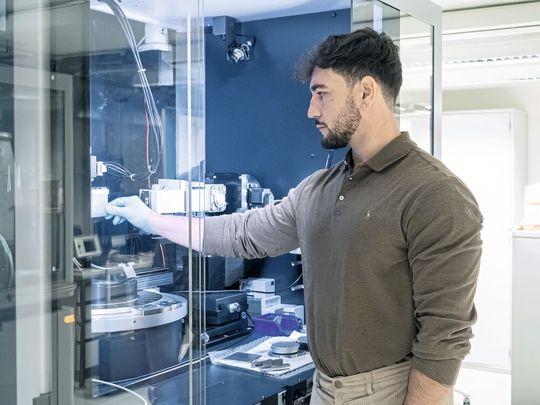
Empa researcher Damien Terebenec analyzes the structure of metallic glasses in an X-ray diffractometer.
(Image: Empa)
The tricky part, however, is the production of the metallic glasses, because most metals "prefer" to take on their natural crystalline form. "It is particularly difficult to retain the amorphous structure when manufacturing larger components," says Empa researcher Damien Terebenec, who is researching metallic glasses at the Empa Center for X-ray Analytics.
"We need a certain critical mass"
From environmental observation to the future moon base: innovative materials, processes and models are indispensable for space travel. Lorenz Herrmann, member of Empa's Directorate and Head of the "Advanced Materials and Surfaces" Department, explains in an interview how Empa's strengths can strengthen the Swiss space industry and why collaboration remains key.
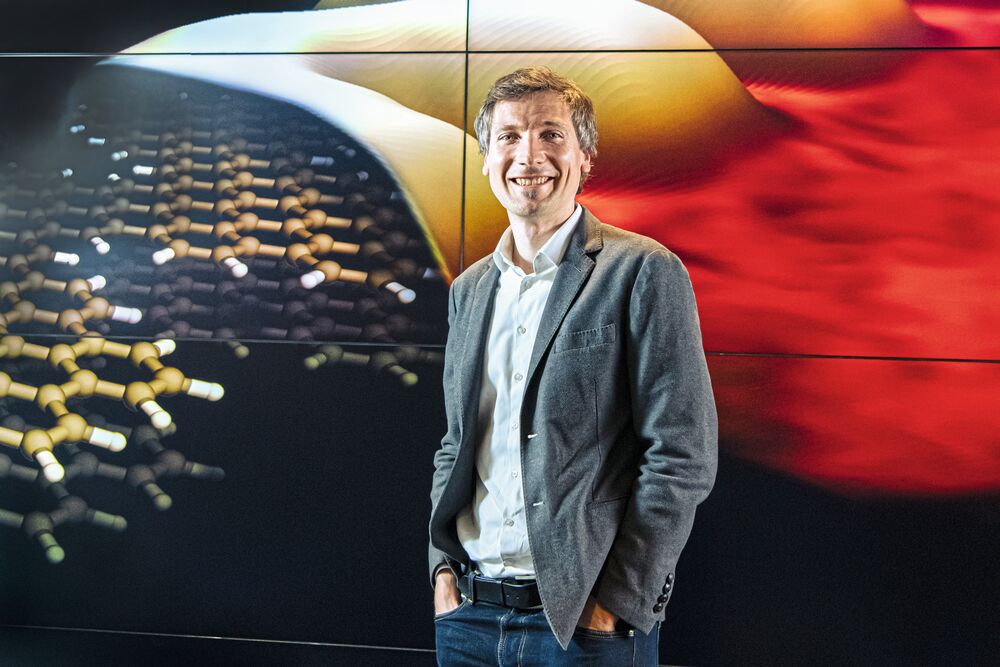
Lorenz Herrmann studied and completed his doctorate in physics at the University of Regensburg and the Ecole Normale Supérieure in Paris. In 2010, he joined the ABB Research Center in Dättwil, where he most recently headed the "Energy Technologies" department. Since August 2022, he has headed the Empa department "Modern Materials and Surfaces", and since January 2023 also the research focus "Nanoscale Materials and Technologies".
(Image:Marion Nitsch / Empa)
Mr Herrmann, what is Empa, as a materials research institute, doing in space?
Lorenz Herrmann: Firstly, we have long been leaders in environmental modelling and analysis. In other words, we combine the observation and measurement of certain gases from space – such as greenhouse gases or air pollutants – with highly sensitive environmental analysis and atmospheric modelling.
And secondly, Empa naturally stands for novel materials and innovative production technologies – in this context, specifically for the ‘Space Equipment’ application field, such as satellites, components for space stations and research equipment for scientific missions. And all of this must, of course, function maintenance-free for years under extreme conditions. That would simply be unthinkable without enormous expertise in materials science.
Linked to this, but taking it a step further, is materials research and development in microgravity, i.e. on the International Space Station (ISS) or during parabolic flights. This is very fundamental in nature, but has, of course, always been a core area of Empa’s work.
And last but not least, a look to the future: so-called ‘in-space manufacturing’, that is, the idea of establishing production capacities in space with the hope of being able to produce entirely different materials with very specific structures and properties under these highly specialised conditions in space, for example for quantum computers or chip manufacturing.
And perhaps taking it a step further: space agencies are once again increasingly pursuing the vision of building a station on the Moon. To do this, you have to make use of whatever is available there. And this naturally calls for an extremely circular approach – precisely a field of research that Empa is currently advancing, for example, in our NEST building laboratory. That would then be ‘Circular Construction’ on a whole new level.
As you can see, there are quite a few points of contact …
‘Space Technologies’ is a broad field. Where exactly can Empa’s research make a contribution?L. Herrmann: First and foremost, of course, as already mentioned, through our enormous expertise in materials, but also because we at Empa have a very good understanding of ‘translation’ – that is, how to ‘translate’ the latest scientific findings into practical applications. Take ‘in-space manufacturing’ as an example: as soon as the first ideas for specific applications emerge, we could develop suitable materials and production processes that function under these very specific conditions.
Empa has been a member of the ‘Center for Space and Aviation Switzerland and Liechtenstein’ (CSA) since June. What do you hope to gain from this partnership?
L. Herrmann: Our primary goal is to gain access to this new market: space technologies and applications. In future, Swiss companies will also be developing numerous new products and applications in this field, and we at Empa naturally want to be part of that through this alliance. And then, of course, a certain level of visibility vis-à-vis the ‘big players’ in the sector, namely the ESA and NASA. A certain critical mass is essential for this, which we hope to achieve through this partnership. Another major advantage for us is the proximity to the Innovation Park just round the corner here in Dübendorf.
Good point: at the end of July, the CSA, ‘Switzerland Innovation’ and ‘Space Florida’ agreed to establish a joint hub for research and innovation in space technology at the Innovation Park. There seems to be a bit of a gold rush atmosphere at the moment when it comes to space …
L. Herrmann: That’s certainly the case, particularly in the field of satellite-based communication technologies. This sector will become even more important globally in the future than it already is, especially as it is also of geostrategic significance. We will almost certainly see growth and a corresponding boom there in the future. What will certainly continue – presumably on the same scale as before – are the scientific space missions for Earth and space observation. After all, these are hugely important for better understanding climate phenomena, for example. In the more visionary fields, we are currently still on the lookout for a genuine ‘killer application’. We will certainly continue to monitor this closely.
How is the collaboration with the ‘big players’, such as the ESA?
L. Herrmann: Through our long-standing partnership with the University of Bern, we are involved in numerous ESA projects, and that is going very well. Since May, there has been a further link via the new ‘European Space Deep-Tech Innovation Centre Switzerland’ (ESDI), which was opened by ESA in collaboration with the Paul Scherrer Institute (PSI) at Park Innovaare and on whose ‘Advisory Board’ I sit. The aim is to strengthen research collaboration with ESA.
Switch off gravity
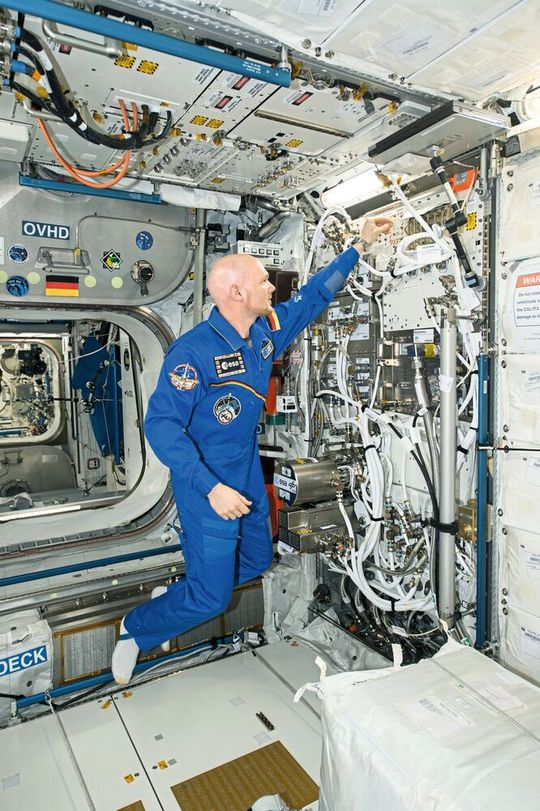
ESA astronaut Alexander Gerst installs the "Electromagnetic Levitator" (EML) on board the ISS. Gerst later used this instrument to carry out Empa's experiments with metallic glasses.
(Image: NASA)
Materials researchers such as Terebenec work with complex alloys and precisely controlled processes to produce amorphous metals. This requires a precise understanding of the physical properties of the material, especially in its liquid form, in the melt. And even that is not easy: "You have to examine liquid metal droplets in suspension, as contact with a crucible can trigger crystallisation of the metal and thus jeopardise the entire experiment," explains Terebenec. This can be achieved using strong electromagnetic fields, for example - but the earth's gravity deforms the round droplets and distorts the measurements.
For this reason, Terebenec and other researchers at the Center for X-ray Analytics, led by Antonia Neels, are using a very special research platform: the International Space Station (ISS). As part of the European Space Agency's (ESA) "Thermoprop" research project, which is led by Neels, the researchers are investigating the physical properties of metallic glasses in microgravity - the near weightlessness in low-Earth orbit. At the same time, experiments are also underway at Empa in Dübendorf, where Neels, Terebenec and their colleagues are investigating the structure of metallic glasses using various X-ray techniques.
"The data from the experiments on the ISS are fed into computer simulations, which in turn can be used to develop and optimise industrial processes," says Antonia Neels. Despite the lofty - or rather airless - heights at which some of the experiments take place, the project is anything but "off the ground": in addition to the researchers from Empa and EPFL, an industrial partner has also been involved from the outset. The Swiss company PX Group from La Chaux-de-Fonds manufactures metallic glasses for the watch industry, where the hard, flexible materials are used for precise mechanisms and robust housings. "Our partner has already been able to incorporate our findings from the project into improved manufacturing processes," says Neels.
Reliable mechanisms for satellites
However, the knowledge gained on board the ISS and at Empa also flows back into space. In addition to their terrestrial applications, metallic glasses are also suitable for applications on board spaceships and satellites. Their elasticity and resilience make it possible, for example, to construct reliable mechanisms that function maintenance-free for a long time. In a second project with ESA, Empa researchers are exposing material samples to the harsh conditions in space.
The corresponding experiment called "SESAME" flew to the ISS in November 2024 and was installed on the outside of the European laboratory module "Columbus" in December. It contains numerous material samples from 15 European research institutions. After around a year in space, the samples are to be returned to Earth and analysed - including the metallic glass from the Empa team. "We can simulate individual conditions from space on Earth, such as temperature fluctuations, vacuum or radiation - but not everything together," explains Neels. "We want to know whether a longer stay in space conditions changes the structure of the material. Because the structure defines the material properties," adds Terebenec.
Date: 08.12.2025
Naturally, we always handle your personal data responsibly. Any personal data we receive from you is processed in accordance with applicable data protection legislation. For detailed information please see our privacy policy.
Consent to the use of data for promotional purposes
I hereby consent to Vogel Communications Group GmbH & Co. KG, Max-Planck-Str. 7-9, 97082 Würzburg including any affiliated companies according to §§ 15 et seq. AktG (hereafter: Vogel Communications Group) using my e-mail address to send editorial newsletters. A list of all affiliated companies can be found here
Newsletter content may include all products and services of any companies mentioned above, including for example specialist journals and books, events and fairs as well as event-related products and services, print and digital media offers and services such as additional (editorial) newsletters, raffles, lead campaigns, market research both online and offline, specialist webportals and e-learning offers. In case my personal telephone number has also been collected, it may be used for offers of aforementioned products, for services of the companies mentioned above, and market research purposes.
Additionally, my consent also includes the processing of my email address and telephone number for data matching for marketing purposes with select advertising partners such as LinkedIn, Google, and Meta. For this, Vogel Communications Group may transmit said data in hashed form to the advertising partners who then use said data to determine whether I am also a member of the mentioned advertising partner portals. Vogel Communications Group uses this feature for the purposes of re-targeting (up-selling, cross-selling, and customer loyalty), generating so-called look-alike audiences for acquisition of new customers, and as basis for exclusion for on-going advertising campaigns. Further information can be found in section “data matching for marketing purposes”.
In case I access protected data on Internet portals of Vogel Communications Group including any affiliated companies according to §§ 15 et seq. AktG, I need to provide further data in order to register for the access to such content. In return for this free access to editorial content, my data may be used in accordance with this consent for the purposes stated here. This does not apply to data matching for marketing purposes.
Right of revocation
I understand that I can revoke my consent at will. My revocation does not change the lawfulness of data processing that was conducted based on my consent leading up to my revocation. One option to declare my revocation is to use the contact form found at https://contact.vogel.de. In case I no longer wish to receive certain newsletters, I have subscribed to, I can also click on the unsubscribe link included at the end of a newsletter. Further information regarding my right of revocation and the implementation of it as well as the consequences of my revocation can be found in the data protection declaration, section editorial newsletter.
The experiments on the ISS take place in different phases. Further experiments with liquid metallic glasses from Empa on board the ISS are planned for next year. "Both projects will probably run until the end of the ISS in 2030," says Neels. There is still a lot to learn in - and for - space. The projects are being carried out as part of the ESA PRODEX program (Programme de Développement d'Expériences Scientifiques) and are supported by the Swiss Space Office (SSO) and the PRODEX Office.
From Dübendorf ad astra
Space probes are at the cutting edge of engineering. They have to be light and compact, withstand the vibrations of a rocket launch and then function for years without any maintenance - under extreme conditions, such as vacuum, strong radiation and large temperature fluctuations. Every component of the highly complex probes has to meet the highest requirements.
Empa engineers from the Joining Technology and Corrosion research department have been working in partnership with the University of Bern for over 20 years, manufacturing components for measuring instruments for space probes on various European Space Agency (ESA) space missions. This often involves the high-precision soldering of metal and ceramics in a high vacuum. One mission with components from Dübendorf has already been successfully completed, three are currently in space and two more are in preparation.




:quality(80)/p7i.vogel.de/wcms/27/29/2729da9d77bbe3a97ef364594a4d7fa5/screenshot-202026-03-23-20134204-932x524v1.png "(Source: AI-generated)")
:quality(80)/p7i.vogel.de/wcms/d6/0d/d60dbd35064daafce089426fa50a27e2/0130207422v1.jpeg "The largest new construction project for the German Navy is stalling. It is years behind schedule. It involves several F126 frigates. Now the armaments group Rheinmetall is counting on taking over the project in order to finish it quickly ... (Source: Ladies Naval)")
:quality(80)/p7i.vogel.de/wcms/c6/47/c64705c706eefa87feeb5a39ab057c2c/0130179612v1.jpeg "The Leopard 2 main battle tank (here the latest A8 version) is used by many NATO countries. The Franco-German MGCS tank system, which is currently under development, is intended to replace it, but is not running so smoothly. This is not stopping KNDS from going public this year. (Source: KNDS)")
:quality(80)/p7i.vogel.de/wcms/5b/2c/5b2cceb9038883edfacb76a61fca350b/vw-os-4-25--28cropped-29-3136x1765v1.jpeg "VW Osnabrück: Following Rheinmetall, KNDS is now also interested in at least a partial takeover of the plant. One popular example for the shift from civilian to military production. (Picture: Wiki Commons)")
:quality(80)/p7i.vogel.de/wcms/a3/66/a3666c01ec1a8b58da812faa80ab9f31/0130225449v1.jpeg "In 2004, the decision was made for the first \"Droop+Rein FOGS M40,\" a machine characterized by stability, precision, and flexibility. (Image:Starrag / Ralf Baumgarten)")
:quality(80)/p7i.vogel.de/wcms/b1/58/b158a5cc771fac7941d6bc3414becb5a/zeroe-20fully-20electric-20hydrogen-powered-20four-20pod-20aircraft-zeroe-turboprop-aib-vcity-16-9-5000x2811v1-999x562v1.jpeg "Airbus is working on the propulsion of short-haul aircraft using hydrogen and fuel cells as part of the “GENtwoPRO” project. (Source: Airbus SAS 2025)")
:quality(80)/p7i.vogel.de/wcms/2c/2c/2c2c63c23a1be1fe8259e3da28ebaff2/figure3-3864x2172v1.jpeg "(Source: AI-generated)")
:quality(80)/p7i.vogel.de/wcms/a2/66/a266453da44556de3d18a0976597a605/sintavia-press-release-image-31726-1333x750v1.jpeg "Scooped version of representative heat exchanger. (Source: Sintavia)")
:quality(80)/p7i.vogel.de/wcms/c2/5e/c25e38d6d559fc809a10bdceb15ebced/0129879115v1.jpeg "The twin of this sample is located on the outside of the ISS as part of the \"SESAME\" experiment. (Image:Empa)")
:quality(80)/p7i.vogel.de/wcms/3a/da/3adad9cc561900df0446f19c74a4d4df/0129938355v1.jpeg "Ganfeng Lithium, together with Geely subsidiary Aerofugia, has developed semi-solid batteries for eVTOLs. (Image:Aerofugia)")
:quality(80)/p7i.vogel.de/wcms/b4/ae/b4ae65d3fb3903a13571d9ea3e61da8a/mock-up-vleo-def-1920x1079v1.jpeg "Illustration of the VLEO-DEF satellite in orbit (Source: EDA)")
:quality(80)/p7i.vogel.de/wcms/74/81/748181a9121c4b65450f978e0e360950/comsol-astronauten-nasa--20-28cc-29-20image-20by-20nasa-20and-20in-20the-20public-20domain-20via-20wikimedia-20commons-4928x2770v1.jpeg "Astronauts working on the CDRA. (Source: NASA)")
:quality(80)/p7i.vogel.de/wcms/06/37/0637c7dd3fab9b00a8e96f98133cd1dc/260304-d-d0477-1005-5892x3317v1.png "A B-52H Stratofortress idles prior to taking off in support of Operation Epic Fury in March 2026. (Source: U.S. Air Force)")
:quality(80)/p7i.vogel.de/wcms/13/2b/132bb2831ae98c4c3bdd0ee2990ba1eb/bareways-20deck-20--20crisis-20coordination-20platformv1.jpeg "(Source: Bareways)")
:quality(80)/p7i.vogel.de/wcms/93/f1/93f1e4dba53b2c9589fab17a525df55e/adobestock-163119218-2480x1394v1.jpeg "(Source: Kernkonzept GmbH)")
:quality(80)/p7i.vogel.de/wcms/8d/76/8d764c984e44153da8f0dfa88cd6d75e/0129843677v1.jpeg "A successful drone attack on two data centers of the Amazon subsidiary AWS shows that the danger of drones is virtually unavoidable in modern warfare ... (Source: Cerberus)")
:quality(80)/p7i.vogel.de/wcms/84/63/8463d680832f3be7e5b3b5a189a0cac7/drohnen-1536x864v1.png "(Source: Elbit Systems Deutschland GmbH & Co. KG)")
:quality(80)/p7i.vogel.de/wcms/14/d3/14d3e0847d222af54aa5ab625480507f/0130015022v1.jpeg "A German-French battle tank project was approved some time ago (symbol image). But a modern drive system is also needed for it. This is now being developed by Rolls-Royce Power Systems and ZF in the coming years... (Image:Rheinmetall)")
:quality(80)/p7i.vogel.de/wcms/bd/21/bd2191aab59c430b3c74a2be07120333/image-196-1294x728v1.png "(Image:SkyDefender © Thales)")
:quality(80)/p7i.vogel.de/wcms/d4/dc/d4dc9a59e1698ae295b1e6e64a29a55b/geralt-handshake-5768632-1280-1280x720v1.jpeg "Rheinmetall and Nooteboom Trailers are collaborating on the development and marketing of heavy equipment trailer systems designed for transporting modern tracked and wheeled military vehicles. (Image:Gerd Altmann from Pixabay)")
:quality(80)/p7i.vogel.de/wcms/f9/2f/f92f1ef8c739c34c70d99f7b0997621b/stra007-20--20cover-20image-5472x3076v1.jpeg "(Source: Stratasys)")
:quality(80)/p7i.vogel.de/wcms/5e/18/5e184e4961f190c86a1ea3227104cab5/26pm03-20kompakte-20l-c3-b6sungen-20f-c3-bcr-20luft--20und-20raumfahrt-202-2362x1329v1.jpeg "(Picture: Keysight)")
:quality(80)/p7i.vogel.de/wcms/67/4c/674c54baa745be497cecb716826af339/stahlwille-hero-1807x1016v1.jpeg "A new modular tool solution designed for safety, precision, and mobility in aviation maintenance. (Source: STAHLWILLE)")
:quality(80)/p7i.vogel.de/wcms/0d/01/0d01a051ba894332a8091e3a3f9394e1/hytorc-defense-solutions-boxersatz-1899x1068v1.jpeg "HYTORC’s Defence Solutions toolkit, proven on the GTK Boxer, enables safe, traceable fastening of critical components across multiple Bundeswehr platforms. (Source: Image: HYTORC)")
:quality(80)/p7i.vogel.de/wcms/f3/4e/f34ed744bb30817d3432c7ad522e6f30/engine-1v1.jpeg "Engineering with aluminium profiles really can be this easy – the item Engineeringtool and its smart functions help you save valuable time. (Source: item)")
:quality(80)/p7i.vogel.de/wcms/fb/8e/fb8e5ae2aa27bcf3e466815505ca4ff2/alumin-1v1.jpeg "The aluminium profile technology of the item Building Kit System has been used to build a huge variety of structures for decades. (Source: item)")
:quality(80)/p7i.vogel.de/wcms/be/84/be84bbede3e40b1101cd3efa35a6ffa0/overview-of-20work-bench-design-in-productionv1.jpeg "With modular work bench design, you can convert or extend a work bench with ease by changing or adding accessories. This means changes can be implemented quickly and cost-effectively, thus boosting quality and productivity. (Source: item)")
:fill(fff,0)/p7i.vogel.de/companies/69/6d/696de2483d115/logo--fastems-rgb-horizontal.jpeg "logo--fastems-rgb-horizontal (Fastems)")
:fill(fff,0)/images.vogel.de/vogelonline/companyimg/84700/84735/65.jpg "logo_item_rgb_neu.jpg ()")
:quality(80)/p7i.vogel.de/wcms/c6/c7/c6c74b9c1032b66daa76c5697b91c896/0129878569v1.jpeg "Preview of the \"Space Experiment Study on Ageing of MatErial\" (SESAME) part of the Euro Material Ageing Investigation. SESAME is an exposure unit for the space environment containing various samples and sensors. The samples were selected according to the project requirements and the research and development activities.(Image: NASA / CNES)")
:quality(80)/p7i.vogel.de/wcms/de/b6/deb673098c84fa4870ed29f334905a01/0129878582v1.jpeg "(Source: Empa)")
:quality(80)/p7i.vogel.de/wcms/90/30/90306eb32180ea336c39816f64dff38c/0129897632v1.jpeg "The twin of this sample is located on the outside of the ISS as part of the \"SESAME\" experiment.(Source: Empa)")
:quality(80)/p7i.vogel.de/wcms/12/9d/129d836b3a046217738b429175d6fe78/0129897974v1.jpeg "Empa researcher Damien Terebenec: \"The structure defines the material properties.\"(Source: Empa)")
:quality(80)/p7i.vogel.de/wcms/46/23/4623deb9f8bf7a000b0ee0fe50435287/0128578467v1.jpeg "Johanna Byloff analyzes the samples on the coating machine of the Empa spin-off Swiss Cluster. (Image:Empa)")
:quality(80)/p7i.vogel.de/wcms/0a/bf/0abff386f41a7de33e0dee5de011cad0/0122518010v1.jpeg "Tests of the 3D printer during ESA's parabolic flight campaign on board the \"Vomit Comet\". (Image:University of Glasgow)")