



:quality(80)/p7i.vogel.de/wcms/9c/ea/9cea728e016b7bbed6cef9293b42dffb/0132595365v1.jpeg "A look into the engine assembly at MTU in Munich. The best part: The order situation is already so strong (primarily from the civil sector) that there is no need to worry about the medium-term future... (Source: MTU)")
:quality(80)/p7i.vogel.de/wcms/65/97/6597b7ef2d3be722c6ccceffb9037991/0132346449v1.jpeg "Joby Aviation and Toyota have entered the first phase of their strategic production alliance. As part of this alliance, a joint venture will also be established. (Source: Toyota)")
:quality(80)/p7i.vogel.de/wcms/7a/78/7a78021aba51686c537b8737ba5a42b1/gmfx-vls-convoy-1883x1060v1.png "Rheinmetall unveils GMF140 next-generation guided missile frigate (Source: Rheinmetall)")
:quality(80)/p7i.vogel.de/wcms/d9/bd/d9bd76f98f82db31e6bf17b9c35b1c68/0132385839v1.jpeg "Hitachi and Eve Air Mobility have signed a memorandum of understanding regarding future collaboration in the field of vertiports. (Image:Hitachi)")
:quality(80)/p7i.vogel.de/wcms/d7/3b/d73b7bc7df945598f64670db3522f90d/abbildung-1-feierliche-er-ffnung-der-space-factory-im-esa-phi-lab-austria-1920x1079v1.jpeg "Official opening of the space factory at ESA Phi-Lab Austria. (Source: Vienna Airport)")
:quality(80)/p7i.vogel.de/wcms/9f/c4/9fc469efea02b9d29153cf281ba0278e/0132594808v1.jpeg "In a monetary sense, Rolls-Royce is currently propelled by its own jet engines. But the British systems for data centers are also in high demand due to the AI boom... (Source: Rolls-Royce)")
:quality(80)/p7i.vogel.de/wcms/1c/af/1caf95af66a2c53008271adfd09af864/0132348702v1.jpeg "With its system solutions for the series production of drone components and electric drive systems, Grob supports manufacturers on their journey from prototype production to industrial series production. (Source: Grob-Werke)")
:quality(80)/p7i.vogel.de/wcms/b2/21/b2217f161496c7a48311130879b84933/0132412565v1.jpeg "EOS can rejoice, as the demand for engine systems from its customer Beehive Industries (one is seen in the picture) from the USA is rising as a result of global crises. Now there has been a nice order for 3D printers ... (Source: N. Leach-Proffer)")
:quality(80)/p7i.vogel.de/wcms/a9/34/a934c9dd0692a4d995190803ee8fb58d/pei189-1920x1079v1.jpeg "Modern electrical connectors help commercial aircraft achieve greater efficiency, reliability and power density while supporting increasingly complex onboard systems. (Source: PEI-Genesis)")
:quality(80)/p7i.vogel.de/wcms/4e/1c/4e1c2b1b0075c60cca6d8e813700fb0e/0132312891v1.jpeg "Airbus and MTU Aero Engines plan to establish a joint venture for the development and marketing of hydrogen fuel cell propulsion systems, which is scheduled to begin operations in 2027. (Source: Airbus)")
:quality(80)/p7i.vogel.de/wcms/3d/be/3dbeb9f3494b60dd377c647b142abec4/0132348702v1.jpeg "With its equipment solutions for the mass production of drone components and electric propulsion systems, Grob supports manufacturers as they transition from prototype production to industrial mass production. (Source: Grob Works)")
:quality(80)/p7i.vogel.de/wcms/3f/46/3f467afcad036bbf7daa8c3c7a01ccb2/dsc00150-1920x1079v1.jpeg "Designed around a fully European supply chain and minimal logistical footprint, Reliant will now compete for major global contracts. (Source: Quantum-Systems GmbH)")
:quality(80)/p7i.vogel.de/wcms/e2/0d/e20dda1e5bfe97e4fca0250dab642778/0132406729v1.jpeg "ESA has commissioned Keysight and Sateliot to develop a blockchain-based framework for non-terrestrial 5G networks. (Image:Keysight)")
:quality(80)/p7i.vogel.de/wcms/c7/48/c7488c4ca37fbf8bf94377a993c996f3/01-header-cyber-resilience-1536x864v1.png "Concept: Martin Oppermann; image generated with OpenAI. (Source: KI-generiert / Gemini)")
:quality(80)/p7i.vogel.de/wcms/cf/d5/cfd5ef0e30297293527b9891ba134109/de-buch-ki-a5-260702-ebook-titel-lowres-874x492v1.jpeg "(Source: Vogel Communications Group GmbH & Co. KG)")
:quality(80)/p7i.vogel.de/wcms/34/04/3404f9381a137f50c68b42dd76875da1/swi499-20--20ic-20image-3837x2160v1.jpeg "(Source: SWINDON SILICON SYSTEMS LTD)")
:quality(80)/p7i.vogel.de/wcms/e2/5c/e25cd1bd58dbdb37b3d0e69a001cfbfc/autonlogistics-1920x1079v1.jpeg "American Rheinmetall has been selected by the US Army to develop next generation autonomous hybrid UGVs for tactical logistics missions under Project Sustainment. (Source: Rheinmetall AG)")
:quality(80)/p7i.vogel.de/wcms/64/1d/641da1ecd6aa1147b21cb9a628bca55e/03-02-visuel-land-fullres-2026-07--prs-core-module-radio-b-2-1294x728v1.png "(Source: Thales)")
:quality(80)/p7i.vogel.de/wcms/04/3b/043bb9d3cac1b001c57ac67fe627baf2/jpgv1.jpeg "(Source: )")
:quality(80)/p7i.vogel.de/wcms/4e/ca/4ecaa39f247490eded591b652c33aee3/thilmann-hcp-web-20kleiner-20ausschnitt-1442x811v1.jpeg "Entering the defence market can be challenging for start-ups, says HCP Sense CEO Ansgar Thilmann. (Picture: HCP Sense)")
:quality(80)/p7i.vogel.de/wcms/7a/51/7a511b80041d3f1335f3a5aa56fe75da/delivery-7022432-1280-1280x720v1.png "(Source: Mohamed_hassan)")
:quality(80)/p7i.vogel.de/wcms/f9/2f/f92f1ef8c739c34c70d99f7b0997621b/stra007-20--20cover-20image-5472x3076v1.jpeg "(Source: Stratasys)")
:quality(80)/p7i.vogel.de/wcms/5e/18/5e184e4961f190c86a1ea3227104cab5/26pm03-20kompakte-20l-c3-b6sungen-20f-c3-bcr-20luft--20und-20raumfahrt-202-2362x1329v1.jpeg "(Picture: Keysight)")
:quality(80)/p7i.vogel.de/wcms/ec/a9/eca9062ccbe4b042f8515846340410d8/aerospace-and-defence-stairways-platforms-and-much-morev1.jpeg "Modular constructions enable flexible modification. That applies to larger structures such as stairways and platforms, too. And that means aerospace and defence companies can reconfigure their maintenance platforms fast (itemitem)")
:quality(80)/p7i.vogel.de/wcms/30/2a/302a7b5723ad38fbde812fd3a468ad04/safety-on-stairways-in-industry-key-considerationsv1.jpeg "Stairways and platforms are used widely in maintenance and assembly areas in the aerospace and defence sectors. (Source: item)")
:quality(80)/p7i.vogel.de/wcms/f3/4e/f34ed744bb30817d3432c7ad522e6f30/engine-1v1.jpeg "Engineering with aluminium profiles really can be this easy – the item Engineeringtool and its smart functions help you save valuable time. (Source: item)")
Date: 08.12.2025
Naturally, we always handle your personal data responsibly. Any personal data we receive from you is processed in accordance with applicable data protection legislation. For detailed information please see our privacy policy.
Consent to the use of data for promotional purposes
I hereby consent to Vogel Communications Group GmbH & Co. KG, Max-Planck-Str. 7-9, 97082 Würzburg including any affiliated companies according to §§ 15 et seq. AktG (hereafter: Vogel Communications Group) using my e-mail address to send editorial newsletters. A list of all affiliated companies can be found here
Newsletter content may include all products and services of any companies mentioned above, including for example specialist journals and books, events and fairs as well as event-related products and services, print and digital media offers and services such as additional (editorial) newsletters, raffles, lead campaigns, market research both online and offline, specialist webportals and e-learning offers. In case my personal telephone number has also been collected, it may be used for offers of aforementioned products, for services of the companies mentioned above, and market research purposes.
Additionally, my consent also includes the processing of my email address and telephone number for data matching for marketing purposes with select advertising partners such as LinkedIn, Google, and Meta. For this, Vogel Communications Group may transmit said data in hashed form to the advertising partners who then use said data to determine whether I am also a member of the mentioned advertising partner portals. Vogel Communications Group uses this feature for the purposes of re-targeting (up-selling, cross-selling, and customer loyalty), generating so-called look-alike audiences for acquisition of new customers, and as basis for exclusion for on-going advertising campaigns. Further information can be found in section “data matching for marketing purposes”.
In case I access protected data on Internet portals of Vogel Communications Group including any affiliated companies according to §§ 15 et seq. AktG, I need to provide further data in order to register for the access to such content. In return for this free access to editorial content, my data may be used in accordance with this consent for the purposes stated here. This does not apply to data matching for marketing purposes.
Right of revocation
I understand that I can revoke my consent at will. My revocation does not change the lawfulness of data processing that was conducted based on my consent leading up to my revocation. One option to declare my revocation is to use the contact form found at https://contact.vogel.de. In case I no longer wish to receive certain newsletters, I have subscribed to, I can also click on the unsubscribe link included at the end of a newsletter. Further information regarding my right of revocation and the implementation of it as well as the consequences of my revocation can be found in the data protection declaration, section editorial newsletter.
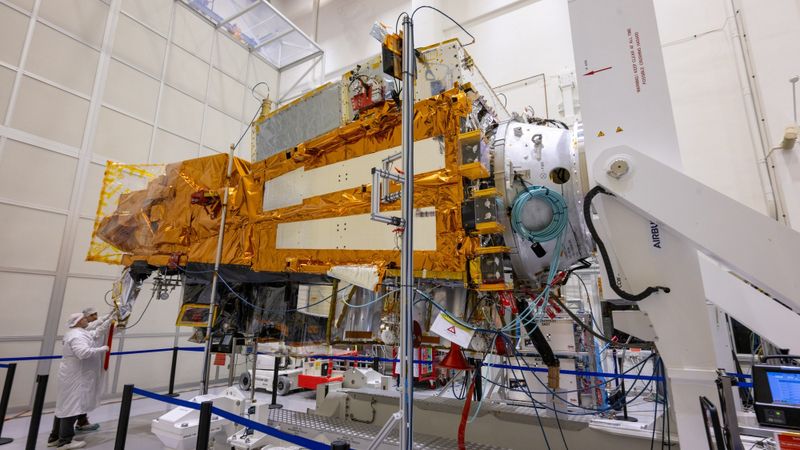
:quality(80)/p7i.vogel.de/wcms/72/09/720965c88a922a7f6013bff231b4f8c2/airbus-20satellit-981x552v1.jpeg "The Airbus-built Sentinel-4 aboard MTG-S1 and the Sentinel-5 instrument on MetOp-SG A will deliver high-frequency, high-resolution atmospheric pollution measurements across Europe. (Bild: Airbus/EUMETSAT)")
:quality(80)/p7i.vogel.de/wcms/c5/69/c56908303c0282f9d14e85944332f961/0128226312v1.jpeg "The A4Climate project is investigating how contrails can be avoided. (Image:Project A4Climate)")