It is the year 2040: Operations to secure a long-term human presence on the lunar surface using lunar resources have begun—What sounds like the beginning of a science fiction novel was the start of the mission for the robotics team from the Karlsruhe FZI Research Center for Information Technology at this year's "Space Resources" competition of the European Space Agency (ESA).
This time, the task for the FZI team was to collect moon regolith—a loose rock material from the lunar surface—and prepare it for oxygen extraction through particle size separation.
(Image: FZI)
After its victory in the first "ESA ESRIC Space Resources Challenge" three years ago, the FZI once again competed in this competition against other international teams. This time, the task was to collect lunar regolith—a loose rocky material from the lunar surface—and prepare it for oxygen extraction through particle size separation. The goal was to produce a material optimally suited for molten salt electrolysis. In the competition, enough regolith needed to be prepared to generate sufficient oxygen using this method for eight astronauts during a 30-day lunar mission.
Robots extract artificial moon rock under special conditions
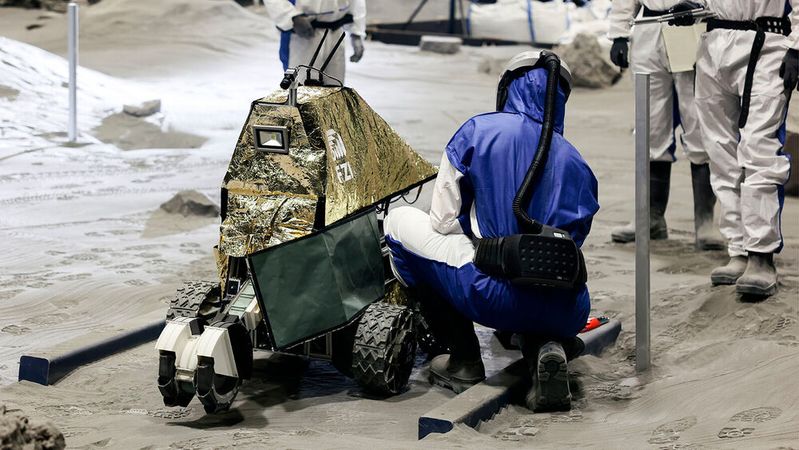
Not only did the ESA's task for the eight finalists' teams seem futuristic: The field test for the autonomous robots took place in mid-October at the "LUNA" lunar center at the DLR site in Cologne. In the newly opened facility, future astronauts are being prepared for lunar missions. The facility, covering an area of over 700 m² (approx. 7530 sq ft), simulates the challenging conditions on the Moon with realistic lighting conditions and the specific properties of regolith. The lunar surface was replicated in the hall with approximately 900 tons of regolith simulant. This consists of fine basalt dust, whose grain size and composition were specifically developed for the facility. In its properties, the dust is very similar to the original lunar regolith.
“The dust was indeed a major challenge for the robots and our technology,” says Dr.-Ing. Georg Heppner, FZI department head and leader of the FZI Challenge Team DUST (Distributed Unit for Sorting and Transport). “Regolith is very fine and causes mechanisms to clog and wear out quickly. Therefore, we had to continuously monitor the material transport and the functionality of all rover components from the control room and intervene accordingly in case of errors.”
The extraction of lunar rock is comparable to terrestrial mining, where soil, rock, or other materials are removed to access valuable resources. For the specific lunar conditions, suitable methods must be developed to efficiently loosen, transport, and prepare the material.
Processing encompasses all methods that increase the economic or practical value of a raw material by removing unwanted components. On Earth, this occurs through sorting, crushing, or cleaning ores, for example. In the context of so-called In-Situ Resource Utilization (ISRU) in space, processing means that the extracted lunar regolith is further processed directly on-site—for instance, by separating it by particle size or enriching specific minerals. This creates a material that is better suited for the next processing step, such as extracting oxygen, water, or building materials for future lunar missions.
Working in space research is very challenging because the conditions in space are truly unique, and the conditions on Earth in the lab are so different. Tests like the deployment in the LUNA lunar center make it tangible and incredibly motivating as a sense of immediacy is created. For a permanent human presence on other celestial bodies, many different disciplines must work together, and it is great to be able to contribute to that.
Niklas Spielbauer, Research Assistant at FZI and DUST Team Leader
FZI robotics team participates with a tailored robot solution
The FZI team deployed the Modular DUST Rover—a platform with four wheels and modular attachments specifically designed for the challenge. The team benefited from the fact that, in addition to the fully equipped FZI Living Lab Service Robotics, the FZI also has its own metal workshop for robotic prototypes.
A prerequisite for the challenge was a robot capable of processing at least 15 kg of lunar rock, weighing a maximum of 60 kg, and generating as little dust as possible during operation. The unique feature of the FZI solution was that all necessary capabilities were integrated directly into the robot: excavation and screening were carried out without detours. In contrast, other teams had to drive their robot to a separate station to screen the rock. The FZI team's expertise also came from a single source: rapid prototyping, the robot itself, and in-house modular software. Especially for teleoperation, the FZI strongly relies on the open-source framework Robot Operating System, or ROS. The FZI is highly committed to open-source software (OSS) through various publications and is a member of the ROS-Industrial Consortium Europe.
At the FZI, we have been researching robotics for around 40 years, focusing primarily on intelligent mobile systems and walking robots. Recently, our focus has been on autonomy functions for space exploration or for safety-critical and hostile environments. The developments are tested in real-world analog scenarios—such as in the desert, a nuclear power plant, or, as in this challenge, in a lunar test environment.
Dr.-Ing. Georg Heppner
Before the final round, the team was provided with aerial images and 3D maps of the test area. Using these, the most promising extraction zones were identified, and safe routes between the starting area and target points were planned. During the challenge, on-board cameras were used for orientation to precisely follow the planned routes.
Chance for a real moon mission
All eight teams participated in the field test from October 13 to 17, 2025, and subsequently submitted their project development concepts to the ESA by the end of the month. Then it was time to wait for the winner announcement. Who will win the development contract worth 500,000 euros for a feasibility study with ESA? And which team demonstrated the strongest performance in the beneficiation category? This is the process by which the economic value of an ore is improved by removing gangue minerals, resulting in a higher-grade product. The winning team will be rewarded with up to 250,000 euros (approx. 300,000 USD) by the Luxembourg Space Agency (LSA) and ESRIC.
Date: 08.12.2025
Naturally, we always handle your personal data responsibly. Any personal data we receive from you is processed in accordance with applicable data protection legislation. For detailed information please see our privacy policy.
Consent to the use of data for promotional purposes
I hereby consent to Vogel Communications Group GmbH & Co. KG, Max-Planck-Str. 7-9, 97082 Würzburg including any affiliated companies according to §§ 15 et seq. AktG (hereafter: Vogel Communications Group) using my e-mail address to send editorial newsletters. A list of all affiliated companies can be found here
Newsletter content may include all products and services of any companies mentioned above, including for example specialist journals and books, events and fairs as well as event-related products and services, print and digital media offers and services such as additional (editorial) newsletters, raffles, lead campaigns, market research both online and offline, specialist webportals and e-learning offers. In case my personal telephone number has also been collected, it may be used for offers of aforementioned products, for services of the companies mentioned above, and market research purposes.
Additionally, my consent also includes the processing of my email address and telephone number for data matching for marketing purposes with select advertising partners such as LinkedIn, Google, and Meta. For this, Vogel Communications Group may transmit said data in hashed form to the advertising partners who then use said data to determine whether I am also a member of the mentioned advertising partner portals. Vogel Communications Group uses this feature for the purposes of re-targeting (up-selling, cross-selling, and customer loyalty), generating so-called look-alike audiences for acquisition of new customers, and as basis for exclusion for on-going advertising campaigns. Further information can be found in section “data matching for marketing purposes”.
In case I access protected data on Internet portals of Vogel Communications Group including any affiliated companies according to §§ 15 et seq. AktG, I need to provide further data in order to register for the access to such content. In return for this free access to editorial content, my data may be used in accordance with this consent for the purposes stated here. This does not apply to data matching for marketing purposes.
Right of revocation
I understand that I can revoke my consent at will. My revocation does not change the lawfulness of data processing that was conducted based on my consent leading up to my revocation. One option to declare my revocation is to use the contact form found at https://contact.vogel.de. In case I no longer wish to receive certain newsletters, I have subscribed to, I can also click on the unsubscribe link included at the end of a newsletter. Further information regarding my right of revocation and the implementation of it as well as the consequences of my revocation can be found in the data protection declaration, section editorial newsletter.
"The field test was, of course, incredibly exciting for us. We finished the preparations for the software, hardware, and mechanics just in time, and then our rover was 'ready to go.' And then, of course, you want to deliver what we had planned," recalls Niklas Spielbauer. "We also didn’t know how it went for the other competitors. On-site, we were hardly allowed to exchange ideas with each other, and every finalist's approach had its pros and cons."
Creating a flexible foundation for future space projects
Yesterday, the long-awaited results were announced: This time, the FZI team did not manage to win the competition. “We congratulate Team Bremen on their outstanding performance! We take the experience from the challenge into our applied research and look forward to hopefully competing against such top teams again in the next challenge! A big thank you to the entire FZI DUST team and also to the other finalists! We have all demonstrated how strong European robotics research is,” said Dr.-Ing. Georg Heppner.
What’s next? Even without a subsequent project, the development of the rover is currently being further advanced. On the one hand, to learn from the challenges encountered and analyze them scientifically, and on the other hand, to create a flexible foundation for future space projects and further develop them.



:quality(80)/p7i.vogel.de/wcms/be/0b/be0b550a4fc2724afeed0713f65e7675/spexer-anechoic-chamber-1280x720v1.png "(Source: Hensoldt AG)")
:quality(80)/p7i.vogel.de/wcms/6f/0f/6f0fc6e3348925946d77fa2339e53005/0130142731v1.jpeg "Heidelberger Druckmaschinen Aktiengesellschaft establishes a joint venture with Ondas. The aim is to provide and market effective drone defence systems in Europe and Ukraine. (Source: Ondas)")
:quality(80)/p7i.vogel.de/wcms/05/29/05295a4f758848ae6c027cc78947453c/17818f1a7b12-banner-format-970x546v1.jpeg "(Source: Diehl Defence)")
:quality(80)/p7i.vogel.de/wcms/44/2f/442f8206549c08b8fd79666b1e2c1096/suv-20wald-1536x864v1.png "(Source: AI-generated)")
:quality(80)/p7i.vogel.de/wcms/2e/15/2e15396bd28d5cc96f2c339a6b7bf1e8/l3harris-disco-1220-1217x684v1.jpeg "(Source: L3Harris Technologies)")
:quality(80)/p7i.vogel.de/wcms/0c/70/0c701a79c1f183921b8ee9341ef61db8/0129694966v1.jpeg "Robonode's DVK Development Kit: This is available through Codico's sample shop. (Image:8DEVICES)")
:quality(80)/p7i.vogel.de/wcms/7c/12/7c123d3888ed3a37a83b0793be569f00/hon-aero-hguide-i700-imu-comp-view-2880x1440-1024x576v1.webp "(Source: Honeywell)")
:quality(80)/p7i.vogel.de/wcms/62/06/6206d30afc9c4f286f4ecf4cedf575c5/stark-20virtus-20side-1920x1079v1.jpeg "To be introduced into service with the Bundeswehr: The “Virtus” developed by Stark has a range of up to 100 km and is designed to engage targets on the battlefield. (Picture: STARK Defence)")
:quality(80)/p7i.vogel.de/wcms/b4/ae/b4ae65d3fb3903a13571d9ea3e61da8a/mock-up-vleo-def-1920x1079v1.jpeg "Illustration of the VLEO-DEF satellite in orbit (Source: EDA)")
:quality(80)/p7i.vogel.de/wcms/11/c8/11c8d30d75151329d2700176eb7a0383/0130110840v1.jpeg "Zenadrone, a subsidiary of Zenatec, is working on developing an operational low-cost drone as a disposable concept (symbol image). The first prototype already exists. In the future, it is intended to counter increasing enemy drone attacks without significant financial effort... (Source: Zenadrone)")
:quality(80)/p7i.vogel.de/wcms/c8/4c/c84cef4bf459f1280823827c3e3615c2/7cf414af-d41d-46ac-b22b-890f9f32d24c-2048x1151v1.jpeg "In Manching, Germany, Airbus is currently preparing two Valkyries for their first flight with its European mission system. The picture shows one of them. (Source: Airbus)")
:quality(80)/p7i.vogel.de/wcms/e3/d7/e3d7de9cfaac27f48ee6e162f9b309e9/0128899731v1.jpeg "Here, Lufthansa's first anniversary aircraft lands in Frankfurt. (Image:Lufthansa)")
:quality(80)/p7i.vogel.de/wcms/06/37/0637c7dd3fab9b00a8e96f98133cd1dc/260304-d-d0477-1005-5892x3317v1.png "A B-52H Stratofortress idles prior to taking off in support of Operation Epic Fury in March 2026. (Source: U.S. Air Force)")
:quality(80)/p7i.vogel.de/wcms/13/2b/132bb2831ae98c4c3bdd0ee2990ba1eb/bareways-20deck-20--20crisis-20coordination-20platformv1.jpeg "(Source: Bareways)")
:quality(80)/p7i.vogel.de/wcms/93/f1/93f1e4dba53b2c9589fab17a525df55e/adobestock-163119218-2480x1394v1.jpeg "(Source: Kernkonzept GmbH)")
:quality(80)/p7i.vogel.de/wcms/8d/76/8d764c984e44153da8f0dfa88cd6d75e/0129843677v1.jpeg "A successful drone attack on two data centers of the Amazon subsidiary AWS shows that the danger of drones is virtually unavoidable in modern warfare ... (Source: Cerberus)")
:quality(80)/p7i.vogel.de/wcms/14/d3/14d3e0847d222af54aa5ab625480507f/0130015022v1.jpeg "A German-French battle tank project was approved some time ago (symbol image). But a modern drive system is also needed for it. This is now being developed by Rolls-Royce Power Systems and ZF in the coming years... (Image:Rheinmetall)")
:quality(80)/p7i.vogel.de/wcms/bd/21/bd2191aab59c430b3c74a2be07120333/image-196-1294x728v1.png "(Image:SkyDefender © Thales)")
:quality(80)/p7i.vogel.de/wcms/d4/dc/d4dc9a59e1698ae295b1e6e64a29a55b/geralt-handshake-5768632-1280-1280x720v1.jpeg "Rheinmetall and Nooteboom Trailers are collaborating on the development and marketing of heavy equipment trailer systems designed for transporting modern tracked and wheeled military vehicles. (Image:Gerd Altmann from Pixabay)")
:quality(80)/p7i.vogel.de/wcms/22/54/2254d1e2667aff755e7aba0bcaf2eb42/0130021093v1.jpeg "Daimler Truck and Quantum Systems are jointly developing unmanned military vehicles. (Image:Quantum Systems)")
:quality(80)/p7i.vogel.de/wcms/f9/2f/f92f1ef8c739c34c70d99f7b0997621b/stra007-20--20cover-20image-5472x3076v1.jpeg "(Source: Stratasys)")
:quality(80)/p7i.vogel.de/wcms/5e/18/5e184e4961f190c86a1ea3227104cab5/26pm03-20kompakte-20l-c3-b6sungen-20f-c3-bcr-20luft--20und-20raumfahrt-202-2362x1329v1.jpeg "(Picture: Keysight)")
:quality(80)/p7i.vogel.de/wcms/67/4c/674c54baa745be497cecb716826af339/stahlwille-hero-1807x1016v1.jpeg "A new modular tool solution designed for safety, precision, and mobility in aviation maintenance. (Source: STAHLWILLE)")
:quality(80)/p7i.vogel.de/wcms/0d/01/0d01a051ba894332a8091e3a3f9394e1/hytorc-defense-solutions-boxersatz-1899x1068v1.jpeg "HYTORC’s Defence Solutions toolkit, proven on the GTK Boxer, enables safe, traceable fastening of critical components across multiple Bundeswehr platforms. (Source: Image: HYTORC)")
:fill(fff,0)/p7i.vogel.de/companies/69/6d/696de2483d115/logo--fastems-rgb-horizontal.jpeg "logo--fastems-rgb-horizontal (Fastems)")
:fill(fff,0)/images.vogel.de/vogelonline/companyimg/84700/84735/65.jpg "logo_item_rgb_neu.jpg ()")
:quality(80)/p7i.vogel.de/wcms/79/43/794319671330405714ca5d30e9c857a5/0128524669v1.jpeg "The FZI team with the rover: Nicolas Hügel, Marvin Swatek, Elias Birkefeld, Niklas Spielbauer, Robert Wilbrandt, Dr.-Ing. Georg Heppner (from left to right)(Image: FZI)")
:quality(80)/p7i.vogel.de/wcms/32/81/32810105c48e7fbd1f18c71a5fe90ac8/0128524668v1.jpeg "The lunar surface was replicated in the hall with approximately 900 tons of regolith simulant. This consists of fine basalt dust, with grain size and composition specifically developed for the facility. In its properties, the dust is very similar to the original lunar regolith.(Image: FZI)")
:quality(80)/p7i.vogel.de/wcms/6c/09/6c09e623ec6dd32ea12e752dfc6ccc86/0128524666v1.jpeg "A prerequisite for the challenge was a robot that can process at least 15 kg of lunar rock, weighs a maximum of 60 kg, and kicks up as little dust as possible during operation.(Image: FZI)")
:quality(80)/p7i.vogel.de/wcms/2c/30/2c30099f99e231babc9789af3d0a65ad/0128524672v1.jpeg "The field test for the autonomous robots took place in mid-October at the \"LUNA\" lunar center at the DLR site in Cologne (Germany).(Image: FZI)")
:quality(80)/p7i.vogel.de/wcms/e4/9b/e49b68797f0853b3da11f020bc451baf/0124240663v1.jpeg "The Mars Perseverance Rover (Source: Image Courtesy of NASA/JPL – Cal Tech)")
:quality(80)/p7i.vogel.de/wcms/d0/2c/d02c67aabdf1f25e53a2e1778533badc/robotertraining-aus-dem-all-pillars-1920x1080v1.jpeg "In the final phase of ESA and DLR’s Surface Avatar experiment, astronaut Jonny Kim remotely commanded robots from the ISS, including ESA’s Spot and DLR’s humanoid Rollin’ Justin, in a simulated Martian environment. (Bild: ESA Standard Licence)")