When a company decides it wants to use mobile industrial robots to create a driverless transport system, thorough planning is essential. From analysing requirements to picking peripherals – read on to find out what really matters.
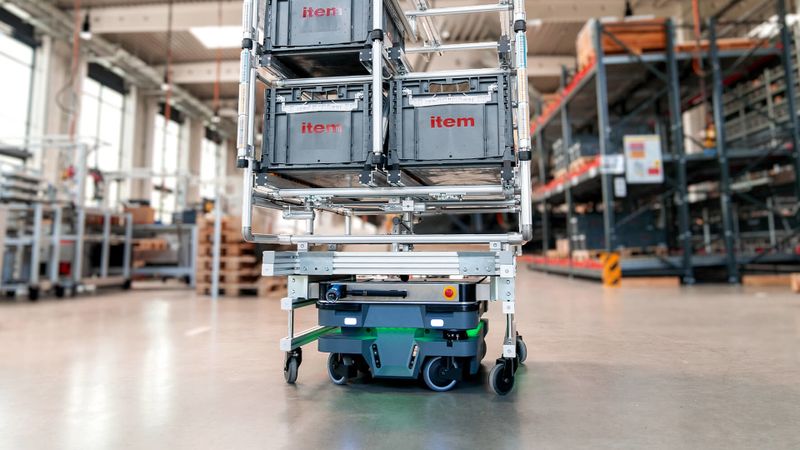
Support for planning a driverless transport system: The interplay between Base Carts and Top Modules (customised superstructures) opens up a wide range of possibilities for using mobile industrial robots.
(Source: item)
Driverless transport systems that operate with mobile robots have become indispensable for automated intralogistics. They streamline transport processes and reduce the strain on staff. But what is the best way to get started with a project like this? If you want to integrate mobile robots efficiently and run them cost-effectively, you first need to plan your driverless transport system in detail. Although technical components play an important role, responsibilities, safety aspects, environmental conditions and the right peripherals are also crucial.
Would you like to find out about the basics of mobile industrial robots first? The free white paper from item Industrietechnik provides an excellent introduction to the topic:
The first step is to clarify responsibilities. Involve all the relevant people directly – both for planning and implementation. This is the only way to obtain a complete overview of all processes. During this phase, you should try to answer questions such as:
Who is responsible for planning and implementation?
Have all the related departments been informed about the project?
Determine the tasks and objectives for the mobile robots
Once the project team has been established, key issues need to be addressed: What requirements does the driverless transport system need to meet? Answering the following questions can help you work out which specific mobile industrial robots are suitable:
Which processes are to be automated?
What goods are being moved around – pallets, mesh boxes, small load carriers (SLCs) or bulk goods?
Are the goods being transported changed or swapped?
How often do transport operations take place?
How heavy are the goods and what shape are they?
How many robots do you need for your planned system?
Another white paper from item sets out all the relevant details for carefully planning and implementing a driverless transport system using mobile robots:
Besides analysing the tasks, you should also consider the environment where the robots will be operating. The physical conditions have a direct impact on how they run, their sensor technology and their navigation. Consider the following questions:
Is a stable Wi-Fi connection available?
What is the condition of the floor?
Are there any obstacles, such as door thresholds?
Can lifts or other systems be integrated?
Does the environment offer sufficient space for safe track guidance?
Are there fixed points of orientation such as walls or pillars?
Take into account IT connectivity early on
A driverless transport system never operates in isolation – it is always integrated into a networked intralogistics system. It is therefore essential to consider IT integration. The following questions are particularly important to answer:
Is there already a wireless network?
Is there a warehouse management system?
Which system interface needs to be factored in for the warehouse equipment?
Consistently incorporate safety aspects
When planning a driverless transport system, safety requirements should be taken into account from the outset. VDI 2510 Sheet 2 describes the relevant specifications for operators and manufacturers of mobile industrial robots. Many mobile robots use lights or sounds to warn that they are approaching. Additional aspects to consider include:
Will the mobile robots operate in areas where employees are present?
Will the mobile robots work with people, or just on their own?
Will the mobile robots have a route reserved specifically for them?
Choosing the right mobile industrial robot
Which mobile industrial robot is best for your needs depends on all the factors listed above. It is important to think about technical, logistical and economic requirements as a whole:
What are the characteristics of the goods to be transported?
How is the load placed on the robot – manually, mechanically or automatically?
How does the robot navigate?
Which drive concept is used? Do you intend to change batteries manually, or use an inductive energy supply?
What is the available budget?
Don’t forget about transport and loading aids
Besides the robot itself, it is also essential to plan the peripherals for your driverless transport system. These must be optimally tailored to the transport task. Clarify the following questions:
Are the loading aids stackable and versatile?
What are the characteristics of the goods being transported in terms of shape, size and sensitivity to external influences, for example?
How safe is the transport process?
Can different goods be carried on the same type of robot?
Wouldn’t it be ideal if one solution could cover as many mobile industrial robots and transport goods as possible? This is where the specially developed Base Carts and Top Modules from item come into play. The Base Carts are base frames that have been adapted to the requirements of well-known mobile robot manufacturers. The Top Modules are superstructures that you can connect directly to the Base Carts via a standard interface. You can either design your own Top Modules with the item Engineeringtool or make use of preconfigured sample solutions. These can be adapted as required.
Whether you’re working with Euro pallets, mesh boxes, SLCs or racks, you can use item solutions to create modular mobile robot peripherals for a huge variety of transport tasks. This means that one robot can be used for multiple tasks.
Make the most of expert know-how and keep your plans realistic
Numerous factors determine whether your plans for a driverless transport system can be successfully put into practice. Not every mobile industrial robot is suitable for every application – and not every function is really necessary. It is best to involve an experienced partner at an early stage. This could be a manufacturer or integrator who will work with you from the planning stage through implementation to commissioning. Bear in mind that projects like these can take several months to complete. Realistic time planning is therefore a must.
Date: 08.12.2025
Naturally, we always handle your personal data responsibly. Any personal data we receive from you is processed in accordance with applicable data protection legislation. For detailed information please see our privacy policy.
Consent to the use of data for promotional purposes
I hereby consent to Vogel Communications Group GmbH & Co. KG, Max-Planck-Str. 7-9, 97082 Würzburg including any affiliated companies according to §§ 15 et seq. AktG (hereafter: Vogel Communications Group) using my e-mail address to send editorial newsletters. A list of all affiliated companies can be found here
Newsletter content may include all products and services of any companies mentioned above, including for example specialist journals and books, events and fairs as well as event-related products and services, print and digital media offers and services such as additional (editorial) newsletters, raffles, lead campaigns, market research both online and offline, specialist webportals and e-learning offers. In case my personal telephone number has also been collected, it may be used for offers of aforementioned products, for services of the companies mentioned above, and market research purposes.
Additionally, my consent also includes the processing of my email address and telephone number for data matching for marketing purposes with select advertising partners such as LinkedIn, Google, and Meta. For this, Vogel Communications Group may transmit said data in hashed form to the advertising partners who then use said data to determine whether I am also a member of the mentioned advertising partner portals. Vogel Communications Group uses this feature for the purposes of re-targeting (up-selling, cross-selling, and customer loyalty), generating so-called look-alike audiences for acquisition of new customers, and as basis for exclusion for on-going advertising campaigns. Further information can be found in section “data matching for marketing purposes”.
In case I access protected data on Internet portals of Vogel Communications Group including any affiliated companies according to §§ 15 et seq. AktG, I need to provide further data in order to register for the access to such content. In return for this free access to editorial content, my data may be used in accordance with this consent for the purposes stated here. This does not apply to data matching for marketing purposes.
Right of revocation
I understand that I can revoke my consent at will. My revocation does not change the lawfulness of data processing that was conducted based on my consent leading up to my revocation. One option to declare my revocation is to use the contact form found at https://contact.vogel.de. In case I no longer wish to receive certain newsletters, I have subscribed to, I can also click on the unsubscribe link included at the end of a newsletter. Further information regarding my right of revocation and the implementation of it as well as the consequences of my revocation can be found in the data protection declaration, section editorial newsletter.




:quality(80)/p7i.vogel.de/wcms/ec/ee/ecee771dce48d9c693f8869da717ceeb/robertwaghorn-jet-2974131-4777x2687v1.jpeg "European allies intensify cooperation efforts to boost defence capabilities and ensure long-term security stability. (Source: Robert Waghorn on Pixabay)")
:quality(80)/p7i.vogel.de/wcms/be/0b/be0b550a4fc2724afeed0713f65e7675/spexer-anechoic-chamber-1280x720v1.png "(Source: Hensoldt AG)")
:quality(80)/p7i.vogel.de/wcms/6f/0f/6f0fc6e3348925946d77fa2339e53005/0130142731v1.jpeg "Heidelberger Druckmaschinen Aktiengesellschaft establishes a joint venture with Ondas. The aim is to provide and market effective drone defence systems in Europe and Ukraine. (Source: Ondas)")
:quality(80)/p7i.vogel.de/wcms/05/29/05295a4f758848ae6c027cc78947453c/17818f1a7b12-banner-format-970x546v1.jpeg "(Source: Diehl Defence)")
:quality(80)/p7i.vogel.de/wcms/2e/15/2e15396bd28d5cc96f2c339a6b7bf1e8/l3harris-disco-1220-1217x684v1.jpeg "(Source: L3Harris Technologies)")
:quality(80)/p7i.vogel.de/wcms/0c/70/0c701a79c1f183921b8ee9341ef61db8/0129694966v1.jpeg "Robonode's DVK Development Kit: This is available through Codico's sample shop. (Image:8DEVICES)")
:quality(80)/p7i.vogel.de/wcms/7c/12/7c123d3888ed3a37a83b0793be569f00/hon-aero-hguide-i700-imu-comp-view-2880x1440-1024x576v1.webp "(Source: Honeywell)")
:quality(80)/p7i.vogel.de/wcms/62/06/6206d30afc9c4f286f4ecf4cedf575c5/stark-20virtus-20side-1920x1079v1.jpeg "To be introduced into service with the Bundeswehr: The “Virtus” developed by Stark has a range of up to 100 km and is designed to engage targets on the battlefield. (Picture: STARK Defence)")
:quality(80)/p7i.vogel.de/wcms/b4/ae/b4ae65d3fb3903a13571d9ea3e61da8a/mock-up-vleo-def-1920x1079v1.jpeg "Illustration of the VLEO-DEF satellite in orbit (Source: EDA)")
:quality(80)/p7i.vogel.de/wcms/11/c8/11c8d30d75151329d2700176eb7a0383/0130110840v1.jpeg "Zenadrone, a subsidiary of Zenatec, is working on developing an operational low-cost drone as a disposable concept (symbol image). The first prototype already exists. In the future, it is intended to counter increasing enemy drone attacks without significant financial effort... (Source: Zenadrone)")
:quality(80)/p7i.vogel.de/wcms/c8/4c/c84cef4bf459f1280823827c3e3615c2/7cf414af-d41d-46ac-b22b-890f9f32d24c-2048x1151v1.jpeg "In Manching, Germany, Airbus is currently preparing two Valkyries for their first flight with its European mission system. The picture shows one of them. (Source: Airbus)")
:quality(80)/p7i.vogel.de/wcms/e3/d7/e3d7de9cfaac27f48ee6e162f9b309e9/0128899731v1.jpeg "Here, Lufthansa's first anniversary aircraft lands in Frankfurt. (Image:Lufthansa)")
:quality(80)/p7i.vogel.de/wcms/06/37/0637c7dd3fab9b00a8e96f98133cd1dc/260304-d-d0477-1005-5892x3317v1.png "A B-52H Stratofortress idles prior to taking off in support of Operation Epic Fury in March 2026. (Source: U.S. Air Force)")
:quality(80)/p7i.vogel.de/wcms/13/2b/132bb2831ae98c4c3bdd0ee2990ba1eb/bareways-20deck-20--20crisis-20coordination-20platformv1.jpeg "(Source: Bareways)")
:quality(80)/p7i.vogel.de/wcms/93/f1/93f1e4dba53b2c9589fab17a525df55e/adobestock-163119218-2480x1394v1.jpeg "(Source: Kernkonzept GmbH)")
:quality(80)/p7i.vogel.de/wcms/8d/76/8d764c984e44153da8f0dfa88cd6d75e/0129843677v1.jpeg "A successful drone attack on two data centers of the Amazon subsidiary AWS shows that the danger of drones is virtually unavoidable in modern warfare ... (Source: Cerberus)")
:quality(80)/p7i.vogel.de/wcms/14/d3/14d3e0847d222af54aa5ab625480507f/0130015022v1.jpeg "A German-French battle tank project was approved some time ago (symbol image). But a modern drive system is also needed for it. This is now being developed by Rolls-Royce Power Systems and ZF in the coming years... (Image:Rheinmetall)")
:quality(80)/p7i.vogel.de/wcms/bd/21/bd2191aab59c430b3c74a2be07120333/image-196-1294x728v1.png "(Image:SkyDefender © Thales)")
:quality(80)/p7i.vogel.de/wcms/d4/dc/d4dc9a59e1698ae295b1e6e64a29a55b/geralt-handshake-5768632-1280-1280x720v1.jpeg "Rheinmetall and Nooteboom Trailers are collaborating on the development and marketing of heavy equipment trailer systems designed for transporting modern tracked and wheeled military vehicles. (Image:Gerd Altmann from Pixabay)")
:quality(80)/p7i.vogel.de/wcms/22/54/2254d1e2667aff755e7aba0bcaf2eb42/0130021093v1.jpeg "Daimler Truck and Quantum Systems are jointly developing unmanned military vehicles. (Image:Quantum Systems)")
:quality(80)/p7i.vogel.de/wcms/f9/2f/f92f1ef8c739c34c70d99f7b0997621b/stra007-20--20cover-20image-5472x3076v1.jpeg "(Source: Stratasys)")
:quality(80)/p7i.vogel.de/wcms/5e/18/5e184e4961f190c86a1ea3227104cab5/26pm03-20kompakte-20l-c3-b6sungen-20f-c3-bcr-20luft--20und-20raumfahrt-202-2362x1329v1.jpeg "(Picture: Keysight)")
:quality(80)/p7i.vogel.de/wcms/67/4c/674c54baa745be497cecb716826af339/stahlwille-hero-1807x1016v1.jpeg "A new modular tool solution designed for safety, precision, and mobility in aviation maintenance. (Source: STAHLWILLE)")
:quality(80)/p7i.vogel.de/wcms/0d/01/0d01a051ba894332a8091e3a3f9394e1/hytorc-defense-solutions-boxersatz-1899x1068v1.jpeg "HYTORC’s Defence Solutions toolkit, proven on the GTK Boxer, enables safe, traceable fastening of critical components across multiple Bundeswehr platforms. (Source: Image: HYTORC)")
:quality(80)/p7i.vogel.de/wcms/f3/4e/f34ed744bb30817d3432c7ad522e6f30/engine-1v1.jpeg "Engineering with aluminium profiles really can be this easy – the item Engineeringtool and its smart functions help you save valuable time. (Source: item)")
:quality(80)/p7i.vogel.de/wcms/fb/8e/fb8e5ae2aa27bcf3e466815505ca4ff2/alumin-1v1.jpeg "The aluminium profile technology of the item Building Kit System has been used to build a huge variety of structures for decades. (Source: item)")
:quality(80)/p7i.vogel.de/wcms/be/84/be84bbede3e40b1101cd3efa35a6ffa0/overview-of-20work-bench-design-in-productionv1.jpeg "With modular work bench design, you can convert or extend a work bench with ease by changing or adding accessories. This means changes can be implemented quickly and cost-effectively, thus boosting quality and productivity. (Source: item)")
:fill(fff,0)/images.vogel.de/vogelonline/companyimg/84700/84735/65.jpg "logo_item_rgb_neu.jpg ()")
:quality(80)/p7i.vogel.de/wcms/1c/a5/1ca520d57f3c6108dc6ebb2c77ec34f2/manufa-1v1.jpeg "Operating equipment, fixtures and fittings that can be easily adapted give high-tech manufacturing companies a decisive competitive advantage. The modular building kit principle from item Industrietechnik makes it much easier to design and build solutions such as stairways and platforms. (Source: item)")
:quality(80)/p7i.vogel.de/wcms/f3/4e/f34ed744bb30817d3432c7ad522e6f30/engine-1v1.jpeg "Engineering with aluminium profiles really can be this easy – the item Engineeringtool and its smart functions help you save valuable time. (Source: item)")