Embedded software for extreme requirementsPreprocess 20 Terabytes of Raw Data in the Satellite
From
| Translated by AI
4 min Reading Time
The preprocessing of large amounts of data on-site is not only a complex task for software systems. The required AI algorithms are supposed to work both on high-performance edge computing systems and on embedded platforms in satellites and ground stations.
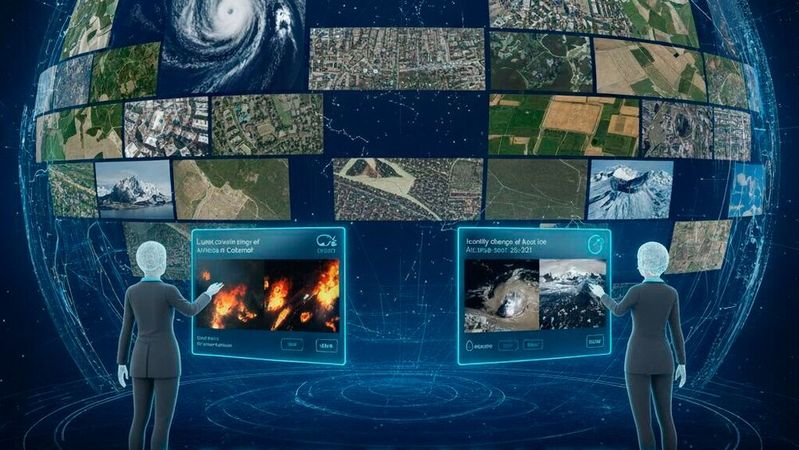
Agent BigEarth is based on a novel combination of several AI modules working together as specialised subagents.
(Image: BIFOLD)
What used to run on mainframes often has to work on resource-constrained embedded platforms today: from AI inference in satellites to complex routing algorithms in network hardware. The question is how to optimise compute-intensive algorithms so that they function reliably even on embedded systems with limited computing power and energy budgets. Two current research projects at TU Berlin demonstrate exemplary solution approaches.
Prof. Dr. Begüm Demir, head of the Remote Sensing Department and research group leader at BIFOLD (Berlin Institute for the Foundations of Learning and Data) at TU Berlin, as well as Prof. Dr. Stefan Schmid, head of the Internet Architecture and Management Department, each won one of the prestigious Proof of Concept Grants from the European Research Council (ERC). These grants bridge the gap between fundamental research and practical application, contributing to the translation of groundbreaking research results into concrete societal or economic benefits.
Both projects pose special challenges for embedded software development: the development of a digital, AI-supported assistant requires the optimisation of complex algorithms for resource-constrained embedded platforms, while automated tools for resilient communication networks demand real-time capable embedded networking software. Each of the grants is endowed with €150,000 (approx. 178,000 USD).
AI inference at the edge for satellite data
With the AI agent Agent BigEarth planned by Begüm Demir, the use of satellite data is reaching a turning point. At the same time, it poses a complex embedded software challenge. The BIFOLD scientists aim to develop Agent BigEarth to make large volumes of complex satellite data accessible not only to experts but also to interested laypeople. Particularly demanding: the AI modules should function on both high-performance edge computing systems and embedded platforms in satellites and ground stations.
Copernicus delivers around 20 terabytes of high-resolution Earth observation data daily with its Sentinel satellites. These massive data volumes require highly optimised embedded software for preprocessing directly on the satellite itself, as a complete transmission to Earth is not practical. The challenge for embedded developers: AI algorithms must run on ARM-based satellite computers with severely limited resources (power consumption, memory, computing power).
Europe’s security landscape is changing rapidly
(Source: VCG)
As defence budgets rise and EU programmes expand, civil technology providers are becoming vital contributors to Europe’s strategic autonomy. The event will act as a neutral platform for dialogue between technology suppliers, integrators, and decision-makers shaping the next generation of European defence capabilities and aims to open doors between civil industry and defence procurement, providing practical insights.
Technically, Agent BigEarth is based on a novel combination of multiple AI modules that collaborate as specialised subagents. This is also referred to as a classic embedded architecture pattern. The individual modules take on different tasks and are implemented as separate tasks or threads, coordinated via inter-process communication (IPC). A central control element functions as a real-time scheduler, coordinating operations and ensuring that complex requests are processed even under strict real-time requirements.
Embedded-specific challenges:
Memory Management: Efficient memory management for large image data.
Power Optimisation: Adaptive algorithms based on available satellite energy.
Fault Tolerance: Robust software for the harsh space environment.
Real-Time Constraints: Deterministic response times for time-critical Earth observation.
"If the implementation succeeds, Agent BigEarth could take a pioneering role for Europe in AI-supported environmental information," says Begüm Demir. Particularly interesting for embedded developers: The developed optimisation techniques can be applied to other resource-constrained AI applications.
Embedded networking under extreme conditions
Communication networks are a critical infrastructure of our digital society, whose embedded software components must operate under the toughest demands. In large networks, it is unavoidable that connections between network nodes fail. In such cases, the embedded routing software must find and configure alternative paths within microseconds. However, configuring these rerouting mechanisms is extremely complex and error-prone, as the embedded network processors only have a local view of the entire system.
With his ERC Proof of Concept Grant, Stefan Schmid is developing automated software tools that run directly on embedded network processing units and SDN controllers. These tools enhance the resilience of rerouting mechanisms against the simultaneous failure of multiple connections while meeting strict real-time constraints.
Recursive algorithms for embedded network processors
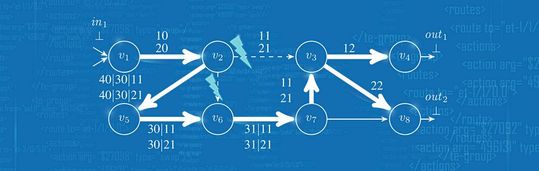
A link failure can result in communication traffic initially being redirected in another direction, away from the actual destination. Such rerouting can be recursive. On the alternative backup path, another link failure may require finding yet another alternative path.
(Image: Stefan Schmid)
The software tools are based on a recursive approach: similar to a back-pass play in football, embedded routing algorithms initially transport data packets in a different direction if all direct connections to the destination have failed. The particular challenge: these decisions must be made by distributed embedded systems in real time, without a global network view.
Date: 08.12.2025
Naturally, we always handle your personal data responsibly. Any personal data we receive from you is processed in accordance with applicable data protection legislation. For detailed information please see our privacy policy.
Consent to the use of data for promotional purposes
I hereby consent to Vogel Communications Group GmbH & Co. KG, Max-Planck-Str. 7-9, 97082 Würzburg including any affiliated companies according to §§ 15 et seq. AktG (hereafter: Vogel Communications Group) using my e-mail address to send editorial newsletters. A list of all affiliated companies can be found here
Newsletter content may include all products and services of any companies mentioned above, including for example specialist journals and books, events and fairs as well as event-related products and services, print and digital media offers and services such as additional (editorial) newsletters, raffles, lead campaigns, market research both online and offline, specialist webportals and e-learning offers. In case my personal telephone number has also been collected, it may be used for offers of aforementioned products, for services of the companies mentioned above, and market research purposes.
Additionally, my consent also includes the processing of my email address and telephone number for data matching for marketing purposes with select advertising partners such as LinkedIn, Google, and Meta. For this, Vogel Communications Group may transmit said data in hashed form to the advertising partners who then use said data to determine whether I am also a member of the mentioned advertising partner portals. Vogel Communications Group uses this feature for the purposes of re-targeting (up-selling, cross-selling, and customer loyalty), generating so-called look-alike audiences for acquisition of new customers, and as basis for exclusion for on-going advertising campaigns. Further information can be found in section “data matching for marketing purposes”.
In case I access protected data on Internet portals of Vogel Communications Group including any affiliated companies according to §§ 15 et seq. AktG, I need to provide further data in order to register for the access to such content. In return for this free access to editorial content, my data may be used in accordance with this consent for the purposes stated here. This does not apply to data matching for marketing purposes.
Right of revocation
I understand that I can revoke my consent at will. My revocation does not change the lawfulness of data processing that was conducted based on my consent leading up to my revocation. One option to declare my revocation is to use the contact form found at https://contact.vogel.de. In case I no longer wish to receive certain newsletters, I have subscribed to, I can also click on the unsubscribe link included at the end of a newsletter. Further information regarding my right of revocation and the implementation of it as well as the consequences of my revocation can be found in the data protection declaration, section editorial newsletter.
Embedded software requirements:
Deterministic Execution: Routing decisions within guaranteed time windows.
Memory-Efficient Data Structures: Optimised routing tables for embedded RAM.
Distributed Coordination: Synchronisation between embedded network nodes without a central instance.
Fault-Tolerant Programming: Software must function even in the event of partial hardware failures.
The working group of Professor Schmid is also cooperating with that of Prof. Dr. Jiri Srba from Aalborg University in Denmark and is developing implementations specifically optimised for embedded network hardware.
Simulation and verification on embedded target platforms
The approach also enables efficient "what-if analyses" directly on the embedded target platforms: a system operator can verify through such in-system simulations whether a current network configuration would function even in case of failures, without endangering the productive system. "Our development will provide the concrete foundation for application-ready software that could be immediately deployed on existing embedded hardware," says Stefan Schmid.
Conclusion: Both projects exemplify how complex algorithms and AI systems can be implemented on resource-constrained systems through smart embedded software architectures: from satellite computers to network processors. (heh)




:quality(80)/p7i.vogel.de/wcms/ac/7d/ac7dbefc23814d8f819c5751def8eada/et-copyright-nuernbergmesse-jpg-scaled-2560x1440v1.webp "At Enforce Tac 2026, TQ-Group presents modular embedded platforms and robust electronics systems for demanding security and defence applications. (Image: NürnbergMesse)")
:quality(80)/p7i.vogel.de/wcms/f3/bd/f3bd00e1542643e0cf654cc70e2e41ff/rose-gehaeuse-wehrtechnik-1-web-2052x1154v1.jpeg "Defence technology enclosures from ROSE are optimally customised for each specific application. (Image:ROSE Systemtechnik GmbH)")
:quality(80)/p7i.vogel.de/wcms/39/83/39833da1e9706839624b699018d42dee/oerlikon-skynex-01-1335x751v1.png "(Source: Rheinmetall)")
:quality(80)/p7i.vogel.de/wcms/5f/93/5f939961b9ae334fc5f9ac08851b7d7e/0129564079v1.jpeg "Better not ? The drones from Stark Defence can also carry out kamikaze actions. But there are concerns about the Bundeswehr purchasing the systems. It could be that the US investor Thiel could have too much influence over the company ... (Image:SD)")
:quality(80)/p7i.vogel.de/wcms/22/0f/220f18c2bd4c568655f4b73b2f4caa30/hohe-20sp-c3-bclqualit-c3-a4t-20bei-20high-20purity-20reinigung-kompr--6000x3373v1.jpeg "High flushing quality for high-purity cleaning: Test cleaning at the BvL Technology Center with the Atlantic cleaning system and a ultrapure water treatment system (EnviroFalk) (Source: BvL Oberflächentechnik GmbH )")
:quality(80)/p7i.vogel.de/wcms/2e/26/2e266230c10214384454c78a60c6f555/0129209328v1.jpeg "Agent BigEarth is based on a novel combination of several AI modules working together as specialized subagents. (Image:BIFOLD)")
:quality(80)/p7i.vogel.de/wcms/6d/08/6d088b8a36bcbc339121496f57f47b56/5-26-20peltier-20-28mil-29-druck-2100x1181v1.jpeg "(Source: Peltier)")
:quality(80)/p7i.vogel.de/wcms/c2/22/c222ab56cb3ec811c11a7c6595c53ac3/4u001-111-7680x4322v1.jpeg "(Source: Peli Products)")
:quality(80)/p7i.vogel.de/wcms/d6/2e/d62e273fe38b3d8e065f1a18fc0139ae/flugzeug-20am-20himmel-1792x1009v1.png "(Source: AI-generated)")
:quality(80)/p7i.vogel.de/wcms/b5/73/b5730627e660c2876c939c269f6ee206/galaxie-1792x1009v1.png "(Source: AI-generated)")
:quality(80)/p7i.vogel.de/wcms/cd/e0/cde08a34a9ee51700129d0264f4729e9/space-20debris-1536x864v1.png "(Source: AI-generated)")
:quality(80)/p7i.vogel.de/wcms/c6/2b/c62bfecb6c5ea4c72ed5fea645d6d501/esa-20artemis-1920x1079v1.jpeg "(Source: ESA - S. Corvaja)")
:quality(80)/p7i.vogel.de/wcms/08/e1/08e18119c40b9ccb8a253d8bafebf99b/signing-hensoldt-schwarz-digits-1280x720v1.png "At the signing (left to right): Christian Müller (Co-CEO Schwarz Digits), Oliver Dörre (CEO HENSOLDT), Rolf Schumann (Co-CEO Schwarz Digits). (Source: Schwarz Digits)")
:quality(80)/p7i.vogel.de/wcms/d8/84/d884e6d5d1f613f96f3b81caf770f4a1/volzi-hands-8062985-1280-1280x720v1.jpeg "Sphera’s Hazardous Material Management System (HMMS) supports current and future NASA missions, advances world-class research, innovation and exploration, and protects the people behind them. (Image:Andreas Volz on Pixabay)")
:quality(80)/p7i.vogel.de/wcms/a2/83/a2834934b7b64c86a2071c7d40deab79/evolution-wifi-3840x2158v1.png "The evolution of WiFi according to Qualcomm. (Copyright: Qualcomm)")
:quality(80)/p7i.vogel.de/wcms/3b/30/3b306e8e4a378f13cdb12b3107c5c642/curtiss-wright-2026-425x239v1.jpeg "(Image:Curtiss-Wright, Green Hills Software)")
:quality(80)/p7i.vogel.de/wcms/42/53/425386d9947a2808f3ca893cb8e9a6b0/img-20251008-150724-4640x2608v1.webp "(Source: EDA)")
:quality(80)/p7i.vogel.de/wcms/56/05/5605b839b834ac95bf6080eb8d45da8d/0129486952v1.jpeg "(Image:Helsing)")
:quality(80)/p7i.vogel.de/wcms/71/0a/710acaf63161980c2f36191d24dfcbac/hyperschallflugkoerper-bild-mod-uk-852x479v1.jpeg "(Source: Amentum)")
:quality(80)/p7i.vogel.de/wcms/f6/ce/f6ce03a1e0751ef6e8d9a63f6bf52dd5/istock-939134866-satellite-1920x1079v1.jpeg "(Source: SiTime)")
:quality(80)/p7i.vogel.de/wcms/5e/18/5e184e4961f190c86a1ea3227104cab5/26pm03-20kompakte-20l-c3-b6sungen-20f-c3-bcr-20luft--20und-20raumfahrt-202-2362x1329v1.jpeg "(Picture: Keysight)")
:quality(80)/p7i.vogel.de/wcms/67/4c/674c54baa745be497cecb716826af339/stahlwille-hero-1807x1016v1.jpeg "A new modular tool solution designed for safety, precision, and mobility in aviation maintenance. (Source: STAHLWILLE)")
:quality(80)/p7i.vogel.de/wcms/0d/01/0d01a051ba894332a8091e3a3f9394e1/hytorc-defense-solutions-boxersatz-1899x1068v1.jpeg "HYTORC’s Defence Solutions toolkit, proven on the GTK Boxer, enables safe, traceable fastening of critical components across multiple Bundeswehr platforms. (Source: Image: HYTORC)")
:quality(80)/p7i.vogel.de/wcms/f1/ab/f1ab7543976a5ac7364579f3106a3774/-e2-80-8b-e2-80-8bground-20container-20system-20for-20the-20eurofighter-20weapon-20system-20phot-20hensoldt-20agclipboard-07-25-2025-01-1022x575v1.jpeg "The GSCS: A fully shielded, self-sufficient ground system for mission and maintenance data processing, developed by HENSOLDT and steep for the Eurofighter weapon system. (Bild: HENSOLDT AG)")

:quality(80)/p7i.vogel.de/wcms/a1/cb/a1cb7d05f07da83f82bf38b09e8cff04/0125976394v1.jpeg "According to Deloitte's forecasts, revenues indicate that the chip industry could reach a volume of 1 trillion US dollars by 2030. (Image:Deloitte)")
:quality(80)/p7i.vogel.de/wcms/03/ee/03ee4a0432c83875e75602b49c2509a6/0118830961v1.jpeg "The integration of artificial intelligence in satellites enables faster, autonomous decision-making processes and optimizes the use of data downlink bandwidths in space. (Image:AMD)")