Researchers demonstrate for the first time that entangled quantum states can also be realized via the uplink—from Earth to satellite. Despite atmospheric disturbances and extremely low success rates, this method opens up new pathways for global quantum communication and thus for the quantum internet.
Quantum entanglement is expected to enable faster and more secure internet in the future.
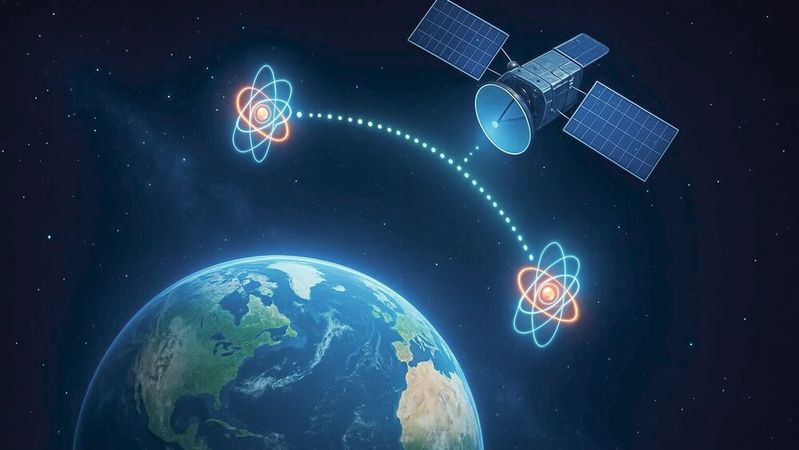
(Image: AI-generated)
The distribution of quantum state entanglement is a key component for future quantum-based communication and computing networks. Ground-satellite systems are considered a promising path to realize such connections over long distances. So far, the focus has mainly been on satellites generating entangled photon pairs in space and sending them down to Earth (downlink). This paper reverses that approach and systematically investigates the feasibility of the so-called uplink configuration: Two ground stations each generate a photon pair, send one photon from each pair to orbit, where a Bell measurement entangles the remaining qubits on the ground stations. This method theoretically offers advantages, such as reduced satellite hardware requirements and a shift in power demand to the ground, but has been considered practically unfeasible until now. The authors now show through numerical modeling that this uplink variant is, in principle, feasible.
Draft of the protocol
In the described setup, two ground stations are separated by a distance (DG). A satellite in low Earth orbit (LEO) is equidistant from both ground stations. Each ground station generates a Bell pair (in the model, perfect Bell pairs with Fidelity = 1 are assumed) and encodes one photon of the pair into the polarization of a photon, while retaining the other as a stationary qubit. Both photons are sent simultaneously to the orbiting satellite. In the satellite, an optical Bell measurement is performed using a combination of a polarization beam splitter (PBS), a 45° wave plate (Hadamard), and polarization splitting with detectors. A successful detection is registered if exactly two clicks are observed—one in each of the two spatially resolved modes—signifying that the remaining stationary qubits at the two ground stations are entangled.
Modeling of significant error sources
The authors consider several physical effects that could impact the success and quality (fidelity) of the protocol:
Mode mismatch: For the Bell measurement to function correctly, the two photons must arrive at the satellite perfectly overlapped in time and space. Any deviation increases the distinguishability of the photons and lowers the fidelity. The use of time gating reduces the proportion of unsynchronized photons but at the cost of success probability.
Beam widening and wandering: During the ascent to orbit, the photon beam increasingly spreads ("beam widening") and its center shifts randomly ("beam wandering") due to atmospheric turbulence. These effects reduce the coupling to the satellite telescope and thus the overall efficiency.
Atmospheric attenuation: The path through Earth's atmosphere leads to absorption and scattering – in the uplink variant, already at the beginning of the path, making the impact stronger than in the downlink variant.
Noise photons and background interference: The receiving area in the satellite is exposed not only to targeted photons but also to numerous unwanted photons, such as reflected sunlight, moonlight, or from the Earth's surface. These can cause erroneous measurements, thereby reducing the effective fidelity and success probability.
Success probability and quality
The overall performance of the protocol is characterized by two key metrics: the success probability (ηtot) and the resulting fidelity (F). The success probability is determined by the likelihood of obtaining a correct detection pattern ("signature") indicating a successful Bell measurement, accounting for all losses and noise sources. Fidelity, on the other hand, quantifies how "close" the generated entangled state is to an ideal Bell state, and it directly depends on the probability that a legitimate set of photon events is detected (relative to error events caused by noise). Simulations reveal a trade-off between a larger time-gating window (which allows for more photon detections) and higher fidelity: while a larger window increases the success probability, it also permits more noise or unsynchronized photons, thereby reducing fidelity.
Date: 08.12.2025
Naturally, we always handle your personal data responsibly. Any personal data we receive from you is processed in accordance with applicable data protection legislation. For detailed information please see our privacy policy.
Consent to the use of data for promotional purposes
I hereby consent to Vogel Communications Group GmbH & Co. KG, Max-Planck-Str. 7-9, 97082 Würzburg including any affiliated companies according to §§ 15 et seq. AktG (hereafter: Vogel Communications Group) using my e-mail address to send editorial newsletters. A list of all affiliated companies can be found here
Newsletter content may include all products and services of any companies mentioned above, including for example specialist journals and books, events and fairs as well as event-related products and services, print and digital media offers and services such as additional (editorial) newsletters, raffles, lead campaigns, market research both online and offline, specialist webportals and e-learning offers. In case my personal telephone number has also been collected, it may be used for offers of aforementioned products, for services of the companies mentioned above, and market research purposes.
Additionally, my consent also includes the processing of my email address and telephone number for data matching for marketing purposes with select advertising partners such as LinkedIn, Google, and Meta. For this, Vogel Communications Group may transmit said data in hashed form to the advertising partners who then use said data to determine whether I am also a member of the mentioned advertising partner portals. Vogel Communications Group uses this feature for the purposes of re-targeting (up-selling, cross-selling, and customer loyalty), generating so-called look-alike audiences for acquisition of new customers, and as basis for exclusion for on-going advertising campaigns. Further information can be found in section “data matching for marketing purposes”.
In case I access protected data on Internet portals of Vogel Communications Group including any affiliated companies according to §§ 15 et seq. AktG, I need to provide further data in order to register for the access to such content. In return for this free access to editorial content, my data may be used in accordance with this consent for the purposes stated here. This does not apply to data matching for marketing purposes.
Right of revocation
I understand that I can revoke my consent at will. My revocation does not change the lawfulness of data processing that was conducted based on my consent leading up to my revocation. One option to declare my revocation is to use the contact form found at https://contact.vogel.de. In case I no longer wish to receive certain newsletters, I have subscribed to, I can also click on the unsubscribe link included at the end of a newsletter. Further information regarding my right of revocation and the implementation of it as well as the consequences of my revocation can be found in the data protection declaration, section editorial newsletter.
Further simulations show that as the satellite altitude and the distance between ground stations increase, both fidelity and success probability decrease significantly. Initially, increasing altitude improves the situation because photons traverse less atmosphere (due to a decreasing zenith angle). However, at higher altitudes, beam divergence becomes the dominant factor. Additionally, as the distance between ground stations increases, the photon path length grows, which amplifies losses and noise.
Under optimized parameters – e.g., time gating of 40 ns, wave packet width 10 ns, satellite altitude 200 km (approx. 124 miles), ground station distance 300 km (approx. 186 miles)—a fidelity of approximately 0.972 with a success probability of around 1.5 × 10⁻⁴ can be achieved. For more realistic altitudes (500 km) and distances (1,000 km, approx. 620 miles), still acceptable values of fidelity ~ 0.84 and η ≈ 2.4 × 10⁻⁶ are obtained.
Discussion and outlook
The study demonstrates that the uplink variant of entanglement distribution is theoretically feasible, but under specific conditions: nighttime operation, shorter distances between ground stations, low orbital altitude, and excellent synchronization and optics are required. During daytime, noise levels are so high that fidelity drops to approximately 0.25, rendering the operation practically inefficient. However, the significant advantage lies in the fact that ground stations can provide much higher photon generation power than satellites. This opens up possibilities for more compact satellite architectures that primarily serve as measurement stations, while high-powered ground stations handle the main workload.
For future work, the hardware implementation will be particularly critical: the study assumes on-demand photon sources as a model, but these are not yet experimentally available with sufficient quality. Pulsed sources, which produce photons probabilistically, introduce additional synchronization challenges between the two ground stations. The multiplexing of the protocol—essential for achieving higher rates—also requires thorough investigation, as does a synchronization protocol to correctly tag the photons for entanglement.
Final remark
In summary, the analysis demonstrates that the use of satellites for uplink methods in quantum optical entanglement distribution is not merely a theoretical variation but a realistic option. Although the achieved success probabilities are very low—around 10⁻⁶—they provide new avenues for the global networking of quantum stations when sufficient fidelity is ensured. This represents another building block for the future realization of the "quantum internet." (mr)




:quality(80)/p7i.vogel.de/wcms/d9/a3/d9a3c241961e6c2aa668d0147292bc49/screenshot-2026-09-17-113517-931x524v1.png "Dr. Elisabeth Hauschild will take over as Chief Executive of the BDSV in November 2026. (Source: BDSV)")
:quality(80)/p7i.vogel.de/wcms/da/35/da35a98002ba254047f09248e6bbca56/si-wafer-1920x1080v1.jpeg "Fridge, Car, Tank? Semiconductors are a key dual-use technology. Chips developed for civilian markets are increasingly critical to drones, sensors, communications and other defence systems. (Photo: )")
:quality(80)/p7i.vogel.de/wcms/f9/b2/f9b2efe6f896ab3431ddf07882ea4cfd/chatgpt-image-17--sept--2026-10-47-05-1536x864v1.png "Rare Earth supply will remain a bottleneck for European Defence companies as China controls most mining and production capacities. (Picture: AI generated)")
:quality(80)/p7i.vogel.de/wcms/54/cb/54cbfdb9d826c9efc90ac358dcf62c6c/ktyvus-624x351v1.jpeg "(Source: Aktyvus Photonics)")
:quality(80)/p7i.vogel.de/wcms/0a/14/0a1495d9b570ae32a5a7cc748b9a3c60/st-hannover-035-1920x1079v1-999x562v1.jpeg "Fastening technology you can experience first-hand—visitors to Schraubtec in Bochum (Germany) can see it for themselves at the Ruhr Congress on September 30, 2026. (Source: PHOTOVISION-DH GmbH)")
:quality(80)/p7i.vogel.de/wcms/cd/a9/cda92b173afa9d0b455d4f11b281c9ea/0094-to-image--capstone-cdr-1440x810v1.png "(Source: Terran Orbital)")
:quality(80)/p7i.vogel.de/wcms/e0/45/e045bc5414d7263fb308bdd501b5fcc1/0133113962v1.jpeg "The HSWL 354 is the transmission used, for example, in the Leopard 2 main battle tank. Renk manufactures this system and is now preparing to significantly increase its cycle time. As a result, Renk is placing greater emphasis on the military sector as a customer ... (Source: Renk)")
:quality(80)/p7i.vogel.de/wcms/a1/5c/a15c2aeba563d5bc3e11fb879b21eb2c/0132989650v1.jpeg "FSS, the flexible clamping system for varying free-form surfaces, is designed for the aerospace industry and other sectors. (Source: Römheld GmbH Friedrichshütte)")
:quality(80)/p7i.vogel.de/wcms/93/5b/935bf130ead9c4dc6aac0f47e386a56a/0133268906v1.jpeg "Here, two experts from Lufthansa Technik are applying the film called “AeroSHARK” to an aircraft. Until now, Boeing has been using this coating, which mimics the skin structure of sharks. Now Airbus also wants to use it to make its aircraft more fuel-efficient. (Source: Lufthansa Technik)")
:quality(80)/p7i.vogel.de/wcms/fc/14/fc144df6171fd26da8fe1a0a30c28505/bild-1-tom-bild-der-herausgeschleuderten-aschewolke-anak-krakatau-9-2026-tom-zentrum-f-r-telematik-w-rzburg-802x451v1.png "The TOM satellites happened to be flying over the volcanic island of Anak Krakatau during the eruption and observed the rising volcanic ash cloud from an optimal position as it was ejected to an altitude of up to 15 km (approx. 9.3 miles). (Source: TOM, Center for Telematics Würzburg)")
:quality(80)/p7i.vogel.de/wcms/46/8e/468effa87546a2b036dc88ca40e2843e/129fbcac92ce7da872b13af0281b0799-l-png-1920x1079v1.webp "(Source: Arianespace)")
:quality(80)/p7i.vogel.de/wcms/8f/10/8f10697d4bfbd70edf615cca76eaedfd/pete-linforth-on-pixabay-1920x1080v1.jpeg "(Source: Pete Linforth on Pixabay / AI-generated)")
:quality(80)/p7i.vogel.de/wcms/9d/8a/9d8addea8cc4e6f7a4793563ca397f2a/ai-im-milit-r-1672x940v1.png "(Source: KI-generiert / Gemini)")
:quality(80)/p7i.vogel.de/wcms/7f/5f/7f5fba2c729ec3aa256bf1a18d74529b/ai-chip-1672x940v1.png "(Source: KI-generiert / Gemini)")
:quality(80)/p7i.vogel.de/wcms/64/1b/641b6474b2a614cde7730c89ef2a3015/2026-09-09-rheinmetall-veroeffentlicht-battlesuite-schnittstellen-e8c18194-1225x690v1.jpeg "Rheinmetall’s Battlesuite provides a modular digital platform for connecting and integrating sensors, hardware and software components. (Source: Rheinmetall AG)")
:quality(80)/p7i.vogel.de/wcms/6f/fe/6ffef325e7f233cc3521943158eb1ebd/0132763535v1.jpeg "Two companies are planning to establish, for the first time in 2027, an optical laser communication link directly between a satellite in low Earth orbit (LEO) and a re-entering spacecraft. (Source: ATMOS Space Cargo)")
:quality(80)/p7i.vogel.de/wcms/8f/f9/8ff91b78b26cb5a2b8a29e39835005b1/2026-09-10-repmus-teaser-images-retouched-dsc01292-1024x683-1024x576v1.jpeg "(Source: Quantum Systems GmbH)")
:quality(80)/p7i.vogel.de/wcms/bf/4a/bf4a237e60d3d4bd1bbdbad918f3c697/airbus-defence-and-space-3-1280x720v1.jpeg "(Source: Airbus Defence and Space)")
:quality(80)/p7i.vogel.de/wcms/e0/d1/e0d112a0d54a4fa9603ec855f7d25b47/t-rex-content-photo-jpg-pc-adaptive-990-medium-988x556v1.jpeg "Swarm of UAVs conducting a fully autonomous collaborative swarm mission. (Source: Lockheed Martin)")
:quality(80)/p7i.vogel.de/wcms/79/fc/79fcaa7ca33e393b11a4740d7d8f3dbe/vilkasss-handshake-9459740-1911x1076v1.jpeg "(Source: Vilius Kukanauskas on Pixabay)")
:quality(80)/p7i.vogel.de/wcms/90/a8/90a849f0023f11d1eb642eb4751a0321/bild2-h-c3-a4nel-ict-20truck-20and-20trailer-20parts-4320x2429v1.jpeg "Product information is visible at all times and retrieval of items
is confirmed by employees directly on the display of the Hänel MP 14 N
controller. (Source: René Marks)")
:quality(80)/p7i.vogel.de/wcms/4e/ca/4ecaa39f247490eded591b652c33aee3/thilmann-hcp-web-20kleiner-20ausschnitt-1442x811v1.jpeg "Entering the defence market can be challenging for start-ups, says HCP Sense CEO Ansgar Thilmann. (Picture: HCP Sense)")
:quality(80)/p7i.vogel.de/wcms/7a/51/7a511b80041d3f1335f3a5aa56fe75da/delivery-7022432-1280-1280x720v1.png "(Source: Mohamed_hassan)")
:quality(80)/p7i.vogel.de/wcms/f9/2f/f92f1ef8c739c34c70d99f7b0997621b/stra007-20--20cover-20image-5472x3076v1.jpeg "(Source: Stratasys)")
:quality(80)/p7i.vogel.de/wcms/ec/a9/eca9062ccbe4b042f8515846340410d8/aerospace-and-defence-stairways-platforms-and-much-morev1.jpeg "Modular constructions enable flexible modification. That applies to larger structures such as stairways and platforms, too. And that means aerospace and defence companies can reconfigure their maintenance platforms fast (itemitem)")
:quality(80)/p7i.vogel.de/wcms/30/2a/302a7b5723ad38fbde812fd3a468ad04/safety-on-stairways-in-industry-key-considerationsv1.jpeg "Stairways and platforms are used widely in maintenance and assembly areas in the aerospace and defence sectors. (Source: item)")
:quality(80)/p7i.vogel.de/wcms/f3/4e/f34ed744bb30817d3432c7ad522e6f30/engine-1v1.jpeg "Engineering with aluminium profiles really can be this easy – the item Engineeringtool and its smart functions help you save valuable time. (Source: item)")
:fill(fff,0)/p7i.vogel.de/companies/69/6d/696de2483d115/logo--fastems-rgb-horizontal.jpeg "logo--fastems-rgb-horizontal (Fastems)")
:fill(fff,0)/images.vogel.de/vogelonline/companyimg/84700/84735/65.jpg "logo_item_rgb_neu.jpg ()")
:quality(80)/p7i.vogel.de/wcms/57/db/57db8c40974f389e9f98518f89820913/0127272373v1.jpeg "Key experiment in the QuNET project: A research aircraft served as a mobile node in a quantum network and established a connection to a ground station. Photons were received and measured on the ground. (Image:DLR. All rights reserved)")
:quality(80)/p7i.vogel.de/wcms/21/a9/21a98d8261e93fe9425796a7c6c7b5f5/0127301615v1.jpeg "The communication of IoT devices via standard mobile network protocols through satellites is possible. (Image:Sateliot)")