Repurposed composites take gold—and show why collaboration is the key to aerospace circularity
Airbus demonstrates how innovative engineering and cross-industry collaboration enable circular economy principles in aerospace.
(Image: Chris on Pixabay)
Airbus has helped to engineer a new second life for a thermoplastic composite flying part. This successful repurposing doesn’t just mark a technical breakthrough. It’s a demonstration of why the circular economy requires working together across the supply chain. The proof? The collaborative project is now a prize-winning success!
A consortium of aerospace companies has successfully recycled and repurposed a thermoplastic composite aircraft part. One of the partners, Toray, has earned a prestigious Innovation Award from the composite industry organisation JEC in the process.
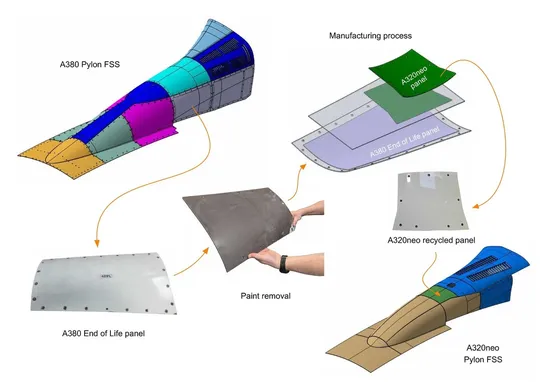
The consortium took an end-of-life A380 engine pylon fairing cover and transformed it into an equivalent component for the A320neo. The division of labour between the partners demonstrates the centrality of collaboration to circularity, from the biggest OEMs to niche specialists. It’s also a great example of how Airbus is encouraging innovation in the complex science of composite recycling.
Recycling and Repurposing
The recycling process.
(Image: Airbus)
Composites are hard to recycle and even harder to repurpose for aerospace. The prize-winning initiative, a collaboration between Airbus, Daher, Tarmac Aerosave and Toray Advanced Composites, shows that a pathway to industrial-scale repurposing for certain types of composite materials could be possible.
This is significant, as aircraft manufacturers increasingly use composite materials to save weight and lower aircraft fuel burn. Additionally, identifying methods to reuse composite materials could mean reduced waste and a more localised approach to materials sourcing, both key to a circular economy. Lastly, recycling parts consumes less energy than manufacturing new ones.
The initiative converted an end-of-life A380 engine pylon cowl (a ‘secondary structure’ in the jargon) into a smaller-sized panel that can be installed on the pylon of a A320neo, once re-certified.
Progress through Partnership
JEC hosts its prestigious Composites Innovation Awards every January. The Awards are not limited to aerospace and are highly competitive, receiving more than 170 applications each year.
Europe’s security landscape is changing rapidly
(Source: VCG)
As defence budgets rise and EU programmes expand, civil technology providers are becoming vital contributors to Europe’s strategic autonomy. The event will act as a neutral platform for dialogue between technology suppliers, integrators, and decision-makers shaping the next generation of European defence capabilities and aims to open doors between civil industry and defence procurement, providing practical insights.
The Award in the circularity and recycling category went to Toray—the supplier and manufacturer of the Toray Cetex® thermoplastic composite material used for the original A380 cowl—for overseeing the initiative. “This recognition from the JEC shows how complex challenges, including high-value recycling, are best tackled through partnership,” says Isabell Gradert, Airbus VP Central Research and Technology, who represented the company at the January 2026 ceremony. “We exist in a complex aerospace supply chain in a hyper-connected world. If a company comes up with a solution on its own, that’s a great story. If an entire industry does it together, that’s transformative, since it can lead to something bigger!”
Airbus was part of the consortium that won the award in this category in 2025. Moreover, two other Airbus-led projects won prizes in their categories this year, including one also linked to thermoplastics. A fourth project finished in the top three in its category.
Recycling an A380 secondary Structure for Use on an A320neo: Who Does What?
Partner
Technical role
Contribution to the circular economy
Toray Advanced Composites Specialist in the development and production of advanced thermoplastic and thermoset composite materials.
JEC Innovation Award Winner – Developed and manufactured the original advanced composite thermoplastic material used to produce the A380 pylon cover; characterised the material and provided expert technical support for stamp forming and reshaping.
Developed recyclable thermoplastic composite materials, enabling reshaping, reuse and remanufacturing of aerospace components, while reducing material waste and lifecycle environmental impacts.
TARMAC Aerosave Aircraft storage, maintenance and end-of-life recycling specialist
Provided the end-of-life (EoL) A380 source parts that initiated the project.
Enabled the initiative by diverting high-value assets from waste streams and facilitating asset revaluation.
DAHER Aircraft manufacturer and industrial services provider.
Manufactured and produced the new A320neo components using the recovered material.
Implemented the industrial process necessary to repurpose the composite material at scale.
Airbus Original Equipment Manufacturer
Scientifically proved the different steps of thermoplastic reuse and initiated the framework to bring the partners together.
Integration of the recycled solution into a flight-test A320neo aircraft ahead of commercial deployment.
The consortium’s core innovation, a thermoplastic A380 engine pylon cowl, was ‘re-manufactured’ into a new, smaller A320neo pylon cowl. The quality and mechanical properties of this repurposed part are such that it is indistinguishable from a brand-new panel, potentially opening the way for scalable applications and both line-fit and retrofit introduction of recycled panels.
Data gathered from the initiative will inform Airbus' eco-design strategy, whereby new components are engineered from the outset to maximise material recovery and reuse at the end of their lifecycle.
The A380 contains over 10,000 flying parts made from different varieties of carbon fibre-reinforced thermoplastic composites. This makes the aircraft an ideal platform for testing and validating recycled material recovery practices
What is Circularity?
The ‘Circular Economy’ is an economic model that optimises the use and reuse of products, components and materials, while maintaining their integrity for as long as possible and minimising waste, emissions and energy consumption, through the appropriate design and continuous improvement of systems and business models.
Composites are difficult to recycle, which is why investigating new and innovative approaches is crucial. This has the potential to reduce reliance on virgin materials and the energy-intensive processes that often accompany them.
Date: 08.12.2025
Naturally, we always handle your personal data responsibly. Any personal data we receive from you is processed in accordance with applicable data protection legislation. For detailed information please see our privacy policy.
Consent to the use of data for promotional purposes
I hereby consent to Vogel Communications Group GmbH & Co. KG, Max-Planck-Str. 7-9, 97082 Würzburg including any affiliated companies according to §§ 15 et seq. AktG (hereafter: Vogel Communications Group) using my e-mail address to send editorial newsletters. A list of all affiliated companies can be found here
Newsletter content may include all products and services of any companies mentioned above, including for example specialist journals and books, events and fairs as well as event-related products and services, print and digital media offers and services such as additional (editorial) newsletters, raffles, lead campaigns, market research both online and offline, specialist webportals and e-learning offers. In case my personal telephone number has also been collected, it may be used for offers of aforementioned products, for services of the companies mentioned above, and market research purposes.
Additionally, my consent also includes the processing of my email address and telephone number for data matching for marketing purposes with select advertising partners such as LinkedIn, Google, and Meta. For this, Vogel Communications Group may transmit said data in hashed form to the advertising partners who then use said data to determine whether I am also a member of the mentioned advertising partner portals. Vogel Communications Group uses this feature for the purposes of re-targeting (up-selling, cross-selling, and customer loyalty), generating so-called look-alike audiences for acquisition of new customers, and as basis for exclusion for on-going advertising campaigns. Further information can be found in section “data matching for marketing purposes”.
In case I access protected data on Internet portals of Vogel Communications Group including any affiliated companies according to §§ 15 et seq. AktG, I need to provide further data in order to register for the access to such content. In return for this free access to editorial content, my data may be used in accordance with this consent for the purposes stated here. This does not apply to data matching for marketing purposes.
Right of revocation
I understand that I can revoke my consent at will. My revocation does not change the lawfulness of data processing that was conducted based on my consent leading up to my revocation. One option to declare my revocation is to use the contact form found at https://contact.vogel.de. In case I no longer wish to receive certain newsletters, I have subscribed to, I can also click on the unsubscribe link included at the end of a newsletter. Further information regarding my right of revocation and the implementation of it as well as the consequences of my revocation can be found in the data protection declaration, section editorial newsletter.




:quality(80)/p7i.vogel.de/wcms/18/83/1883958e6e69d7021484ebabb9841d12/0129986717v1.jpeg "155-millimeter shells for modern artillery are actually Rheinmetall's specialty. However, the Cartel Office has now waved through a Joint venture that will give the Düsseldorf-based company competition in the production of these products. And VW is also thinking about armaments ... (Source: Rheinmetall)")
:quality(80)/p7i.vogel.de/wcms/97/d1/97d1415e5fe96c1d3e31b63bc52f148b/0129969094v1.jpeg "With the Kraken K3 Scout unmanned drone boat, Rheinmetall is also aiming to achieve sales success at sea. This is made possible by the Blohm+Voss shipyard in Hamburg, which recently became part of the Düsseldorf-based armaments giant ... (Source: Blohm+Voss)")
:quality(80)/p7i.vogel.de/wcms/79/6c/796cd95a14147b408e376b3dfb08d056/defence-20equity-20facility-990x557v1.jpeg "(Source: EIB)")
:quality(80)/p7i.vogel.de/wcms/1b/d7/1bd76351ab741a6a2d24e5f2026c65d7/0128247463-1000x563v1.jpeg "(Source: AI-generated)")
:quality(80)/p7i.vogel.de/wcms/7c/12/7c123d3888ed3a37a83b0793be569f00/hon-aero-hguide-i700-imu-comp-view-2880x1440-1024x576v1.webp "(Source: Honeywell)")
:quality(80)/p7i.vogel.de/wcms/62/06/6206d30afc9c4f286f4ecf4cedf575c5/stark-20virtus-20side-1920x1079v1.jpeg "To be introduced into service with the Bundeswehr: The “Virtus” developed by Stark has a range of up to 100 km and is designed to engage targets on the battlefield. (Picture: STARK Defence)")
:quality(80)/p7i.vogel.de/wcms/4b/a3/4ba36ed2a3bbc5632aa56344ed9e9012/design-20ohne-20titel-1795x1009v1.png "High-performance ceramic components demonstrate the potential of advanced materials and additive manufacturing for precision industrial and aerospace applications. (Images:KYOCERA Europe GmbH)")
:quality(80)/p7i.vogel.de/wcms/9e/d8/9ed8df1b1bbd2941d486ed6b31a7078c/mc1753-20--20image-20--20lx4580-20mixed-20signal-ic-2669x1500v1.jpeg "(Image:Microchip Technology Inc. )")
:quality(80)/p7i.vogel.de/wcms/e2/34/e234e56f31ce44de622fb7ee925a904c/bild1-urheber-20kongsberg-1598x899v1.jpeg "(Source: Kongsberg)")
:quality(80)/p7i.vogel.de/wcms/3f/c0/3fc013e170392cf0fa715f22d68197d8/harakan-f2-2-topfront-mirror-1-4607x2592v1.jpeg "The HARAKAN-F2-2 rugged VPX computer from Kontron enables high-performance edge computing, AI processing and sensor fusion for demanding defence missions. (Image:Kontron AG)")
:quality(80)/p7i.vogel.de/wcms/3c/8f/3c8f1351d3d4338c3a4d3f21156d166a/368945-20dam-20imagery-software-driven-innovation-ea-20-282-29-1100x618v1.jpeg "(Source: PTC)")
:quality(80)/p7i.vogel.de/wcms/93/f1/93f1e4dba53b2c9589fab17a525df55e/adobestock-163119218-2480x1394v1.jpeg "(Source: Kernkonzept GmbH)")
:quality(80)/p7i.vogel.de/wcms/8d/76/8d764c984e44153da8f0dfa88cd6d75e/0129843677v1.jpeg "A successful drone attack on two data centers of the Amazon subsidiary AWS shows that the danger of drones is virtually unavoidable in modern warfare ... (Source: Cerberus)")
:quality(80)/p7i.vogel.de/wcms/6f/a7/6fa76be29e77ecb487a2dbbda36fc514/ki-generiert3a35a036-d062-432c-914c-d4fa050cf58f-1536x864v1.png "(Source: AI-generated)")
:quality(80)/p7i.vogel.de/wcms/32/cb/32cb64c4a0486d2f9283b8ea57003421/fkie-fraunhofer-entwickelt-ki-gestuetztes-lernmanagementsystem-fuer-die-bundeswehr-1440x810v1.jpeg "(Source: Philipp Plum / Fraunhofer FOKUS)")
:quality(80)/p7i.vogel.de/wcms/0b/ba/0bbad1438344133fa65cdb70ac833967/2026-03-04-rheinmetall-steigt-bei-kroatischer-dok-ing-ein---media--06a35258--query-402x-114e90d2-1910x1075v1.jpeg "Through the majority acquisition of DOK-ING, Rheinmetall expands its expertise in unmanned ground systems and autonomous military support vehicles. (Image:Rheinmetall AG)")
:quality(80)/p7i.vogel.de/wcms/22/ea/22ea2068a1f2a3ad3cac21eda628b0ad/range-motiv-a4-02-4741x2666v1.jpeg "The acquisition of NVL strengthens Rheinmetall’s position in naval shipbuilding and expands its capabilities in advanced maritime defence systems. (Image:Rheinmetall AG)")
:quality(80)/p7i.vogel.de/wcms/58/5a/585a92223bfdffdd69cbfc52d30e5367/7ba159ca-33ee-46ca-8da8-65ad1acc3aac-3102x1745v1.png "(Source: European Commission)")
:quality(80)/p7i.vogel.de/wcms/f9/2f/f92f1ef8c739c34c70d99f7b0997621b/stra007-20--20cover-20image-5472x3076v1.jpeg "(Source: Stratasys)")
:quality(80)/p7i.vogel.de/wcms/5e/18/5e184e4961f190c86a1ea3227104cab5/26pm03-20kompakte-20l-c3-b6sungen-20f-c3-bcr-20luft--20und-20raumfahrt-202-2362x1329v1.jpeg "(Picture: Keysight)")
:quality(80)/p7i.vogel.de/wcms/67/4c/674c54baa745be497cecb716826af339/stahlwille-hero-1807x1016v1.jpeg "A new modular tool solution designed for safety, precision, and mobility in aviation maintenance. (Source: STAHLWILLE)")
:quality(80)/p7i.vogel.de/wcms/0d/01/0d01a051ba894332a8091e3a3f9394e1/hytorc-defense-solutions-boxersatz-1899x1068v1.jpeg "HYTORC’s Defence Solutions toolkit, proven on the GTK Boxer, enables safe, traceable fastening of critical components across multiple Bundeswehr platforms. (Source: Image: HYTORC)")
:fill(fff,0)/p7i.vogel.de/companies/64/fe/64fec73b1a2fb/logo-master-ggbbytimken-286blue.jpeg "logo-master-ggbbytimken-286blue (GGB)")
:fill(fff,0)/p7i.vogel.de/companies/69/6d/696de2483d115/logo--fastems-rgb-horizontal.jpeg "logo--fastems-rgb-horizontal (Fastems)")


:quality(80):fill(efefef,0)/p7i.vogel.de/wcms/69/2e/692efea0af28e/header-wp-thws-405302.png "Header_WP_THWS_405302")
:quality(80)/p7i.vogel.de/wcms/89/24/8924ffad7a34dbd41d0164d260e030df/airbus-20circular-20economy-775x436v1.jpeg "Additive manufacturing and closed-loop recycling are central to efforts to reduce titanium and aluminium waste in aerospace production. (Bild: EcoTitanium/Airbus)")
:quality(80)/p7i.vogel.de/wcms/eb/0f/eb0f66ba40012a2542d70f48150cf0e9/0129857578v1.jpeg "What you can see here are the first fully automatically produced composite rotor blades made of thermoplastic CFRP for drones. The company that has mastered this production process is called Engel. It will be presented at the JEC World 2026 in Paris. (Source: Angels)")