Germany’s defence industry is growing fast and urgently needs IT and tech experts. From cybersecurity to embedded systems, skilled professionals are in high demand.
Cybersecurity and software specialists are in high demand—especially for secure systems in defence, avionics and critical infrastructure.
(Image: YER Deutschland)
The German arms and defence industry is undergoing a historic upheaval. The term ‘Zeitenwende’, meaning a historic turning point, used by former Federal Chancellor Olaf Scholz on 27 February 2022, marks not only a new approach to security policy, but also a profound shift within the labour market. Defence spending is increasing, the German Armed Force’s EUR 100 billion (approx. 117 billion USD) special fund is acting as a catalyst, and companies in the industry are massively expanding their capacities.
The order pipeline of many systems companies, IT service providers and suppliers is fuller than it has been for decades. According to the Federation of German Security and Defence Industries (BDSV), the German sector is growing at an annual rate of 8 to 10 per cent—and with it the number of personnel required. Particularly in the technical field, the demand for highly qualified specialists is enormous. At the same time, specialised experts are rare—which poses a challenge for companies, while also presenting a great opportunity for applicants with technological expertise and an interest in security-related tasks.
High pressure to innovate, lack of staff
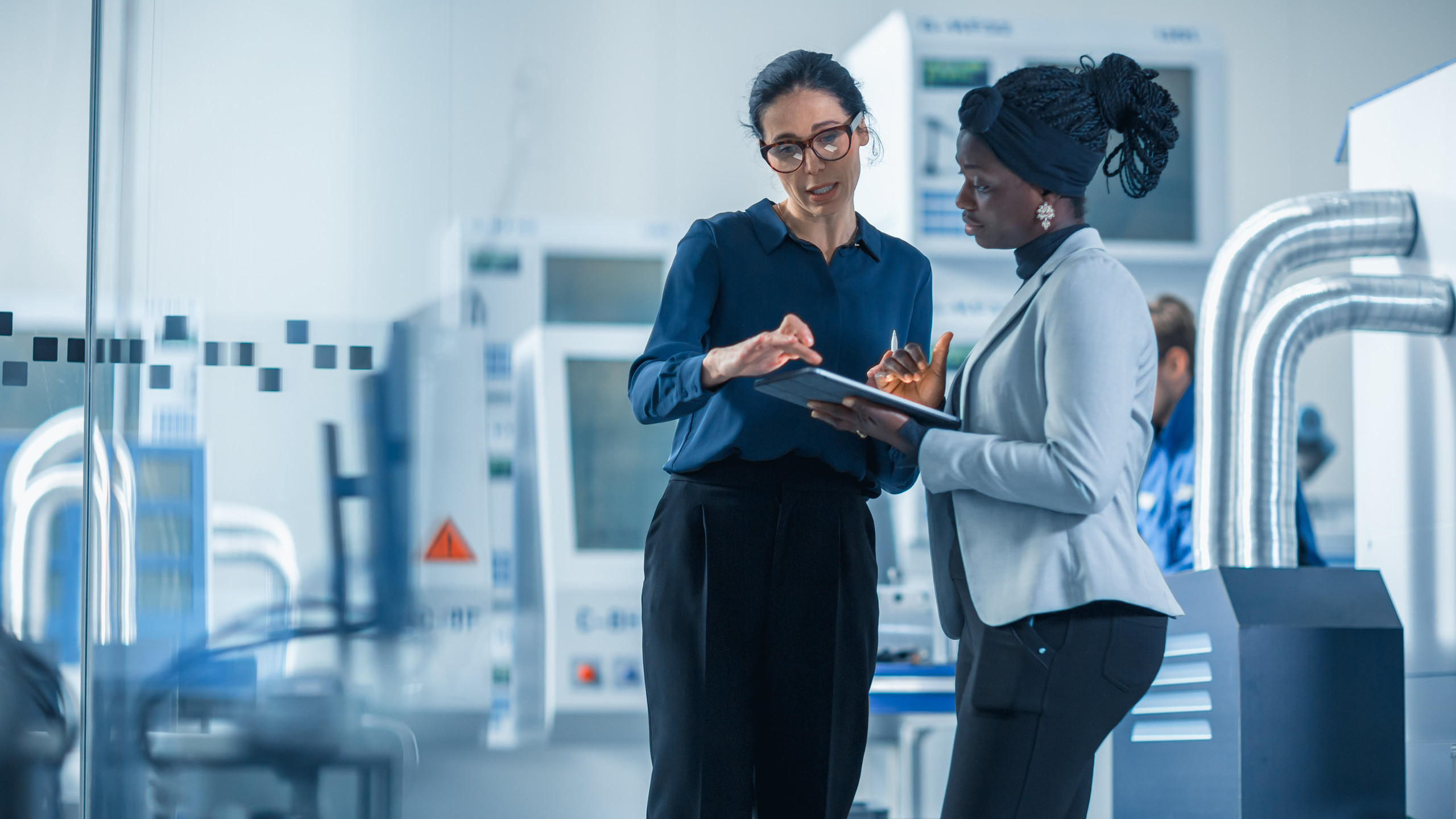
Defence and security projects demand cross-functional collaboration between engineering and project management.
(Image:YER Deutschland)
The acute shortage of skilled workers is exacerbating the already high pressure to innovate in the defence sector—particularly in areas such as cyber defence and electronic warfare. This involves protecting critical infrastructure and quickly detecting and defending against potential attacks. At the same time, technical fields such as sensor technology and reconnaissance, communication and networking (C4ISR), artificial intelligence, robotics and autonomous systems (e.g. drones or UGVs) must provide operational solutions for multinational operations.
Roles with safety-critical responsibilities are particularly affected by the shortage of skilled workers. Here, the demand for personnel is growing faster than the pool of suitable applicants. Technical specialists with in-depth expertise in key technologies—such as embedded systems, system architecture, real-time programming, cybersecurity, avionics, signal processing, sensors and AI and data engineering—are needed.
Recruiters have their sights set on systems, software and sensors
Job profiles in the arms industry are varied, but some sought-after functional areas clearly stand out:
Systems engineering: There is a need for system architects, requirements engineers and safety engineers who structure complex systems, define safety-critical requirements and coordinate implementation.
Hardware development: There is high demand for experts in FPGA design, radio frequency technology (RF/HF) and power electronics—essential for controllers, communication systems and drives.
Embedded software: Specialists in real-time operating systems, firmware development and safety-critical software are urgently needed—often with knowledge of DO-178C (aeronautics) or ISO 26262 (functional safety).
Cybersecurity: Specialists in secure coding, penetration testing and red/blue teaming are required to protect systems against external and internal attacks.
Cryptography: The demand for specialists in post-quantum cryptography, key management, encryption and hardware security modules (HSM) is constantly growing.
Communication and sensor technology: Radar and optronics experts as well as specialists in signal processing—key technologies in reconnaissance, navigation and target tracking—are particularly sought after.
Artificial intelligence and data fusion: AI experts are working on target recognition, autonomous systems and predictive maintenance—a growing field of innovation.
Dual-use technologies as a career bridge
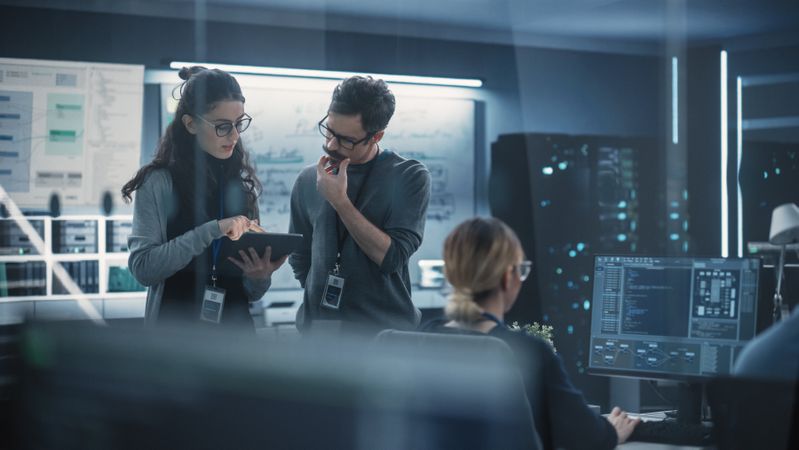
Interdisciplinary teamwork is essential for scaling complex technology projects in modern defence engineering.
(Image:YER Deutschland)
Dual-use technologies—i.e. those that can be used for both civilian and military purposes—play a key role when entering the industry. Examples include communications technology, sensor technology, AI and cybersecurity. For companies, dual use enables them to efficiently transfer the benefits of civilian innovation cycles to military applications, making them faster, more scalable and more independent. This creates attractive entry opportunities for professionals from civilian high-tech industries such as aerospace, robotics, telecommunications and industrial IoT, often with compatible expertise.
Examples of players in this field include Siemens (industrial electronics), Rohde & Schwarz (signal processing, communications), Bosch (robotics, sensor technology) and Quantum Systems (drones with AI). They all develop security-related technologies without necessarily participating directly in conventional arms programmes. The result is a career path with technical depth and social relevance.
A lateral move with a clear focus
If you want to grow and expand, you need people. Entry into security-related projects is therefore no longer limited to arms experts. The aerospace industry in particular is seen as a preferred source of talent, as many processes, technologies and safety standards are comparable—for example, in avionics, systems engineering or software development under regulatory conditions. Applicants from the automotive industry, for example, often need to take into account additional training, as standards, project timing and safety requirements differ significantly in some cases. However, lateral entry is still possible if the technical fit is right—and the applicant is prepared to take on further qualification in security-related requirements.
Tips for starting a career in defence
Applicants who are interested in entering the arms sector should fulfil some basic requirements—and prepare accordingly:
1. Security check: Many positions require a valid security clearance, which can also be requested. It is a clear bonus on your CV. 2. Technical specialisation: Companies are not looking for generalists, but genuine specialists with in-depth expertise—e.g. in signal processing, cybersecurity or embedded software. 3. Interdisciplinary understanding: Defence projects are complex and interlinked. Anyone who understands related fields will excel when it comes to teamwork and interface communication. 4. Knowledge of standards: Knowledge of technical standards such as DO-178C, IEC 61508 or MIL-STD standards is an advantage—or must be acquired during onboarding. 5. Language skills: Technical English is standard in many projects, while technical German remains essential, especially in government projects. 6. Reliability and confidence: Discretion, IT hygiene, loyalty and the confidential handling of information are essential in security-related roles.
Date: 08.12.2025
Naturally, we always handle your personal data responsibly. Any personal data we receive from you is processed in accordance with applicable data protection legislation. For detailed information please see our privacy policy.
Consent to the use of data for promotional purposes
I hereby consent to Vogel Communications Group GmbH & Co. KG, Max-Planck-Str. 7-9, 97082 Würzburg including any affiliated companies according to §§ 15 et seq. AktG (hereafter: Vogel Communications Group) using my e-mail address to send editorial newsletters. A list of all affiliated companies can be found here
Newsletter content may include all products and services of any companies mentioned above, including for example specialist journals and books, events and fairs as well as event-related products and services, print and digital media offers and services such as additional (editorial) newsletters, raffles, lead campaigns, market research both online and offline, specialist webportals and e-learning offers. In case my personal telephone number has also been collected, it may be used for offers of aforementioned products, for services of the companies mentioned above, and market research purposes.
Additionally, my consent also includes the processing of my email address and telephone number for data matching for marketing purposes with select advertising partners such as LinkedIn, Google, and Meta. For this, Vogel Communications Group may transmit said data in hashed form to the advertising partners who then use said data to determine whether I am also a member of the mentioned advertising partner portals. Vogel Communications Group uses this feature for the purposes of re-targeting (up-selling, cross-selling, and customer loyalty), generating so-called look-alike audiences for acquisition of new customers, and as basis for exclusion for on-going advertising campaigns. Further information can be found in section “data matching for marketing purposes”.
In case I access protected data on Internet portals of Vogel Communications Group including any affiliated companies according to §§ 15 et seq. AktG, I need to provide further data in order to register for the access to such content. In return for this free access to editorial content, my data may be used in accordance with this consent for the purposes stated here. This does not apply to data matching for marketing purposes.
Right of revocation
I understand that I can revoke my consent at will. My revocation does not change the lawfulness of data processing that was conducted based on my consent leading up to my revocation. One option to declare my revocation is to use the contact form found at https://contact.vogel.de. In case I no longer wish to receive certain newsletters, I have subscribed to, I can also click on the unsubscribe link included at the end of a newsletter. Further information regarding my right of revocation and the implementation of it as well as the consequences of my revocation can be found in the data protection declaration, section editorial newsletter.
Get expert advice—recruitment agencies provide a critical advantage
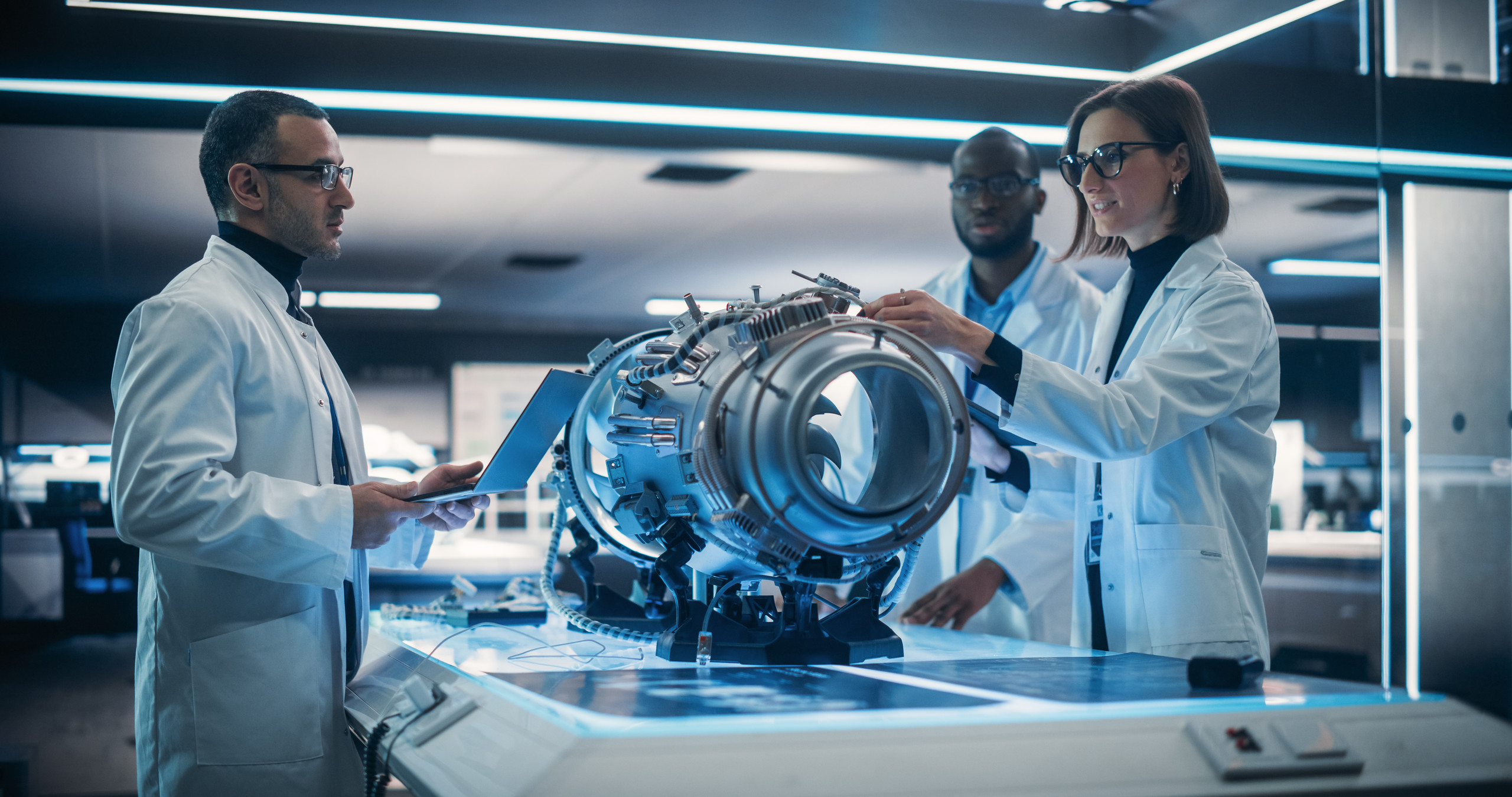
Applied research and innovation in defence technology: From propulsion systems to AI – engineering talent is the key to sovereign capabilities.
(Image:YER Deutschland)
It is precisely because the defence sector has specific requirements that it is worth working with specialist HR consultants. They know the market needs, can help with positioning and application strategy and often accompany the entire matching process between candidate and company. For career changers from IT and electronics in particular, this professional support can make all the difference.
Conclusion
Be it experienced experts or motivated career changers—anyone who wants to do technologically demanding work, carry out long-term projects and participate in tasks relevant to security policy will find a growing and promising professional field in the arms and defence industry. Demand is high, the transition is in full swing—and the time to get started is now.


:quality(80)/p7i.vogel.de/wcms/b7/63/b7636f2b1f7d6bb6336d335e59e4f36e/rheinmetall-werft-im-abendlicht-1672x940v1.png "Rheinmetall plans together with MSC to expand its naval shipbuilding activities at Romania’s Mangalia shipyard. (Symbolic Picture: AI generated)")
:quality(80)/p7i.vogel.de/wcms/45/3e/453ea7d14c36fb525ab9bcc6764021c2/teoresi-delta-1920x1079v1.jpeg "Guido Garelli (Teoresi), Robert Muirhead (Delta), Francesco Cianelli (Teoresi), Stuart Baskcomb (Delta) (Source: Foto Rumberger)")
:quality(80)/p7i.vogel.de/wcms/39/2a/392a5c99cee448cd241259b10273dbf8/ugvs-at-eu-opex-26-1920x1079v1.jpeg "Held with the Portuguese Armed Forces at the Santa Margarida military camp from 21 September to 14 October, it brought European defence innovators together with military users in realistic scenarios. (Source: European Defence Agency)")
:quality(80)/p7i.vogel.de/wcms/13/3a/133a672a407af81d20fcd97c4a10ff91/geralt-handshake-6796386-1920x1081v1.jpeg "(Source: Gerd Altmann from Pixabay)")
:quality(80)/p7i.vogel.de/wcms/9a/bf/9abfeb002156253fb3a82749de35ca28/saf2020-0333676-1800x1013v1.jpeg "A new \"Factory 4.0\" to make primary mirror segments for the Extremely Large Telescope. (Source: Safran Group)")
:quality(80)/p7i.vogel.de/wcms/a6/71/a6713b64fb8aee687258fcf1014ea3b5/2026-03-08-aerospike-09-980x551v1.jpeg "The engine was developed with the aid of Noyron, LEAP 71’s computer-aided design model. Noyron uses basic physical principles, engineering logic, and manufacturing specifications to design autonomously without human intervention. (Source: LEAP 71)")
:quality(80)/p7i.vogel.de/wcms/91/c9/91c93dbd66b08824c35643875aabe61f/bild1-1245x700v1.jpeg "Two scientists in front of a vacuum chamber used for testing. (Source: Busch Group)")
:quality(80)/p7i.vogel.de/wcms/76/1d/761de63f32752dc5a9722559c527fc1f/design-ohne-titel-5-1920x1079v1.png "(Source: Analog Devices)")
:quality(80)/p7i.vogel.de/wcms/f6/90/f69066c327229cfea821628238013ad1/6e0dd4339494960c5f2c491aa30a8d26-l-jpg-1920x1079v1.webp "(Source: Arianespace)")
:quality(80)/p7i.vogel.de/wcms/ae/c1/aec143cc59607cd59eeb8b824b860172/faroe-flag-image-for-pr-6-1680x944v1.png "(Source: Thales)")
:quality(80)/p7i.vogel.de/wcms/94/c2/94c200c11610b28c5107f271c8269c48/airbus-u740-valkyrie-first-flight-photo-02-valkyrie-heroshots-0010-8033-1920x1079v1.jpeg "The Airbus U740 takes off for its first flight in Europe.
(Source: Airbus Defence and Space GmbH 2026)")
:quality(80)/p7i.vogel.de/wcms/41/16/41162d793da057b8926aa216d1917f3a/image-2000-87c4e85417d8ad2252869e1109a24719-1918x1079v1.jpeg "Launch of SpaceX’s Transporter-18 Mission. (Source: SpaceX)")
:quality(80)/p7i.vogel.de/wcms/50/85/50856774ce46ad8f94f37e328ba3b6d3/ptc-frau-arbeitet-mit-model-am-pc-neben-turbine-1911x1076v1.jpeg "(Source: PTC)")
:quality(80)/p7i.vogel.de/wcms/9c/60/9c60e13e660fe6b444ec71c59b5598ce/publicdomainarchive-on-pixabay-1920x1079v1.jpeg "(Source: PublicDomainArchive on Pixabay)")
:quality(80)/p7i.vogel.de/wcms/b6/6d/b66d11215bcdb8e107ca626e6cfd3643/tungart7-future-9045696-1920x1079v1.jpeg "Transparent and controllable AI architectures can support crisis management by making data sources, reasoning processes and uncertainties visible to human decision-makers. (Source: Tung Lam on Pixabay)")
:quality(80)/p7i.vogel.de/wcms/ed/e6/ede67e479952b7bad62244697e3cd3db/aa383c9a-015c-424b-95da-d8d56156c227-1536x864v1.png "Intelic's AI-supported command-and-control system Nexus can integrate sensors and interceptor drones to counter aerial threats (Illustration). (Picture: AI generated)")
:quality(80)/p7i.vogel.de/wcms/25/1f/251f3ec674139d548928e3a2f0a0a040/airbus-1920x1079v1.jpeg "IRIS-T SLM Live Firing. (Source: Bundeswehr/ Hildemann)")
:quality(80)/p7i.vogel.de/wcms/ef/41/ef4177615d9b75cf072b762e861bf907/img-20261013-wa-0024-ef35b96969-1920x1079v1.jpeg "(Source: KNDS)")
:quality(80)/p7i.vogel.de/wcms/77/05/770532609ad5c97f627447f731bf1895/airbus-demonstrates-operational-readiness-for-nato-air-defence-in-crete-1920x1079v1.jpeg "Airbus Demonstrates Operational Readiness for NATO Air Defence in Crete. (Source: Airbus)")
:quality(80)/p7i.vogel.de/wcms/b9/fa/b9fa8db023a4ba7b2f0c7b6e0a611d89/2026-10-12-american-rheinmetall-auf-der-ausa-2026-69222c75-1225x690v1.jpeg "American Rheinmetall presents next-generation defence technologies and capabilities at AUSA 2026 in Washington, D.C. (Source: Rheinmetall AG)")
:quality(80)/p7i.vogel.de/wcms/90/a8/90a849f0023f11d1eb642eb4751a0321/bild2-h-c3-a4nel-ict-20truck-20and-20trailer-20parts-4320x2429v1.jpeg "Product information is visible at all times and retrieval of items
is confirmed by employees directly on the display of the Hänel MP 14 N
controller. (Source: René Marks)")
:quality(80)/p7i.vogel.de/wcms/4e/ca/4ecaa39f247490eded591b652c33aee3/thilmann-hcp-web-20kleiner-20ausschnitt-1442x811v1.jpeg "Entering the defence market can be challenging for start-ups, says HCP Sense CEO Ansgar Thilmann. (Picture: HCP Sense)")
:quality(80)/p7i.vogel.de/wcms/7a/51/7a511b80041d3f1335f3a5aa56fe75da/delivery-7022432-1280-1280x720v1.png "(Source: Mohamed_hassan)")
:quality(80)/p7i.vogel.de/wcms/f9/2f/f92f1ef8c739c34c70d99f7b0997621b/stra007-20--20cover-20image-5472x3076v1.jpeg "(Source: Stratasys)")
:quality(80)/p7i.vogel.de/wcms/ec/a9/eca9062ccbe4b042f8515846340410d8/aerospace-and-defence-stairways-platforms-and-much-morev1.jpeg "Modular constructions enable flexible modification. That applies to larger structures such as stairways and platforms, too. And that means aerospace and defence companies can reconfigure their maintenance platforms fast (itemitem)")
:quality(80)/p7i.vogel.de/wcms/30/2a/302a7b5723ad38fbde812fd3a468ad04/safety-on-stairways-in-industry-key-considerationsv1.jpeg "Stairways and platforms are used widely in maintenance and assembly areas in the aerospace and defence sectors. (Source: item)")
:quality(80)/p7i.vogel.de/wcms/f3/4e/f34ed744bb30817d3432c7ad522e6f30/engine-1v1.jpeg "Engineering with aluminium profiles really can be this easy – the item Engineeringtool and its smart functions help you save valuable time. (Source: item)")
:fill(fff,0)/p7i.vogel.de/companies/69/6d/696de2483d115/logo--fastems-rgb-horizontal.jpeg "logo--fastems-rgb-horizontal (Fastems)")
:fill(fff,0)/images.vogel.de/vogelonline/companyimg/84700/84735/65.jpg "logo_item_rgb_neu.jpg ()")

:quality(80)/p7i.vogel.de/wcms/3a/4e/3a4eee9a02e9c88c4b88fe5b430be79d/bild1-1386x779v1.jpeg "Defence companies need more than investment and technology: They also need the skilled professionals who can turn both into new capabilities. (Source: YER Germany)")
:quality(80)/p7i.vogel.de/wcms/64/53/645362efd3dc106ed3da74acb371d6be/foto-20knds-20boxer-20fertigung-4480x2519v1.jpeg "Skilled workers wanted: Production of BOXER drive modules at KNDS’ Munich facility. (Picture: KNDS)")