Optical data communication lasers can transmit several dozen terabits per second despite numerous disruptive air turbulences. Researchers at ETH Zurich, together with European partners, demonstrated this between Jungfraujoch and Bern. This could soon eliminate the need for the costly construction of undersea cables.
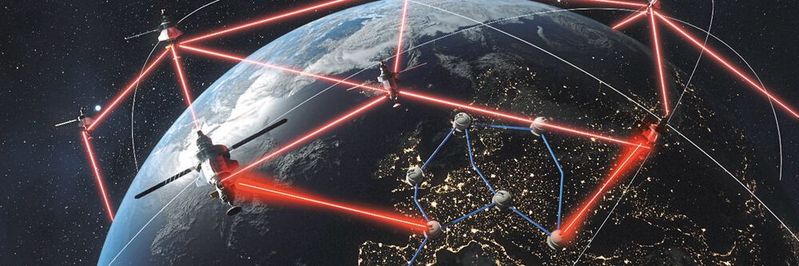
Satellites could soon replace the expensive undersea cables as the internet backbone.
(Image: ETH Zurich/Enea Ingellis)
The backbone of the Internet – the so-called backbone – consists of a dense network of fiber-optic cables, each capable of transporting up to more than a hundred terabits of data per second (1 terabit = 10¹² digital 1/0 signals) between network nodes. The continents are connected via the deep sea – and this is enormously expensive: a single cable across the Atlantic requires investments of several hundred million dollars. The specialized consulting firm Telegeography currently counts 530 active undersea cables, with the number steadily increasing. Soon, however, this effort may no longer be necessary. Scientists at ETH Zurich, together with partners from the aerospace industry, have demonstrated optical terabit data transmission through the air as part of a European Horizon 2020 project. In the future, this will enable backbone connections via low-Earth-orbit satellite constellations that are significantly cheaper and much faster to deploy.
Gallery
Challenging Conditions Between Jungfraujoch and Bern
The project partners did not test their laser system with a satellite in orbit, but rather through a 53-kilometer transmission from the mountain 'Jungfraujoch' to Bern (Capital of Switzerland). “Our test route between the High Alpine Research Station at 'Jungfraujoch' and the Zimmerwald Observatory of the University of Bern is, from the perspective of optical data transmission, significantly more challenging than between a satellite and a ground station,” explains Yannik Horst, the lead author of the study and a researcher at ETH Zurich in the Institute for Electromagnetic Fields, led by Professor Jürg Leuthold. The laser beam had to travel through the dense, near-ground atmosphere along the entire route. The movement of the light waves – and thus the data transmission – was influenced by the diverse turbulence of air currents above the snow-covered high mountains, the water surface of Lake Thun, the densely built-up Thun agglomeration, and the Aare plain. The extent to which this shimmering of the air, caused by thermal phenomena, disturbs the smooth propagation of light can be seen with the naked eye on hot summer days.
Satellite Internet Uses Slow Microwave Signals
Internet connections via satellites are not new. The most well-known example today is Elon Musk’s Starlink constellation, which, with over 2,000 low-Earth-orbit satellites, brings internet access to nearly every corner of the world. However, the technologies used to transmit data between satellites and ground stations are significantly less powerful. They operate like Wi-Fi (Wireless Local Area Network) or mobile networks in the microwave portion of the frequency spectrum, with wavelengths of several centimeters. In contrast, optical laser systems work in the near-infrared light range, with wavelengths around 10,000 times shorter, on the order of a few micrometers. This allows them to carry correspondingly more information per unit of time. To receive a sufficiently strong signal over long distances, the laser’s parallelized light waves are sent through a telescope, which can have a diameter of several dozen centimeters. This broad light beam must then be aimed as precisely as possible at a telescope at the receiver, whose diameter is roughly the same size as the incoming light beam.
Turbulence Wipes Out the Modulated Signals
To achieve the highest possible data rates, the laser light wave is additionally modulated so that a receiver can detect several distinguishable states per oscillation. This allows more than one information bit to be transmitted per oscillation. In practice, different amplitudes (heights) and phase shifts of the light wave are used. Each combination of phase angle and amplitude defines a distinct information symbol. Using a 4×4 scheme, 4 bits can be transmitted per oscillation, and with an 8×8 scheme, 6 bits. The constantly changing turbulence of air particles causes the light waves in the center and at the edges of the light cone to travel at different speeds. At the receiver’s detector, the amplitudes and phase angles then add or subtract from each other, resulting in incorrect values.
Mirrors Correct Wave Phase 1,500 Times Per Second
To prevent these errors, the French project partner provided a so-called MEMS chip (Micro-Electro-Mechanical System) with a matrix of 97 movable mirrors. By moving the mirrors, the phase shift of the beam across its cross-section can be corrected along the currently measured gradient 1,500 times per second. Overall, this results in an improvement of the signals by roughly a factor of 500. This enhancement was essential to achieve a bandwidth of 1 terabit per second over a distance of 53 kilometers, as Horst emphasizes. For the first time in the project, new, robust light modulation formats were also used. They massively increase detection sensitivity, enabling high data rates even under poor weather conditions or with low laser power. This is achieved through clever encoding of information bits onto properties of the light wave such as amplitude, phase, and polarization. “With our new 4D-BPSK modulation format (Binary Phase-Shift Keying), an information bit can still be correctly detected at the receiver with a very small number of only about four photons,” explains Horst. Overall, the success of the project required the specific expertise of three partners. The French aerospace company Thales Alenia Space excels in centimeter-precise laser targeting over thousands of kilometers in space. The also-French aerospace research institute Onera provides expertise in MEMS-based adaptive optics, which largely eliminated the effects of atmospheric turbulence. And the highly efficient modulation of signals, essential for high data rates, falls within the specialties of Leuthold’s research group.
Date: 08.12.2025
Naturally, we always handle your personal data responsibly. Any personal data we receive from you is processed in accordance with applicable data protection legislation. For detailed information please see our privacy policy.
Consent to the use of data for promotional purposes
I hereby consent to Vogel Communications Group GmbH & Co. KG, Max-Planck-Str. 7-9, 97082 Würzburg including any affiliated companies according to §§ 15 et seq. AktG (hereafter: Vogel Communications Group) using my e-mail address to send editorial newsletters. A list of all affiliated companies can be found here
Newsletter content may include all products and services of any companies mentioned above, including for example specialist journals and books, events and fairs as well as event-related products and services, print and digital media offers and services such as additional (editorial) newsletters, raffles, lead campaigns, market research both online and offline, specialist webportals and e-learning offers. In case my personal telephone number has also been collected, it may be used for offers of aforementioned products, for services of the companies mentioned above, and market research purposes.
Additionally, my consent also includes the processing of my email address and telephone number for data matching for marketing purposes with select advertising partners such as LinkedIn, Google, and Meta. For this, Vogel Communications Group may transmit said data in hashed form to the advertising partners who then use said data to determine whether I am also a member of the mentioned advertising partner portals. Vogel Communications Group uses this feature for the purposes of re-targeting (up-selling, cross-selling, and customer loyalty), generating so-called look-alike audiences for acquisition of new customers, and as basis for exclusion for on-going advertising campaigns. Further information can be found in section “data matching for marketing purposes”.
In case I access protected data on Internet portals of Vogel Communications Group including any affiliated companies according to §§ 15 et seq. AktG, I need to provide further data in order to register for the access to such content. In return for this free access to editorial content, my data may be used in accordance with this consent for the purposes stated here. This does not apply to data matching for marketing purposes.
Right of revocation
I understand that I can revoke my consent at will. My revocation does not change the lawfulness of data processing that was conducted based on my consent leading up to my revocation. One option to declare my revocation is to use the contact form found at https://contact.vogel.de. In case I no longer wish to receive certain newsletters, I have subscribed to, I can also click on the unsubscribe link included at the end of a newsletter. Further information regarding my right of revocation and the implementation of it as well as the consequences of my revocation can be found in the data protection declaration, section editorial newsletter.
Easily Scalable to 40 Terabits Per Second
The results of the experiment, presented for the first time at the European Conference on Optical Communication (ECOC) in Basel, are causing a worldwide stir, according to Leuthold: “Our system represents a breakthrough. Until now, it was only possible to either cover long distances with small bandwidths of a few gigabits or short distances of a few meters with high bandwidths using free-space lasers.” Additionally, the 1-terabit-per-second performance was achieved using a single wavelength. In a future practical application, the system can easily be scaled with standard technologies to 40 channels, reaching 40 terabits per second. However, Leuthold and his team will no longer focus on this. The practical implementation into a market-ready product will be handled by the industry partners. The ETH researchers will continue to pursue part of the work, though. The new modulation format they developed is expected to increase bandwidths in other data transmission methods where the energy of the radiation can become a limiting factor.



:quality(80)/p7i.vogel.de/wcms/49/1d/491decf8495373adfa5e31cf2921bef2/spectrum-fairing-and-mountain-c-isar-aerospace-1920x1080v1.jpeg "(Source: Isar Aerospace)")
:quality(80)/p7i.vogel.de/wcms/2a/ce/2aceb569f5721e88e4355be4dfa047f9/0132143966v1.jpeg "Underwater drones are the field in which the specialists at Exail Technologies operate. Now Thales, a defence contractor also based in France, has set its sights on the company with a view to acquiring it. (Source: Exail Technologies)")
:quality(80)/p7i.vogel.de/wcms/91/cd/91cdbe24534be1cf26391ebf274b6d6f/european-20defence-20projects-20of-20common-20interest-20-28edpci-29-20--20-28169-29-20-281-29-990x557v1.png "(Source: European Commission)")
:quality(80)/p7i.vogel.de/wcms/a2/59/a2594943bd88d379f4796a886d1ea95e/0132142400v1.jpeg "Record order for submarine builder TKMS. Canada has ambitious plans to protect its long coastline. This is to be achieved in the near future with the help of a dozen Model 212CD submarines. (Source: TKMS)")
:quality(80)/p7i.vogel.de/wcms/d1/90/d1900b4067dc7b3937b46cd929162a2c/uds-3-5220x2935v1.png "(Source: Unmanned Defense Systems)")
:quality(80)/p7i.vogel.de/wcms/f6/5e/f65e6f4b74ea62348db67acc8321fc16/pilotarcm2-1672x940v1.png "The Pilotarc M2 Desktop Plasma Cutting System enables on-site production of metal parts. (Picture: Pilotarc UG)")
:quality(80)/p7i.vogel.de/wcms/f2/b1/f2b170b6e6300d2203674681435a75fe/pm-akl-nachbericht-bild-5-6549x3685v1.jpeg "Fraunhofer ILT in Aachen is developing a highly complex laser-optical system for a quantum computer currently under development at the 5th Institute of Physics at the University of Stuttgart. (Source: Fraunhofer ILT)")
:quality(80)/p7i.vogel.de/wcms/34/3e/343ed2695270ad8597acb15e2e515354/s960-fleet-20260624-xt0077-049-960x540v1.jpeg "(Source: GOV.UK)")
:quality(80)/p7i.vogel.de/wcms/6b/db/6bdb23267ed0e7b7a0a47aedc19fd6c6/qs-featured-speed-record-260703-1024x695-1024x576v1.png "(Source: Quantum Systems)")
:quality(80)/p7i.vogel.de/wcms/35/21/352179f537683e7fffd0fa61bc91723e/0131827530v1.jpeg "The Spectrum rocket from Isar Aerospace has once again been forced to remain grounded. For the fourth time, the second test flight had to be postponed... (Image:Isar Aerospace)")
:quality(80)/p7i.vogel.de/wcms/09/bd/09bd9e7ad549cec143a9a8fe04603665/tom-20trill-2c-20manfred-20horstmann-gf-dresden-20qualinx-4261x2395v1.jpeg "(Source: GlobalFoundries)")
:quality(80)/p7i.vogel.de/wcms/ec/16/ec1675b83aed8931556f7061efbe3fc4/0130556122-788x443v1.jpeg "(Source: Isar Aerospace)")
:quality(80)/p7i.vogel.de/wcms/a8/e1/a8e10a20452ff393a79b411918940b1e/bild-ptc-01-7680x4316v1.jpeg "(Source: PTC Systems)")
:quality(80)/p7i.vogel.de/wcms/51/8e/518e0a6471912db2843f7250104ce22a/ab1d8ee7-64c8-4285-972c-1fc4fd9c5d72-1084x610v1.png "(Source: Mathworks)")
:quality(80)/p7i.vogel.de/wcms/81/a0/81a05ec8571bf896da1831e74e1e09ad/nemacs-promotional-image-200-202895-960-540-1v1.jpeg "(Source: Rohde & Schwarz)")
:quality(80)/p7i.vogel.de/wcms/ed/69/ed69fb4fafbccc1e284a074223cd1a11/forschungspreis-fram-piotr-banczerowski-1440x810v1.jpeg "Save energy, compute faster and retain data permanently: the new memory technology meets precisely these requirements. (Source: Fraunhofer / Piotr Banczerowski)")
:quality(80)/p7i.vogel.de/wcms/6c/0f/6c0f988379c1c0aa73845b1210d9331c/basisbild-1672x940v1.png "(Source: AI-Generated/ChatGPT)")
:quality(80)/p7i.vogel.de/wcms/51/76/5176a9e9bcb62937dcc13e844b59457f/20251203-uebergabe-arrow-3-hildemann-074v1.jpeg "The Inspector of the Air Force, Lieutenant General Holger Neumann, announced in December 2025 the Initial Operating Capability of the Arrow missile defence system to soldiers at Annaburger Heide. (Source: Bundeswehr/Francis Hildemann)")
:quality(80)/p7i.vogel.de/wcms/df/38/df388d746f1652f3c0b5e061ece4512f/chatgpt-20image-2030--20juni-202026-2c-2010-32-59-1536x864v1.png "Fire Point says 'Freyja' interceptors could be ready by year-end. (Picture: AI Generated)")
:quality(80)/p7i.vogel.de/wcms/79/28/7928f8c9a5de252cf9c3cc40cbd4ffe3/stand-exterieur-8-2048x1378-2048x1152v1.jpeg "Suricate (Source: Atermes)")
:quality(80)/p7i.vogel.de/wcms/7a/51/7a511b80041d3f1335f3a5aa56fe75da/delivery-7022432-1280-1280x720v1.png "(Source: Mohamed_hassan)")
:quality(80)/p7i.vogel.de/wcms/f9/2f/f92f1ef8c739c34c70d99f7b0997621b/stra007-20--20cover-20image-5472x3076v1.jpeg "(Source: Stratasys)")
:quality(80)/p7i.vogel.de/wcms/5e/18/5e184e4961f190c86a1ea3227104cab5/26pm03-20kompakte-20l-c3-b6sungen-20f-c3-bcr-20luft--20und-20raumfahrt-202-2362x1329v1.jpeg "(Picture: Keysight)")
:quality(80)/p7i.vogel.de/wcms/67/4c/674c54baa745be497cecb716826af339/stahlwille-hero-1807x1016v1.jpeg "A new modular tool solution designed for safety, precision, and mobility in aviation maintenance. (Source: STAHLWILLE)")
:quality(80)/p7i.vogel.de/wcms/ec/a9/eca9062ccbe4b042f8515846340410d8/aerospace-and-defence-stairways-platforms-and-much-morev1.jpeg "Modular constructions enable flexible modification. That applies to larger structures such as stairways and platforms, too. And that means aerospace and defence companies can reconfigure their maintenance platforms fast (itemitem)")
:quality(80)/p7i.vogel.de/wcms/30/2a/302a7b5723ad38fbde812fd3a468ad04/safety-on-stairways-in-industry-key-considerationsv1.jpeg "Stairways and platforms are used widely in maintenance and assembly areas in the aerospace and defence sectors. (Source: item)")
:quality(80)/p7i.vogel.de/wcms/f3/4e/f34ed744bb30817d3432c7ad522e6f30/engine-1v1.jpeg "Engineering with aluminium profiles really can be this easy – the item Engineeringtool and its smart functions help you save valuable time. (Source: item)")
:fill(fff,0)/p7i.vogel.de/companies/69/6d/696de2483d115/logo--fastems-rgb-horizontal.jpeg "logo--fastems-rgb-horizontal (Fastems)")
:quality(80)/p7i.vogel.de/wcms/57/16/5716bfcb0d640e43ae95210efb09c790/0112475916v1.jpeg "The researchers tested data transmission via laser over 53 kilometers from Jungfraujoch to Zimmerwald near Bern.(Image: ETH Zurich)")
:quality(80)/p7i.vogel.de/wcms/c3/c8/c3c869c3c7cc15d2239ab807c11704eb/0112483571v1.jpeg "Satellites could soon replace the expensive undersea cables as the internet backbone.(Image: ETH Zurich/Enea Ingellis)")
:quality(80)/p7i.vogel.de/wcms/a5/11/a511c0b5365da1dbb3708f76bee39ef1/0112476211v1.jpeg "Satellites could soon replace the expensive undersea cables as the internet backbone.(Image: ETH Zurich/Enea Ingellis)")
:quality(80)/p7i.vogel.de/wcms/5f/69/5f69c2c76e58ee6e9a59f605035927d9/astrolight-20solution-20scheme-3840x2158v1.png "Visualisation of the Astrolight solution (Source: Astrolight)")
:quality(80)/p7i.vogel.de/wcms/5e/24/5e24f505a3df4b0043d271d6e8ba05d0/rosenbergerharsh2-1920x1079v1.png "rosenbergerharsh2-1920x1079v1 (Picture: Rosenberger)")