Modular, container-based clearance where each added drone increases throughput for post-conflict, military and civil-protection missions. A game changer in global mine clearance.
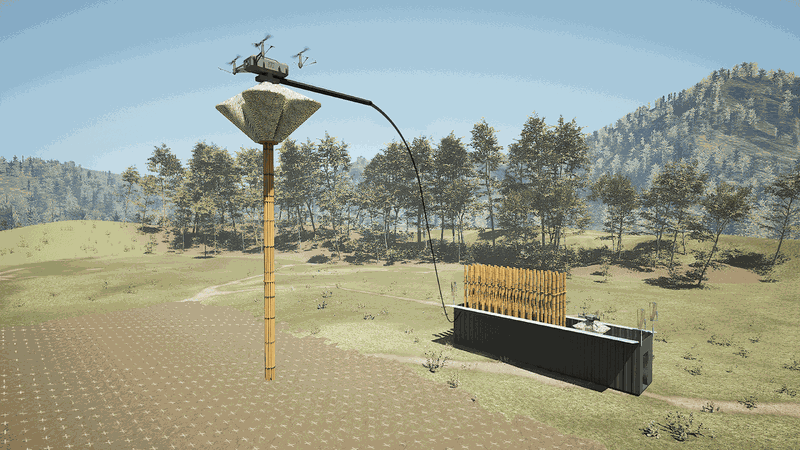
The new NoMoreMines Drone Fleet Concept is based on heavy-lift drone protected by Kevlar that can do much more than fly over minefields.
(Source: Prof. Dr. habil. Nicholas H. Müller)
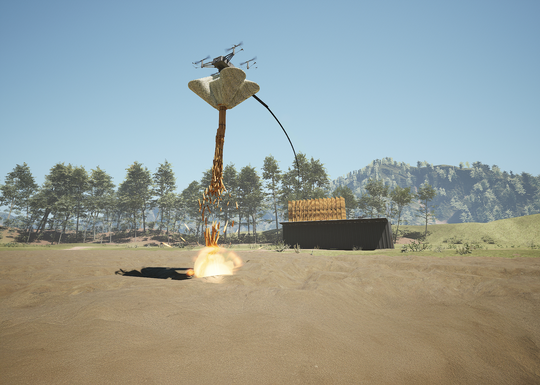
The NoMoreMines approach is based on a simple principle: keeping humans as far away from explosives as possible and letting machines do the dangerous, repetitive work. At the heart of this approach is a heavy-lift drone protected by Kevlar that can do much more than fly over minefields. It surveys the ground, interacts with it, neutralises buried threats and generates a digital, auditable record of every square metre it covers.
Each intervention on the ground is linked to precise positioning
What sets NoMoreMines apart is its ability to bridge the gap between 'we think this area is safe' and 'we can prove it'. Each intervention on the ground is linked to precise positioning and system telemetry, creating a structured, georeferenced record of where the drone has operated and the results obtained. Rather than relying on manual logbooks or incomplete reports, the authorities receive a consistent, machine-generated clearance dossier that they can review, archive and use as evidence. This is particularly important in post-conflict settings, where questions of liability, donor scrutiny and public expectations require robust evidence.
Safety improvements are experienced by both sides. For civilians, faster and more scalable clearance means farmland, housing and infrastructure corridors can be put to productive use earlier in the reconstruction cycle. As each operation is transparently documented, communities and local authorities can trust that an area is genuinely safe. For operators, the difference is even more tangible: rather than kneeling in front of an unknown object with a probe, they now work from a containerised base station that provides power, battery management, rod reloads and communications. From this hub, they can plan and supervise missions while the armoured, instrumented and expendable drone absorbs the residual risk of blasts or fragmentation. A platform can be repaired or replaced, but a skilled deminer cannot.
Customers to size their fleet
The overall architecture is designed to be scalable. The container functions as an autonomous hub and each drone essentially acts as a modular tool head, which can be added to or removed from the system as demand changes. When more drones are connected to a hub, throughput increases almost linearly, subject only to airspace management and practical logistics. This enables customers to size their fleet according to their mission profile: one aircraft for small or highly complex sites, and several working in parallel for wide corridors, large agricultural areas, and long infrastructure routes. As the hub can operate using solar and wind power with battery storage when grid connections are unavailable, operations can continue for weeks or months, even in remote or heavily damaged regions.
(Source: Prof. Dr. habil Nicholas H. Müller)
The implications extend beyond humanitarian demining. In military contexts, NoMoreMines drones can be used to clear and verify safe passageways through minefields for manoeuvre units. This provides commanders with data-backed information on which routes are safe for follow-on forces and logistics. Unlike many traditional breaching systems, which rely on large explosive charges, this approach does not introduce additional blast effects to the battlefield and is therefore better suited to urban environments and areas near critical infrastructure or sensitive regions, where minimising collateral damage is paramount. These core capabilities also translate into civil protection and disaster response applications. After flooding, landslides or prolonged saturation, the subsurface structure of dirt roads and embankments can be highly uncertain. NoMoreMines drones can be deployed ahead of convoys to assess ground conditions and load-bearing capacity, ensuring that heavy vehicles such as fire engines, engineering equipment and mobile hospitals are not driven onto compromised routes unknowingly.
New operational model that treats interaction with the ground
(Source: Prof. Dr. habil. Nicholas H. Müller)
The system delivers a consistent data product as well as physical intervention across all use cases, including post-conflict clearance, military breaching, civil protection and disaster relief. Commanders, engineers and civil authorities receive structured, georeferenced records detailing what was done, where it was done and the outcome. This consistent data layer enables better after-action reviews, supports legal and regulatory oversight, and ultimately raises the standard of accountability in environments where failure can have deadly consequences. In this respect, NoMoreMines is less about a single drone and more about a new operational model that treats interaction with the ground as both a safety-critical service and a source of hard evidence. This model is scalable not by sending more people into danger, but by adding more autonomous machines to the field
Date: 08.12.2025
Naturally, we always handle your personal data responsibly. Any personal data we receive from you is processed in accordance with applicable data protection legislation. For detailed information please see our privacy policy.
Consent to the use of data for promotional purposes
I hereby consent to Vogel Communications Group GmbH & Co. KG, Max-Planck-Str. 7-9, 97082 Würzburg including any affiliated companies according to §§ 15 et seq. AktG (hereafter: Vogel Communications Group) using my e-mail address to send editorial newsletters. A list of all affiliated companies can be found here
Newsletter content may include all products and services of any companies mentioned above, including for example specialist journals and books, events and fairs as well as event-related products and services, print and digital media offers and services such as additional (editorial) newsletters, raffles, lead campaigns, market research both online and offline, specialist webportals and e-learning offers. In case my personal telephone number has also been collected, it may be used for offers of aforementioned products, for services of the companies mentioned above, and market research purposes.
Additionally, my consent also includes the processing of my email address and telephone number for data matching for marketing purposes with select advertising partners such as LinkedIn, Google, and Meta. For this, Vogel Communications Group may transmit said data in hashed form to the advertising partners who then use said data to determine whether I am also a member of the mentioned advertising partner portals. Vogel Communications Group uses this feature for the purposes of re-targeting (up-selling, cross-selling, and customer loyalty), generating so-called look-alike audiences for acquisition of new customers, and as basis for exclusion for on-going advertising campaigns. Further information can be found in section “data matching for marketing purposes”.
In case I access protected data on Internet portals of Vogel Communications Group including any affiliated companies according to §§ 15 et seq. AktG, I need to provide further data in order to register for the access to such content. In return for this free access to editorial content, my data may be used in accordance with this consent for the purposes stated here. This does not apply to data matching for marketing purposes.
Right of revocation
I understand that I can revoke my consent at will. My revocation does not change the lawfulness of data processing that was conducted based on my consent leading up to my revocation. One option to declare my revocation is to use the contact form found at https://contact.vogel.de. In case I no longer wish to receive certain newsletters, I have subscribed to, I can also click on the unsubscribe link included at the end of a newsletter. Further information regarding my right of revocation and the implementation of it as well as the consequences of my revocation can be found in the data protection declaration, section editorial newsletter.
These works served as the basis for a patent application filed with the German Patent and Trade Mark Office (DPMA). In addition, a positive PCT report was issued confirming the novelty, inventive step, and industrial applicability of the patent.
Author: Prof. Dr. habil. Nicholas H. Müller, Technical University of Applied Sciences Würzburg-Schweinfurt/Germany, Faculty of Computer Science and Business Information Systems, Research-Professorship Socioinformatics and Societal Aspects of Digitalization, Head of the IDIS Institute, Institute for Design and Information Systems Postal address: Münzstraße 1297070 Würzburg/Germany, +49 931 3511-8186 +49 172 4719548 nicholas.mueller@thws.de




:quality(80)/p7i.vogel.de/wcms/5b/2c/5b2cceb9038883edfacb76a61fca350b/vw-os-4-25--28cropped-29-3136x1765v1.jpeg "VW Osnabrück: Following Rheinmetall, KNDS is now also interested in at least a partial takeover of the plant. One popular example for the shift from civilian to military production. (Picture: Wiki Commons)")
:quality(80)/p7i.vogel.de/wcms/ec/ee/ecee771dce48d9c693f8869da717ceeb/robertwaghorn-jet-2974131-4777x2687v1.jpeg "European allies intensify cooperation efforts to boost defence capabilities and ensure long-term security stability. (Source: Robert Waghorn on Pixabay)")
:quality(80)/p7i.vogel.de/wcms/be/0b/be0b550a4fc2724afeed0713f65e7675/spexer-anechoic-chamber-1280x720v1.png "(Source: Hensoldt AG)")
:quality(80)/p7i.vogel.de/wcms/6f/0f/6f0fc6e3348925946d77fa2339e53005/0130142731v1.jpeg "Heidelberger Druckmaschinen Aktiengesellschaft establishes a joint venture with Ondas. The aim is to provide and market effective drone defence systems in Europe and Ukraine. (Source: Ondas)")
:quality(80)/p7i.vogel.de/wcms/a2/66/a266453da44556de3d18a0976597a605/sintavia-press-release-image-31726-1333x750v1.jpeg "Scooped version of representative heat exchanger. (Source: Sintavia)")
:quality(80)/p7i.vogel.de/wcms/2e/15/2e15396bd28d5cc96f2c339a6b7bf1e8/l3harris-disco-1220-1217x684v1.jpeg "(Source: L3Harris Technologies)")
:quality(80)/p7i.vogel.de/wcms/0c/70/0c701a79c1f183921b8ee9341ef61db8/0129694966v1.jpeg "Robonode's DVK Development Kit: This is available through Codico's sample shop. (Image:8DEVICES)")
:quality(80)/p7i.vogel.de/wcms/7c/12/7c123d3888ed3a37a83b0793be569f00/hon-aero-hguide-i700-imu-comp-view-2880x1440-1024x576v1.webp "(Source: Honeywell)")
:quality(80)/p7i.vogel.de/wcms/b4/ae/b4ae65d3fb3903a13571d9ea3e61da8a/mock-up-vleo-def-1920x1079v1.jpeg "Illustration of the VLEO-DEF satellite in orbit (Source: EDA)")
:quality(80)/p7i.vogel.de/wcms/11/c8/11c8d30d75151329d2700176eb7a0383/0130110840v1.jpeg "Zenadrone, a subsidiary of Zenatec, is working on developing an operational low-cost drone as a disposable concept (symbol image). The first prototype already exists. In the future, it is intended to counter increasing enemy drone attacks without significant financial effort... (Source: Zenadrone)")
:quality(80)/p7i.vogel.de/wcms/c8/4c/c84cef4bf459f1280823827c3e3615c2/7cf414af-d41d-46ac-b22b-890f9f32d24c-2048x1151v1.jpeg "In Manching, Germany, Airbus is currently preparing two Valkyries for their first flight with its European mission system. The picture shows one of them. (Source: Airbus)")
:quality(80)/p7i.vogel.de/wcms/e3/d7/e3d7de9cfaac27f48ee6e162f9b309e9/0128899731v1.jpeg "Here, Lufthansa's first anniversary aircraft lands in Frankfurt. (Image:Lufthansa)")
:quality(80)/p7i.vogel.de/wcms/06/37/0637c7dd3fab9b00a8e96f98133cd1dc/260304-d-d0477-1005-5892x3317v1.png "A B-52H Stratofortress idles prior to taking off in support of Operation Epic Fury in March 2026. (Source: U.S. Air Force)")
:quality(80)/p7i.vogel.de/wcms/13/2b/132bb2831ae98c4c3bdd0ee2990ba1eb/bareways-20deck-20--20crisis-20coordination-20platformv1.jpeg "(Source: Bareways)")
:quality(80)/p7i.vogel.de/wcms/93/f1/93f1e4dba53b2c9589fab17a525df55e/adobestock-163119218-2480x1394v1.jpeg "(Source: Kernkonzept GmbH)")
:quality(80)/p7i.vogel.de/wcms/8d/76/8d764c984e44153da8f0dfa88cd6d75e/0129843677v1.jpeg "A successful drone attack on two data centers of the Amazon subsidiary AWS shows that the danger of drones is virtually unavoidable in modern warfare ... (Source: Cerberus)")
:quality(80)/p7i.vogel.de/wcms/14/d3/14d3e0847d222af54aa5ab625480507f/0130015022v1.jpeg "A German-French battle tank project was approved some time ago (symbol image). But a modern drive system is also needed for it. This is now being developed by Rolls-Royce Power Systems and ZF in the coming years... (Image:Rheinmetall)")
:quality(80)/p7i.vogel.de/wcms/bd/21/bd2191aab59c430b3c74a2be07120333/image-196-1294x728v1.png "(Image:SkyDefender © Thales)")
:quality(80)/p7i.vogel.de/wcms/d4/dc/d4dc9a59e1698ae295b1e6e64a29a55b/geralt-handshake-5768632-1280-1280x720v1.jpeg "Rheinmetall and Nooteboom Trailers are collaborating on the development and marketing of heavy equipment trailer systems designed for transporting modern tracked and wheeled military vehicles. (Image:Gerd Altmann from Pixabay)")
:quality(80)/p7i.vogel.de/wcms/22/54/2254d1e2667aff755e7aba0bcaf2eb42/0130021093v1.jpeg "Daimler Truck and Quantum Systems are jointly developing unmanned military vehicles. (Image:Quantum Systems)")
:quality(80)/p7i.vogel.de/wcms/f9/2f/f92f1ef8c739c34c70d99f7b0997621b/stra007-20--20cover-20image-5472x3076v1.jpeg "(Source: Stratasys)")
:quality(80)/p7i.vogel.de/wcms/5e/18/5e184e4961f190c86a1ea3227104cab5/26pm03-20kompakte-20l-c3-b6sungen-20f-c3-bcr-20luft--20und-20raumfahrt-202-2362x1329v1.jpeg "(Picture: Keysight)")
:quality(80)/p7i.vogel.de/wcms/67/4c/674c54baa745be497cecb716826af339/stahlwille-hero-1807x1016v1.jpeg "A new modular tool solution designed for safety, precision, and mobility in aviation maintenance. (Source: STAHLWILLE)")
:quality(80)/p7i.vogel.de/wcms/0d/01/0d01a051ba894332a8091e3a3f9394e1/hytorc-defense-solutions-boxersatz-1899x1068v1.jpeg "HYTORC’s Defence Solutions toolkit, proven on the GTK Boxer, enables safe, traceable fastening of critical components across multiple Bundeswehr platforms. (Source: Image: HYTORC)")
:quality(80)/p7i.vogel.de/wcms/f3/4e/f34ed744bb30817d3432c7ad522e6f30/engine-1v1.jpeg "Engineering with aluminium profiles really can be this easy – the item Engineeringtool and its smart functions help you save valuable time. (Source: item)")
:quality(80)/p7i.vogel.de/wcms/fb/8e/fb8e5ae2aa27bcf3e466815505ca4ff2/alumin-1v1.jpeg "The aluminium profile technology of the item Building Kit System has been used to build a huge variety of structures for decades. (Source: item)")
:quality(80)/p7i.vogel.de/wcms/be/84/be84bbede3e40b1101cd3efa35a6ffa0/overview-of-20work-bench-design-in-productionv1.jpeg "With modular work bench design, you can convert or extend a work bench with ease by changing or adding accessories. This means changes can be implemented quickly and cost-effectively, thus boosting quality and productivity. (Source: item)")
:fill(fff,0)/p7i.vogel.de/companies/69/6d/696de2483d115/logo--fastems-rgb-horizontal.jpeg "logo--fastems-rgb-horizontal (Fastems)")
:fill(fff,0)/images.vogel.de/vogelonline/companyimg/84700/84735/65.jpg "logo_item_rgb_neu.jpg ()")

:quality(80)/p7i.vogel.de/wcms/13/2b/132bb2831ae98c4c3bdd0ee2990ba1eb/bareways-20deck-20--20crisis-20coordination-20platformv1.jpeg "bareways-20deck-20--20crisis-20coordination-20platformv1 (Source: Bareways)")
:quality(80)/p7i.vogel.de/wcms/7d/62/7d625d80d65193a7f2cad10747b3312b/chip-8530784-1280-1274x717v1.jpeg "chip-8530784-1280-1274x717v1 (Source: Bild von Brian Penny auf Pixabay)")