Satellite communications are the backbone of modern connectivity, supporting everything from global navigation and weather forecasting to broadband internet and defence operations. Yet these systems face a dual challenge: rising cyber threats and constant exposure to space radiation. Both can compromise data integrity, disrupt encryption, and jeopardize mission-critical reliability. This article explores the risks and highlights how integrated, radiation-hardened cryptographic solutions—such as Microchip’s AES-GCM-256 platform—are redefining secure communications in orbit.
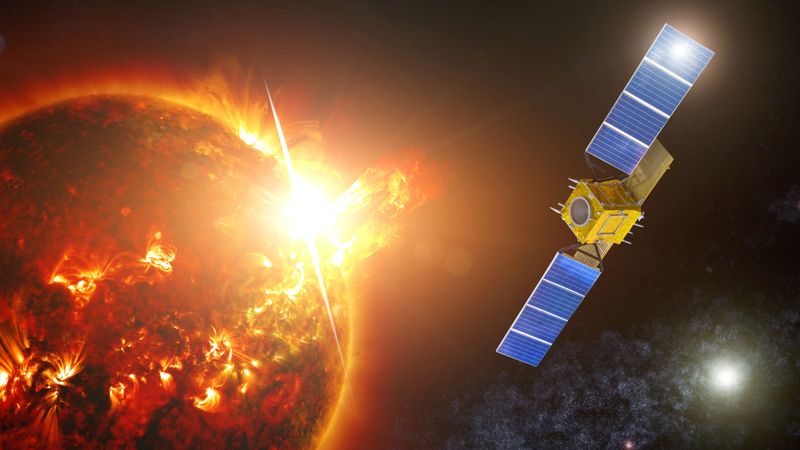
Symbol image: Satellites in orbit face a dual challenge—constant exposure to cosmic radiation and growing cybersecurity threats to secure communications.
(Source: Microchip)
In an era where global connectivity, defence operations and critical infrastructure increasingly rely on satellite communications, the integrity and security of data transmitted through space has never been more vital. From GPS navigation and weather forecasting to military reconnaissance and broadband internet, satellites form the backbone of modern communication systems. However, as indispensable as these systems are, they face a unique and formidable set of challenges—chief among them, the dual threat of cyber vulnerabilities and space radiation.
The Growing Importance—and Vulnerability—of Satellite Communications
Satellite communications are inherently exposed. Unlike terrestrial networks, which can be physically secured and monitored, satellites operate in the vast openness of space, transmitting signals across thousands of miles. This makes them susceptible to a wide range of threats:
Eavesdropping and interception: Adversaries can attempt to intercept satellite signals to gain unauthorized access to sensitive data.
Data tampering and spoofing: Malicious actors may try to alter or forge data in transit, undermining the trustworthiness of the communication.
Denial-of-service attacks: Jamming or flooding satellite channels can disrupt critical services, from navigation to emergency response.
These threats are not hypothetical. Incidents of satellite signal jamming and spoofing have been documented in both civilian and military contexts. As geopolitical tensions rise and the commercial space sector expands, the attack surface for satellite communications continues to grow.
The Hidden Threat: Radiation-Induced Errors
While cybersecurity threats are well-known, a less visible but equally dangerous challenge lies in the physical environment of space itself. Satellites operate in a high-radiation environment where they are constantly bombarded by cosmic rays, solar particles and trapped radiation belts. These high-energy particles can cause Single Event Effects (SEEs), which are disruptions in electronic circuits caused by a single ionizing particle.
One of the most common SEEs is the Single Event Upset (SEU), where a charged particle strikes a semiconductor device and flips a bit in memory or logic. In the context of satellite communications, this can lead to:
Corrupted data packets: A single flipped bit can render a message unreadable or incorrect.
Loss of encryption integrity: If a bit flip occurs in an encryption key or authentication tag, it can invalidate the entire cryptographic process.
System instability: Repeated SEUs can accumulate and cause broader system malfunctions or failures.
These radiation-induced errors are particularly insidious because they are random, difficult to predict, and can mimic the effects of cyberattacks or hardware faults. Traditional error detection and correction methods, while helpful, are not always sufficient—especially when data integrity and security are paramount.
The Challenge of Balancing Security, Performance and Reliability
To address these threats, satellite systems must implement robust encryption and authentication mechanisms. The Advanced Encryption Standard (AES) is widely used for this purpose, offering strong protection against unauthorized access. However, not all encryption modes are created equal.
In high-performance, real-time communication systems like those used in satellites, encryption must be:
Fast and efficient: Latency and throughput are critical in satellite links.
Authenticated: Encryption alone is not enough; data must also be verified for integrity.
Resilient to radiation: Cryptographic operations must tolerate SEUs without compromising security.
This is where traditional encryption schemes often fall short. Many do not provide built-in authentication, requiring additional mechanisms to verify data integrity. Others are not optimized for the constrained power and processing environments of spaceborne systems. And few are designed with radiation resilience in mind.
The Hardware Gap: Limitations of Conventional Platforms
Even the best cryptographic algorithms are only as effective as the hardware they run on. In space applications, hardware must meet stringent requirements:
Radiation tolerance: Devices must withstand SEUs and other radiation effects without data loss or corruption.
Low power consumption: Satellites have limited power budgets, especially in small form-factor platforms like CubeSats.
Secure key storage: Cryptographic keys must be protected from both physical and logical attacks.
High-speed I/O: To support modern data rates, hardware must offer fast, reliable interfaces.
Conventional FPGAs and processors often struggle to meet these demands. Volatile configuration memory is vulnerable to SEUs. External key storage can be a security risk. And general-purpose processors may lack the performance needed for real-time encryption and authentication.
The Need for an Integrated, Radiation-Hardened Security Solution
Given these challenges, the satellite industry needs a new approach—one that integrates robust cryptographic capabilities with radiation-hardened hardware and efficient system design. The ideal solution must:
Combine encryption and authentication in a single, efficient algorithm.
Detect and respond to SEUs in real time, ensuring data integrity even in the presence of radiation.
Leverage secure, non-volatile memory for key storage and initialization vectors.
Leverage secure, non-volatile memory for key storage and initialization vectors. Offload cryptographic operations to dedicated hardware to reduce CPU load and power consumption.
Provide a scalable platform that can be tailored to different mission profiles and performance requirements.
Microchip addressed this problem with a solution that integrates Advanced Encryption Standard - Galois/Counter Mode (AES-GCM) encryption with authentication, radiation-tolerant FPGA fabric, and a dedicated crypto coprocessor—all within a secure, low-power platform.
Summary of the AES-GCM-256 Solution for Secure Satellite Communications
To address the multifaceted challenges of secure and reliable satellite communications, Microchip presents a robust solution built around the AES-GCM-256 encryption algorithm, implemented on Microchip’s PolarFire® FPGA and RT PolarFire FPGA and SoC platforms. This solution is designed to ensure both data confidentiality and integrity while withstanding the harsh radiation environment of space.
Date: 08.12.2025
Naturally, we always handle your personal data responsibly. Any personal data we receive from you is processed in accordance with applicable data protection legislation. For detailed information please see our privacy policy.
Consent to the use of data for promotional purposes
I hereby consent to Vogel Communications Group GmbH & Co. KG, Max-Planck-Str. 7-9, 97082 Würzburg including any affiliated companies according to §§ 15 et seq. AktG (hereafter: Vogel Communications Group) using my e-mail address to send editorial newsletters. A list of all affiliated companies can be found here
Newsletter content may include all products and services of any companies mentioned above, including for example specialist journals and books, events and fairs as well as event-related products and services, print and digital media offers and services such as additional (editorial) newsletters, raffles, lead campaigns, market research both online and offline, specialist webportals and e-learning offers. In case my personal telephone number has also been collected, it may be used for offers of aforementioned products, for services of the companies mentioned above, and market research purposes.
Additionally, my consent also includes the processing of my email address and telephone number for data matching for marketing purposes with select advertising partners such as LinkedIn, Google, and Meta. For this, Vogel Communications Group may transmit said data in hashed form to the advertising partners who then use said data to determine whether I am also a member of the mentioned advertising partner portals. Vogel Communications Group uses this feature for the purposes of re-targeting (up-selling, cross-selling, and customer loyalty), generating so-called look-alike audiences for acquisition of new customers, and as basis for exclusion for on-going advertising campaigns. Further information can be found in section “data matching for marketing purposes”.
In case I access protected data on Internet portals of Vogel Communications Group including any affiliated companies according to §§ 15 et seq. AktG, I need to provide further data in order to register for the access to such content. In return for this free access to editorial content, my data may be used in accordance with this consent for the purposes stated here. This does not apply to data matching for marketing purposes.
Right of revocation
I understand that I can revoke my consent at will. My revocation does not change the lawfulness of data processing that was conducted based on my consent leading up to my revocation. One option to declare my revocation is to use the contact form found at https://contact.vogel.de. In case I no longer wish to receive certain newsletters, I have subscribed to, I can also click on the unsubscribe link included at the end of a newsletter. Further information regarding my right of revocation and the implementation of it as well as the consequences of my revocation can be found in the data protection declaration, section editorial newsletter.
Key highlights include:
AES-GCM-256 integration: The solution leverages AES-GCM, which combines encryption and authentication in a single, efficient algorithm. This dual capability is critical for detecting both malicious tampering and radiation-induced bit flips.
Radiation-tolerant hardware: PolarFire FPGAs feature configuration logic that is immune to Single Event Upsets (SEUs), along with Single Error Correction, Double Error Detection (SECDED)-protected memory blocks and secure non-volatile memory (sNVM), making them ideal for space applications.
Dedicated crypto coprocessor: The Athena TeraFire® EXP5200B Crypto Coprocessor offloads cryptographic operations from the main processor, improving performance and reducing power consumption. It also includes a true random number generator for secure IV generation.
Secure key management: Encryption keys are stored in on-chip sNVM, protected by AES-SIV encryption, ensuring secure data at rest. The system supports secure provisioning and runtime key management.
End-to-end message protection: Messages are encrypted, authenticated and stored in SEU-immune buffers before transmission. On the receiving end, the same architecture verifies message integrity and authenticity, with failed authentications triggering retransmission requests.
Demonstration design: A working demo on the PolarFire MPF300TS device showcases the full encryption-decryption cycle using test vectors, with support for automated testing via TeraTerm macro scripts.
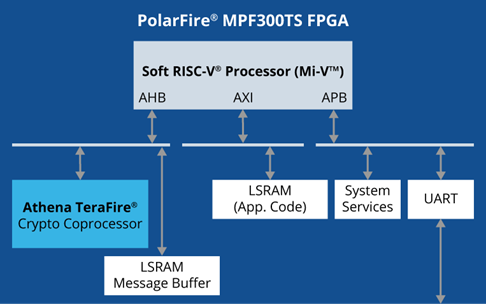
Microchip’s PolarFire FPGA provides a robust and secure platform for implementing advanced cryptographic solutions, such as the AES-GCM-256 encryption algorithm. In this architecture, a soft RISC-V CPU (Mi-V™) orchestrates system operations, with its application code stored and executed from high-speed LSRAM memory blocks within the FPGA fabric. The Mi-V processor interfaces with several key peripherals to deliver a comprehensive encryption solution.
The Athena TeraFire crypto coprocessor is leveraged for hardware-accelerated AES-GCM encryption and random number generation, ensuring both performance and security. Encrypted messages are temporarily stored in a dedicated LSRAM message buffer, while System Services provide a secure interface to the sNVM block for storing and accessing AES cryptographic keys. Additionally, a UART interface enables user interaction, allowing payload data and parameters to be sourced for demonstration purposes. This tightly integrated design highlights the flexibility and security of the PolarFire FPGA platform for modern cryptographic applications.
The integrated approach not only secures satellite communications against cyber threats but also provides a resilient defence against the unpredictable effects of space radiation. It exemplifies how modern cryptographic techniques, when paired with radiation-hardened hardware, can deliver trustworthy and high-performance communication systems for space missions.
Tim Morin is a technical fellow for Microchip’s FPGA business unit.




:quality(80)/p7i.vogel.de/wcms/d9/a3/d9a3c241961e6c2aa668d0147292bc49/screenshot-2026-09-17-113517-931x524v1.png "Dr. Elisabeth Hauschild will take over as Chief Executive of the BDSV in November 2026. (Source: BDSV)")
:quality(80)/p7i.vogel.de/wcms/da/35/da35a98002ba254047f09248e6bbca56/si-wafer-1920x1080v1.jpeg "Fridge, Car, Tank? Semiconductors are a key dual-use technology. Chips developed for civilian markets are increasingly critical to drones, sensors, communications and other defence systems. (Photo: )")
:quality(80)/p7i.vogel.de/wcms/f9/b2/f9b2efe6f896ab3431ddf07882ea4cfd/chatgpt-image-17--sept--2026-10-47-05-1536x864v1.png "Rare Earth supply will remain a bottleneck for European Defence companies as China controls most mining and production capacities. (Picture: AI generated)")
:quality(80)/p7i.vogel.de/wcms/54/cb/54cbfdb9d826c9efc90ac358dcf62c6c/ktyvus-624x351v1.jpeg "(Source: Aktyvus Photonics)")
:quality(80)/p7i.vogel.de/wcms/0a/14/0a1495d9b570ae32a5a7cc748b9a3c60/st-hannover-035-1920x1079v1-999x562v1.jpeg "Fastening technology you can experience first-hand—visitors to Schraubtec in Bochum (Germany) can see it for themselves at the Ruhr Congress on September 30, 2026. (Source: PHOTOVISION-DH GmbH)")
:quality(80)/p7i.vogel.de/wcms/cd/a9/cda92b173afa9d0b455d4f11b281c9ea/0094-to-image--capstone-cdr-1440x810v1.png "(Source: Terran Orbital)")
:quality(80)/p7i.vogel.de/wcms/e0/45/e045bc5414d7263fb308bdd501b5fcc1/0133113962v1.jpeg "The HSWL 354 is the transmission used, for example, in the Leopard 2 main battle tank. Renk manufactures this system and is now preparing to significantly increase its cycle time. As a result, Renk is placing greater emphasis on the military sector as a customer ... (Source: Renk)")
:quality(80)/p7i.vogel.de/wcms/a1/5c/a15c2aeba563d5bc3e11fb879b21eb2c/0132989650v1.jpeg "FSS, the flexible clamping system for varying free-form surfaces, is designed for the aerospace industry and other sectors. (Source: Römheld GmbH Friedrichshütte)")
:quality(80)/p7i.vogel.de/wcms/93/5b/935bf130ead9c4dc6aac0f47e386a56a/0133268906v1.jpeg "Here, two experts from Lufthansa Technik are applying the film called “AeroSHARK” to an aircraft. Until now, Boeing has been using this coating, which mimics the skin structure of sharks. Now Airbus also wants to use it to make its aircraft more fuel-efficient. (Source: Lufthansa Technik)")
:quality(80)/p7i.vogel.de/wcms/fc/14/fc144df6171fd26da8fe1a0a30c28505/bild-1-tom-bild-der-herausgeschleuderten-aschewolke-anak-krakatau-9-2026-tom-zentrum-f-r-telematik-w-rzburg-802x451v1.png "The TOM satellites happened to be flying over the volcanic island of Anak Krakatau during the eruption and observed the rising volcanic ash cloud from an optimal position as it was ejected to an altitude of up to 15 km (approx. 9.3 miles). (Source: TOM, Center for Telematics Würzburg)")
:quality(80)/p7i.vogel.de/wcms/46/8e/468effa87546a2b036dc88ca40e2843e/129fbcac92ce7da872b13af0281b0799-l-png-1920x1079v1.webp "(Source: Arianespace)")
:quality(80)/p7i.vogel.de/wcms/8f/10/8f10697d4bfbd70edf615cca76eaedfd/pete-linforth-on-pixabay-1920x1080v1.jpeg "(Source: Pete Linforth on Pixabay / AI-generated)")
:quality(80)/p7i.vogel.de/wcms/9d/8a/9d8addea8cc4e6f7a4793563ca397f2a/ai-im-milit-r-1672x940v1.png "(Source: KI-generiert / Gemini)")
:quality(80)/p7i.vogel.de/wcms/7f/5f/7f5fba2c729ec3aa256bf1a18d74529b/ai-chip-1672x940v1.png "(Source: KI-generiert / Gemini)")
:quality(80)/p7i.vogel.de/wcms/64/1b/641b6474b2a614cde7730c89ef2a3015/2026-09-09-rheinmetall-veroeffentlicht-battlesuite-schnittstellen-e8c18194-1225x690v1.jpeg "Rheinmetall’s Battlesuite provides a modular digital platform for connecting and integrating sensors, hardware and software components. (Source: Rheinmetall AG)")
:quality(80)/p7i.vogel.de/wcms/6f/fe/6ffef325e7f233cc3521943158eb1ebd/0132763535v1.jpeg "Two companies are planning to establish, for the first time in 2027, an optical laser communication link directly between a satellite in low Earth orbit (LEO) and a re-entering spacecraft. (Source: ATMOS Space Cargo)")
:quality(80)/p7i.vogel.de/wcms/8f/f9/8ff91b78b26cb5a2b8a29e39835005b1/2026-09-10-repmus-teaser-images-retouched-dsc01292-1024x683-1024x576v1.jpeg "(Source: Quantum Systems GmbH)")
:quality(80)/p7i.vogel.de/wcms/bf/4a/bf4a237e60d3d4bd1bbdbad918f3c697/airbus-defence-and-space-3-1280x720v1.jpeg "(Source: Airbus Defence and Space)")
:quality(80)/p7i.vogel.de/wcms/e0/d1/e0d112a0d54a4fa9603ec855f7d25b47/t-rex-content-photo-jpg-pc-adaptive-990-medium-988x556v1.jpeg "Swarm of UAVs conducting a fully autonomous collaborative swarm mission. (Source: Lockheed Martin)")
:quality(80)/p7i.vogel.de/wcms/79/fc/79fcaa7ca33e393b11a4740d7d8f3dbe/vilkasss-handshake-9459740-1911x1076v1.jpeg "(Source: Vilius Kukanauskas on Pixabay)")
:quality(80)/p7i.vogel.de/wcms/90/a8/90a849f0023f11d1eb642eb4751a0321/bild2-h-c3-a4nel-ict-20truck-20and-20trailer-20parts-4320x2429v1.jpeg "Product information is visible at all times and retrieval of items
is confirmed by employees directly on the display of the Hänel MP 14 N
controller. (Source: René Marks)")
:quality(80)/p7i.vogel.de/wcms/4e/ca/4ecaa39f247490eded591b652c33aee3/thilmann-hcp-web-20kleiner-20ausschnitt-1442x811v1.jpeg "Entering the defence market can be challenging for start-ups, says HCP Sense CEO Ansgar Thilmann. (Picture: HCP Sense)")
:quality(80)/p7i.vogel.de/wcms/7a/51/7a511b80041d3f1335f3a5aa56fe75da/delivery-7022432-1280-1280x720v1.png "(Source: Mohamed_hassan)")
:quality(80)/p7i.vogel.de/wcms/f9/2f/f92f1ef8c739c34c70d99f7b0997621b/stra007-20--20cover-20image-5472x3076v1.jpeg "(Source: Stratasys)")
:quality(80)/p7i.vogel.de/wcms/ec/a9/eca9062ccbe4b042f8515846340410d8/aerospace-and-defence-stairways-platforms-and-much-morev1.jpeg "Modular constructions enable flexible modification. That applies to larger structures such as stairways and platforms, too. And that means aerospace and defence companies can reconfigure their maintenance platforms fast (itemitem)")
:quality(80)/p7i.vogel.de/wcms/30/2a/302a7b5723ad38fbde812fd3a468ad04/safety-on-stairways-in-industry-key-considerationsv1.jpeg "Stairways and platforms are used widely in maintenance and assembly areas in the aerospace and defence sectors. (Source: item)")
:quality(80)/p7i.vogel.de/wcms/f3/4e/f34ed744bb30817d3432c7ad522e6f30/engine-1v1.jpeg "Engineering with aluminium profiles really can be this easy – the item Engineeringtool and its smart functions help you save valuable time. (Source: item)")
:fill(fff,0)/p7i.vogel.de/companies/69/6d/696de2483d115/logo--fastems-rgb-horizontal.jpeg "logo--fastems-rgb-horizontal (Fastems)")
:fill(fff,0)/images.vogel.de/vogelonline/companyimg/84700/84735/65.jpg "logo_item_rgb_neu.jpg ()")
:quality(80)/p7i.vogel.de/wcms/c1/80/c180ace150e784fb8ff6af01cd569c18/202201-006-600-cern-1920x1080v1.png "202201-006-600-cern-1920x1080v1 (Picture: CERN)")
:quality(80)/p7i.vogel.de/wcms/13/2b/132bb2831ae98c4c3bdd0ee2990ba1eb/bareways-20deck-20--20crisis-20coordination-20platformv1.jpeg "bareways-20deck-20--20crisis-20coordination-20platformv1 (Source: Bareways)")