In space exploration, components are particularly susceptible to radiation effects such as single-event burnout (SEB) or single-event gate rupture (SEGR). Due to the lack of atmosphere, the radiation intensity is significantly higher. Gallium nitride (GaN) technology offers substantial advantages in terms of robustness and reliability due to its design.
Gallium nitride (GaN) solutions offer significant advantages for critical applications.
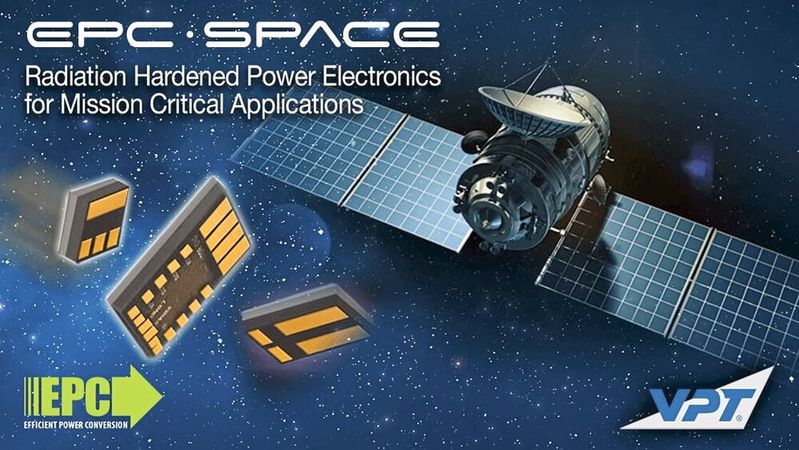
(Image: EPC Space)
With the EPC7030MSH, EPC Space, a joint venture between Efficient Power Conversion (EPC) and VPT Inc., introduces a component that marks another step towards more compact, efficient, and radiation-resistant power supply systems for satellites. The transistor is the first 300-volt Rad-Hard GaN FET of its kind and is aimed at applications requiring higher bus voltages—such as electric propulsion systems, power distribution units, or onboard networks of modern communication satellites.
The FET is based on enhancement-mode GaN technology, meaning it operates as a voltage-controlled device like a MOSFET, but offers significantly higher power density. EPC Space combines this technological approach with a hermetically sealed surface-mount package, specifically designed for conduction-cooled designs in satellites. This enables the realization of power converters with high packaging density and reduced weight—two critical factors in space applications.
Technical classification and application framework
With a drain-source breakdown voltage (VDSS) of 300 V, the EPC7030MSH expands the previously available voltage range of radiation-hardened GaN FETs. According to the manufacturer, the component is designed for Linear Energy Transfer values (LET) of up to 84.6 MeV (300 V: LET = 63 MeV, 250 V: LET = 84.6 MeV), thereby demonstrating exceptional resistance to single-event effects (SEE).
The combination of low on-resistance and low gate charge enables high switching frequencies with minimal losses. For system designers, this means smaller magnetics, more compact filters, and overall higher power density. This is a significant advantage, especially in satellite onboard power supply systems, where every gram of weight matters.
The package design further enhances robustness. With extended creepage distances and hermetic sealing, it meets the requirements for space and high-voltage environments. The component is intended for use in DC-DC front ends, power distribution systems, and high-performance motor controls.
GaN under radiation—Material physics as an advantage
The radiation tolerance of GaN components is not solely the result of special protective measures but is largely a consequence of the material itself. Gallium nitride belongs to the so-called wide bandgap semiconductors, whose band gap, at approximately 3.4 eV, is about three times larger than that of silicon. This wide band gap reduces the likelihood of ionizing radiation generating free charge carriers in the material, which could alter parameters such as threshold voltage or leakage currents.
In addition, GaN's high "displacement threshold energy" means significantly more energy is required to displace an atom in the crystal lattice compared to silicon. As a result, fewer lattice defects occur under neutron or proton bombardment.
Another point concerns the device architecture. In GaN FETs, a thin AlGaN barrier separates the gate from the conducting channel. This structure does not accumulate ionized charge when exposed to gamma radiation. This is a significant difference compared to silicon MOSFETs, where oxide charges build up in the gate dielectric and can alter the switching characteristics over time.
Comparison to silicon MOSFETs
Rad-hard MOSFETs based on silicon are considered established and well-characterized, but they are increasingly reaching their physical limits in modern high-performance satellite systems. Under Total Ionizing Dose (TID) conditions, Si-MOSFETs often experience gate threshold drift, increased leakage, and reduced lifespan.
GaN FETs demonstrate significantly more stable characteristics in these tests. Studies by the NASA NEPP initiative and various space laboratories confirm that the variation in key parameters remains minimal even after irradiation with several Mrad. This enables designers to apply more conservative derating factors, leading to more efficient utilization of the component.
Moreover, the higher efficiency of GaN is not only energetically advantageous but also thermally significant: less power loss means reduced thermal stress and, consequently, lower susceptibility to radiation-induced aging effects.
Date: 08.12.2025
Naturally, we always handle your personal data responsibly. Any personal data we receive from you is processed in accordance with applicable data protection legislation. For detailed information please see our privacy policy.
Consent to the use of data for promotional purposes
I hereby consent to Vogel Communications Group GmbH & Co. KG, Max-Planck-Str. 7-9, 97082 Würzburg including any affiliated companies according to §§ 15 et seq. AktG (hereafter: Vogel Communications Group) using my e-mail address to send editorial newsletters. A list of all affiliated companies can be found here
Newsletter content may include all products and services of any companies mentioned above, including for example specialist journals and books, events and fairs as well as event-related products and services, print and digital media offers and services such as additional (editorial) newsletters, raffles, lead campaigns, market research both online and offline, specialist webportals and e-learning offers. In case my personal telephone number has also been collected, it may be used for offers of aforementioned products, for services of the companies mentioned above, and market research purposes.
Additionally, my consent also includes the processing of my email address and telephone number for data matching for marketing purposes with select advertising partners such as LinkedIn, Google, and Meta. For this, Vogel Communications Group may transmit said data in hashed form to the advertising partners who then use said data to determine whether I am also a member of the mentioned advertising partner portals. Vogel Communications Group uses this feature for the purposes of re-targeting (up-selling, cross-selling, and customer loyalty), generating so-called look-alike audiences for acquisition of new customers, and as basis for exclusion for on-going advertising campaigns. Further information can be found in section “data matching for marketing purposes”.
In case I access protected data on Internet portals of Vogel Communications Group including any affiliated companies according to §§ 15 et seq. AktG, I need to provide further data in order to register for the access to such content. In return for this free access to editorial content, my data may be used in accordance with this consent for the purposes stated here. This does not apply to data matching for marketing purposes.
Right of revocation
I understand that I can revoke my consent at will. My revocation does not change the lawfulness of data processing that was conducted based on my consent leading up to my revocation. One option to declare my revocation is to use the contact form found at https://contact.vogel.de. In case I no longer wish to receive certain newsletters, I have subscribed to, I can also click on the unsubscribe link included at the end of a newsletter. Further information regarding my right of revocation and the implementation of it as well as the consequences of my revocation can be found in the data protection declaration, section editorial newsletter.
Challenges and limitations
Despite the inherent advantages, radiation hardening remains a systemic process. Even GaN components can be damaged by single-event burnout (SEB) or gate rupture (SEGR) if voltage spikes exceed critical levels. Packaging, layout, and design are therefore just as crucial as material selection.
GaN components like the EPC7030MSH are essential for radiation-hardened power electronics. With the 300-volt VDSS, satellites with significantly higher performance are now possible. The higher bus voltages result in weight reduction, which is indispensable in space exploration.
GaN technology proves not only to be more efficient but also more resistant to radiation effects. Overall, the new EPC FET represents the transition to a generation of space power components that achieve robustness not solely through protective measures but through their material itself. (mr)




:quality(80)/p7i.vogel.de/wcms/be/0b/be0b550a4fc2724afeed0713f65e7675/spexer-anechoic-chamber-1280x720v1.png "(Source: Hensoldt AG)")
:quality(80)/p7i.vogel.de/wcms/6f/0f/6f0fc6e3348925946d77fa2339e53005/0130142731v1.jpeg "Heidelberger Druckmaschinen Aktiengesellschaft establishes a joint venture with Ondas. The aim is to provide and market effective drone defence systems in Europe and Ukraine. (Source: Ondas)")
:quality(80)/p7i.vogel.de/wcms/05/29/05295a4f758848ae6c027cc78947453c/17818f1a7b12-banner-format-970x546v1.jpeg "(Source: Diehl Defence)")
:quality(80)/p7i.vogel.de/wcms/44/2f/442f8206549c08b8fd79666b1e2c1096/suv-20wald-1536x864v1.png "(Source: AI-generated)")
:quality(80)/p7i.vogel.de/wcms/2e/15/2e15396bd28d5cc96f2c339a6b7bf1e8/l3harris-disco-1220-1217x684v1.jpeg "(Source: L3Harris Technologies)")
:quality(80)/p7i.vogel.de/wcms/0c/70/0c701a79c1f183921b8ee9341ef61db8/0129694966v1.jpeg "Robonode's DVK Development Kit: This is available through Codico's sample shop. (Image:8DEVICES)")
:quality(80)/p7i.vogel.de/wcms/7c/12/7c123d3888ed3a37a83b0793be569f00/hon-aero-hguide-i700-imu-comp-view-2880x1440-1024x576v1.webp "(Source: Honeywell)")
:quality(80)/p7i.vogel.de/wcms/62/06/6206d30afc9c4f286f4ecf4cedf575c5/stark-20virtus-20side-1920x1079v1.jpeg "To be introduced into service with the Bundeswehr: The “Virtus” developed by Stark has a range of up to 100 km and is designed to engage targets on the battlefield. (Picture: STARK Defence)")
:quality(80)/p7i.vogel.de/wcms/b4/ae/b4ae65d3fb3903a13571d9ea3e61da8a/mock-up-vleo-def-1920x1079v1.jpeg "Illustration of the VLEO-DEF satellite in orbit (Source: EDA)")
:quality(80)/p7i.vogel.de/wcms/11/c8/11c8d30d75151329d2700176eb7a0383/0130110840v1.jpeg "Zenadrone, a subsidiary of Zenatec, is working on developing an operational low-cost drone as a disposable concept (symbol image). The first prototype already exists. In the future, it is intended to counter increasing enemy drone attacks without significant financial effort... (Source: Zenadrone)")
:quality(80)/p7i.vogel.de/wcms/c8/4c/c84cef4bf459f1280823827c3e3615c2/7cf414af-d41d-46ac-b22b-890f9f32d24c-2048x1151v1.jpeg "In Manching, Germany, Airbus is currently preparing two Valkyries for their first flight with its European mission system. The picture shows one of them. (Source: Airbus)")
:quality(80)/p7i.vogel.de/wcms/e3/d7/e3d7de9cfaac27f48ee6e162f9b309e9/0128899731v1.jpeg "Here, Lufthansa's first anniversary aircraft lands in Frankfurt. (Image:Lufthansa)")
:quality(80)/p7i.vogel.de/wcms/06/37/0637c7dd3fab9b00a8e96f98133cd1dc/260304-d-d0477-1005-5892x3317v1.png "A B-52H Stratofortress idles prior to taking off in support of Operation Epic Fury in March 2026. (Source: U.S. Air Force)")
:quality(80)/p7i.vogel.de/wcms/13/2b/132bb2831ae98c4c3bdd0ee2990ba1eb/bareways-20deck-20--20crisis-20coordination-20platformv1.jpeg "(Source: Bareways)")
:quality(80)/p7i.vogel.de/wcms/93/f1/93f1e4dba53b2c9589fab17a525df55e/adobestock-163119218-2480x1394v1.jpeg "(Source: Kernkonzept GmbH)")
:quality(80)/p7i.vogel.de/wcms/8d/76/8d764c984e44153da8f0dfa88cd6d75e/0129843677v1.jpeg "A successful drone attack on two data centers of the Amazon subsidiary AWS shows that the danger of drones is virtually unavoidable in modern warfare ... (Source: Cerberus)")
:quality(80)/p7i.vogel.de/wcms/14/d3/14d3e0847d222af54aa5ab625480507f/0130015022v1.jpeg "A German-French battle tank project was approved some time ago (symbol image). But a modern drive system is also needed for it. This is now being developed by Rolls-Royce Power Systems and ZF in the coming years... (Image:Rheinmetall)")
:quality(80)/p7i.vogel.de/wcms/bd/21/bd2191aab59c430b3c74a2be07120333/image-196-1294x728v1.png "(Image:SkyDefender © Thales)")
:quality(80)/p7i.vogel.de/wcms/d4/dc/d4dc9a59e1698ae295b1e6e64a29a55b/geralt-handshake-5768632-1280-1280x720v1.jpeg "Rheinmetall and Nooteboom Trailers are collaborating on the development and marketing of heavy equipment trailer systems designed for transporting modern tracked and wheeled military vehicles. (Image:Gerd Altmann from Pixabay)")
:quality(80)/p7i.vogel.de/wcms/22/54/2254d1e2667aff755e7aba0bcaf2eb42/0130021093v1.jpeg "Daimler Truck and Quantum Systems are jointly developing unmanned military vehicles. (Image:Quantum Systems)")
:quality(80)/p7i.vogel.de/wcms/f9/2f/f92f1ef8c739c34c70d99f7b0997621b/stra007-20--20cover-20image-5472x3076v1.jpeg "(Source: Stratasys)")
:quality(80)/p7i.vogel.de/wcms/5e/18/5e184e4961f190c86a1ea3227104cab5/26pm03-20kompakte-20l-c3-b6sungen-20f-c3-bcr-20luft--20und-20raumfahrt-202-2362x1329v1.jpeg "(Picture: Keysight)")
:quality(80)/p7i.vogel.de/wcms/67/4c/674c54baa745be497cecb716826af339/stahlwille-hero-1807x1016v1.jpeg "A new modular tool solution designed for safety, precision, and mobility in aviation maintenance. (Source: STAHLWILLE)")
:quality(80)/p7i.vogel.de/wcms/0d/01/0d01a051ba894332a8091e3a3f9394e1/hytorc-defense-solutions-boxersatz-1899x1068v1.jpeg "HYTORC’s Defence Solutions toolkit, proven on the GTK Boxer, enables safe, traceable fastening of critical components across multiple Bundeswehr platforms. (Source: Image: HYTORC)")
:quality(80)/p7i.vogel.de/wcms/f3/4e/f34ed744bb30817d3432c7ad522e6f30/engine-1v1.jpeg "Engineering with aluminium profiles really can be this easy – the item Engineeringtool and its smart functions help you save valuable time. (Source: item)")
:quality(80)/p7i.vogel.de/wcms/fb/8e/fb8e5ae2aa27bcf3e466815505ca4ff2/alumin-1v1.jpeg "The aluminium profile technology of the item Building Kit System has been used to build a huge variety of structures for decades. (Source: item)")
:quality(80)/p7i.vogel.de/wcms/be/84/be84bbede3e40b1101cd3efa35a6ffa0/overview-of-20work-bench-design-in-productionv1.jpeg "With modular work bench design, you can convert or extend a work bench with ease by changing or adding accessories. This means changes can be implemented quickly and cost-effectively, thus boosting quality and productivity. (Source: item)")
:fill(fff,0)/p7i.vogel.de/companies/64/fe/64fec73b1a2fb/logo-master-ggbbytimken-286blue.jpeg "logo-master-ggbbytimken-286blue (GGB)")
:fill(fff,0)/p7i.vogel.de/companies/69/6d/696de2483d115/logo--fastems-rgb-horizontal.jpeg "logo--fastems-rgb-horizontal (Fastems)")
:fill(fff,0)/images.vogel.de/vogelonline/companyimg/84700/84735/65.jpg "logo_item_rgb_neu.jpg ()")
:quality(80)/p7i.vogel.de/wcms/da/1e/da1e41c3f300922704eb81704996c154/0129293948v1.jpeg "The EPC2366 (Image:Efficient Power Conversion)")
:quality(80)/p7i.vogel.de/wcms/8d/0e/8d0e2c5c98ba5131a0f2fda64a3051d2/0123169191v1.jpeg "In addition to GaN FETs, GaN FET gate drivers are also required and offer precise control with short switching times. (Image:Texas Instruments)")