



:quality(80)/p7i.vogel.de/wcms/be/0b/be0b550a4fc2724afeed0713f65e7675/spexer-anechoic-chamber-1280x720v1.png "(Source: Hensoldt AG)")
:quality(80)/p7i.vogel.de/wcms/6f/0f/6f0fc6e3348925946d77fa2339e53005/0130142731v1.jpeg "Heidelberger Druckmaschinen Aktiengesellschaft establishes a joint venture with Ondas. The aim is to provide and market effective drone defence systems in Europe and Ukraine. (Source: Ondas)")
:quality(80)/p7i.vogel.de/wcms/05/29/05295a4f758848ae6c027cc78947453c/17818f1a7b12-banner-format-970x546v1.jpeg "(Source: Diehl Defence)")
:quality(80)/p7i.vogel.de/wcms/44/2f/442f8206549c08b8fd79666b1e2c1096/suv-20wald-1536x864v1.png "(Source: AI-generated)")
:quality(80)/p7i.vogel.de/wcms/2e/15/2e15396bd28d5cc96f2c339a6b7bf1e8/l3harris-disco-1220-1217x684v1.jpeg "(Source: L3Harris Technologies)")
:quality(80)/p7i.vogel.de/wcms/0c/70/0c701a79c1f183921b8ee9341ef61db8/0129694966v1.jpeg "Robonode's DVK Development Kit: This is available through Codico's sample shop. (Image:8DEVICES)")
:quality(80)/p7i.vogel.de/wcms/7c/12/7c123d3888ed3a37a83b0793be569f00/hon-aero-hguide-i700-imu-comp-view-2880x1440-1024x576v1.webp "(Source: Honeywell)")
:quality(80)/p7i.vogel.de/wcms/62/06/6206d30afc9c4f286f4ecf4cedf575c5/stark-20virtus-20side-1920x1079v1.jpeg "To be introduced into service with the Bundeswehr: The “Virtus” developed by Stark has a range of up to 100 km and is designed to engage targets on the battlefield. (Picture: STARK Defence)")
:quality(80)/p7i.vogel.de/wcms/b4/ae/b4ae65d3fb3903a13571d9ea3e61da8a/mock-up-vleo-def-1920x1079v1.jpeg "Illustration of the VLEO-DEF satellite in orbit (Source: EDA)")
:quality(80)/p7i.vogel.de/wcms/11/c8/11c8d30d75151329d2700176eb7a0383/0130110840v1.jpeg "Zenadrone, a subsidiary of Zenatec, is working on developing an operational low-cost drone as a disposable concept (symbol image). The first prototype already exists. In the future, it is intended to counter increasing enemy drone attacks without significant financial effort... (Source: Zenadrone)")
:quality(80)/p7i.vogel.de/wcms/c8/4c/c84cef4bf459f1280823827c3e3615c2/7cf414af-d41d-46ac-b22b-890f9f32d24c-2048x1151v1.jpeg "In Manching, Germany, Airbus is currently preparing two Valkyries for their first flight with its European mission system. The picture shows one of them. (Source: Airbus)")
:quality(80)/p7i.vogel.de/wcms/e3/d7/e3d7de9cfaac27f48ee6e162f9b309e9/0128899731v1.jpeg "Here, Lufthansa's first anniversary aircraft lands in Frankfurt. (Image:Lufthansa)")
:quality(80)/p7i.vogel.de/wcms/06/37/0637c7dd3fab9b00a8e96f98133cd1dc/260304-d-d0477-1005-5892x3317v1.png "A B-52H Stratofortress idles prior to taking off in support of Operation Epic Fury in March 2026. (Source: U.S. Air Force)")
:quality(80)/p7i.vogel.de/wcms/13/2b/132bb2831ae98c4c3bdd0ee2990ba1eb/bareways-20deck-20--20crisis-20coordination-20platformv1.jpeg "(Source: Bareways)")
:quality(80)/p7i.vogel.de/wcms/93/f1/93f1e4dba53b2c9589fab17a525df55e/adobestock-163119218-2480x1394v1.jpeg "(Source: Kernkonzept GmbH)")
:quality(80)/p7i.vogel.de/wcms/8d/76/8d764c984e44153da8f0dfa88cd6d75e/0129843677v1.jpeg "A successful drone attack on two data centers of the Amazon subsidiary AWS shows that the danger of drones is virtually unavoidable in modern warfare ... (Source: Cerberus)")
:quality(80)/p7i.vogel.de/wcms/14/d3/14d3e0847d222af54aa5ab625480507f/0130015022v1.jpeg "A German-French battle tank project was approved some time ago (symbol image). But a modern drive system is also needed for it. This is now being developed by Rolls-Royce Power Systems and ZF in the coming years... (Image:Rheinmetall)")
:quality(80)/p7i.vogel.de/wcms/bd/21/bd2191aab59c430b3c74a2be07120333/image-196-1294x728v1.png "(Image:SkyDefender © Thales)")
:quality(80)/p7i.vogel.de/wcms/d4/dc/d4dc9a59e1698ae295b1e6e64a29a55b/geralt-handshake-5768632-1280-1280x720v1.jpeg "Rheinmetall and Nooteboom Trailers are collaborating on the development and marketing of heavy equipment trailer systems designed for transporting modern tracked and wheeled military vehicles. (Image:Gerd Altmann from Pixabay)")
:quality(80)/p7i.vogel.de/wcms/22/54/2254d1e2667aff755e7aba0bcaf2eb42/0130021093v1.jpeg "Daimler Truck and Quantum Systems are jointly developing unmanned military vehicles. (Image:Quantum Systems)")
:quality(80)/p7i.vogel.de/wcms/f9/2f/f92f1ef8c739c34c70d99f7b0997621b/stra007-20--20cover-20image-5472x3076v1.jpeg "(Source: Stratasys)")
:quality(80)/p7i.vogel.de/wcms/5e/18/5e184e4961f190c86a1ea3227104cab5/26pm03-20kompakte-20l-c3-b6sungen-20f-c3-bcr-20luft--20und-20raumfahrt-202-2362x1329v1.jpeg "(Picture: Keysight)")
:quality(80)/p7i.vogel.de/wcms/67/4c/674c54baa745be497cecb716826af339/stahlwille-hero-1807x1016v1.jpeg "A new modular tool solution designed for safety, precision, and mobility in aviation maintenance. (Source: STAHLWILLE)")
:quality(80)/p7i.vogel.de/wcms/0d/01/0d01a051ba894332a8091e3a3f9394e1/hytorc-defense-solutions-boxersatz-1899x1068v1.jpeg "HYTORC’s Defence Solutions toolkit, proven on the GTK Boxer, enables safe, traceable fastening of critical components across multiple Bundeswehr platforms. (Source: Image: HYTORC)")
:fill(fff,0)/p7i.vogel.de/companies/64/fe/64fec73b1a2fb/logo-master-ggbbytimken-286blue.jpeg "logo-master-ggbbytimken-286blue (GGB)")
:fill(fff,0)/p7i.vogel.de/companies/69/6d/696de2483d115/logo--fastems-rgb-horizontal.jpeg "logo--fastems-rgb-horizontal (Fastems)")
:fill(fff,0)/images.vogel.de/vogelonline/companyimg/84700/84735/65.jpg "logo_item_rgb_neu.jpg ()")
:quality(80)/p7i.vogel.de/wcms/28/58/285826fd101b7fbd514a51a040a337b2/0113982588.jpeg "Im Rahmen der unbemannten Mondmission IM-2, die derzeit für ein dreimonatiges Zeitfenster ab November 2023 geplant ist und am Südpol des Mondes landen soll, arbeitet Nokia beispielsweise mit den Firmen Intuitive Machines und Lunar Outpost zusammen. (Bild: Intuitive Machines and Nokia Bell Labs)")
Date: 08.12.2025
Naturally, we always handle your personal data responsibly. Any personal data we receive from you is processed in accordance with applicable data protection legislation. For detailed information please see our privacy policy.
Consent to the use of data for promotional purposes
I hereby consent to Vogel Communications Group GmbH & Co. KG, Max-Planck-Str. 7-9, 97082 Würzburg including any affiliated companies according to §§ 15 et seq. AktG (hereafter: Vogel Communications Group) using my e-mail address to send editorial newsletters. A list of all affiliated companies can be found here
Newsletter content may include all products and services of any companies mentioned above, including for example specialist journals and books, events and fairs as well as event-related products and services, print and digital media offers and services such as additional (editorial) newsletters, raffles, lead campaigns, market research both online and offline, specialist webportals and e-learning offers. In case my personal telephone number has also been collected, it may be used for offers of aforementioned products, for services of the companies mentioned above, and market research purposes.
Additionally, my consent also includes the processing of my email address and telephone number for data matching for marketing purposes with select advertising partners such as LinkedIn, Google, and Meta. For this, Vogel Communications Group may transmit said data in hashed form to the advertising partners who then use said data to determine whether I am also a member of the mentioned advertising partner portals. Vogel Communications Group uses this feature for the purposes of re-targeting (up-selling, cross-selling, and customer loyalty), generating so-called look-alike audiences for acquisition of new customers, and as basis for exclusion for on-going advertising campaigns. Further information can be found in section “data matching for marketing purposes”.
In case I access protected data on Internet portals of Vogel Communications Group including any affiliated companies according to §§ 15 et seq. AktG, I need to provide further data in order to register for the access to such content. In return for this free access to editorial content, my data may be used in accordance with this consent for the purposes stated here. This does not apply to data matching for marketing purposes.
Right of revocation
I understand that I can revoke my consent at will. My revocation does not change the lawfulness of data processing that was conducted based on my consent leading up to my revocation. One option to declare my revocation is to use the contact form found at https://contact.vogel.de. In case I no longer wish to receive certain newsletters, I have subscribed to, I can also click on the unsubscribe link included at the end of a newsletter. Further information regarding my right of revocation and the implementation of it as well as the consequences of my revocation can be found in the data protection declaration, section editorial newsletter.
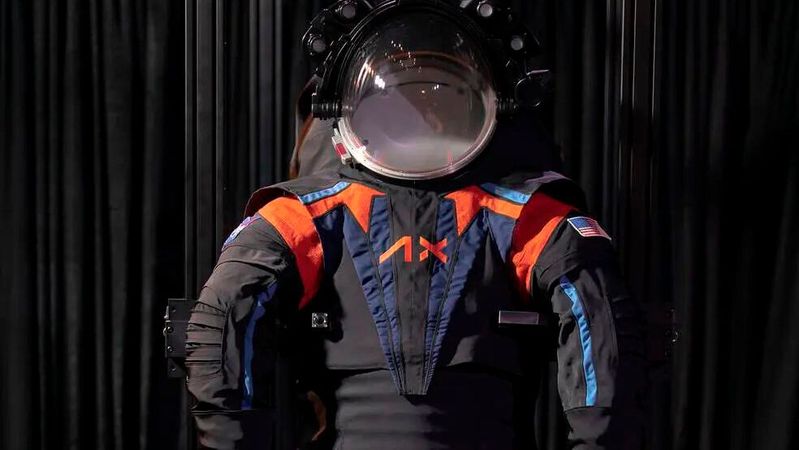
:quality(80)/p7i.vogel.de/wcms/b6/7e/b67ecc3d83864471029fac6bcf68d8ac/0120278911v1.jpeg "The prototype of the Artemis III spacesuit, the AxEMU. Although this prototype uses a dark gray cover material, the final version will probably be all white when worn by NASA astronauts on the lunar surface. (Image:Axiom Space)")
:quality(80)/p7i.vogel.de/wcms/02/18/02186af935a157c8047868de01327996/0127845434v1.jpeg "This is how NASA envisions the approach to the lunar surface with the planned Orion spacecraft as part of the Artemis mission. The fourth module for Orion comes from the Airbus plant in Bremen and is scheduled to be shipped to Florida in mid-November 2025. (Image:Nasa)")