While 90 percent of the world's population now has mobile network coverage, this only covers about 15 percent of the Earth's surface. Taking into account the oceans and vast undeveloped and rural areas, the idea of global connectivity quickly falters. At the same time, the demand for data connectivity in these remote areas is growing.
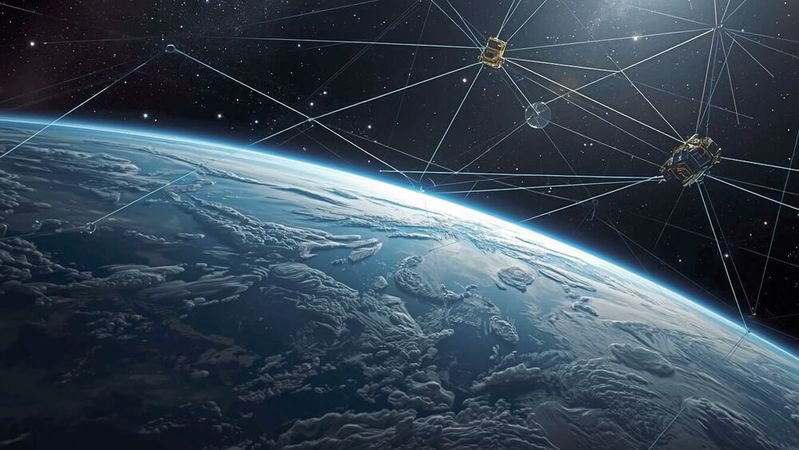
Space satellites: "The construction and deployment of NTN have never been easier."
(Image: AI-generated)
Non-terrestrial networks (NTN), which use satellites as a universal communication infrastructure, could be the solution. Advances in satellite communication in low Earth orbit (LEO) and geostationary orbit (GEO) are making the concept of a cost-effective, energy-efficient, scalable, and standardized data connection without boundaries a reality. This has far-reaching implications, but IoT applications, in particular, will benefit from it.
Limitless IoT
The potential benefits are as profound as they are diverse. They range from enhanced security to global asset tracking and remote maintenance of infrastructure. Crop yields can be increased, and management in maritime navigation and fishing can be optimized. Conservation and wildlife monitoring gain more possibilities. Even emergency responses and disaster relief benefit, as the systems continue to function when local terrestrial networks fail, providing early warnings and potentially life-saving insights.
Gallery
The alternative—building and operating terrestrial networks (TN) in these remote locations—is often time-consuming, costly, and offers too little ROI to be economically viable. Even relatively concentrated locations like mining and drilling sites face enormous logistical hurdles when establishing data connectivity, especially for temporary sites. Not to mention maritime applications, whose limited connections at sea are already almost entirely dependent on satellites.
Although NTN is a relatively new service, leading satellite companies like Iridium, Skylo, and Myriota are pioneering in the field. Even today, their NTNs provide essential connectivity for IoT applications in areas such as smart agriculture, environmental data collection, infrastructure monitoring, and global asset tracking. Their services deliver instant data connectivity even in the most remote locations and seamless handovers from terrestrial networks—essential when facilities or assets need to operate independently of networks.
A new generation
Satellite communication (Satcom) for commercial purposes is not a new idea. Since the early 1960s, we have been searching for ways to make Satcom profitable. However, advances in IoT applications encountered some hurdles, particularly concerning link budgeting.
Link budgets calculate all gains and losses a signal experiences on its path between point A and B, from the transmitter to the receiver. Since satellites can be located in low Earth orbit (LEO) between 500 and 800 km (approx. 310 and 500 miles) and in geostationary orbit (GEO) up to 36,000 km away (approx. 22,370 miles)—practically in space—the signal losses are extremely high.
One reason for this is latency. In GEO communication, latency can reach hundreds of milliseconds, which feels like an eternity compared to approximately 10 ms in TN (LTE-M). Similarly, the movement of LEO and MEO satellites (medium Earth orbit) leads to changing radio cell patterns, higher Doppler shifts, and faster fluctuations in propagation delay. Moreover, NTNs have significantly larger cell sizes than TNs, often spanning hundreds of kilometers. This can also result in greater fluctuations in propagation delay, with strong near-far effects overshadowing weaker signals. Atmospheric disturbances must also be considered, as the troposphere and ionosphere affect radio signals in different ways.
Establishing sufficiently strong connections therefore consumed a lot of energy. Battery-powered IoT devices with small form factors and operational lifespans of several years simply could not meet the required energy demands.
However, this changed with 3GPP Releases 17 and 18. The two updates expanded the 5G architecture to include support for NTN access as well as NTN support for NB-IoT and eMTC/LTE-M protocols. This allowed standard IoT devices to connect via satellite without the need for expensive, energy-intensive hardware or extensive protocol overhauls.
These updates also included new timing advance/TA values, synchronization, and HARQ adjustments (Hybrid Automatic Repeat Request) to compensate for the challenges of latency and Doppler shifts and achieve significant energy savings. Together, these adjustments have significantly improved connection stability (connection reliability) and enabled a stable, energy-efficient satellite connection under previously unreachable conditions.
Date: 08.12.2025
Naturally, we always handle your personal data responsibly. Any personal data we receive from you is processed in accordance with applicable data protection legislation. For detailed information please see our privacy policy.
Consent to the use of data for promotional purposes
I hereby consent to Vogel Communications Group GmbH & Co. KG, Max-Planck-Str. 7-9, 97082 Würzburg including any affiliated companies according to §§ 15 et seq. AktG (hereafter: Vogel Communications Group) using my e-mail address to send editorial newsletters. A list of all affiliated companies can be found here
Newsletter content may include all products and services of any companies mentioned above, including for example specialist journals and books, events and fairs as well as event-related products and services, print and digital media offers and services such as additional (editorial) newsletters, raffles, lead campaigns, market research both online and offline, specialist webportals and e-learning offers. In case my personal telephone number has also been collected, it may be used for offers of aforementioned products, for services of the companies mentioned above, and market research purposes.
Additionally, my consent also includes the processing of my email address and telephone number for data matching for marketing purposes with select advertising partners such as LinkedIn, Google, and Meta. For this, Vogel Communications Group may transmit said data in hashed form to the advertising partners who then use said data to determine whether I am also a member of the mentioned advertising partner portals. Vogel Communications Group uses this feature for the purposes of re-targeting (up-selling, cross-selling, and customer loyalty), generating so-called look-alike audiences for acquisition of new customers, and as basis for exclusion for on-going advertising campaigns. Further information can be found in section “data matching for marketing purposes”.
In case I access protected data on Internet portals of Vogel Communications Group including any affiliated companies according to §§ 15 et seq. AktG, I need to provide further data in order to register for the access to such content. In return for this free access to editorial content, my data may be used in accordance with this consent for the purposes stated here. This does not apply to data matching for marketing purposes.
Right of revocation
I understand that I can revoke my consent at will. My revocation does not change the lawfulness of data processing that was conducted based on my consent leading up to my revocation. One option to declare my revocation is to use the contact form found at https://contact.vogel.de. In case I no longer wish to receive certain newsletters, I have subscribed to, I can also click on the unsubscribe link included at the end of a newsletter. Further information regarding my right of revocation and the implementation of it as well as the consequences of my revocation can be found in the data protection declaration, section editorial newsletter.
Limitless data connectivity
NTN support for the 5G mobile ecosystem significantly simplifies the deployment of NTN. This enabled their integration into terrestrial networks for 3GPP providers. NTN act as complementary components of the Radio Access Network (RAN), with satellites serving as access nodes or relay stations and maintaining a stable connection to the core network.
The key advantage of this integration lies in the seamless mobility between terrestrial and non-terrestrial networks. This enables applications where end devices—whether IoT systems, vehicles, asset tracking nodes, etc.—can switch between terrestrial and satellite coverage with consistent network quality (QoS; Quality of Service).
Upcoming NTN-connected IoT systems
These innovations have significantly raised the standard for NTN-IoT data connectivity. To take full advantage, device manufacturers need hardware that simplifies and accelerates production while ensuring reliable and energy-efficient data connectivity in small form factors.
System-in-Package/SIP solutions from providers with years of experience in energy-efficient mobile connectivity are in demand. SiPs are a complete package or platform for IoT solutions. They include various components, most notably an application processor and a modem. This simplifies design, procurement, and production processes while reducing power consumption and the overall complexity of the system.
Ideally, chipsets—such as the nRF9151 from Nordic Semiconductor – also offer GNSS functions (Global Navigation Satellite System) and predictive GNSS features. These reduce the time required for the first position fix—the time a GPS navigation device needs to receive satellite signals and navigation data and calculate a position solution—from minutes to seconds.
Limitless possibilities
The deployment and provision of NTN has never been easier. With advancements in technology, the barriers to truly global, scalable, and energy-efficient IoT deployment have nearly disappeared. What was once a niche solution is quickly becoming a crucial factor for borderless data connectivity. With NTN-optimized protocols and integrated SiP platforms, developers now have the tools to offer seamless, energy-efficient IoT solutions that operate far beyond the traditional boundaries of cellular coverage. The possibilities are limitless. (mc)
*Martin Lesund is Technical Marketing Manager, Cellular IoT at Nordic Semiconductor.




:quality(80)/p7i.vogel.de/wcms/09/eb/09eb390bca7e654430ac8f81ac5b6bf6/0129830738v1.jpeg "Data centers in orbit are indeed a vision of the future, while underwater data centers are already being tested. (Image:Dall-E / AI-generated)")
:quality(80)/p7i.vogel.de/wcms/e3/a7/e3a73b85d9e799a712cfd049c3c5fd1b/0130047131v1.jpeg "The first option is not happening! At the VW plant in Osnabrück, Rheinmetall had reportedly assessed the situation for potential production projects. The construction of this type of 6-wheel armored vehicles would have been possible. However, this will not happen, as Rheinmetall has now announced. (Image:Rheinmetall / W. Geiger)")
:quality(80)/p7i.vogel.de/wcms/64/61/6461b49748f359bbae2ee6669a871923/issa-j1-cg-5-1920x1079v1.webp "(Image: Astroscale )")
:quality(80)/p7i.vogel.de/wcms/dd/ce/ddcef80b290218276bf857cdb64a45e1/finkel-stephan-4162x2341v1.jpeg "Stephan Finkel, Partner and Industry Lead Defence & Security at 3DSE (Source: 3DSE)")
:quality(80)/p7i.vogel.de/wcms/0c/70/0c701a79c1f183921b8ee9341ef61db8/0129694966v1.jpeg "Robonode's DVK Development Kit: This is available through Codico's sample shop. (Image:8DEVICES)")
:quality(80)/p7i.vogel.de/wcms/7c/12/7c123d3888ed3a37a83b0793be569f00/hon-aero-hguide-i700-imu-comp-view-2880x1440-1024x576v1.webp "(Source: Honeywell)")
:quality(80)/p7i.vogel.de/wcms/62/06/6206d30afc9c4f286f4ecf4cedf575c5/stark-20virtus-20side-1920x1079v1.jpeg "To be introduced into service with the Bundeswehr: The “Virtus” developed by Stark has a range of up to 100 km and is designed to engage targets on the battlefield. (Picture: STARK Defence)")
:quality(80)/p7i.vogel.de/wcms/4b/a3/4ba36ed2a3bbc5632aa56344ed9e9012/design-20ohne-20titel-1795x1009v1.png "High-performance ceramic components demonstrate the potential of advanced materials and additive manufacturing for precision industrial and aerospace applications. (Images:KYOCERA Europe GmbH)")
:quality(80)/p7i.vogel.de/wcms/5b/44/5b44acf63074c37ab8daaf1225a265cf/launch-vehicle-spectrum-at-andoya-space-c-isar-aerospace-2026-01-30-083741-ruml-4007x2254v1.jpeg "(Source: Isar Aerospace)")
:quality(80)/p7i.vogel.de/wcms/e2/34/e234e56f31ce44de622fb7ee925a904c/bild1-urheber-20kongsberg-1598x899v1.jpeg "(Source: Kongsberg)")
:quality(80)/p7i.vogel.de/wcms/3f/c0/3fc013e170392cf0fa715f22d68197d8/harakan-f2-2-topfront-mirror-1-4607x2592v1.jpeg "The HARAKAN-F2-2 rugged VPX computer from Kontron enables high-performance edge computing, AI processing and sensor fusion for demanding defence missions. (Image:Kontron AG)")
:quality(80)/p7i.vogel.de/wcms/93/f1/93f1e4dba53b2c9589fab17a525df55e/adobestock-163119218-2480x1394v1.jpeg "(Source: Kernkonzept GmbH)")
:quality(80)/p7i.vogel.de/wcms/8d/76/8d764c984e44153da8f0dfa88cd6d75e/0129843677v1.jpeg "A successful drone attack on two data centers of the Amazon subsidiary AWS shows that the danger of drones is virtually unavoidable in modern warfare ... (Source: Cerberus)")
:quality(80)/p7i.vogel.de/wcms/6f/a7/6fa76be29e77ecb487a2dbbda36fc514/ki-generiert3a35a036-d062-432c-914c-d4fa050cf58f-1536x864v1.png "(Source: AI-generated)")
:quality(80)/p7i.vogel.de/wcms/32/cb/32cb64c4a0486d2f9283b8ea57003421/fkie-fraunhofer-entwickelt-ki-gestuetztes-lernmanagementsystem-fuer-die-bundeswehr-1440x810v1.jpeg "(Source: Philipp Plum / Fraunhofer FOKUS)")
:quality(80)/p7i.vogel.de/wcms/d4/dc/d4dc9a59e1698ae295b1e6e64a29a55b/geralt-handshake-5768632-1280-1280x720v1.jpeg "Rheinmetall and Nooteboom Trailers are collaborating on the development and marketing of heavy equipment trailer systems designed for transporting modern tracked and wheeled military vehicles. (Image:Gerd Altmann from Pixabay)")
:quality(80)/p7i.vogel.de/wcms/22/54/2254d1e2667aff755e7aba0bcaf2eb42/0130021093v1.jpeg "Daimler Truck and Quantum Systems are jointly developing unmanned military vehicles. (Image:Quantum Systems)")
:quality(80)/p7i.vogel.de/wcms/0b/ba/0bbad1438344133fa65cdb70ac833967/2026-03-04-rheinmetall-steigt-bei-kroatischer-dok-ing-ein---media--06a35258--query-402x-114e90d2-1910x1075v1.jpeg "Through the majority acquisition of DOK-ING, Rheinmetall expands its expertise in unmanned ground systems and autonomous military support vehicles. (Image:Rheinmetall AG)")
:quality(80)/p7i.vogel.de/wcms/f9/2f/f92f1ef8c739c34c70d99f7b0997621b/stra007-20--20cover-20image-5472x3076v1.jpeg "(Source: Stratasys)")
:quality(80)/p7i.vogel.de/wcms/5e/18/5e184e4961f190c86a1ea3227104cab5/26pm03-20kompakte-20l-c3-b6sungen-20f-c3-bcr-20luft--20und-20raumfahrt-202-2362x1329v1.jpeg "(Picture: Keysight)")
:quality(80)/p7i.vogel.de/wcms/67/4c/674c54baa745be497cecb716826af339/stahlwille-hero-1807x1016v1.jpeg "A new modular tool solution designed for safety, precision, and mobility in aviation maintenance. (Source: STAHLWILLE)")
:quality(80)/p7i.vogel.de/wcms/0d/01/0d01a051ba894332a8091e3a3f9394e1/hytorc-defense-solutions-boxersatz-1899x1068v1.jpeg "HYTORC’s Defence Solutions toolkit, proven on the GTK Boxer, enables safe, traceable fastening of critical components across multiple Bundeswehr platforms. (Source: Image: HYTORC)")
:fill(fff,0)/p7i.vogel.de/companies/64/fe/64fec73b1a2fb/logo-master-ggbbytimken-286blue.jpeg "logo-master-ggbbytimken-286blue (GGB)")
:fill(fff,0)/p7i.vogel.de/companies/69/6d/696de2483d115/logo--fastems-rgb-horizontal.jpeg "logo--fastems-rgb-horizontal (Fastems)")
:quality(80)/p7i.vogel.de/wcms/a8/a0/a8a0d751d131f9d0aa7efd3555992e77/0128247463v1.jpeg "Space satellites: \"The construction and deployment of NTN have never been easier.\"(Image: AI-generated)")
:quality(80)/p7i.vogel.de/wcms/ff/6e/ff6e0827618564af23598b500c94f0c5/0128247166v1.jpeg "Non-terrestrial networks: Global satellite coverage(Image: Nordic Semiconductors)")
:quality(80)/p7i.vogel.de/wcms/b6/51/b65191544a0edfab433f19f79bd4a975/0128247168v1.jpeg "nRF9151 from Nordic Semiconductor: The chipset also offers GNSS functionality.(Image: Nordic Semiconductors)")
:quality(80)/p7i.vogel.de/wcms/21/a9/21a98d8261e93fe9425796a7c6c7b5f5/0127301615v1.jpeg "The communication of IoT devices via standard mobile network protocols through satellites is possible. (Image:Sateliot)")
:quality(80)/p7i.vogel.de/wcms/87/64/8764805769502526a7f6a32c767c22cd/0124246561v1.jpeg "0124246561v1 (Source: Analog Devices)")