In the current discussion on aviation decarbonization, the focus often shifts to costly new technologies like synthetic fuels. However, a key to enhanced sustainability lies in the digitalization of air traffic management.
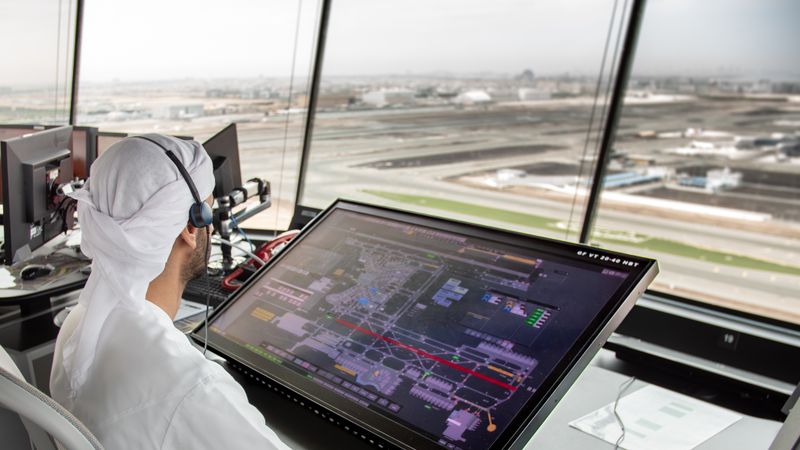
Abu Dhabi Airport saved 3,000 tons of CO₂ due to a digital assistance system for air-traffic controllers in the tower.
(Source: Frequentis)
Abu Dhabi Airport has saved 3,000 tons of CO₂ over the past three years. This is equivalent to the amount that around 200,000 trees could absorb in a year. And this despite the fact that passenger numbers doubled during the same period. This achievement was not the result of new engines or synthetic fuels, as such measures are costly and time-consuming to implement. For example, synthetic fuels currently cost three times as much as kerosene. In Abu Dhabi, the reduction was made possible by a digital assistance system for air-traffic controllers in the tower.
A frequently overlooked lever for decarbonising aviation lies in the digitalisation of air-traffic management. Even small improvements in communication and coordination add up to tangible reductions in CO₂ emissions.
43 European Airspace Sectors – a Barrier to Climate Action
Public pressure, national climate targets, and global initiatives such as the Paris Agreement are pushing airports and airlines across Europe to take action. They have therefore set ambitious goals, and many aim to drastically reduce their emissions or become climate-neutral by 2050 at the latest. However, rising passenger volumes make this increasingly difficult, and time is running out.
A major obstacle lies in the structure of European airspace itself. It is currently fragmented into 43 national sectors, each with its own rules and procedures. In practice, this often leads to extended flight routes due to detours or holding patterns. The result: additional, avoidable fuel consumption. Studies show that a unified European airspace could reduce CO₂ emissions by up to ten percent, equivalent to around 40 million tons per year, roughly the annual emissions of all passenger cars in Spain.
This is precisely where the European initiative SESAR (Single European Sky ATM Research) comes in. It brings together airlines, air-navigation service providers, airports, and technology companies to harmonise airspace, advance research in air-traffic management, and meet climate targets. The goal of intelligent air-traffic management is to optimise flight routes and procedures so that airspace is used more efficiently. This reduces fuel consumption, emissions and delays.
Europe’s security landscape is changing rapidly
(Source: VCG)
As defence budgets rise and EU programmes expand, civil technology providers are becoming vital contributors to Europe’s strategic autonomy. The event will act as a neutral platform for dialogue between technology suppliers, integrators, and decision-makers shaping the next generation of European defence capabilities and aims to open doors between civil industry and defence procurement, providing practical insights.
The advantages of intelligent air-traffic management become apparent through many small but cumulatively effective optimisations. One example is the “Follow the Greens” system, in which green taxiway lights guide pilots efficiently across the airport apron. The system automates the switching of taxiway centerline lights and stop bars, ensuring pilots always follow the optimal route. The system introduced at Abu Dhabi Airports reduces taxi times by an average of 14 seconds per flight. With 820 flights per day, this results in significant fuel and CO₂ savings.
At the same time, ultrafine particle and particulate pollution on the ground is reduced—crucial for public health near airports. In Europe, according to the European Environment Agency, around 52 million people near major airports are exposed to elevated levels of ultrafine particles, meaning even small reductions can have noticeable effects.
Optimised Approaches and a Low-Thrust Descent Save Fuel
Another measure is just-in-time arrival planning. A digital Arrival Manager ensures aircraft are sequenced long before reaching the airport, eliminating the need for holding patterns. The Arrival Manager is based on a unified platform that consolidates all flight-planning and airport operations systems in a central environment. Real-time data and workflows between air-traffic control, airlines, and ground services are synchronised, creating a shared, always up-to-date overview of all flight movements and resources. Systems of this kind are already in use in London, Singapore, and Hong Kong, reducing holding times by up to 30 minutes.
Combined with “continuous descent”- a smooth glide path instead of energy-intensive step-down approaches - further emission reductions can be achieved. During descent, aircraft can throttle engines to idle and descend for up to 70 kilometers without additional fuel consumption. From a technical perspective, continuous descent is enabled by tight integration of air-traffic management systems with weather data, flight-plan information, and real-time aircraft positioning.
These data streams produce customised descent profiles that adapt dynamically to traffic and weather conditions. The resulting guidance is shared across all stakeholders: air-traffic controllers receive precise approach profiles and timing information, while pilots access required waypoints, altitude profiles, and descent schedules via onboard systems. However, this works only if the approach is planned early. According to EUROCONTROL, around 145 kilograms of CO₂ can be saved per flight. Across Europe, this amounts to approximately 340,000 tons of fuel and 1 million tons of CO₂ per year. Noise is also reduced by up to 5 dB.
Date: 08.12.2025
Naturally, we always handle your personal data responsibly. Any personal data we receive from you is processed in accordance with applicable data protection legislation. For detailed information please see our privacy policy.
Consent to the use of data for promotional purposes
I hereby consent to Vogel Communications Group GmbH & Co. KG, Max-Planck-Str. 7-9, 97082 Würzburg including any affiliated companies according to §§ 15 et seq. AktG (hereafter: Vogel Communications Group) using my e-mail address to send editorial newsletters. A list of all affiliated companies can be found here
Newsletter content may include all products and services of any companies mentioned above, including for example specialist journals and books, events and fairs as well as event-related products and services, print and digital media offers and services such as additional (editorial) newsletters, raffles, lead campaigns, market research both online and offline, specialist webportals and e-learning offers. In case my personal telephone number has also been collected, it may be used for offers of aforementioned products, for services of the companies mentioned above, and market research purposes.
Additionally, my consent also includes the processing of my email address and telephone number for data matching for marketing purposes with select advertising partners such as LinkedIn, Google, and Meta. For this, Vogel Communications Group may transmit said data in hashed form to the advertising partners who then use said data to determine whether I am also a member of the mentioned advertising partner portals. Vogel Communications Group uses this feature for the purposes of re-targeting (up-selling, cross-selling, and customer loyalty), generating so-called look-alike audiences for acquisition of new customers, and as basis for exclusion for on-going advertising campaigns. Further information can be found in section “data matching for marketing purposes”.
In case I access protected data on Internet portals of Vogel Communications Group including any affiliated companies according to §§ 15 et seq. AktG, I need to provide further data in order to register for the access to such content. In return for this free access to editorial content, my data may be used in accordance with this consent for the purposes stated here. This does not apply to data matching for marketing purposes.
Right of revocation
I understand that I can revoke my consent at will. My revocation does not change the lawfulness of data processing that was conducted based on my consent leading up to my revocation. One option to declare my revocation is to use the contact form found at https://contact.vogel.de. In case I no longer wish to receive certain newsletters, I have subscribed to, I can also click on the unsubscribe link included at the end of a newsletter. Further information regarding my right of revocation and the implementation of it as well as the consequences of my revocation can be found in the data protection declaration, section editorial newsletter.
Who Decides on Sustainability in the Airspace?
Airlines benefit greatly from these savings - shorter flight times, fewer delays, and lower fuel consumption - but they do not bear the investment costs. The decision to purchase and operate such systems lies solely with air-navigation service providers. These are state-run in most European countries and rely on public funding and investment programs.
Introducing air-traffic management systems requires substantial upfront investment. Major airports can usually afford it, while smaller regional airports struggle. Additionally, the aviation sector has a conservative safety culture: new technologies undergo years of testing and certification, such as the EUROCAE ED-153 standard for software safety assurance, before they can enter regular operation. After all, safety in the airspace is paramount.
It is therefore crucial that policymakers, air-navigation service providers, and airlines work together to advance the digitalisation of airspace. Organisations such as SESAR were created precisely for this purpose.
Sustainability Begins in the Tower
While many emission-reduction measures, such as new aircraft technologies or widespread availability of affordable alternative fuels, are still in development or face significant implementation barriers, the situation is different for air-traffic management systems. These systems already exist and could often be deployed within months. This is especially true for airports, where decisions can be made locally with relatively little coordination. As a result, tower and airport-based solutions can deliver noticeable improvements quickly.
Europe is already taking an important first step with SESAR to support the harmonised rollout of digital decision-support systems. The initiative focuses on cross-border, interoperable systems that enable further savings, across all phases of flight, from takeoff to en-route operations to approach. If successful, efficiencies like those seen at Abu Dhabi Airport could become standard practice.




:quality(80)/p7i.vogel.de/wcms/8b/f4/8bf4a7aa5a40349c3a6f67a8aa806f6b/image-imageformat-carousel-505514996-2665x1498v1.jpeg "Each of the isolated indium atoms (in gold color) can catalyse the synthesis of methanol (top right). (Image:Constance Ko / ETH Zurich)")
:quality(80)/p7i.vogel.de/wcms/46/8e/468e6c3702956b17505237994d8dad97/0129920231v1.jpeg "Hensoldt, a sensor specialist for critical defence applications among other things, now has a strategic milestone ahead of it. The company is planning to acquire Nedinsco, an optronics company from Venlo in the Netherlands. Here's what's to come ... (Source: Hensoldt)")
:quality(80)/p7i.vogel.de/wcms/56/05/5605373104ee6d3fcf8bbfa608731091/0129915700v1.jpeg "After the first \"Kübel\" and the Schwimmwagen, Volkswagen has made itself popular with the Bundeswehr with this Kübel here, as well as with the VW Bus. Now there are initial reports that the armored vehicle track could also be used. (Source: Volkswagen)")
:quality(80)/p7i.vogel.de/wcms/ff/2a/ff2adcb48e6b6a81a77ce9c6f62334ce/0129914625v1.jpeg "Looking ahead to 2025, Renk cites record figures in particular. Find out here how the armaments business in particular is currently paying off for the Group ... (Image:Renk)")
:quality(80)/p7i.vogel.de/wcms/05/04/050472eef4626e049667afe3ae3e5909/pm-draht-lmd-bild-3-1920x1081v1.jpeg "(Source: Fraunhofer ILT, Aachen, Germany / Volker Lannert.)")
:quality(80)/p7i.vogel.de/wcms/34/48/3448103f90626143970ac1e54dc70f5c/0129896088v1.jpeg "View of a Wickert hydraulic press, which is suitable for producing safety-relevant components from various composite materials. The spectrum ranges from personal protection to the armoring of armor systems of all kinds. (Image:Wickert mechanical engineering)")
:quality(80)/p7i.vogel.de/wcms/5b/eb/5beb9d1d593df5ec59156f6dc22fbbd9/bischof-brugg-pipes-3y1a0339-2399x1349v1.jpeg "(Source: Brugg Pipes)")
:quality(80)/p7i.vogel.de/wcms/6f/eb/6feb6f0a4d94e54014d7b1869452ce53/picmax-3840x2158v1.png "Three layers of a silver ion-doped polyheptazine imide polymeric network. In this example the metal ions are located between the layers, inducing lattice expansion and structural distortion. However, the polymeric backbone remains intact. Only the pore geometry changes. (Source: Dr. Bernd Schröder)")
:quality(80)/p7i.vogel.de/wcms/9a/a0/9aa09568db7b06b1a5d1d196bd7d0bc5/0129568242v1.jpeg "Air bp and Airbus have signed a multi-year fuel supply contract. (Image:Airbus)")
:quality(80)/p7i.vogel.de/wcms/1e/52/1e52027cb1285c559cc28d89cee5954c/airbus-1251x703v1.png "(Image: Airbus)")
:quality(80)/p7i.vogel.de/wcms/21/e3/21e3203ba1d373548efb6fcfcdb26a6c/esa-20artemis-1920x1079v1.jpeg "(Source: NASA)")
:quality(80)/p7i.vogel.de/wcms/d6/2e/d62e273fe38b3d8e065f1a18fc0139ae/flugzeug-20am-20himmel-1792x1009v1.png "(Source: AI-generated)")
:quality(80)/p7i.vogel.de/wcms/93/f1/93f1e4dba53b2c9589fab17a525df55e/adobestock-163119218-2480x1394v1.jpeg "(Source: Kernkonzept GmbH)")
:quality(80)/p7i.vogel.de/wcms/8d/76/8d764c984e44153da8f0dfa88cd6d75e/0129843677v1.jpeg "A successful drone attack on two data centers of the Amazon subsidiary AWS shows that the danger of drones is virtually unavoidable in modern warfare ... (Source: Cerberus)")
:quality(80)/p7i.vogel.de/wcms/6f/a7/6fa76be29e77ecb487a2dbbda36fc514/ki-generiert3a35a036-d062-432c-914c-d4fa050cf58f-1536x864v1.png "(Source: AI-generated)")
:quality(80)/p7i.vogel.de/wcms/32/cb/32cb64c4a0486d2f9283b8ea57003421/fkie-fraunhofer-entwickelt-ki-gestuetztes-lernmanagementsystem-fuer-die-bundeswehr-1440x810v1.jpeg "(Source: Philipp Plum / Fraunhofer FOKUS)")
:quality(80)/p7i.vogel.de/wcms/22/ea/22ea2068a1f2a3ad3cac21eda628b0ad/range-motiv-a4-02-4741x2666v1.jpeg "The acquisition of NVL strengthens Rheinmetall’s position in naval shipbuilding and expands its capabilities in advanced maritime defence systems. (Image:Rheinmetall AG)")
:quality(80)/p7i.vogel.de/wcms/58/5a/585a92223bfdffdd69cbfc52d30e5367/7ba159ca-33ee-46ca-8da8-65ad1acc3aac-3102x1745v1.png "(Source: European Commission)")
:quality(80)/p7i.vogel.de/wcms/43/7b/437b848e817e7e6018612389b9e65046/0129580414v1.jpeg "Until now, Rheinmetall has primarily equipped warships with laser systems and cannons, such as the Oerlikon Millennium Gun for fast surface targets. Now, however, the Düsseldorf (Germany) -based defence company wants to build entire ships, as it is allowed to take over NVL ... (Image:Rheinmetall Air Defence AG)")
:quality(80)/p7i.vogel.de/wcms/42/53/425386d9947a2808f3ca893cb8e9a6b0/img-20251008-150724-4640x2608v1.webp "(Source: EDA)")
:quality(80)/p7i.vogel.de/wcms/f9/2f/f92f1ef8c739c34c70d99f7b0997621b/stra007-20--20cover-20image-5472x3076v1.jpeg "(Source: Stratasys)")
:quality(80)/p7i.vogel.de/wcms/5e/18/5e184e4961f190c86a1ea3227104cab5/26pm03-20kompakte-20l-c3-b6sungen-20f-c3-bcr-20luft--20und-20raumfahrt-202-2362x1329v1.jpeg "(Picture: Keysight)")
:quality(80)/p7i.vogel.de/wcms/67/4c/674c54baa745be497cecb716826af339/stahlwille-hero-1807x1016v1.jpeg "A new modular tool solution designed for safety, precision, and mobility in aviation maintenance. (Source: STAHLWILLE)")
:quality(80)/p7i.vogel.de/wcms/0d/01/0d01a051ba894332a8091e3a3f9394e1/hytorc-defense-solutions-boxersatz-1899x1068v1.jpeg "HYTORC’s Defence Solutions toolkit, proven on the GTK Boxer, enables safe, traceable fastening of critical components across multiple Bundeswehr platforms. (Source: Image: HYTORC)")
:fill(fff,0)/p7i.vogel.de/companies/69/6d/696de2483d115/logo--fastems-rgb-horizontal.jpeg "logo--fastems-rgb-horizontal (Fastems)")

:quality(80)/p7i.vogel.de/wcms/07/0f/070f2f6a28e954422c60a0e15cb73471/0128576617v1.jpeg "The aerospace industry is under great pressure to develop faster, plan more efficiently, and utilize resources better. Quantum computing can help with this. (Image:freely licensed on Pixabay)")
:quality(80)/p7i.vogel.de/wcms/63/6a/636a93541f97452f86a72db78a3ec847/saab-20poland-1281x720v1.jpeg "Saab’s Remote Tower operations centre: high-resolution visual feeds and advanced controller interfaces enable air traffic control from a centralised location – even across multiple airports. (Bild: Saab)")