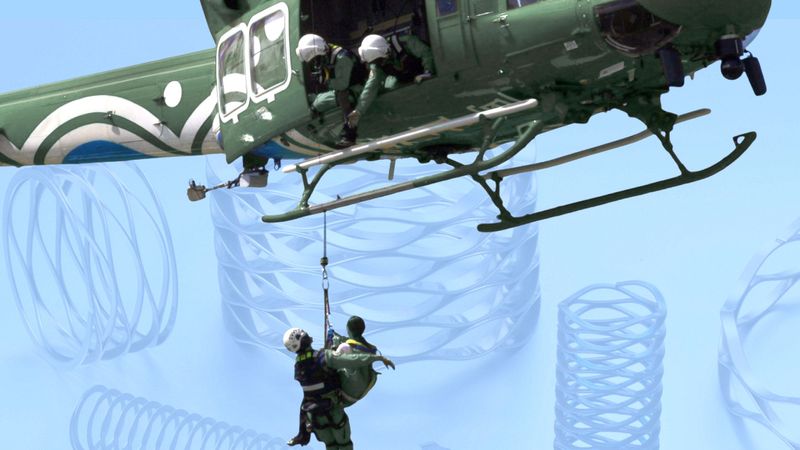
Defence manufacturers rely on wave springs from the AFC portfolio.
Smalley wave springs offered by AFC Europe are also used in the design of defence and security systems. Here, they often replace springs made from stamped sheet metal.
(Source: AFC/ Smalley)
The flat wire wave springs from Smalley are a proven problem solver in the realisation of kinematic assemblies. They are among the core products in the portfolio of AFC Europe (formerly TFC) and are currently being increasingly used by manufacturers of defence and security systems. Specific applications include absorbing defined loads, setting preloads and compensating axial tolerances.
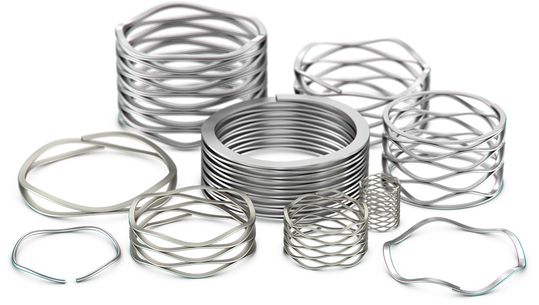
Smalley wave springs from AFC can be specified very precisely in terms of load capacity, tolerance, material and spring rate.
(Source: AFC / Smalley)
Whether it is helicopter winches, mobile targeting devices or the gear systems of special vehicles: the realisation of kinematic assemblies that must operate reliably and precisely under extreme loads is undoubtedly one of the central tasks of designers of defence and security systems. For engineers, procurement specialists and buyers in the industry, this means that when selecting all relevant machine elements, their focus must be on components that meet particularly high quality requirements. Under these demanding conditions, Smalley wave springs (supplied by AFC Europe) have gained considerable importance. Time and again, these elements made from rolled and coiled flat wire prove to be a welcome solution for typical challenges arising in the design of kinematic precision assemblies. Whether it is the absorption of specific loads, the targeted setting of preloads, the reliable compensation of bearing clearances or the compensation of operational tolerances, Smalley wave springs often demonstrate clear advantages over conventional round wire springs or stamped sheet metal components. Regardless of their dimensions, they can be specified very precisely in terms of load capacity, tolerance, material and spring rate. And when, in addition to solving the kinematic problem, reducing installation space and miniaturising the assembly are required, the wave spring proves to be almost unbeatable.
The load determines the layers
As an exclusive partner of Smalley, AFC Europe offers a wide range of single-layer and multi-layer wave springs in many sizes as well as metric and imperial dimensions. The single-layer variants are primarily suitable for designs with short spring travel, where low to medium loads need to be handled. They are available with open gaps or overlapping ends and are installed with an interference fit, allowing free and unrestricted spring operation.
Europe’s security landscape is changing rapidly
(Source: VCG)
As defence budgets rise and EU programmes expand, civil technology providers are becoming vital contributors to Europe’s strategic autonomy. The event will act as a neutral platform for dialogue between technology suppliers, integrators, and decision-makers shaping the next generation of European defence capabilities and aims to open doors between civil industry and defence procurement, providing practical insights.
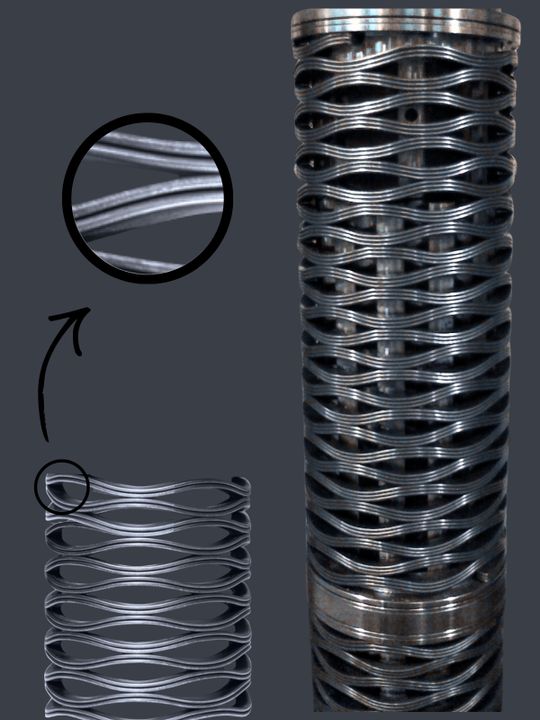
The multi-layer wave springs in the AFC portfolio, on the other hand, feature continuously and uninterruptedly coiled turns. They carry the product designation Crest-to-Crest®, indicating that all peaks (maxima) of the flat wire touch each other. They are supplied in imperial and metric series and in many sizes with up to 15 turns. In addition, depending on the installation scenario, the designer can choose between two end types: parallel ends, which form circumferentially closed contact surfaces, or waved ends that rest on the peaks of the flat wire waves.
In a multi-layer wave spring, the spring rate decreases proportionally with the number of turns. This means it is an ideal solution for applications with long spring travel where uniform and linear force development is required. Neither alignment of the turns nor the use of shims nor fixation by welding points is necessary. This simplifies the design and minimises both assembly effort and the number of components. Not to be overlooked: Crest-to-Crest® wave springs enable the greatest reductions in installation space. With the same spring travel and load capacity, they require up to 50 percent less axial installation space than a round wire or coil spring. This prevents design collisions and enables significant space optimisation.
Wide range of applications
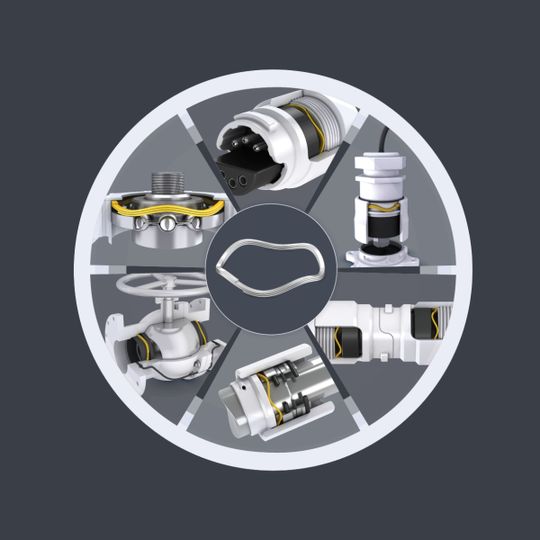
In addition to the examples mentioned at the beginning, Smalley wave springs are also used in defence and security technology in recoil systems of launch systems, in control units of missiles, in stabilisation axes of gyroscopes, in optics of navigation systems as well as in satellite housings and servo drives. In some cases, the focus is on motion guidance or energy absorption, in others on providing preload, damping vibration or controlling axial loads.
For applications requiring high forces and long spring travel, AFC recommends the Interlaced wave spring type with nested turns.
(Source: AFC / Smalley)
A multi-layer wave spring of the Nested Spirawave® type delivers up to three times the spring force of a single-layer wave spring.
(Source: AFC / Smalley)
As a specialised solution for preloading bearing bushings of hydraulic telescopic tubes and for applications with limited radial installation space, the narrow-section wave springs of the YSSR-N type have proven effective. For assemblies where large forces are at work and long spring travel is required, AFC’s consultants recommend the Interlaced wave spring type. It is a combination of up to three integrated Crest-to-Crest® springs and can substitute stacked disc springs or nested coil springs. This reduces assembly effort and, because neither stacking nor alignment is required, the design of housings and supports can be eliminated entirely. Also of interest for defence applications is the Nested Spirawave® wave spring, designed for high-load use. Its flat wire turns run parallel and lie flush and fully in contact. In addition, Smalley guarantees that it is consistently manufactured from a single piece of flat wire. A Nested Spirawave® can deliver up to three times the spring force of a single-layer wave spring. This eliminates the need to stack or nest multiple single-layer wave springs, and misalignment or uneven loading does not occur.
Date: 08.12.2025
Naturally, we always handle your personal data responsibly. Any personal data we receive from you is processed in accordance with applicable data protection legislation. For detailed information please see our privacy policy.
Consent to the use of data for promotional purposes
I hereby consent to Vogel Communications Group GmbH & Co. KG, Max-Planck-Str. 7-9, 97082 Würzburg including any affiliated companies according to §§ 15 et seq. AktG (hereafter: Vogel Communications Group) using my e-mail address to send editorial newsletters. A list of all affiliated companies can be found here
Newsletter content may include all products and services of any companies mentioned above, including for example specialist journals and books, events and fairs as well as event-related products and services, print and digital media offers and services such as additional (editorial) newsletters, raffles, lead campaigns, market research both online and offline, specialist webportals and e-learning offers. In case my personal telephone number has also been collected, it may be used for offers of aforementioned products, for services of the companies mentioned above, and market research purposes.
Additionally, my consent also includes the processing of my email address and telephone number for data matching for marketing purposes with select advertising partners such as LinkedIn, Google, and Meta. For this, Vogel Communications Group may transmit said data in hashed form to the advertising partners who then use said data to determine whether I am also a member of the mentioned advertising partner portals. Vogel Communications Group uses this feature for the purposes of re-targeting (up-selling, cross-selling, and customer loyalty), generating so-called look-alike audiences for acquisition of new customers, and as basis for exclusion for on-going advertising campaigns. Further information can be found in section “data matching for marketing purposes”.
In case I access protected data on Internet portals of Vogel Communications Group including any affiliated companies according to §§ 15 et seq. AktG, I need to provide further data in order to register for the access to such content. In return for this free access to editorial content, my data may be used in accordance with this consent for the purposes stated here. This does not apply to data matching for marketing purposes.
Right of revocation
I understand that I can revoke my consent at will. My revocation does not change the lawfulness of data processing that was conducted based on my consent leading up to my revocation. One option to declare my revocation is to use the contact form found at https://contact.vogel.de. In case I no longer wish to receive certain newsletters, I have subscribed to, I can also click on the unsubscribe link included at the end of a newsletter. Further information regarding my right of revocation and the implementation of it as well as the consequences of my revocation can be found in the data protection declaration, section editorial newsletter.
Prototypes and customised solutions possible
The manufacturing basis for producing Smalley wave springs is the Circular-Grain® method, a variant of edgewinding technology. It allows modifications to be made to the flat wire elements without the use of additional tools. Against this background, AFC Europe is also able to offer its customers rapid prototype production and—even for small batch sizes—cost-effective manufacturing of customised solutions.




:quality(80)/p7i.vogel.de/wcms/f4/02/f402dd05a26acf096436c3ced716d083/0130342170v1.jpeg "The start-up Helsing, which actually specialises in conventional combat drones, is gearing up for future military orders with plans for a new plant near Munich. Perhaps the new CA-1 UAV AI fighter aircraft (pictured) will also be scurrying out of the factory gates there in the future. (Source: Helsing)")
:quality(80)/p7i.vogel.de/wcms/33/93/33932c5539478e892c5ed8c815794b52/bgr-peter-paul-20weiler3-2673x1503v1.jpeg "Dr. Martin Erdmann: \"We need greater awareness of raw material extraction in our society.\" (Picture: BGR / Peter-Paul Weiler)")
:quality(80)/p7i.vogel.de/wcms/85/77/8577c8e8ff17f2c87cb826f660df3aea/20240417-friedrich-merz-2759-1163x654v1.jpeg "German Chancellor Merz: Germany prepares to take a stake in a \"large Franco-German defence company, for example specialising in armoured land vehicles.\" (Archive picture) (Photo: Wiki Commons / Michael Lucan, CC BY-SA 3.0 DE )")
:quality(80)/p7i.vogel.de/wcms/a1/cc/a1cc1d34709a9faa39711865dff43b2a/generalleutnant-christian-freuding-bild-bundeswehr-510x287v1.jpeg "Lieutenant General Christian Freuding, Inspector of the German Army, eyes AI for warfare decision making. (Picture: Wiki Commons)")
:quality(80)/p7i.vogel.de/wcms/08/2e/082e7ee4fff00331de609913c1c062f9/afc-0326-1-2480x1395v1.jpeg "Smalley wave springs offered by AFC Europe are also used in the design of defence and security systems. Here, they often replace springs made from stamped sheet metal. (Source: AFC/ Smalley)")
:quality(80)/p7i.vogel.de/wcms/49/38/493876a248943456b7e4a6db6edfc454/0130230765v1.jpeg "Safe and reliable in aircraft construction: light-curing adhesive bond combined with universal fastening elements. (Source: Delo)")
:quality(80)/p7i.vogel.de/wcms/7e/b1/7eb1594d4436420e178f3c1a0cd8fccc/0130342170v1.jpeg "The start-up Helsing, which is actually specialized in conventional combat drones, is preparing for future military orders with plans for a new plant near Munich. Perhaps in the future, the new AI combat aircraft of the CA-1 UAV type (image) will also glide out of the hangar doors there. (Image:Helsing)")
:quality(80)/p7i.vogel.de/wcms/f3/28/f3286d41a4bf6162bd95957d3a8169c9/0130229987v1.jpeg "Process reliability for large components: Automated mass finishing system \"SF-HP\" for engine components. (Source: Otec)")
:quality(80)/p7i.vogel.de/wcms/06/37/0637c7dd3fab9b00a8e96f98133cd1dc/260304-d-d0477-1005-5892x3317v1.png "A B-52H Stratofortress idles prior to taking off in support of Operation Epic Fury in March 2026. (Source: U.S. Air Force)")
:quality(80)/p7i.vogel.de/wcms/80/e3/80e36e9ce7e6f1fba308a3d72afb0328/drohne-adobestock-227592407-cegli-4993x2807v1.jpeg "Can chains fend off drones? Yes, as this article shows. (Source: © cegli - stock-adobe)")
:quality(80)/p7i.vogel.de/wcms/f9/2f/f92f1ef8c739c34c70d99f7b0997621b/stra007-20--20cover-20image-5472x3076v1.jpeg "(Source: Stratasys)")
:fill(fff,0)/p7i.vogel.de/companies/64/fe/64fec73b1a2fb/logo-master-ggbbytimken-286blue.jpeg "logo-master-ggbbytimken-286blue (GGB)")
:fill(fff,0)/p7i.vogel.de/companies/69/6d/696de2483d115/logo--fastems-rgb-horizontal.jpeg "logo--fastems-rgb-horizontal (Fastems)")
:fill(fff,0)/images.vogel.de/vogelonline/companyimg/84700/84735/65.jpg "logo_item_rgb_neu.jpg ()")

:quality(80)/p7i.vogel.de/wcms/fb/8e/fb8e5ae2aa27bcf3e466815505ca4ff2/alumin-1v1.jpeg "The aluminium profile technology of the item Building Kit System has been used to build a huge variety of structures for decades. (Source: item)")
:quality(80)/p7i.vogel.de/wcms/16/b0/16b068df91f8b7b0c648d51ef6a666ac/0126826819v1.jpeg "Hypertac hyperboloid contact connectors from Smiths Interconnect. (Image:Smiths Interconnect)")