Drones are becoming increasingly important. Originally developed for military purposes, drones are now used in many civilian areas. But what exactly is a drone, what variants exist, and what components are they made of?
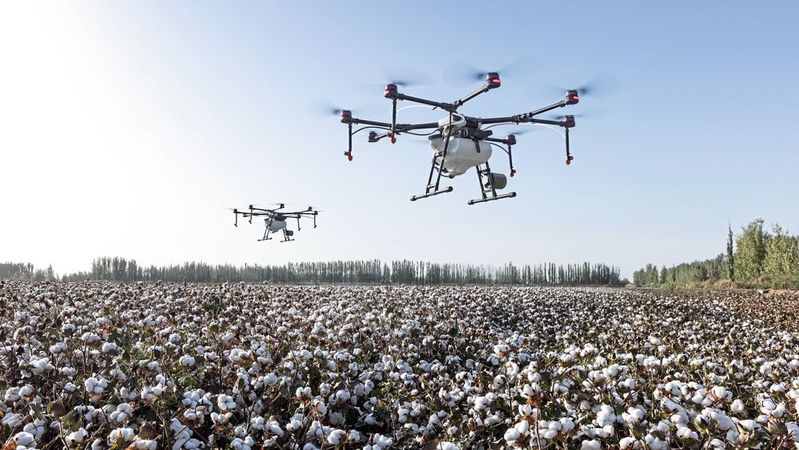
Very versatile: In agriculture, drones, for example, support more efficient management of agricultural land.
A drone (English: Unmanned Aerial Vehicle, UAV) is an unmanned, electrically powered aircraft. Drones are either remotely controlled, navigate via software, or fly autonomously along pre-programmed flight paths monitored using satellites (GPS). [1]
Originally, the term "drone" was used for military aircraft. Today, it is also used for civilian and private aerial devices that can be controlled for taking photo and/or video recordings from the air using a remote control, smartphone, or other mobile devices. There are also drones nowadays that can be controlled solely through hand gestures.
Thanks to modern technologies, drones have become more compact, powerful, and lightweight, providing easy access to this technology for both individuals and businesses.
While military drones often resemble larger model airplanes, civilian devices are more akin to small helicopters with multiple rotors. Among experts, such aircraft are also referred to as "multicopters" due to their variable number of rotors. Therefore, the terms "drone" and "multicopter" will be used synonymously hereafter.
This article focuses on the civilian, industrial, and governmental applications of drones.
What is a multicopter?
Drones or multicopters are equipped with multiple rotors oriented vertically downward, providing lift and control. The rotors, arranged on a horizontal plane, are individually powered by electric motors. By precisely adjusting the rotational speeds of specific rotors, various flight maneuvers can be executed: ascending, descending, rotating, forward flight, and backward flight. Unlike traditional helicopters, which primarily use a main rotor and a tail rotor, multicopters do away with complex mechanics such as swashplates or adjustable rotor blades. All stabilization and flight movements are achieved solely through the precise control of motor speeds. [2]
What components make up a drone?
The main components of multicopters are
the frame,
the motors,
the propellers,
electronic speed controllers (ESC),
the flight controller,
a receiver,
various sensors,
a camera and a video transmitter, as well as
the batteries.
The frame provides the supporting structure to which all components of the multicopter are attached. Modern frames are usually made of robust and lightweight carbon fiber.
For the motors, brushless DC motors (BLDC motors) are used to drive the propellers. The choice of such motors is no coincidence, as brushless DC motors have lower wear and a high efficiency of typically 85 to 90 percent. Brushless DC motors can deliver more power at the same size compared to brushed motors and have a simple mechanical design, making them particularly robust and less prone to wear (long lifespan). Additionally, through electronic commutation, these DC motors enable precise control of rotational speed and position, which is essential for the flight stability of a multicopter. They also offer quiet and low-vibration operation, which is important for quality recordings and overall comfort during control and flight. [3]
The propellers are driven by the motors and provide the necessary lift and thrust, with the selection, quantity, and arrangement of the propellers significantly influencing the flight performance of a multicopter. Propellers and motors together form the rotors of the aircraft.
The electronic speed controllers regulate the speed of each motor and implement the control commands from the flight controller. It is essentially the intelligent core of a multicopter, as this is where all sensor data converges and the motors are controlled.
The receiver receives the control commands for the multicopter from the operator or pilot, for example via a remote control, and passes them on to the flight controller.
Common sensors in multicopters include gyroscopes, accelerometers, barometers, GPS, and potentially magnetometers. The sensors enable orientation, stabilization, and navigation of the multicopter.
Date: 08.12.2025
Naturally, we always handle your personal data responsibly. Any personal data we receive from you is processed in accordance with applicable data protection legislation. For detailed information please see our privacy policy.
Consent to the use of data for promotional purposes
I hereby consent to Vogel Communications Group GmbH & Co. KG, Max-Planck-Str. 7-9, 97082 Würzburg including any affiliated companies according to §§ 15 et seq. AktG (hereafter: Vogel Communications Group) using my e-mail address to send editorial newsletters. A list of all affiliated companies can be found here
Newsletter content may include all products and services of any companies mentioned above, including for example specialist journals and books, events and fairs as well as event-related products and services, print and digital media offers and services such as additional (editorial) newsletters, raffles, lead campaigns, market research both online and offline, specialist webportals and e-learning offers. In case my personal telephone number has also been collected, it may be used for offers of aforementioned products, for services of the companies mentioned above, and market research purposes.
Additionally, my consent also includes the processing of my email address and telephone number for data matching for marketing purposes with select advertising partners such as LinkedIn, Google, and Meta. For this, Vogel Communications Group may transmit said data in hashed form to the advertising partners who then use said data to determine whether I am also a member of the mentioned advertising partner portals. Vogel Communications Group uses this feature for the purposes of re-targeting (up-selling, cross-selling, and customer loyalty), generating so-called look-alike audiences for acquisition of new customers, and as basis for exclusion for on-going advertising campaigns. Further information can be found in section “data matching for marketing purposes”.
In case I access protected data on Internet portals of Vogel Communications Group including any affiliated companies according to §§ 15 et seq. AktG, I need to provide further data in order to register for the access to such content. In return for this free access to editorial content, my data may be used in accordance with this consent for the purposes stated here. This does not apply to data matching for marketing purposes.
Right of revocation
I understand that I can revoke my consent at will. My revocation does not change the lawfulness of data processing that was conducted based on my consent leading up to my revocation. One option to declare my revocation is to use the contact form found at https://contact.vogel.de. In case I no longer wish to receive certain newsletters, I have subscribed to, I can also click on the unsubscribe link included at the end of a newsletter. Further information regarding my right of revocation and the implementation of it as well as the consequences of my revocation can be found in the data protection declaration, section editorial newsletter.
With the camera, the operator of the multicopter can capture images and videos during flight. A relevant term in this context is FPV flight (First Person View), where the operator adopts a pilot's perspective from within the drone. This is achieved either through video goggles or a monitor. The cameras are typically mounted on a gimbal (a gimbal suspension) for stabilization and to compensate for flight movements, enabling high-quality aerial recordings. The footage is usually stored "on board" on a memory card, which can be accessed via a PC after the flight.
Finally, the batteries are required to power the rotors and the camera.
The mentioned components, except for the frame, are modular and can be adapted or expanded depending on the application and model of the drone. [4]
What are the types of multicopters?
Multicopters are primarily distinguished by the number of rotors.
A multicopter has at least three rotors, called a tricopter,
followed by quadcopters with four rotors,
hexacopters with six rotors,
octocopters with eight rotors,
decacopters with ten rotors, and finally
dodecacopters, which have 12 rotors. [5]
Why is the number of rotors important?
The number of rotors on multicopters significantly affects their flight stability, as multiple rotors not only provide a steadier flight position but also enable more precise control and flight maneuvers through finely tuned regulation of individual motor speeds.
Multicopters with more than four rotors (e.g., hexacopters or octocopters) have higher fail-safety as they can continue flying even if one rotor fails completely. A quadcopter, on the other hand, would crash in the event of a motor failure unless equipped with a parachute, which is now available for these devices.
As the number of rotors increases, so does the potential load capacity of a multicopter. In particular, multicopters with six to twelve rotors can lift relatively heavier loads and are therefore better suited for professional applications such as aerial photography or transport tasks, especially as there are already a number of pilot projects in this area. Additionally, a higher number of rotors distributes the lift across multiple motors, which is advantageous for heavy loads. However, the complexity of controlling the aircraft also increases with the number of rotors, as does the energy consumption and the required battery capacity.
Multicopters with fewer rotors, on the other hand, are lighter and require fewer components but demand a high level of concentration from operators in terms of control, as they have less stable flight positions. [6]
As is often the case, choosing the right drone or multicopter depends on the specific application, the associated tasks, and the possible expectations.
Where are multicopters used?
The potential fields of application in the civilian sector are very diverse, not least due to the immensely large selection of different drones, with versatility and flexibility being particularly emphasized.
In the industry, multicopters can monitor plant boundaries, inspect industrial facilities and buildings from the air, or more specifically, identify potential problems or defects in widely distributed facilities in a timely manner. In this context, the use of drones is also conceivable to support a plant fire department or to document industrial infrastructure.
Another industrial application is the transportation of goods (e.g., spare parts) and small items within a factory site to speed up processes and reduce costs.
In the energy and utilities sector, drones are already commonly used for the inspection of wind turbines, photovoltaic systems, high-voltage towers, as well as above-ground pipelines and power plants.
In the construction and real estate industry, drones enable land surveying. Other applications include construction documentation, facade inspections, monitoring projects during the construction phase (progress monitoring), or 3D modeling of construction sites and buildings using Lidar.
In agriculture and forestry, drones support, for example, more efficient management of agricultural land as well as targeted monitoring of forest areas and natural zones, where they can also be used for observing, controlling, and counting wildlife populations.
In fire and disaster protection, aerial imagery is increasingly used, whether for situational assessment, monitoring rescue operations, or searching for missing persons, often with the use of specialized sensors like thermal imaging cameras. During the warm seasons with heightened risk of forest fires, drones have become indispensable tools, providing firefighters on-site with an initial critical overview of the fire's extent and geographical distribution.
In Spain, drones are now used for the surveillance of tourist beaches to rescue swimmers in distress. The multicopters carry two life jackets that can be dropped above the swimmer, as every minute counts during rescues in strong sea currents.
Universities and research institutions use multicopters for surveying glaciers and volcanoes in hard-to-reach areas (geosciences), for wildlife observations (biological and natural sciences), for air quality measurements (meteorology), or even as cooperative systems in swarms for logistics or search missions, to name just a few examples.
In film and television productions, aerial shots are increasingly being used, which in the past required significant effort, such as using helicopters.
Last but not least, such footage is likely also a reason why multicopters are becoming increasingly popular for private use. [7]



:quality(80)/p7i.vogel.de/wcms/f6/95/f6954fa7c09ba58863a3730f5e384a62/arek-socha-on-pixabay-1707x960v1.jpeg "A new national space strategy brings together UK’s plans for growth, defence, and national security to help reindustrialise the UK. (Source: Arek Socha on Pixabay)")
:quality(80)/p7i.vogel.de/wcms/63/0f/630f214fa760b8c7f7f7d6279d411fcf/d4ceed8f2f52-2026-08-30-hydef-06--msc4159-1200x675v1.webp "(Source: Diehl Defence)")
:quality(80)/p7i.vogel.de/wcms/4e/7d/4e7d38327c6c928b403249e3c24a2a7c/0132118791v1.jpeg "Porsche Holding SE announces that it is once again turning to rocket technology. Following its investment in Isar Aerospace, the company is now acquiring a stake in a U.S. firm ... (Source: Porsche)")
:quality(80)/p7i.vogel.de/wcms/1c/08/1c082bbd9d05b634168b617aa26fcdcf/safe-bg-lv-ro-v1-991x557v1.png "(Source: European Commission)")
:quality(80)/p7i.vogel.de/wcms/0a/14/0a1495d9b570ae32a5a7cc748b9a3c60/st-hannover-035-1920x1079v1-999x562v1.jpeg "Fastening technology you can experience first-hand—visitors to Schraubtec in Bochum (Germany) can see it for themselves at the Ruhr Congress on September 30, 2026. (Source: PHOTOVISION-DH GmbH)")
:quality(80)/p7i.vogel.de/wcms/cd/a9/cda92b173afa9d0b455d4f11b281c9ea/0094-to-image--capstone-cdr-1440x810v1.png "(Source: Terran Orbital)")
:quality(80)/p7i.vogel.de/wcms/e0/45/e045bc5414d7263fb308bdd501b5fcc1/0133113962v1.jpeg "The HSWL 354 is the transmission used, for example, in the Leopard 2 main battle tank. Renk manufactures this system and is now preparing to significantly increase its cycle time. As a result, Renk is placing greater emphasis on the military sector as a customer ... (Source: Renk)")
:quality(80)/p7i.vogel.de/wcms/a1/5c/a15c2aeba563d5bc3e11fb879b21eb2c/0132989650v1.jpeg "FSS, the flexible clamping system for varying free-form surfaces, is designed for the aerospace industry and other sectors. (Source: Römheld GmbH Friedrichshütte)")
:quality(80)/p7i.vogel.de/wcms/46/8e/468effa87546a2b036dc88ca40e2843e/129fbcac92ce7da872b13af0281b0799-l-png-1920x1079v1.webp "(Source: Arianespace)")
:quality(80)/p7i.vogel.de/wcms/8f/10/8f10697d4bfbd70edf615cca76eaedfd/pete-linforth-on-pixabay-1920x1080v1.jpeg "(Source: Pete Linforth on Pixabay / AI-generated)")
:quality(80)/p7i.vogel.de/wcms/0f/99/0f99561bf51818af92b2960656405aa5/roland-4d-pippes-on-pixabay-1460x820v1.jpeg "(Source: Roland 4D Pippes on Pixabay)")
:quality(80)/p7i.vogel.de/wcms/05/49/054906f874b94ef08b09d5920396e27d/airbus-h160-1920x1079v1.jpeg "Airbus H160 (Source: Airbus)")
:quality(80)/p7i.vogel.de/wcms/9d/8a/9d8addea8cc4e6f7a4793563ca397f2a/ai-im-milit-r-1672x940v1.png "(Source: KI-generiert / Gemini)")
:quality(80)/p7i.vogel.de/wcms/7f/5f/7f5fba2c729ec3aa256bf1a18d74529b/ai-chip-1672x940v1.png "(Source: KI-generiert / Gemini)")
:quality(80)/p7i.vogel.de/wcms/64/1b/641b6474b2a614cde7730c89ef2a3015/2026-09-09-rheinmetall-veroeffentlicht-battlesuite-schnittstellen-e8c18194-1225x690v1.jpeg "Rheinmetall’s Battlesuite provides a modular digital platform for connecting and integrating sensors, hardware and software components. (Source: Rheinmetall AG)")
:quality(80)/p7i.vogel.de/wcms/6f/fe/6ffef325e7f233cc3521943158eb1ebd/0132763535v1.jpeg "Two companies are planning to establish, for the first time in 2027, an optical laser communication link directly between a satellite in low Earth orbit (LEO) and a re-entering spacecraft. (Source: ATMOS Space Cargo)")
:quality(80)/p7i.vogel.de/wcms/8f/f9/8ff91b78b26cb5a2b8a29e39835005b1/2026-09-10-repmus-teaser-images-retouched-dsc01292-1024x683-1024x576v1.jpeg "(Source: Quantum Systems GmbH)")
:quality(80)/p7i.vogel.de/wcms/bf/4a/bf4a237e60d3d4bd1bbdbad918f3c697/airbus-defence-and-space-3-1280x720v1.jpeg "(Source: Airbus Defence and Space)")
:quality(80)/p7i.vogel.de/wcms/e0/d1/e0d112a0d54a4fa9603ec855f7d25b47/t-rex-content-photo-jpg-pc-adaptive-990-medium-988x556v1.jpeg "Swarm of UAVs conducting a fully autonomous collaborative swarm mission. (Source: Lockheed Martin)")
:quality(80)/p7i.vogel.de/wcms/79/fc/79fcaa7ca33e393b11a4740d7d8f3dbe/vilkasss-handshake-9459740-1911x1076v1.jpeg "(Source: Vilius Kukanauskas on Pixabay)")
:quality(80)/p7i.vogel.de/wcms/90/a8/90a849f0023f11d1eb642eb4751a0321/bild2-h-c3-a4nel-ict-20truck-20and-20trailer-20parts-4320x2429v1.jpeg "Product information is visible at all times and retrieval of items
is confirmed by employees directly on the display of the Hänel MP 14 N
controller. (Source: René Marks)")
:quality(80)/p7i.vogel.de/wcms/4e/ca/4ecaa39f247490eded591b652c33aee3/thilmann-hcp-web-20kleiner-20ausschnitt-1442x811v1.jpeg "Entering the defence market can be challenging for start-ups, says HCP Sense CEO Ansgar Thilmann. (Picture: HCP Sense)")
:quality(80)/p7i.vogel.de/wcms/7a/51/7a511b80041d3f1335f3a5aa56fe75da/delivery-7022432-1280-1280x720v1.png "(Source: Mohamed_hassan)")
:quality(80)/p7i.vogel.de/wcms/f9/2f/f92f1ef8c739c34c70d99f7b0997621b/stra007-20--20cover-20image-5472x3076v1.jpeg "(Source: Stratasys)")
:quality(80)/p7i.vogel.de/wcms/ec/a9/eca9062ccbe4b042f8515846340410d8/aerospace-and-defence-stairways-platforms-and-much-morev1.jpeg "Modular constructions enable flexible modification. That applies to larger structures such as stairways and platforms, too. And that means aerospace and defence companies can reconfigure their maintenance platforms fast (itemitem)")
:quality(80)/p7i.vogel.de/wcms/30/2a/302a7b5723ad38fbde812fd3a468ad04/safety-on-stairways-in-industry-key-considerationsv1.jpeg "Stairways and platforms are used widely in maintenance and assembly areas in the aerospace and defence sectors. (Source: item)")
:quality(80)/p7i.vogel.de/wcms/f3/4e/f34ed744bb30817d3432c7ad522e6f30/engine-1v1.jpeg "Engineering with aluminium profiles really can be this easy – the item Engineeringtool and its smart functions help you save valuable time. (Source: item)")
:fill(fff,0)/p7i.vogel.de/companies/69/6d/696de2483d115/logo--fastems-rgb-horizontal.jpeg "logo--fastems-rgb-horizontal (Fastems)")
:fill(fff,0)/images.vogel.de/vogelonline/companyimg/84700/84735/65.jpg "logo_item_rgb_neu.jpg ()")
:quality(80)/p7i.vogel.de/wcms/45/55/45551ebdaa9c639d9cca57e1e6d6925b/bild-01-swd-ag-fa-05-drohnen-und-elektrische-luftfahrtsysteme-1563x879v1.jpeg "The range, weight and operational safety of electrically powered aircraft are significantly influenced by stator and rotor lamination stacks. (Source: SWD AG)")
:quality(80)/p7i.vogel.de/wcms/a7/63/a763e019287f1099bc7b94c26a93b942/1544532155-winmate-remote-20control-20drone-s101tg-gcs-8000x4496v1.jpeg "The effectiveness of military drone operations depends crucially on ground control stations. NATO defines standards for technology and architecture. (Source: TL Electronic GmbH)")