The idea of establishing data centers in Earth's orbit is not new and currently not economical. Tech elites indulge in the fantasy of AI from space while there is other uncharted territory to explore: the sea.
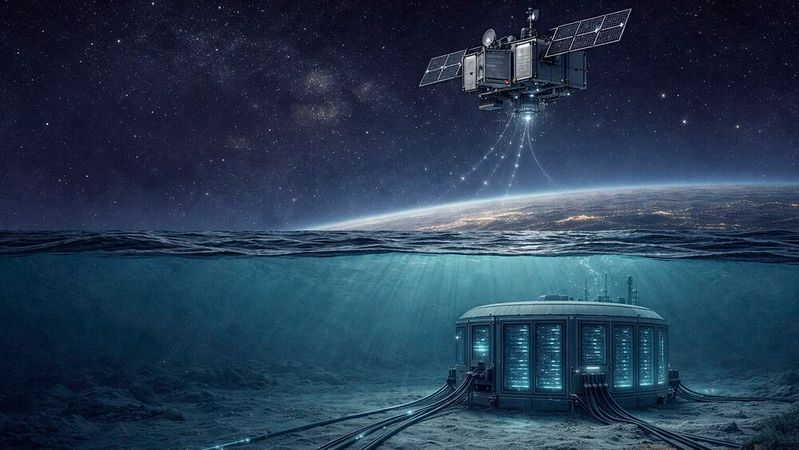
Data centers in orbit are indeed a vision of the future, while underwater data centers are already being tested.
(Image: Dall-E / AI-generated)
The increasing energy demand of data centers, particularly due to AI workloads, has led to increasingly radical infrastructure ideas in recent years. There is talk of locations in cooler regions, then of locations in areas with largely stable weather, such as deserts. Then there are discussions about data centers near renewable energy sources—or near decommissioned nuclear reactors that could potentially be reactivated.
A vision that is both fascinating and controversial regularly emerges in discussions and deliberations: data centers in space. The idea behind it initially seems plausible. In orbit, virtually unlimited solar energy is available. Space constraints, like those on Earth, are no longer an issue. Well, one might quickly believe that—if one chooses not to engage with the issue of space debris.
And yes, the waste heat could theoretically be released into space. Well... due to the vacuum, it’s not that simple. Anyway, let’s stay on the green playground for now. At the same time, data could be processed directly where it is generated—such as with Earth observation satellites. These are all valid ideas that are already being implemented.
Europe’s security landscape is changing rapidly
(Source: VCG)
As defence budgets rise and EU programmes expand, civil technology providers are becoming vital contributors to Europe’s strategic autonomy. The event will act as a neutral platform for dialogue between technology suppliers, integrators, and decision-makers shaping the next generation of European defence capabilities and aims to open doors between civil industry and defence procurement, providing practical insights.
However, when it comes to sending data from Earth into orbit for processing and then sending it back, this is where criticism arises, including from the analyst firm Gartner. In a recent analysis, experts concluded that orbital data centers will not meet terrestrial demands in the foreseeable future, and companies would be better off focusing their investments on infrastructure on Earth.
The reasoning is shaped less by vision and more by physics and economics. Transportation costs dominate every calculation, as IT hardware, power supply, cooling, and structure must first be brought into orbit. Even with sharply declining launch costs, mass and volume remain key cost drivers. Additionally, extreme environmental conditions such as radiation, vacuum, and temperature cycles require specially hardened components, further increasing costs. The challenges electronics would face have already been explained by our space enthusiast Hendrik Härter, when Jeff Bezos shared his vision of AI data centers in space at the Italy Tech Week 2025.
First the setup, then the maintenance
Another key point is maintenance. While servers in terrestrial data centers can be continuously replaced, any repair in orbit would require complex missions or advanced robotics. Without maintenance, systems would quickly contribute to additional space debris; an issue that is already critically discussed today due to its hazardous nature.
At the same time, data transmission remains a limiting factor, as large volumes of data would need to be reliably transferred between Earth and orbit. Against this backdrop, the idea of relocating a significant portion of global cloud capacity to space currently seems neither economically nor practically feasible. Even the often-cited advantage of cooling becomes relative upon closer examination, as heat in a vacuum can only be dissipated through radiation, requiring large radiator surfaces and additional mass.
Additionally, there is an aspect often overlooked in visionary discussions: space problems cannot truly be solved through orbital computing. Data centers require massive infrastructure—energy conversion, communication systems, structural modules—which also demand space and resources. The physical location merely shifts from the Earth's surface to orbit, without addressing the fundamental scaling issues.
Why look up... and not down?
A concept much closer to practical implementation, though still unusual, is data centers in the sea. Underwater data centers take advantage of the high heat capacity and stable temperatures of seawater for cooling, significantly reducing one of the largest energy consumers of traditional data centers. At the same time, many large urban areas are located near coasts, keeping latency low and allowing the use of existing fiber optic infrastructure.
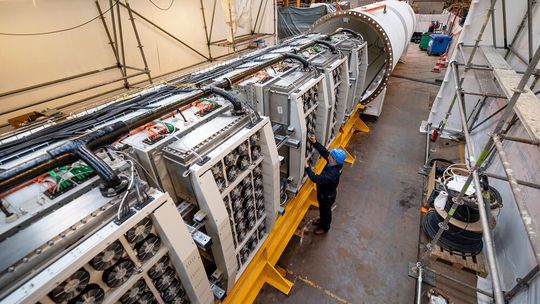
855 servers were accommodated in Project Natick's racks. Of these, six failed during the 25 months of operation—a failure rate of 0.7 percent. The failure rate of the control group (135 servers) on land was just under 6 percent.
(Image: Microsoft)
That this approach is not merely theoretical is demonstrated by projects already carried out. Microsoft tested "Project Natick" over several years with a sealed data center module on the seabed off the Scottish coast. The results indicated, among other things, higher hardware reliability, attributed to the stable environment and closed design. Underwater data centers have also been tested or announced in China, including in connection with offshore energy projects. Such concepts enable direct coupling to renewable energy sources like offshore wind power, unlocking additional efficiency potential.
Date: 08.12.2025
Naturally, we always handle your personal data responsibly. Any personal data we receive from you is processed in accordance with applicable data protection legislation. For detailed information please see our privacy policy.
Consent to the use of data for promotional purposes
I hereby consent to Vogel Communications Group GmbH & Co. KG, Max-Planck-Str. 7-9, 97082 Würzburg including any affiliated companies according to §§ 15 et seq. AktG (hereafter: Vogel Communications Group) using my e-mail address to send editorial newsletters. A list of all affiliated companies can be found here
Newsletter content may include all products and services of any companies mentioned above, including for example specialist journals and books, events and fairs as well as event-related products and services, print and digital media offers and services such as additional (editorial) newsletters, raffles, lead campaigns, market research both online and offline, specialist webportals and e-learning offers. In case my personal telephone number has also been collected, it may be used for offers of aforementioned products, for services of the companies mentioned above, and market research purposes.
Additionally, my consent also includes the processing of my email address and telephone number for data matching for marketing purposes with select advertising partners such as LinkedIn, Google, and Meta. For this, Vogel Communications Group may transmit said data in hashed form to the advertising partners who then use said data to determine whether I am also a member of the mentioned advertising partner portals. Vogel Communications Group uses this feature for the purposes of re-targeting (up-selling, cross-selling, and customer loyalty), generating so-called look-alike audiences for acquisition of new customers, and as basis for exclusion for on-going advertising campaigns. Further information can be found in section “data matching for marketing purposes”.
In case I access protected data on Internet portals of Vogel Communications Group including any affiliated companies according to §§ 15 et seq. AktG, I need to provide further data in order to register for the access to such content. In return for this free access to editorial content, my data may be used in accordance with this consent for the purposes stated here. This does not apply to data matching for marketing purposes.
Right of revocation
I understand that I can revoke my consent at will. My revocation does not change the lawfulness of data processing that was conducted based on my consent leading up to my revocation. One option to declare my revocation is to use the contact form found at https://contact.vogel.de. In case I no longer wish to receive certain newsletters, I have subscribed to, I can also click on the unsubscribe link included at the end of a newsletter. Further information regarding my right of revocation and the implementation of it as well as the consequences of my revocation can be found in the data protection declaration, section editorial newsletter.
The other side of the coin
Of course, underwater data centers are not without challenges. Maintenance interventions are understandably more complex than on land. Long-term material durability in saltwater must be ensured, and ecological impacts need to be assessed. However, these disadvantages are significantly less severe compared to those of orbit. If maintenance in space is considered a solvable problem in many visions, this applies all the more to systems located a few hundred meters below the ocean surface, accessible with existing offshore technology.
Perhaps the future of data centers lies not above our heads but beneath the water's surface. While space-based data centers remain a long-term visionary topic with specialised niche applications, underwater data centers could become a realistic addition to existing infrastructure much sooner. They address specific issues such as cooling, energy efficiency, and space availability without having to overcome the fundamental physical and economic challenges of space exploration.
Whether we will actually need the data center boom in the next 5, 10, 15, or 50 years, or whether ways will be found by then to significantly reduce the energy and space demands of AI, is of course another matter. (sb)




:quality(80)/p7i.vogel.de/wcms/09/eb/09eb390bca7e654430ac8f81ac5b6bf6/0129830738v1.jpeg "Data centers in orbit are indeed a vision of the future, while underwater data centers are already being tested. (Image:Dall-E / AI-generated)")
:quality(80)/p7i.vogel.de/wcms/e3/a7/e3a73b85d9e799a712cfd049c3c5fd1b/0130047131v1.jpeg "The first option is not happening! At the VW plant in Osnabrück, Rheinmetall had reportedly assessed the situation for potential production projects. The construction of this type of 6-wheel armored vehicles would have been possible. However, this will not happen, as Rheinmetall has now announced. (Image:Rheinmetall / W. Geiger)")
:quality(80)/p7i.vogel.de/wcms/64/61/6461b49748f359bbae2ee6669a871923/issa-j1-cg-5-1920x1079v1.webp "(Image: Astroscale )")
:quality(80)/p7i.vogel.de/wcms/dd/ce/ddcef80b290218276bf857cdb64a45e1/finkel-stephan-4162x2341v1.jpeg "Stephan Finkel, Partner and Industry Lead Defence & Security at 3DSE (Source: 3DSE)")
:quality(80)/p7i.vogel.de/wcms/0c/70/0c701a79c1f183921b8ee9341ef61db8/0129694966v1.jpeg "Robonode's DVK Development Kit: This is available through Codico's sample shop. (Image:8DEVICES)")
:quality(80)/p7i.vogel.de/wcms/7c/12/7c123d3888ed3a37a83b0793be569f00/hon-aero-hguide-i700-imu-comp-view-2880x1440-1024x576v1.webp "(Source: Honeywell)")
:quality(80)/p7i.vogel.de/wcms/62/06/6206d30afc9c4f286f4ecf4cedf575c5/stark-20virtus-20side-1920x1079v1.jpeg "To be introduced into service with the Bundeswehr: The “Virtus” developed by Stark has a range of up to 100 km and is designed to engage targets on the battlefield. (Picture: STARK Defence)")
:quality(80)/p7i.vogel.de/wcms/4b/a3/4ba36ed2a3bbc5632aa56344ed9e9012/design-20ohne-20titel-1795x1009v1.png "High-performance ceramic components demonstrate the potential of advanced materials and additive manufacturing for precision industrial and aerospace applications. (Images:KYOCERA Europe GmbH)")
:quality(80)/p7i.vogel.de/wcms/5b/44/5b44acf63074c37ab8daaf1225a265cf/launch-vehicle-spectrum-at-andoya-space-c-isar-aerospace-2026-01-30-083741-ruml-4007x2254v1.jpeg "(Source: Isar Aerospace)")
:quality(80)/p7i.vogel.de/wcms/e2/34/e234e56f31ce44de622fb7ee925a904c/bild1-urheber-20kongsberg-1598x899v1.jpeg "(Source: Kongsberg)")
:quality(80)/p7i.vogel.de/wcms/3f/c0/3fc013e170392cf0fa715f22d68197d8/harakan-f2-2-topfront-mirror-1-4607x2592v1.jpeg "The HARAKAN-F2-2 rugged VPX computer from Kontron enables high-performance edge computing, AI processing and sensor fusion for demanding defence missions. (Image:Kontron AG)")
:quality(80)/p7i.vogel.de/wcms/93/f1/93f1e4dba53b2c9589fab17a525df55e/adobestock-163119218-2480x1394v1.jpeg "(Source: Kernkonzept GmbH)")
:quality(80)/p7i.vogel.de/wcms/8d/76/8d764c984e44153da8f0dfa88cd6d75e/0129843677v1.jpeg "A successful drone attack on two data centers of the Amazon subsidiary AWS shows that the danger of drones is virtually unavoidable in modern warfare ... (Source: Cerberus)")
:quality(80)/p7i.vogel.de/wcms/6f/a7/6fa76be29e77ecb487a2dbbda36fc514/ki-generiert3a35a036-d062-432c-914c-d4fa050cf58f-1536x864v1.png "(Source: AI-generated)")
:quality(80)/p7i.vogel.de/wcms/32/cb/32cb64c4a0486d2f9283b8ea57003421/fkie-fraunhofer-entwickelt-ki-gestuetztes-lernmanagementsystem-fuer-die-bundeswehr-1440x810v1.jpeg "(Source: Philipp Plum / Fraunhofer FOKUS)")
:quality(80)/p7i.vogel.de/wcms/d4/dc/d4dc9a59e1698ae295b1e6e64a29a55b/geralt-handshake-5768632-1280-1280x720v1.jpeg "Rheinmetall and Nooteboom Trailers are collaborating on the development and marketing of heavy equipment trailer systems designed for transporting modern tracked and wheeled military vehicles. (Image:Gerd Altmann from Pixabay)")
:quality(80)/p7i.vogel.de/wcms/22/54/2254d1e2667aff755e7aba0bcaf2eb42/0130021093v1.jpeg "Daimler Truck and Quantum Systems are jointly developing unmanned military vehicles. (Image:Quantum Systems)")
:quality(80)/p7i.vogel.de/wcms/0b/ba/0bbad1438344133fa65cdb70ac833967/2026-03-04-rheinmetall-steigt-bei-kroatischer-dok-ing-ein---media--06a35258--query-402x-114e90d2-1910x1075v1.jpeg "Through the majority acquisition of DOK-ING, Rheinmetall expands its expertise in unmanned ground systems and autonomous military support vehicles. (Image:Rheinmetall AG)")
:quality(80)/p7i.vogel.de/wcms/f9/2f/f92f1ef8c739c34c70d99f7b0997621b/stra007-20--20cover-20image-5472x3076v1.jpeg "(Source: Stratasys)")
:quality(80)/p7i.vogel.de/wcms/5e/18/5e184e4961f190c86a1ea3227104cab5/26pm03-20kompakte-20l-c3-b6sungen-20f-c3-bcr-20luft--20und-20raumfahrt-202-2362x1329v1.jpeg "(Picture: Keysight)")
:quality(80)/p7i.vogel.de/wcms/67/4c/674c54baa745be497cecb716826af339/stahlwille-hero-1807x1016v1.jpeg "A new modular tool solution designed for safety, precision, and mobility in aviation maintenance. (Source: STAHLWILLE)")
:quality(80)/p7i.vogel.de/wcms/0d/01/0d01a051ba894332a8091e3a3f9394e1/hytorc-defense-solutions-boxersatz-1899x1068v1.jpeg "HYTORC’s Defence Solutions toolkit, proven on the GTK Boxer, enables safe, traceable fastening of critical components across multiple Bundeswehr platforms. (Source: Image: HYTORC)")

:quality(80)/p7i.vogel.de/wcms/2b/f9/2bf900b5ce266b0407709cc936482482/0128247466v1.jpeg "Space satellites: \"The construction and deployment of NTN have never been easier.\" (Image:AI-generated)")
:quality(80)/p7i.vogel.de/wcms/c1/80/c180ace150e784fb8ff6af01cd569c18/202201-006-600-cern-1920x1080v1.png "202201-006-600-cern-1920x1080v1 (Picture: CERN)")