This article introduces an accurate series active voltage positioning (AVP) implementation method applied on a μModule regulator. This method achieves a fast load transient response, minimal board space, and an all ceramic capacitor solution. Compared with a shunt AVP design, this series AVP provides a significantly accurate load line accuracy, which greatly improves the output voltage accuracy. The measured results for the load transient response are presented.
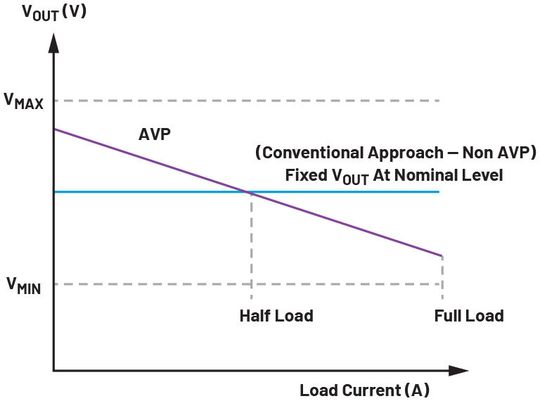
Figure 1: VOUT with AVP vs. the fixed nominal VOUT of a conventional approach (non-AVP).
(Source: Analog Devices)
Active voltage positioning (AVP), or active droop technology, regulates the power supply output at higher voltage at light load and lower voltage at heavy load. One major benefit of implementing AVP control is to improve the load transient response and reduce output capacitance since AVP allows more room for the power supply to respond to the load transients. A μModule regulator is a complete, tested, and qualified power supply in a package solution. Fast load transient response, minimal board space, and an all ceramic capacitor solution are preferred by μModule regulator telecom and data center applications. However, it is challenging to meet all these requirements with traditional non-AVP control.
Gallery
This article introduces an accurate series AVP implementation method by adding two resistors to the feedback control loop. The advantage of this series AVP method is that load line accuracy is almost independent of the gm amplifier gain variations, while other AVP implementation methods like the shunt AVP1 would suffer from poor load line accuracy if the gm amplifier gain has large variations. After implementing this series AVP, up to 50% output capacitance could be reduced while peak-to-peak output voltage transient is also slightly improved. Only ceramic capacitors would be needed due to 50% less capacitance, which greatly improves system reliability and cost since the aluminum electrolytic capacitor is much less reliable and higher cost than the ceramic capacitor.
Another benefit to implementing AVP control is to lower the output voltage when the load current is large and thereby reduce load power consumption. The LTM4650-2 example shows that the net power savings is 1.4 W or 5.6%, which greatly saves power consumption and extends battery life.
Series AVP Implementation
AVP refers to the regulator output voltage regulated at a point that is dependent on the load current, while with the conventional approach (non-AVP) that voltage is fixed at nominal VOUT for all loads as shown in Figure 1. With the AVP approach, the output voltage drops gradually when the output current is increased. At light load, the output voltage is set to regulate to slightly higher than the nominal value, while at heavy load, the output voltage is set to regulate to slightly lower than the nominal value.[1] When load current suddenly increases, the output voltage starts from a level higher than nominal so the output voltage can droop more and stay within the specified voltage range. When load current suddenly decreases, the output voltage starts at a level lower than nominal so the output voltage can have more overshoot and stay within the specified voltage range. The output voltage should be constrained within the specified voltage limits (between VMAX and VMIN) for all load current ranges.
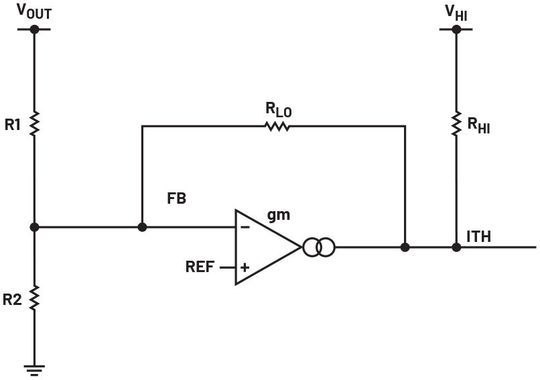
Figure 2: AVP series compensation circuit
(Source: Analog Devices)
Figure 2 shows the AVP series compensation circuit. The internal reference voltage (VREF) and VOUT feedback are connected to the positive and negative inputs of the error amplifier, respectively. VHI (or INTVCC) connected with RHI supplies the appropriate DC voltage to the amplifier output (ITH or COMP) that keeps the output from going into saturation. RLO (feedback resistor) is placed from the output (ITH) to the negative input (or FB). Therefore, RLO dominates the gm amplifier gain. RHIand RLO values should be much higher than R1 and R2.
The load line Equation 1 is shown as:
(Source: Analog Devices)
Ki is the current sense gain, and RSENSE is the current sense resistor value (or inductor DCR value for DCR sensing).
Compared with the AVP shunt compensation circuit[1], the advantage of the series compensation circuit is that the load line is dependent on R1/RLO gain and almost independent of the tolerance of the error amplifier transconductance (gm). IC processes and designs are vast. Unfortunately, some ICs' gm values have a part-to-part variation as large as ±30%, plus the shunt compensation circuit AVP has its load line directly proportional to 1/gm gain. As a result, the shunt AVP suffers a poor load line.
AVP Solution on the LTM4650-2 Regulator
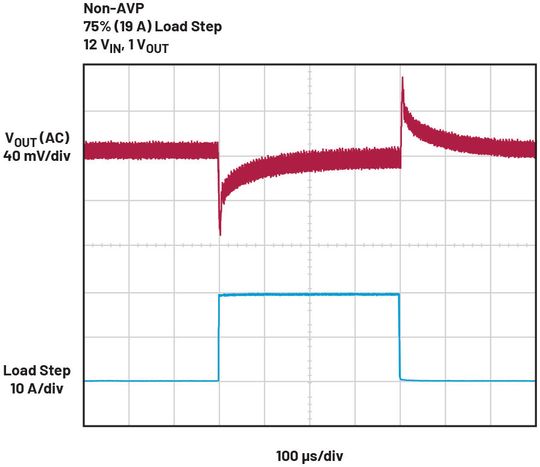
Figure 3: Load transient waveform of non-AVP circuit, 136 mV p-p output voltage transient, COUT1 = 5× 100 μF ceramic, and COUT2 = 2× 470 μF POSCAPs.
(Source: Analog Devices)
On the LTM4650-2 (current-mode synchronous buck regulator), a nominal 1 V output capable of delivering 25 A load with about ±8% (a 160 mV p-p) transient window. On this conventional regulator (non-AVP), an external RC filtering circuit is required to achieve fast Type II control loop compensation. There is a bank of 5× 100 μF ceramic capacitors + 2× 470 μF POSCAPs on the output side. With a 19 A load step (75% of full load) and a slew rate of 19 A/μs, 136 mV p-p of the transient response was as shown in Figure 3.
On AVP implementation, an AVP compensation circuit is applied on COMP as shown in Figure 4, but the RC compensation is not required. At the half load (12.5 A), purposefully set the output voltage to a nominal value (1 V) by fine-tuning the R2. On the load transient response, 95 mV p-p of the VOUT was obtained as shown in Figure 5. The transient performance has been improved. With the setting output voltage 1 V at 25 A (full load), the load power is 25 W. By decreasing the output voltage to 0.945 V at 25 A load, the load power is now 23.6 W, and the new savings is 1.4 W for a single output. For the two outputs, the total net savings is 2.8 W.
Date: 08.12.2025
Naturally, we always handle your personal data responsibly. Any personal data we receive from you is processed in accordance with applicable data protection legislation. For detailed information please see our privacy policy.
Consent to the use of data for promotional purposes
I hereby consent to Vogel Communications Group GmbH & Co. KG, Max-Planck-Str. 7-9, 97082 Würzburg including any affiliated companies according to §§ 15 et seq. AktG (hereafter: Vogel Communications Group) using my e-mail address to send editorial newsletters. A list of all affiliated companies can be found here
Newsletter content may include all products and services of any companies mentioned above, including for example specialist journals and books, events and fairs as well as event-related products and services, print and digital media offers and services such as additional (editorial) newsletters, raffles, lead campaigns, market research both online and offline, specialist webportals and e-learning offers. In case my personal telephone number has also been collected, it may be used for offers of aforementioned products, for services of the companies mentioned above, and market research purposes.
Additionally, my consent also includes the processing of my email address and telephone number for data matching for marketing purposes with select advertising partners such as LinkedIn, Google, and Meta. For this, Vogel Communications Group may transmit said data in hashed form to the advertising partners who then use said data to determine whether I am also a member of the mentioned advertising partner portals. Vogel Communications Group uses this feature for the purposes of re-targeting (up-selling, cross-selling, and customer loyalty), generating so-called look-alike audiences for acquisition of new customers, and as basis for exclusion for on-going advertising campaigns. Further information can be found in section “data matching for marketing purposes”.
In case I access protected data on Internet portals of Vogel Communications Group including any affiliated companies according to §§ 15 et seq. AktG, I need to provide further data in order to register for the access to such content. In return for this free access to editorial content, my data may be used in accordance with this consent for the purposes stated here. This does not apply to data matching for marketing purposes.
Right of revocation
I understand that I can revoke my consent at will. My revocation does not change the lawfulness of data processing that was conducted based on my consent leading up to my revocation. One option to declare my revocation is to use the contact form found at https://contact.vogel.de. In case I no longer wish to receive certain newsletters, I have subscribed to, I can also click on the unsubscribe link included at the end of a newsletter. Further information regarding my right of revocation and the implementation of it as well as the consequences of my revocation can be found in the data protection declaration, section editorial newsletter.
With the AVP implementation, the two POSCAPs can be replaced by two ceramic capacitors, so a total of 7× 100 μF ceramic capacitors are used on the COUT1. The benefit of using a ceramic capacitor is that it has lower equivalent series resistance (ESR), equivalent series inductance (ESL), cost, smaller size, and more reliable performance. The transient performance has been improved, and the measured result was 104 mV p-p of the VOUT as shown in Figure 6.
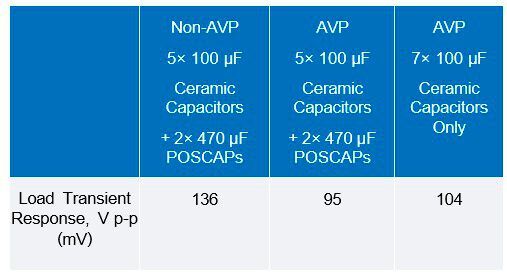
Table 1: The V p-p of Load Transient Response Comparison Between Non-AVP, AVP, and AVP Using Only Output Ceramic Capacitors
(Source: Analog Devices)
Table 1 shows the above measured V p-p of the load transient response of the non-AVP (benchmark), AVP, and AVP using only output ceramic capacitors for comparison.
Conclusion
Implementing the AVP series compensation circuit on the LTM4650-2 μModule regulator achieved an improved transient response performance and lower load-power consumption at high load. Output capacitance of less than 50% is required. Hence, it can replace POSCAPs with ceramic capacitors, reducing cost and minimizing circuit board space. This AVP circuit is also applicable for many other μModule regulators that have an external compensation pin with external RC compensation network (for example, LTM4630-1, LTM4626, LTM4636, LTM8055-1, etc.). (mbf)




:quality(80)/p7i.vogel.de/wcms/ed/1d/ed1dce9f6b05ddb24060464c0bec717f/0131831927-800x450v1.jpeg "(Source: KNDS)")
:quality(80)/p7i.vogel.de/wcms/2f/d0/2fd03a0d616b3c03fa287bddb62d57ad/airbus-512x288v1.jpeg "Michael Schoellhorn, CEO of Airbus Defence and Space, and Mykola Makovieiev, CEO of SkyFall, sign the Memorandum of Understanding at the ILA Berlin Air Show in the presence of German Federal Minister of Defence Boris Pistorius. (Source: Airbus Defence and Space GmbH 2026)")
:quality(80)/p7i.vogel.de/wcms/9c/66/9c66518f56544ca9ea6035fc6e0a0ecd/0131831927v1.jpeg "What you see here is an interim main battle tank solution for France—known as Capint. It is intended to replace the Leclerc before the main battle tank from the Franco-German MGCS project is actually ready, as France wants and cannot afford to wait long for the tank of the future. (Source: dpa / W. v. Dewitz)")
:quality(80)/p7i.vogel.de/wcms/4e/1f/4e1f4d990967b66741a93d3a77e519cf/0131826760v1.jpeg "With these military trucks, for example, the newly founded company Daimler Truck Defence aims to use increased sales in the defence sector over the next few years to at least partially offset certain shortfalls that have arisen in Daimler Truck’s standard truck business. (Source: Daimler Truck)")
:quality(80)/p7i.vogel.de/wcms/4f/37/4f37e5686a19c0f5029ee6e4b96558a6/rg-4troop-5460x3072v1.jpeg "Renault and Thales will collaborate on building drones. (Source: Renault)")
:quality(80)/p7i.vogel.de/wcms/0b/8e/0b8e89c744254a936e5ab8d4c5ac8ed5/20260610-ohb-ramses-signature-event-ila-scaled-2560x1440v1.jpeg "(Source: OHB SE)")
:quality(80)/p7i.vogel.de/wcms/21/e1/21e1baabcfc9c3fd09c5ced763bdbbb4/annekaiser-hswl-4767-1800x1000-1779x1000v1.webp "(Source: Renk Group AG)")
:quality(80)/p7i.vogel.de/wcms/2d/ba/2dbab47b4f20c66c049feb04af95975a/0113829725v1.jpeg "The integrated DC UPS from Bicker protects the autonomous drone system \"Beehive\" from Sunflower Labs in the event of a power failure, voltage dips or flicker. (Image:Bicker / Sunflower)")
:quality(80)/p7i.vogel.de/wcms/35/21/352179f537683e7fffd0fa61bc91723e/0131827530v1.jpeg "The Spectrum rocket from Isar Aerospace has once again been forced to remain grounded. For the fourth time, the second test flight had to be postponed... (Image:Isar Aerospace)")
:quality(80)/p7i.vogel.de/wcms/09/bd/09bd9e7ad549cec143a9a8fe04603665/tom-20trill-2c-20manfred-20horstmann-gf-dresden-20qualinx-4261x2395v1.jpeg "(Source: GlobalFoundries)")
:quality(80)/p7i.vogel.de/wcms/ec/16/ec1675b83aed8931556f7061efbe3fc4/0130556122-788x443v1.jpeg "(Source: Isar Aerospace)")
:quality(80)/p7i.vogel.de/wcms/0b/05/0b057842e0cb2336ff8065e0172d622c/p19-front-1-1024x571-1016x571v1.png "(Source: Quantum Systems)")
:quality(80)/p7i.vogel.de/wcms/ed/69/ed69fb4fafbccc1e284a074223cd1a11/forschungspreis-fram-piotr-banczerowski-1440x810v1.jpeg "Save energy, compute faster and retain data permanently: the new memory technology meets precisely these requirements. (Source: Fraunhofer / Piotr Banczerowski)")
:quality(80)/p7i.vogel.de/wcms/b2/1d/b21d335e1813d2225c867403503beeca/digital-20transformation-20in-20aerospace-20ptc-3840x2158v1.jpeg "(Source: PTC)")
:quality(80)/p7i.vogel.de/wcms/ec/97/ec97cb796e9319805369826d671ac0af/battle-lab-1280x720v1.png "(Source: Hensoldt AG)")
:quality(80)/p7i.vogel.de/wcms/0e/4f/0e4f3bfac264744ab5b0f78735498d44/mod-noctis-1-20image-202-20starlink-20with-20galaxy-1142x642v1.jpeg "First images from the UK’s Noctis-1 space telescope reveal Starlink satellites orbiting in front of the M101 galaxy as new Borealis space awareness software strengthens protection of critical UK satellite and military space assets. (Source: UK MOD © Crown copyright 2026)")
:quality(80)/p7i.vogel.de/wcms/7e/b7/7eb78c3ea29bd5596af70499a253b033/26dt113-002-6000x3373v1.jpeg "Mercedes-Benz Arocs for the defence sector. (Source: Daimler Truck AG)")
:quality(80)/p7i.vogel.de/wcms/7a/ab/7aab96f172274a092cc8261357c02413/piro4d-satellite-4269348-3840x2158v1.jpeg "Specialised small and mid-sized companies are playing an increasingly important role in modern defence, aerospace and space programmes as governments accelerate investment in advanced capabilities. (Source: PIRO 4D on Pixabay)")
:quality(80)/p7i.vogel.de/wcms/29/b2/29b225d0ba5b9471d3d9600e7c82ac35/0131801240v1.jpeg "In recent months, drones have proven capable of endangering critical infrastructure. That is set to change soon, thanks to the expertise of Deutsche Telekom and Hensoldt. (Source: K. Jüssen)")
:quality(80)/p7i.vogel.de/wcms/1c/fc/1cfce45c43f134c4982772dad53ea534/thoris-lcs-promotional-image-rohde-schwarz-200-202920-1920-1080-1-1920x1079v1.jpeg "Rohde & Schwarz announces the debut of THORIS at ILA Berlin Airshow 2026. (Source: Rohde & Schwarz)")
:quality(80)/p7i.vogel.de/wcms/7a/51/7a511b80041d3f1335f3a5aa56fe75da/delivery-7022432-1280-1280x720v1.png "(Source: Mohamed_hassan)")
:quality(80)/p7i.vogel.de/wcms/f9/2f/f92f1ef8c739c34c70d99f7b0997621b/stra007-20--20cover-20image-5472x3076v1.jpeg "(Source: Stratasys)")
:quality(80)/p7i.vogel.de/wcms/5e/18/5e184e4961f190c86a1ea3227104cab5/26pm03-20kompakte-20l-c3-b6sungen-20f-c3-bcr-20luft--20und-20raumfahrt-202-2362x1329v1.jpeg "(Picture: Keysight)")
:quality(80)/p7i.vogel.de/wcms/67/4c/674c54baa745be497cecb716826af339/stahlwille-hero-1807x1016v1.jpeg "A new modular tool solution designed for safety, precision, and mobility in aviation maintenance. (Source: STAHLWILLE)")
:quality(80)/p7i.vogel.de/wcms/f3/4e/f34ed744bb30817d3432c7ad522e6f30/engine-1v1.jpeg "Engineering with aluminium profiles really can be this easy – the item Engineeringtool and its smart functions help you save valuable time. (Source: item)")
:quality(80)/p7i.vogel.de/wcms/fb/8e/fb8e5ae2aa27bcf3e466815505ca4ff2/alumin-1v1.jpeg "The aluminium profile technology of the item Building Kit System has been used to build a huge variety of structures for decades. (Source: item)")
:quality(80)/p7i.vogel.de/wcms/be/84/be84bbede3e40b1101cd3efa35a6ffa0/overview-of-20work-bench-design-in-productionv1.jpeg "With modular work bench design, you can convert or extend a work bench with ease by changing or adding accessories. This means changes can be implemented quickly and cost-effectively, thus boosting quality and productivity. (Source: item)")
:fill(fff,0)/p7i.vogel.de/companies/69/6d/696de2483d115/logo--fastems-rgb-horizontal.jpeg "logo--fastems-rgb-horizontal (Fastems)")
:quality(80)/p7i.vogel.de/wcms/85/fc/85fc92ab0ba9b6bccad326b207abb015/0124086766v1.jpeg "Figure 4: Circuit with AVP (series compensation circuit)(Source: Analog Devices)")
:quality(80)/p7i.vogel.de/wcms/73/44/73441391d2a148f867fbe08adf971498/0124086775v1.jpeg "Figure 6: Load transient waveform of the circuit with AVP, 104 mV p-p output voltage transient. COUT1 = 7× 100 μF ceramic capacitors.(Source: Analog Devices)")
:quality(80)/p7i.vogel.de/wcms/16/86/1686e9075b8ec0e14d6d7b74ac2028e1/0124086776v1.jpeg "Figure 5: Load transient waveform of Figure 4 circuit with AVP, 95 mV p-p output voltage transient. COUT1 = 5× 100 μF ceramic and COUT2 = 2× 470 μF POSCAPs.(Source: Analog Devices)")

:quality(80)/p7i.vogel.de/wcms/7d/6e/7d6ea97f1a19851813ed5f9971eb2264/0124080886v1.jpeg "Figure 1: The ADI four-switch buck-boost family (Source: Analog Devices)")
:quality(80)/p7i.vogel.de/wcms/86/63/866312b5f610bd359ea7233d65b21da6/0127452188v1.jpeg "For every application: whether in the air, on the road, rail or water. Power electronics are needed everywhere. (Image:Dall-E / AI-generated)")