The monoclinic gamma crystal structure of sulphur is set to push the boundaries of existing battery technologies. This is the promise of the Berlin start-up company Theion. This should make both road and air traffic more efficient and sustainable.
Increasing the range of aircraft: Berlin-based start-up Theion wants to use the monoclinic gamma crystal structure of sulphur to push the boundaries of existing battery technologies.
Rush hour, traffic jams and, in the worst case, traffic accidents: The increasing volume of traffic on the roads also brings with it many problems. Emission-free, CO₂-neutral electric mobility should provide a remedy. The switch to electric cars and trucks is a particularly important factor when it comes to sustainable mobility on land.
There are other unconventional approaches, especially for short distances: Electric vertical take-off and landing vehicles (eVTOLs) create new possibilities for short distances and significantly reduce commuting times. In urban environments, they could offer time savings of 20 to 80 minutes per journey. For medium-haul flights, lithium-sulphur batteries in electric aircraft could increase both range and payload capacity. Such developments not only minimize noise and CO2 emissions, but also offer an environmentally conscious mobility solution.
Longer flight times and higher payloads
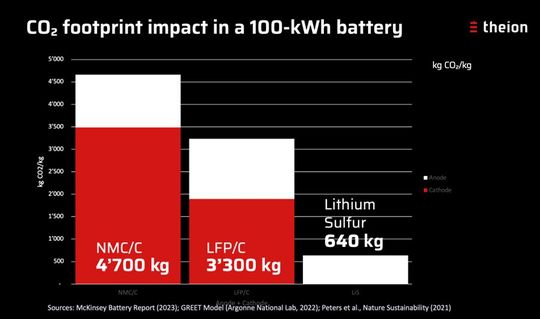
The CO₂ footprint of different active material combinations in the anode and cathode of a 100 kWh battery. Today's technology: nickel manganese cobalt oxide (NMC)/graphite (C), iron phosphate (LFP)/graphite (C). In sulphur technology, lithium (Li) is combined with sulphur (S).
(Image: Theion)
Today, electric aircraft are limited to a flight time of 30 to 60 minutes. The heavy batteries are still a technical problem. The key to electric flight lies in the battery itself. The last battery revolution of lithium-ion batteries was over 30 years ago. Since then, graphite, nickel, manganese and cobalt have been used. But there are alternatives: lithium instead of graphite, and sulphur in a specific crystal form instead of nickel manganese cobalt oxide (NMC).
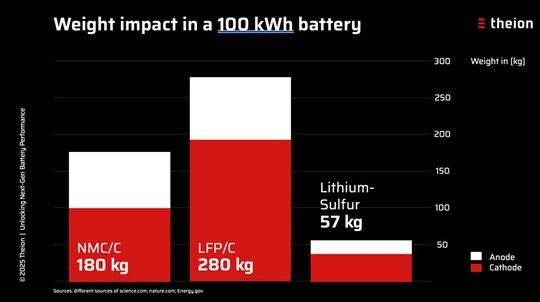
With lighter batteries, longer flight times and higher payloads or more passengers are within reach. For medium-haul flights, lithium-sulphur batteries in electric aircraft could increase both range and payload capacity. Such developments not only reduce noise and CO2 emissions, but also offer an ecologically responsible mobility solution.
About the Author
Ulrich Ehmes has headed the Berlin-based battery start-up Theion, which specializes in the development of lithium-sulphur batteries, since February 2022. He brings over 15 years of experience in battery technology and manufacturing and has in-depth industry knowledge, extensive expertise and innovative approaches to new energy storage solutions. Before joining Theion, he was CEO of the Swiss battery company Leclanché SA. Prior to that, he was Managing Director of Leica Cameras production site in Portugal and Managing Director at SETA Consulting. He is also a board member of the battery association KLIB and is involved in battery research at the BMBF.
Sulphur as a potential game changer?
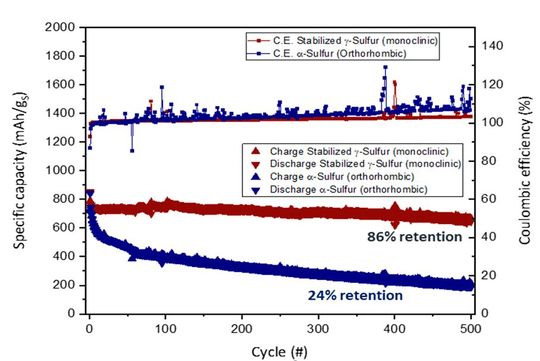
Internal tests by Theion with a button battery cell that has not yet been optimized show the potential of the monoclinic gamma crystal structure (red curve) compared to a battery with orthorhombic sulphur (blue curve). A current of 1C was used.
(Image: Theion)
For developers, the use of sulphur batteries means far more than just replacing the storage technology. Sulphur, a natural insulator, must first be made conductive. It is also important to eliminate the side effects of polysulphides, to compensate for volume expansion during charging and to avoid safety-endangering dendrites in the lithium metal anode.
The Berlin-based start-up Theion is tackling these complex challenges. Theion's co-founder Marek Slavik had the idea of overcoming these hurdles ten years ago and has been working with a steadily growing team to develop this technology since 2020. Numerous patents and the first prototypes in the form of button cell batteries underline the success of this approach.
The sulphur-crystal battery approach is showing promise in functional prototypes as button cells. The next development step is the completion of a more powerful pouch cell. This technological advance should make electric flight, whether manned or unmanned, in drones, air cabs or on medium-haul routes, economically feasible.
High number of charging and discharging cycles
Weight comparison of different active material combinations in the anode and cathode of a 100 kWh battery. Today's technology: nickel manganese cobalt oxide (NMC)/graphite (C), iron phosphate (LFP)/graphite (C). In sulphur technology, lithium (Li) is combined with sulphur (S).
(Image: Theion)
Theion's unique approach lies in the use of the monoclinic gamma crystal structure of sulphur. This structure is particularly suitable for a high number of charging and discharging cycles, as confirmed by Drexel University in the USA. On this basis, the company is developing lithium-sulphur batteries with high energy density, low weight and an improved ecological profile. The aim is to achieve gravimetric energy densities of 500 Wh/kg to 1,000 Wh/kg, depending on the specification, compared to the 130 to 300 Wh/kg commonly used today. Cyclization tests with button cells show significantly better performance values than conventional sulphur in orthorhombic form.
New processes are necessary
The use of sulphur in the monoclinic crystal form requires new processes. The coating processes used today in the battery industry to produce the electrodes, with solvents, long drying distances and high energy input, are not suitable. Theion has therefore re-parameterized and combined processes that have already proven themselves in other industries in order to produce high-performance sulphur electrodes in an energy-saving and efficient manner. These processes include short-term but targeted irradiation processes for the functionalization of materials and surfaces as well as the use of high voltage for the large-area orientation of nanoparticles. All innovative processes are patent pending.
Date: 08.12.2025
Naturally, we always handle your personal data responsibly. Any personal data we receive from you is processed in accordance with applicable data protection legislation. For detailed information please see our privacy policy.
Consent to the use of data for promotional purposes
I hereby consent to Vogel Communications Group GmbH & Co. KG, Max-Planck-Str. 7-9, 97082 Würzburg including any affiliated companies according to §§ 15 et seq. AktG (hereafter: Vogel Communications Group) using my e-mail address to send editorial newsletters. A list of all affiliated companies can be found here
Newsletter content may include all products and services of any companies mentioned above, including for example specialist journals and books, events and fairs as well as event-related products and services, print and digital media offers and services such as additional (editorial) newsletters, raffles, lead campaigns, market research both online and offline, specialist webportals and e-learning offers. In case my personal telephone number has also been collected, it may be used for offers of aforementioned products, for services of the companies mentioned above, and market research purposes.
Additionally, my consent also includes the processing of my email address and telephone number for data matching for marketing purposes with select advertising partners such as LinkedIn, Google, and Meta. For this, Vogel Communications Group may transmit said data in hashed form to the advertising partners who then use said data to determine whether I am also a member of the mentioned advertising partner portals. Vogel Communications Group uses this feature for the purposes of re-targeting (up-selling, cross-selling, and customer loyalty), generating so-called look-alike audiences for acquisition of new customers, and as basis for exclusion for on-going advertising campaigns. Further information can be found in section “data matching for marketing purposes”.
In case I access protected data on Internet portals of Vogel Communications Group including any affiliated companies according to §§ 15 et seq. AktG, I need to provide further data in order to register for the access to such content. In return for this free access to editorial content, my data may be used in accordance with this consent for the purposes stated here. This does not apply to data matching for marketing purposes.
Right of revocation
I understand that I can revoke my consent at will. My revocation does not change the lawfulness of data processing that was conducted based on my consent leading up to my revocation. One option to declare my revocation is to use the contact form found at https://contact.vogel.de. In case I no longer wish to receive certain newsletters, I have subscribed to, I can also click on the unsubscribe link included at the end of a newsletter. Further information regarding my right of revocation and the implementation of it as well as the consequences of my revocation can be found in the data protection declaration, section editorial newsletter.
As energy density increases, so do the demands on inverters, DC/DC converters and OBCs (on-board chargers). Modern SiC/GaN semiconductors enable more efficient energy conversion, which helps to reduce the overall system weight. Despite the lower fire load compared to classic Li-ion cells, continuous monitoring systems for temperature and cell voltage control are crucial in order to detect degradation at an early stage.
Cycle stability is still limited
The cycle stability of the first Li-S prototypes is still limited. The decisive factor here is how the battery management system (BMS) manages degradation and reliably predicts the range during operation. Higher theoretical energy densities offer the possibility of greater ranges, but require adapted charging profiles and optimized fast-charging capabilities. Lighter battery packs create scope for integration into vehicle platforms, which has implications for power electronics and cooling concepts.
While the next development steps in road transportation are moving towards cost-efficient and long-lasting Li-S batteries, long-term applications are emerging in aviation. Here, eVTOLs could be used for short distances or electric aircraft for medium ranges. Although these scenarios are not yet an immediate everyday reality for developers, they offer a boost to innovation and set the course for technological progress.
The further development of battery technology not only affects materials research, but also directly affects the work of electronics developers in the automotive industry. Key tasks for the next generation of electric vehicles include the development of adaptive BMS algorithms for new cell chemistries, the safeguarding of safety and thermal management systems and integration into performance-optimized SiC/GaN-based drive and charging electronics. Electronics developers play a key role in determining how quickly and reliably sulphur and other innovative battery technologies find their way into products ready for series production.
This article was created with material from the start-up Theion.(heh)




:quality(80)/p7i.vogel.de/wcms/7a/62/7a6234d6f489a80a6a12867d77131ede/cadfem-blueprint-tal-berioli-mit-mo-1920x1079v1.jpeg "Blueprint Talk with (from left to right) Christoph Spranger, Yvonne Weitsch, Matteo Berioli and host Sarah Yvonne Elsser. (Source: CADFEM Germany GmbH / Nadine Wilhelm Fotografie)")
:quality(80)/p7i.vogel.de/wcms/96/b5/96b5f7f5f6c4fb4792a5ab32d0f80052/exercise-noble-jump-23-tank--engineer--infantry--medic-training---wisent-2-norwegian-army--2-1000x563v1.webp "FFG's Wisent 2 armoured recovery vehicle during Exercise Noble Jump 2023. Deutz plans to acquire the Flensburg-based defence specialist in its largest acquisition to date. (Photo: OR-2 Synne Nilsson, U.S. Army (Public Domain), via DVIDS/Wikimedia Commons)")
:quality(80)/p7i.vogel.de/wcms/df/82/df826148f35f20a976d6d249299f3580/advertorial-eviom-960x540-1672x940v1.png "(Quelle: KI-generiert)")
:quality(80)/p7i.vogel.de/wcms/01/d2/01d2f4973a407a7d3d0e2b6a24c8b97f/deutschlandfonds-877x493v1.jpeg "German Finance Minister Lars Klingbeil, Economy Minister Katherina Reiche and KfW CEO Stefan B. Wintels present Germany’s new state-backed investment framework, laying the financial groundwork for a new generation of DefenceTech startups. (Source: KfW/Thomas Meyer/Ostkreuz)")
:quality(80)/p7i.vogel.de/wcms/1c/af/1caf95af66a2c53008271adfd09af864/0132348702v1.jpeg "With its system solutions for the series production of drone components and electric drive systems, Grob supports manufacturers on their journey from prototype production to industrial series production. (Source: Grob-Werke)")
:quality(80)/p7i.vogel.de/wcms/b2/21/b2217f161496c7a48311130879b84933/0132412565v1.jpeg "EOS can rejoice, as the demand for engine systems from its customer Beehive Industries (one is seen in the picture) from the USA is rising as a result of global crises. Now there has been a nice order for 3D printers ... (Source: N. Leach-Proffer)")
:quality(80)/p7i.vogel.de/wcms/d2/bc/d2bc582469c6cc40185afadbdcfc1de1/kloeckner-20metals-20germany-20er-c3-b6ffnung-20h-c3-bcrth-20ambo-20stahl-20h-c3-bcrth-pressefoto005-4000x2249v1.jpeg "(Source: Kloeckner Metals Germany GmbH)")
:quality(80)/p7i.vogel.de/wcms/29/57/2957386c9f15d8ee16b07f95523834d5/cuby-5-deployment-20-28-c2-a9-20oliver-20ruf-20s4-20gmbh-20-20w-c3-bcrzburg-20-20-20credits-20spacex-20videostream-29-1920x1079v1.png "At the top left, CuBy-5 is being deployed from the container attached to the rocket. (Source: Oliver Ruf S4 GmbH Würzburg, credits: SpaceX videostream)")
:quality(80)/p7i.vogel.de/wcms/3f/46/3f467afcad036bbf7daa8c3c7a01ccb2/dsc00150-1920x1079v1.jpeg "Designed around a fully European supply chain and minimal logistical footprint, Reliant will now compete for major global contracts. (Source: Quantum-Systems GmbH)")
:quality(80)/p7i.vogel.de/wcms/ee/20/ee20c1cd9f46bf8913d18bd2fd2b6a52/0132412565v1.jpeg "EOS has reason to celebrate, as demand for the engine systems from its U.S. customer Beehive Industries (one of which is shown in the picture) is on the rise due to the global crises. Now the company has received a nice order for 3D printers. (Source: N. Leach-Proffer)")
:quality(80)/p7i.vogel.de/wcms/29/31/29316aba4f27ae1b93a8cb31104c6c1b/valkyrie-drone-2048x1151v1.jpeg "Kratos XQ 58A Valkyrie, a stealthy unmanned combat high subsonic UAV being integrated into European concepts for “loyal wingman” drones working alongside crewed jets, with Airbus as a key partner. (Source: Airbus Defence and Space GmbH)")
:quality(80)/p7i.vogel.de/wcms/49/78/4978ff9dbea15de343a95232a4ef6924/0132290829v1.jpeg "Work on the travel motor glider \"Taifun 17 H₂\": Research associate Jan Hußlein, engineer Tom Wollin, dean Prof. Dr. Johannes Paulus, and master’s student Sebastian Stenger (from left to right) (Source: Eva Kaupp | THWS)")
:quality(80)/p7i.vogel.de/wcms/cf/d5/cfd5ef0e30297293527b9891ba134109/de-buch-ki-a5-260702-ebook-titel-lowres-874x492v1.jpeg "(Source: Vogel Communications Group GmbH & Co. KG)")
:quality(80)/p7i.vogel.de/wcms/34/04/3404f9381a137f50c68b42dd76875da1/swi499-20--20ic-20image-3837x2160v1.jpeg "(Source: SWINDON SILICON SYSTEMS LTD)")
:quality(80)/p7i.vogel.de/wcms/50/98/50988123a8f0142ac07bd294d33c7144/xavveo-logo-1280x719v1.jpeg "(Source: Xavveo)")
:quality(80)/p7i.vogel.de/wcms/28/9a/289aa7b22d6ee746edd407acf4113753/public-sector-and-defense-5120x2877v1.jpeg "(Source: Atos)")
:quality(80)/p7i.vogel.de/wcms/64/1d/641da1ecd6aa1147b21cb9a628bca55e/03-02-visuel-land-fullres-2026-07--prs-core-module-radio-b-2-1294x728v1.png "(Source: Thales)")
:quality(80)/p7i.vogel.de/wcms/04/3b/043bb9d3cac1b001c57ac67fe627baf2/jpgv1.jpeg "(Source: )")
:quality(80)/p7i.vogel.de/wcms/44/a5/44a5af5f4ea7e0e60fe12275258b5ef8/ukrainian-drone-operators-1600x899v1.png "“Sometimes FPV pilots are supported by reconnaissance drone teams, but sometimes they operate blindly”, said a Ukrainian FPV pilot known by the callsign “Karat” who was invited to NATO exercises on the Swedish island of Gotland in early 2026. He continued: “Western militaries cannot fully understand what that is like. You have to see it with your own eyes.” (Source: Ministry of Defence of Ukraine)")
:quality(80)/p7i.vogel.de/wcms/6e/c1/6ec164f8f6b854640f9441f24922d8d1/robertwaghorn-jet-2974131-4777x2687v1.jpeg "(Source: Robert Waghorn on Pixabay)")
:quality(80)/p7i.vogel.de/wcms/4e/ca/4ecaa39f247490eded591b652c33aee3/thilmann-hcp-web-20kleiner-20ausschnitt-1442x811v1.jpeg "Entering the defence market can be challenging for start-ups, says HCP Sense CEO Ansgar Thilmann. (Picture: HCP Sense)")
:quality(80)/p7i.vogel.de/wcms/7a/51/7a511b80041d3f1335f3a5aa56fe75da/delivery-7022432-1280-1280x720v1.png "(Source: Mohamed_hassan)")
:quality(80)/p7i.vogel.de/wcms/f9/2f/f92f1ef8c739c34c70d99f7b0997621b/stra007-20--20cover-20image-5472x3076v1.jpeg "(Source: Stratasys)")
:quality(80)/p7i.vogel.de/wcms/5e/18/5e184e4961f190c86a1ea3227104cab5/26pm03-20kompakte-20l-c3-b6sungen-20f-c3-bcr-20luft--20und-20raumfahrt-202-2362x1329v1.jpeg "(Picture: Keysight)")
:quality(80)/p7i.vogel.de/wcms/ec/a9/eca9062ccbe4b042f8515846340410d8/aerospace-and-defence-stairways-platforms-and-much-morev1.jpeg "Modular constructions enable flexible modification. That applies to larger structures such as stairways and platforms, too. And that means aerospace and defence companies can reconfigure their maintenance platforms fast (itemitem)")
:quality(80)/p7i.vogel.de/wcms/30/2a/302a7b5723ad38fbde812fd3a468ad04/safety-on-stairways-in-industry-key-considerationsv1.jpeg "Stairways and platforms are used widely in maintenance and assembly areas in the aerospace and defence sectors. (Source: item)")
:quality(80)/p7i.vogel.de/wcms/f3/4e/f34ed744bb30817d3432c7ad522e6f30/engine-1v1.jpeg "Engineering with aluminium profiles really can be this easy – the item Engineeringtool and its smart functions help you save valuable time. (Source: item)")
:fill(fff,0)/p7i.vogel.de/companies/64/fe/64fec73b1a2fb/logo-master-ggbbytimken-286blue.jpeg "logo-master-ggbbytimken-286blue (GGB)")
:fill(fff,0)/p7i.vogel.de/companies/69/6d/696de2483d115/logo--fastems-rgb-horizontal.jpeg "logo--fastems-rgb-horizontal (Fastems)")
:fill(fff,0)/images.vogel.de/vogelonline/companyimg/84700/84735/65.jpg "logo_item_rgb_neu.jpg ()")
:quality(80)/p7i.vogel.de/wcms/10/f4/10f44dbdd9e760498e963ad676f9d08f/blobid1-1672x940v1.png "blobid1-1672x940v1 (Source: Theion)")
:quality(80)/p7i.vogel.de/wcms/3a/da/3adad9cc561900df0446f19c74a4d4df/0129938355v1.jpeg "Ganfeng Lithium, together with Geely subsidiary Aerofugia, has developed semi-solid batteries for eVTOLs. (Image:Aerofugia)")