In over 20 years, Liebherr-Aerospace has built a global manufacturing network in which 13 Starrag machines contribute to producing landing gears for pinpoint landings with eagle precision.
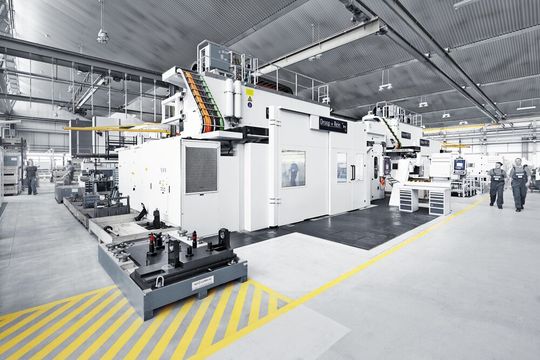
In 2004, the decision was made for the first "Droop+Rein FOGS M40," a machine characterised by stability, precision, and flexibility.
(Image: Starrag / Ralf Baumgarten)
A YouTube video from Liebherr, viewed over 7,000 times, shows the calm, precise landing of an eagle on rocky ground, accompanied by the slogan: "The best landing gears are built by nature. But we are working on it." A fitting image, yet the demands in aviation are far more complex. The eagle weighs barely five kilograms, reaches 160 km/h (approx. 100 mph) in a dive—and only carries itself. A modern landing gear, on the other hand, must reliably handle over 300 tons of flight weight, regardless of weather, terrain, or time of day. The film still captures the essence: safe landing under almost all conditions. Together with Starrag, Liebherr is therefore committed to manufacturing landing gear systems that function safely, precisely, and durably even under extreme conditions.
Gallery
The nucleus of this philosophy lies in Lindenberg in the Allgäu, around 20 kilometers (approx. 12 miles) east of Lake Constance. The location has been regarded as a center for aviation technology and precise metalworking for decades. Here, Liebherr established a repair operation in 1960, which evolved into today's Liebherr-Aerospace Lindenberg GmbH, a globally leading system supplier for flight controls and landing gear.
Heavy stress on landing gear components
Even though they are visually less noticeable compared to engines or wings, landing gear components are among the most heavily stressed parts of an aircraft.
(Image: Liebherr)
Even though they are visually less noticeable compared to engines or wings, landing gear components are among the most heavily stressed parts of an aircraft. Their task is to safely absorb the entire weight of the aircraft, including passengers, luggage, and fuel, during every landing, in any weather, and on any surface.
Requirements for material, geometry, and manufacturing quality have been high from the beginning: over 80 percent machining share, complex part geometries, machining strategies with µm tolerances, complemented by process-reliable automation. This is also reflected in the production. New landing gears are made from high-strength titanium or steel alloys. In the future, stainless steel alloys could also be used, for which Liebherr is well-prepared with its powerful and stable "Droop+Rein" machines, designed to handle demanding machining properties. The machining process involves up to 40 work steps and includes complex external contours, tightly tolerated multiple drillings, and heat treatment.
One special feature is the construction of the landing gear. "As soon as a machining feature protrudes from the cylinder housing, it can no longer be reasonably rotated on a lathe—then it has to be milled," explains Lee Scott, Director Sales and Applications for Starrag UK. "It's almost like mold making: complex external contours, tight tolerances, numerous drillings—and all of this in a single clamping."
Complete machining in a single clamping
To be able to manufacture components of this complexity in-house, Liebherr-Aerospace Lindenberg GmbH relies on a high level of manufacturing depth. "We place great importance on quality and availability. That's why we produce the main components of our landing gears ourselves," says Bernd Molinari, group leader in landing gear manufacturing.
In 2004, the decision was made for the first "Droop+Rein FOGS M40," a machine characterised by stability, precision, and flexibility. One determining factor was the similarity of the component geometries to those in tool and mold making. The complex contours and drillings of the landing gear could be machined economically and precisely on the "Droop+Rein FOGS" in a single clamping. This marked the beginning of a long-term partnership.
Between 2004 and 2014, Liebherr-Aerospace in Lindenberg built a dynamic manufacturing network, whose centerpiece now comprises four “Droop+Rein FOGS” machines. The machines were gradually expanded, modernised, and purposefully automated: with robot-assisted tool handling, laser measuring systems, and tool magazines for up to 250 tools.
Over 95 percent availability
This collaboration was designed not only for productivity but also for maximum availability. "Since the first installations, we have been operating with a contractually guaranteed technical availability of over 95 percent," explains Heiko Quack, Director Sales Large Projects at Starrag's "Droop+Rein" product division in Bielefeld (Germany). "We achieve this, in addition to the high-quality machine construction that Starrag is known for, with modern and proven technology, as well as through close collaboration: maintenance contracts, regular service workshops, coordinated upkeep—Liebherr operates the machines proactively and in a spirit of partnership." With success: the machines from the early years are still in operation and continue to achieve a technical availability of over 95 percent.
Date: 08.12.2025
Naturally, we always handle your personal data responsibly. Any personal data we receive from you is processed in accordance with applicable data protection legislation. For detailed information please see our privacy policy.
Consent to the use of data for promotional purposes
I hereby consent to Vogel Communications Group GmbH & Co. KG, Max-Planck-Str. 7-9, 97082 Würzburg including any affiliated companies according to §§ 15 et seq. AktG (hereafter: Vogel Communications Group) using my e-mail address to send editorial newsletters. A list of all affiliated companies can be found here
Newsletter content may include all products and services of any companies mentioned above, including for example specialist journals and books, events and fairs as well as event-related products and services, print and digital media offers and services such as additional (editorial) newsletters, raffles, lead campaigns, market research both online and offline, specialist webportals and e-learning offers. In case my personal telephone number has also been collected, it may be used for offers of aforementioned products, for services of the companies mentioned above, and market research purposes.
Additionally, my consent also includes the processing of my email address and telephone number for data matching for marketing purposes with select advertising partners such as LinkedIn, Google, and Meta. For this, Vogel Communications Group may transmit said data in hashed form to the advertising partners who then use said data to determine whether I am also a member of the mentioned advertising partner portals. Vogel Communications Group uses this feature for the purposes of re-targeting (up-selling, cross-selling, and customer loyalty), generating so-called look-alike audiences for acquisition of new customers, and as basis for exclusion for on-going advertising campaigns. Further information can be found in section “data matching for marketing purposes”.
In case I access protected data on Internet portals of Vogel Communications Group including any affiliated companies according to §§ 15 et seq. AktG, I need to provide further data in order to register for the access to such content. In return for this free access to editorial content, my data may be used in accordance with this consent for the purposes stated here. This does not apply to data matching for marketing purposes.
Right of revocation
I understand that I can revoke my consent at will. My revocation does not change the lawfulness of data processing that was conducted based on my consent leading up to my revocation. One option to declare my revocation is to use the contact form found at https://contact.vogel.de. In case I no longer wish to receive certain newsletters, I have subscribed to, I can also click on the unsubscribe link included at the end of a newsletter. Further information regarding my right of revocation and the implementation of it as well as the consequences of my revocation can be found in the data protection declaration, section editorial newsletter.
The production structure at the site became the blueprint for other partner plants worldwide. Standardised processes and reliable machines formed the foundation. The period up to 2014 marked the expansion of the internal machinery and the beginning of a strategic network with a high degree of automation, which forms the basis for today's global production strategy.
Following the pandemic-related downturn and the subsequent market recovery, Liebherr-Aerospace focused on the targeted expansion of its global network. In addition to the four "Droop+Rein FOGS" machines in Lindenberg, another nine machines were installed at partners in China, India, France, and, until 2022, also in Russia. "Liebherr carefully selected its partners worldwide," says Quack. "We transferred our technology to these locations together with Liebherr. Wherever new plants were established or existing production facilities were enabled for landing gear manufacturing, we were involved from the very beginning." Another "Droop+Rein FOGS" is currently on its way to Liebherr-Aerospace's newest production partner and is expected to begin production later in 2025.
Partnership of two market leaders
This close collaboration takes place on equal footing—not least because Starrag is regarded as a global leader in the field of landing gear manufacturing. Today, around 60 machining centers from "Droop+Rein" are in use for this task. Approximately one in seven of them operates directly or indirectly within Liebherr-Aerospace's production network. Quack emphasises: "In this market segment, we are the manufacturer of choice—not only because of our technology but also because of our reliable, globally established partnership and position in this demanding segment."
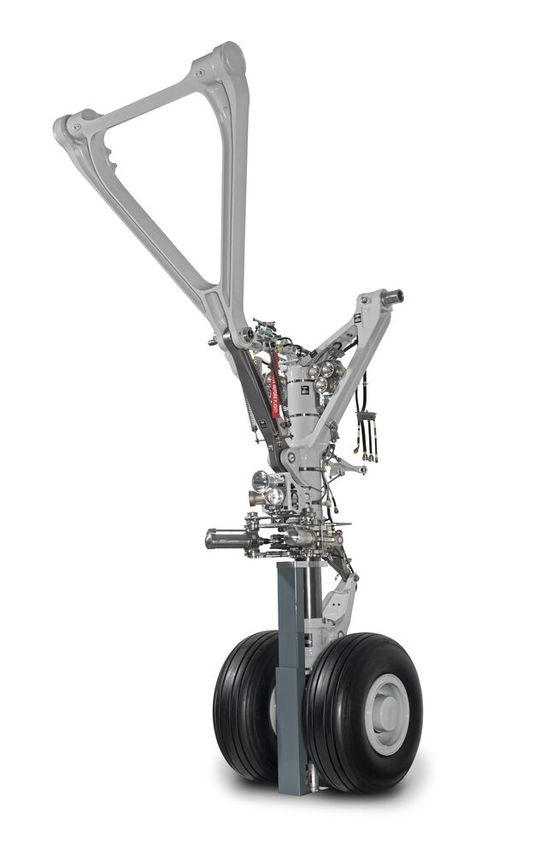
What emerged was showcased by Starrag at EMO 2025 for the first time: a fully assembled nose landing gear (NLG) of the Airbus A350, manufactured at Liebherr-Aerospace in Lindenberg. This component is not only a technological highlight but also the largest landing gear Liebherr has developed to date. Since the entry into service of the Airbus A350-900 in 2016, Liebherr has been supplying the system for all A350 variants. For the Airbus A350-1000, which completed its maiden flight on November 24, 2016, the nose landing gear was newly designed—partly due to the higher maximum takeoff weight of 308 tons. Liebherr was able to specifically incorporate its experience from the A350-900 program into this development.
In addition to the nose landing gear, Liebherr-Aerospace also produces other systems for the Airbus A350, including components for the control of slats and flaps as well as for load measurement and damping. The support covers the entire lifecycle: from development to maintenance.
The housing of the displayed landing gear is manufactured on a "Droop+Rein FOGS" in Lindenberg. Unlike the significantly larger main landing gear, the nose landing gear accounts for only a smaller portion of the aircraft's weight but is just as safety-critical. It is subjected to heavy stress during takeoff and landing and must handle extreme shock loads as well as directional changes. A landing gear manufactured with high precision, like the exhibit, ensures safe operation and also reduces maintenance costs over its lifecycle.
With the A350 landing gear exhibited for the first time, the circle is complete: What began symbolically in Liebherr's YouTube clip—the flight and precise landing of an eagle—became tangible in technical form at EMO 2025. Because although nature still designs the best landing gear, technology comes remarkably close to its example.
Newly developed free scanner
In aviation, the highest quality counts—for every single workpiece. For measuring surface quality, Liebherr-Verzahntechnik GmbH is the only manufacturer to offer a solution for internal and external gearings with either skids or free scanners—in a single clamping.
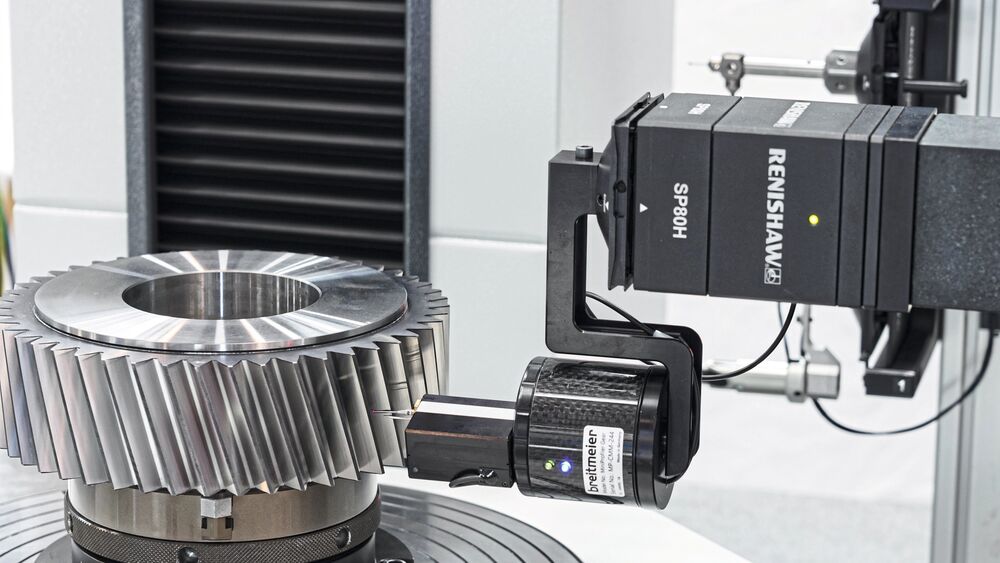
Light and compact mechanics enable the highest precision in roughness measurement.
(Image:Liebherr)
For the aerospace industry, the highly precise roughness measurement of the surface quality of gearings is a key requirement to ensure dimensional accuracy, wear resistance, and durability. With its new development, Liebherr-Verzahntechnik GmbH is the only provider that enables roughness measurements on gearings with both skid probes and free probes.
Skid probes use a sliding skid as a reference plane and measure the micro-profile of the surface relative to it. They are lightweight, easy to handle, and sufficient for many standard applications. However, for particularly high demands—such as in aviation—more extensive values must be recorded.
The free stylus is freely movable and measures not only roughness but also other geometric features of the surface. Its mechanics are designed to be so lightweight and compact that it fits into even the smallest installation spaces and captures all relevant roughness characteristics. "Our free stylus can be used from module 1.0 and in internal gears with diameters starting from 120 millimeters," explains Omar Sharif, Head of the Metrology Department.
Gear and roughness measurements can be performed in a single clamping, with the probe change occurring automatically. With the "LHInspect" software, the parameters of the roughness measurement and the roughness characteristics to be analysed can be configured in detail.




:quality(80)/p7i.vogel.de/wcms/27/29/2729da9d77bbe3a97ef364594a4d7fa5/screenshot-202026-03-23-20134204-932x524v1.png "(Source: AI-generated)")
:quality(80)/p7i.vogel.de/wcms/d6/0d/d60dbd35064daafce089426fa50a27e2/0130207422v1.jpeg "The largest new construction project for the German Navy is stalling. It is years behind schedule. It involves several F126 frigates. Now the armaments group Rheinmetall is counting on taking over the project in order to finish it quickly ... (Source: Ladies Naval)")
:quality(80)/p7i.vogel.de/wcms/c6/47/c64705c706eefa87feeb5a39ab057c2c/0130179612v1.jpeg "The Leopard 2 main battle tank (here the latest A8 version) is used by many NATO countries. The Franco-German MGCS tank system, which is currently under development, is intended to replace it, but is not running so smoothly. This is not stopping KNDS from going public this year. (Source: KNDS)")
:quality(80)/p7i.vogel.de/wcms/5b/2c/5b2cceb9038883edfacb76a61fca350b/vw-os-4-25--28cropped-29-3136x1765v1.jpeg "VW Osnabrück: Following Rheinmetall, KNDS is now also interested in at least a partial takeover of the plant. One popular example for the shift from civilian to military production. (Picture: Wiki Commons)")
:quality(80)/p7i.vogel.de/wcms/a3/66/a3666c01ec1a8b58da812faa80ab9f31/0130225449v1.jpeg "In 2004, the decision was made for the first \"Droop+Rein FOGS M40,\" a machine characterized by stability, precision, and flexibility. (Image:Starrag / Ralf Baumgarten)")
:quality(80)/p7i.vogel.de/wcms/b1/58/b158a5cc771fac7941d6bc3414becb5a/zeroe-20fully-20electric-20hydrogen-powered-20four-20pod-20aircraft-zeroe-turboprop-aib-vcity-16-9-5000x2811v1-999x562v1.jpeg "Airbus is working on the propulsion of short-haul aircraft using hydrogen and fuel cells as part of the “GENtwoPRO” project. (Source: Airbus SAS 2025)")
:quality(80)/p7i.vogel.de/wcms/2c/2c/2c2c63c23a1be1fe8259e3da28ebaff2/figure3-3864x2172v1.jpeg "(Source: AI-generated)")
:quality(80)/p7i.vogel.de/wcms/a2/66/a266453da44556de3d18a0976597a605/sintavia-press-release-image-31726-1333x750v1.jpeg "Scooped version of representative heat exchanger. (Source: Sintavia)")
:quality(80)/p7i.vogel.de/wcms/c2/5e/c25e38d6d559fc809a10bdceb15ebced/0129879115v1.jpeg "The twin of this sample is located on the outside of the ISS as part of the \"SESAME\" experiment. (Image:Empa)")
:quality(80)/p7i.vogel.de/wcms/3a/da/3adad9cc561900df0446f19c74a4d4df/0129938355v1.jpeg "Ganfeng Lithium, together with Geely subsidiary Aerofugia, has developed semi-solid batteries for eVTOLs. (Image:Aerofugia)")
:quality(80)/p7i.vogel.de/wcms/b4/ae/b4ae65d3fb3903a13571d9ea3e61da8a/mock-up-vleo-def-1920x1079v1.jpeg "Illustration of the VLEO-DEF satellite in orbit (Source: EDA)")
:quality(80)/p7i.vogel.de/wcms/74/81/748181a9121c4b65450f978e0e360950/comsol-astronauten-nasa--20-28cc-29-20image-20by-20nasa-20and-20in-20the-20public-20domain-20via-20wikimedia-20commons-4928x2770v1.jpeg "Astronauts working on the CDRA. (Source: NASA)")
:quality(80)/p7i.vogel.de/wcms/06/37/0637c7dd3fab9b00a8e96f98133cd1dc/260304-d-d0477-1005-5892x3317v1.png "A B-52H Stratofortress idles prior to taking off in support of Operation Epic Fury in March 2026. (Source: U.S. Air Force)")
:quality(80)/p7i.vogel.de/wcms/13/2b/132bb2831ae98c4c3bdd0ee2990ba1eb/bareways-20deck-20--20crisis-20coordination-20platformv1.jpeg "(Source: Bareways)")
:quality(80)/p7i.vogel.de/wcms/93/f1/93f1e4dba53b2c9589fab17a525df55e/adobestock-163119218-2480x1394v1.jpeg "(Source: Kernkonzept GmbH)")
:quality(80)/p7i.vogel.de/wcms/8d/76/8d764c984e44153da8f0dfa88cd6d75e/0129843677v1.jpeg "A successful drone attack on two data centers of the Amazon subsidiary AWS shows that the danger of drones is virtually unavoidable in modern warfare ... (Source: Cerberus)")
:quality(80)/p7i.vogel.de/wcms/84/63/8463d680832f3be7e5b3b5a189a0cac7/drohnen-1536x864v1.png "(Source: Elbit Systems Deutschland GmbH & Co. KG)")
:quality(80)/p7i.vogel.de/wcms/14/d3/14d3e0847d222af54aa5ab625480507f/0130015022v1.jpeg "A German-French battle tank project was approved some time ago (symbol image). But a modern drive system is also needed for it. This is now being developed by Rolls-Royce Power Systems and ZF in the coming years... (Image:Rheinmetall)")
:quality(80)/p7i.vogel.de/wcms/bd/21/bd2191aab59c430b3c74a2be07120333/image-196-1294x728v1.png "(Image:SkyDefender © Thales)")
:quality(80)/p7i.vogel.de/wcms/d4/dc/d4dc9a59e1698ae295b1e6e64a29a55b/geralt-handshake-5768632-1280-1280x720v1.jpeg "Rheinmetall and Nooteboom Trailers are collaborating on the development and marketing of heavy equipment trailer systems designed for transporting modern tracked and wheeled military vehicles. (Image:Gerd Altmann from Pixabay)")
:quality(80)/p7i.vogel.de/wcms/f9/2f/f92f1ef8c739c34c70d99f7b0997621b/stra007-20--20cover-20image-5472x3076v1.jpeg "(Source: Stratasys)")
:quality(80)/p7i.vogel.de/wcms/5e/18/5e184e4961f190c86a1ea3227104cab5/26pm03-20kompakte-20l-c3-b6sungen-20f-c3-bcr-20luft--20und-20raumfahrt-202-2362x1329v1.jpeg "(Picture: Keysight)")
:quality(80)/p7i.vogel.de/wcms/67/4c/674c54baa745be497cecb716826af339/stahlwille-hero-1807x1016v1.jpeg "A new modular tool solution designed for safety, precision, and mobility in aviation maintenance. (Source: STAHLWILLE)")
:quality(80)/p7i.vogel.de/wcms/0d/01/0d01a051ba894332a8091e3a3f9394e1/hytorc-defense-solutions-boxersatz-1899x1068v1.jpeg "HYTORC’s Defence Solutions toolkit, proven on the GTK Boxer, enables safe, traceable fastening of critical components across multiple Bundeswehr platforms. (Source: Image: HYTORC)")
:quality(80)/p7i.vogel.de/wcms/f3/4e/f34ed744bb30817d3432c7ad522e6f30/engine-1v1.jpeg "Engineering with aluminium profiles really can be this easy – the item Engineeringtool and its smart functions help you save valuable time. (Source: item)")
:quality(80)/p7i.vogel.de/wcms/fb/8e/fb8e5ae2aa27bcf3e466815505ca4ff2/alumin-1v1.jpeg "The aluminium profile technology of the item Building Kit System has been used to build a huge variety of structures for decades. (Source: item)")
:quality(80)/p7i.vogel.de/wcms/be/84/be84bbede3e40b1101cd3efa35a6ffa0/overview-of-20work-bench-design-in-productionv1.jpeg "With modular work bench design, you can convert or extend a work bench with ease by changing or adding accessories. This means changes can be implemented quickly and cost-effectively, thus boosting quality and productivity. (Source: item)")
:fill(fff,0)/p7i.vogel.de/companies/69/6d/696de2483d115/logo--fastems-rgb-horizontal.jpeg "logo--fastems-rgb-horizontal (Fastems)")
:fill(fff,0)/images.vogel.de/vogelonline/companyimg/84700/84735/65.jpg "logo_item_rgb_neu.jpg ()")
:quality(80)/p7i.vogel.de/wcms/0c/27/0c27d1d2f0a66aff30c097aeda48ea75/0129714178v1.jpeg "... tightly toleranced multiple drillings ...(Source: Starrag / Ralf Baumgarten)")
:quality(80)/p7i.vogel.de/wcms/4f/97/4f97c1110b8ae1d47986da86c5b564c5/0129729828v1.jpeg "... and a heat treatment.(Source: Starrag / Ralf Baumgarten)")
:quality(80)/p7i.vogel.de/wcms/67/48/6748c2c3dda81e3003ef7b5742937241/0129714176v1.jpeg "Machining is carried out in up to 40 work steps and includes complex external contours, ...(Source: Starrag / Ralf Baumgarten)")
:quality(80)/p7i.vogel.de/wcms/94/2a/942af8c9b1c51cbc9081ddb30b6e2f46/0129729812v1.jpeg "In 2004, the decision was made for the first \"Droop+Rein FOGS M40,\" a machine characterized by stability, precision, and flexibility.(Source: Starrag / Ralf Baumgarten)")
:quality(80)/p7i.vogel.de/wcms/f6/c4/f6c4b4fb71c49bebe0e0a2f8edd3d09e/0118569195v1.jpeg "For chuck parts with diameters equal to or multiple times larger than the workpiece length, WFL has been able to gain an advantage over the years. (Image:WFL)")
:quality(80)/p7i.vogel.de/wcms/06/c4/06c4c1f7cb2db424a0b487fc3f838c25/aircraft-future-liebherr-w800-800x450v1.png "Liebherr-Aerospace Lindenberg GmbH is leading key LuFo VII research projects to advance digital manufacturing and next-generation flight control technologies for future aircraft. (Image:Liebherr-Aerospace Lindenberg GmbH)")