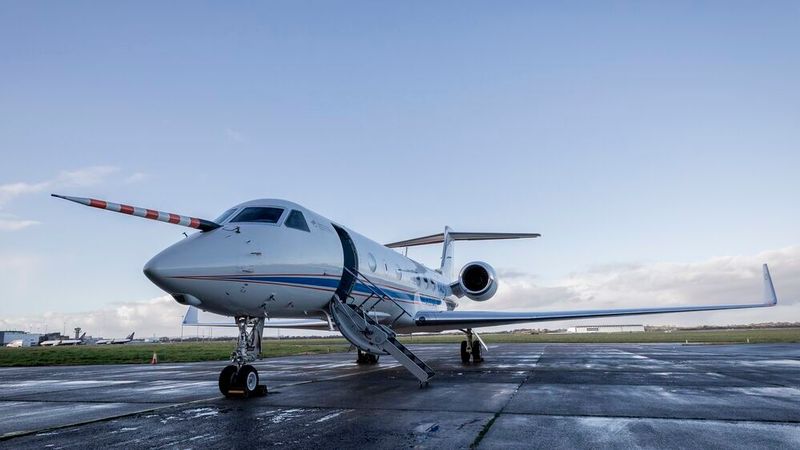
To better understand weather phenomena that lead to extreme weather events, particularly in winter, the research aircraft Halo is being used as part of the NAWDIC measurement campaign. Using lidar measuring instruments from DLR, it studies the dynamics of weather systems over the North Atlantic.
The research aircraft Halo, used as part of the NAWDIC measurement campaign, is stationed at Shannon Airport in Ireland during this time.
(Image: ETH Zurich | Tuule Müürsepp)
At the beginning of January, storm depression Elli swept through Germany, causing significant traffic chaos with heavy snowfall and icy conditions in certain parts as well as in Hamburg and Bremen. However, Elli was not an extraordinary event—strong winds, heavy precipitation, and sudden cold spells characterize winters in Europe. Many of these extreme weather events are associated with low-pressure systems that form over the North Atlantic. When these systems move toward Germany, as with Elli, they can lead to train cancellations, road chaos, and school closures. In extreme cases, lives can be at risk, and damages worth millions can occur.
Many of the physical processes that lead to extreme weather in Europe occur over the Atlantic, a region that is inadequately covered by conventional measurements and thus difficult to study scientifically. This is precisely where the international measurement campaign “North Atlantic Waveguide, Dry Intrusion, and Downstream Impact Campaign” (NAWDIC) comes into play, starting on January 13, 2026. Over six weeks, the data situation in the North Atlantic is to be improved through detailed aircraft- and ground-based observations. A key role in this endeavor is played by the research aircraft Halo, operated by the German Aerospace Center (DLR).
Europe’s security landscape is changing rapidly
(Source: VCG)
As defence budgets rise and EU programmes expand, civil technology providers are becoming vital contributors to Europe’s strategic autonomy. The event will act as a neutral platform for dialogue between technology suppliers, integrators, and decision-makers shaping the next generation of European defence capabilities and aims to open doors between civil industry and defence procurement, providing practical insights.
Investigation of insufficiently understood processes
A scientific focus of the investigations is on dry intrusions. These are dry, cool air masses that descend from the high altitude of the stratosphere into the troposphere, thereby influencing the weather. Especially in winter, they can lead to strong winds, turbulence, and intense precipitation. Many of these atmospheric processes are still insufficiently represented in current forecasting models. "Within NAWDIC, we aim to study processes that are not yet adequately understood but cause winter extreme weather events with significant impacts on society and the economy in Europe. We are combining innovative measurement methods with the unique capabilities of the research aircraft Halo," explains Dr. Andreas Schäfler from the DLR Institute of Atmospheric Physics, who is also co-responsible for coordinating the Halo flights within NAWDIC. The goal is to use the measurements to better understand the dynamics in the North Atlantic atmosphere so that forecasts can become more reliable and timely in the future.
Capture vertical profiles between the aircraft and the Earth's surface
The research aircraft is equipped for NAWDIC with Lidar remote sensing technology from the DLR Institute of Atmospheric Physics to capture continuous vertical profiles of wind, ozone, and humidity between the aircraft and the Earth's surface. It operates at flight altitudes of up to 14 kilometers (approx. 9 miles). Onboard are the water vapor Lidar Wales and the wind Lidar Hedwig, used on Halo for the first time. "By deploying these DLR-developed laser remote sensing instruments in remote regions with low observation density, we not only demonstrate the value of Lidar technology in complementing the global observation system but also its suitability for future satellite-based Lidar instruments," emphasizes Dr. Andreas Fix from the DLR Institute of Atmospheric Physics. For the duration of the project, Halo will be stationed at Shannon Airport in Ireland. From there, it can cover a wide area of the North Atlantic, allowing extensive documentation of water vapor transport and interactions between the atmosphere and ocean.
High planning effort
From an operational flight perspective, the measurement flights over the North Atlantic pose increased demands on planning and execution. The airspace is characterized by transatlantic traffic structures, the NAT-Tracks, which are redefined daily, as well as additional traffic outside these routes, and it lacks continuous radar coverage. The DLR Flight Experiments Facility is therefore responsible for close coordination with the relevant air traffic control centers even in advance. During the flights, the pilots ensure the safe and compliant integration of the research missions into air traffic through predominantly data-based communication.
The aircraft measurements are complemented by ground-based observations using KITcube, the mobile atmospheric observation system of KIT. It has been stationed in Brittany, France, since November 2025. It consists of a network of remote sensing instruments capable of capturing atmospheric processes from a few meters up to ten kilometers (approx. 6 miles) in altitude.
Successful interaction of various measurement campaigns
As part of NAWDIC, more than 100 scientists will be involved in the coming weeks to plan and conduct flights from Ireland, manage measuring instruments, and coordinate activities with partners.
Through long-term planning over the past six years in coordination with the World Meteorological Organization (WMO), it was possible to link NAWDIC with additional meteorological measurement campaigns in North America, which observe weather developments upstream. In January and February 2026, up to ten research aircraft, including Halo, will be deployed simultaneously from the Pacific to Europe. (se)
Date: 08.12.2025
Naturally, we always handle your personal data responsibly. Any personal data we receive from you is processed in accordance with applicable data protection legislation. For detailed information please see our privacy policy.
Consent to the use of data for promotional purposes
I hereby consent to Vogel Communications Group GmbH & Co. KG, Max-Planck-Str. 7-9, 97082 Würzburg including any affiliated companies according to §§ 15 et seq. AktG (hereafter: Vogel Communications Group) using my e-mail address to send editorial newsletters. A list of all affiliated companies can be found here
Newsletter content may include all products and services of any companies mentioned above, including for example specialist journals and books, events and fairs as well as event-related products and services, print and digital media offers and services such as additional (editorial) newsletters, raffles, lead campaigns, market research both online and offline, specialist webportals and e-learning offers. In case my personal telephone number has also been collected, it may be used for offers of aforementioned products, for services of the companies mentioned above, and market research purposes.
Additionally, my consent also includes the processing of my email address and telephone number for data matching for marketing purposes with select advertising partners such as LinkedIn, Google, and Meta. For this, Vogel Communications Group may transmit said data in hashed form to the advertising partners who then use said data to determine whether I am also a member of the mentioned advertising partner portals. Vogel Communications Group uses this feature for the purposes of re-targeting (up-selling, cross-selling, and customer loyalty), generating so-called look-alike audiences for acquisition of new customers, and as basis for exclusion for on-going advertising campaigns. Further information can be found in section “data matching for marketing purposes”.
In case I access protected data on Internet portals of Vogel Communications Group including any affiliated companies according to §§ 15 et seq. AktG, I need to provide further data in order to register for the access to such content. In return for this free access to editorial content, my data may be used in accordance with this consent for the purposes stated here. This does not apply to data matching for marketing purposes.
Right of revocation
I understand that I can revoke my consent at will. My revocation does not change the lawfulness of data processing that was conducted based on my consent leading up to my revocation. One option to declare my revocation is to use the contact form found at https://contact.vogel.de. In case I no longer wish to receive certain newsletters, I have subscribed to, I can also click on the unsubscribe link included at the end of a newsletter. Further information regarding my right of revocation and the implementation of it as well as the consequences of my revocation can be found in the data protection declaration, section editorial newsletter.




:quality(80)/p7i.vogel.de/wcms/18/83/1883958e6e69d7021484ebabb9841d12/0129986717v1.jpeg "155-millimeter shells for modern artillery are actually Rheinmetall's specialty. However, the Cartel Office has now waved through a Joint venture that will give the Düsseldorf-based company competition in the production of these products. And VW is also thinking about armaments ... (Source: Rheinmetall)")
:quality(80)/p7i.vogel.de/wcms/97/d1/97d1415e5fe96c1d3e31b63bc52f148b/0129969094v1.jpeg "With the Kraken K3 Scout unmanned drone boat, Rheinmetall is also aiming to achieve sales success at sea. This is made possible by the Blohm+Voss shipyard in Hamburg, which recently became part of the Düsseldorf-based armaments giant ... (Source: Blohm+Voss)")
:quality(80)/p7i.vogel.de/wcms/79/6c/796cd95a14147b408e376b3dfb08d056/defence-20equity-20facility-990x557v1.jpeg "(Source: EIB)")
:quality(80)/p7i.vogel.de/wcms/1b/d7/1bd76351ab741a6a2d24e5f2026c65d7/0128247463-1000x563v1.jpeg "(Source: AI-generated)")
:quality(80)/p7i.vogel.de/wcms/7c/12/7c123d3888ed3a37a83b0793be569f00/hon-aero-hguide-i700-imu-comp-view-2880x1440-1024x576v1.webp "(Source: Honeywell)")
:quality(80)/p7i.vogel.de/wcms/62/06/6206d30afc9c4f286f4ecf4cedf575c5/stark-20virtus-20side-1920x1079v1.jpeg "To be introduced into service with the Bundeswehr: The “Virtus” developed by Stark has a range of up to 100 km and is designed to engage targets on the battlefield. (Picture: STARK Defence)")
:quality(80)/p7i.vogel.de/wcms/4b/a3/4ba36ed2a3bbc5632aa56344ed9e9012/design-20ohne-20titel-1795x1009v1.png "High-performance ceramic components demonstrate the potential of advanced materials and additive manufacturing for precision industrial and aerospace applications. (Images:KYOCERA Europe GmbH)")
:quality(80)/p7i.vogel.de/wcms/9e/d8/9ed8df1b1bbd2941d486ed6b31a7078c/mc1753-20--20image-20--20lx4580-20mixed-20signal-ic-2669x1500v1.jpeg "(Image:Microchip Technology Inc. )")
:quality(80)/p7i.vogel.de/wcms/e2/34/e234e56f31ce44de622fb7ee925a904c/bild1-urheber-20kongsberg-1598x899v1.jpeg "(Source: Kongsberg)")
:quality(80)/p7i.vogel.de/wcms/3f/c0/3fc013e170392cf0fa715f22d68197d8/harakan-f2-2-topfront-mirror-1-4607x2592v1.jpeg "The HARAKAN-F2-2 rugged VPX computer from Kontron enables high-performance edge computing, AI processing and sensor fusion for demanding defence missions. (Image:Kontron AG)")
:quality(80)/p7i.vogel.de/wcms/3c/8f/3c8f1351d3d4338c3a4d3f21156d166a/368945-20dam-20imagery-software-driven-innovation-ea-20-282-29-1100x618v1.jpeg "(Source: PTC)")
:quality(80)/p7i.vogel.de/wcms/93/f1/93f1e4dba53b2c9589fab17a525df55e/adobestock-163119218-2480x1394v1.jpeg "(Source: Kernkonzept GmbH)")
:quality(80)/p7i.vogel.de/wcms/8d/76/8d764c984e44153da8f0dfa88cd6d75e/0129843677v1.jpeg "A successful drone attack on two data centers of the Amazon subsidiary AWS shows that the danger of drones is virtually unavoidable in modern warfare ... (Source: Cerberus)")
:quality(80)/p7i.vogel.de/wcms/6f/a7/6fa76be29e77ecb487a2dbbda36fc514/ki-generiert3a35a036-d062-432c-914c-d4fa050cf58f-1536x864v1.png "(Source: AI-generated)")
:quality(80)/p7i.vogel.de/wcms/32/cb/32cb64c4a0486d2f9283b8ea57003421/fkie-fraunhofer-entwickelt-ki-gestuetztes-lernmanagementsystem-fuer-die-bundeswehr-1440x810v1.jpeg "(Source: Philipp Plum / Fraunhofer FOKUS)")
:quality(80)/p7i.vogel.de/wcms/0b/ba/0bbad1438344133fa65cdb70ac833967/2026-03-04-rheinmetall-steigt-bei-kroatischer-dok-ing-ein---media--06a35258--query-402x-114e90d2-1910x1075v1.jpeg "Through the majority acquisition of DOK-ING, Rheinmetall expands its expertise in unmanned ground systems and autonomous military support vehicles. (Image:Rheinmetall AG)")
:quality(80)/p7i.vogel.de/wcms/22/ea/22ea2068a1f2a3ad3cac21eda628b0ad/range-motiv-a4-02-4741x2666v1.jpeg "The acquisition of NVL strengthens Rheinmetall’s position in naval shipbuilding and expands its capabilities in advanced maritime defence systems. (Image:Rheinmetall AG)")
:quality(80)/p7i.vogel.de/wcms/58/5a/585a92223bfdffdd69cbfc52d30e5367/7ba159ca-33ee-46ca-8da8-65ad1acc3aac-3102x1745v1.png "(Source: European Commission)")
:quality(80)/p7i.vogel.de/wcms/f9/2f/f92f1ef8c739c34c70d99f7b0997621b/stra007-20--20cover-20image-5472x3076v1.jpeg "(Source: Stratasys)")
:quality(80)/p7i.vogel.de/wcms/5e/18/5e184e4961f190c86a1ea3227104cab5/26pm03-20kompakte-20l-c3-b6sungen-20f-c3-bcr-20luft--20und-20raumfahrt-202-2362x1329v1.jpeg "(Picture: Keysight)")
:quality(80)/p7i.vogel.de/wcms/67/4c/674c54baa745be497cecb716826af339/stahlwille-hero-1807x1016v1.jpeg "A new modular tool solution designed for safety, precision, and mobility in aviation maintenance. (Source: STAHLWILLE)")
:quality(80)/p7i.vogel.de/wcms/0d/01/0d01a051ba894332a8091e3a3f9394e1/hytorc-defense-solutions-boxersatz-1899x1068v1.jpeg "HYTORC’s Defence Solutions toolkit, proven on the GTK Boxer, enables safe, traceable fastening of critical components across multiple Bundeswehr platforms. (Source: Image: HYTORC)")
:fill(fff,0)/p7i.vogel.de/companies/64/fe/64fec73b1a2fb/logo-master-ggbbytimken-286blue.jpeg "logo-master-ggbbytimken-286blue (GGB)")
:fill(fff,0)/p7i.vogel.de/companies/69/6d/696de2483d115/logo--fastems-rgb-horizontal.jpeg "logo--fastems-rgb-horizontal (Fastems)")

:quality(80)/p7i.vogel.de/wcms/80/8f/808f1574133b76d80917117476c6fa86/0128717658v1.jpeg "In the Lime project, companies from the aviation and battery industries are working on a battery system for hybrid-electric aircraft. (Image:freely licensed on Pixabay)")
:quality(80)/p7i.vogel.de/wcms/c5/69/c56908303c0282f9d14e85944332f961/0128226312v1.jpeg "The A4Climate project is investigating how contrails can be avoided. (Image:Project A4Climate)")
:quality(80)/p7i.vogel.de/wcms/48/d2/48d2d7b6f0349ba8c9bb13262a57b7f0/der-20satellit-20metop-sg-a1-20mit-20dem-20metimage-instrument-20im-20reinraum-20bei-20airbus-2000x1124v1.jpeg "Metop-SG-A1 in horizontal position during final assembly: The solar panel is being attached to the front before the satellite is transported to the launch site. On board is the German-built METimage instrument, a core payload for all three generations of Metop-SG satellites. Operating in polar orbit, these platforms will deliver high-resolution weather and climate data over the programme’s planned 24-year lifetime, improving global forecasts by up to ten days in advance. (Source: ESA - M. Pédoussaut )")
:quality(80)/p7i.vogel.de/wcms/c5/69/c56908303c0282f9d14e85944332f961/0128226312v1.jpeg "The A4Climate project is investigating how contrails can be avoided. (Image:Project A4Climate)")