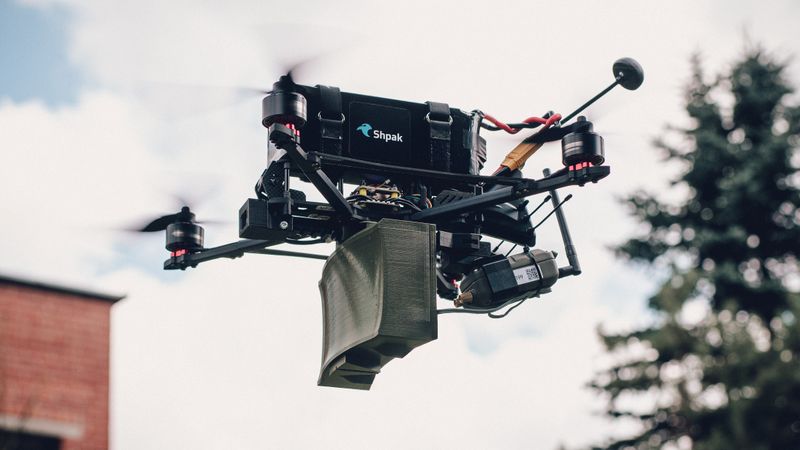
RSI Europe has expanded its battle-proven Shpak FPV drone system with new capabilities and configurations, reinforcing its position as a complete, European-built ecosystem delivered by a single provider.
(Source: RSI Europe)
The company can now provide production capacity of up to 120,000 Shpak drones per year with additional headroom to rapidly scale production responding to demand. Separately, RSI Europe has introduced an NDAA-compliant drone option for customers requiring Western-sourced components. The latest addition to the family, the Shpak TG (Terminal Guidance) variant, brings terminal guidance functionality that further strengthens the system’s operational versatility and is already tested, sold and in active use on the Ukrainian frontline.
Scalable European Production
The Shpak ecosystem is built as a fully integrated FPV system consisting of drones, ground equipment and accessories in mission-ready configurations developed and supplied by RSI Europe. Operating within a single ecosystem ensures FPV strike system equipment interoperability, predictable performance, streamlined deployment, as well as rapid and predictable delivery at scale. Units can switch between the standard Shpak FPV drone and the new Shpak TG variant without changing workflows or ground equipment.
Shpak’s evolution is shaped by sustained frontline use, with thousands of units deployed in real combat. This battlefield experience directly informs design decisions, tooling, component selection and mission workflows, ensuring that the system reflects actual operational requirements rather than theoretical assumptions.
Europe’s security landscape is changing rapidly
(Source: VCG)
As defence budgets rise and EU programmes expand, civil technology providers are becoming vital contributors to Europe’s strategic autonomy. The event will act as a neutral platform for dialogue between technology suppliers, integrators, and decision-makers shaping the next generation of European defence capabilities and aims to open doors between civil industry and defence procurement, providing practical insights.
RSI Europe can provide industrial production capacity of up to 120,000 Shpak drones per year, ensuring reliable supply for active frontline units and enabling rapid scaling in response to battlefield demand. In modern FPV warfare, where operational tempo and attrition rates are high, the ability to sustain mass production becomes a capability in itself—ensuring that units not only receive advanced technology but receive it in the volumes and timelines required to contribute to NATO training needs and at the same time generate effects on the battlefield. This capacity supports sustained operations and reduces the logistical fragmentation often seen when units depend on multiple small-volume manufacturers.
In addition to expanding production, RSI Europe has introduced a new NDAA-compliant Shpak drone configuration, designed for customers who require Western-sourced components or must meet specific procurement rules. This configuration has successfully completed internal qualification and NDAA sourcing validation, ensuring that no prohibited components are used in the compliant variant. The NDAA-configured drone integrates into the existing Shpak ecosystem, allowing customers to adopt it without changing their operational setup.
Gallery
Terminal Guidance Module
Shpak TG introduces an autonomy module designed to increase mission reliability in demanding operational environments, particularly where electronic warfare or terrain may disrupt manual control during the final approach. The module provides three key functions: terminal guidance, enabling autonomous execution of the final attack sequence once a target is locked; cruise control, which maintains direction and altitude autonomously and reduces pilot workload during the approach phase; and altitude hold, which stabilises the drone at a selected height to support target search and precise manoeuvring.
“Shpak TG enhances mission success in the environments where operators face the greatest challenges,” says Liudvikas Jaškūnas, Product Analyst at RSI Europe. “It integrates seamlessly into the Shpak ecosystem, extends the capabilities of units already using the system, and reflects the operational input we receive from the field.”
Shpak TG achieves approximately 90% accuracy on a 1×1 meter (approx. 3×3 ft) target and supports attack angles from 10 to 50 degrees. Its autonomy module measures distance and altitude to the target and adjusts its trajectory accordingly, including automatically climbing to achieve an optimal ~30-degree attack profile. The targeting system combines pixel lock—which allows the operator to lock any point in the video feed—with computer vision trained on hundreds of hours of imagery to identify vehicles and aim at their geometric center.
The system also optimises its attack path. “Shpak TG does not always approach targets along the shortest geometric route,” Jaškūnas explains. “When a target is moving, the system selects a trajectory that maximises the probability of impact.
Date: 08.12.2025
Naturally, we always handle your personal data responsibly. Any personal data we receive from you is processed in accordance with applicable data protection legislation. For detailed information please see our privacy policy.
Consent to the use of data for promotional purposes
I hereby consent to Vogel Communications Group GmbH & Co. KG, Max-Planck-Str. 7-9, 97082 Würzburg including any affiliated companies according to §§ 15 et seq. AktG (hereafter: Vogel Communications Group) using my e-mail address to send editorial newsletters. A list of all affiliated companies can be found here
Newsletter content may include all products and services of any companies mentioned above, including for example specialist journals and books, events and fairs as well as event-related products and services, print and digital media offers and services such as additional (editorial) newsletters, raffles, lead campaigns, market research both online and offline, specialist webportals and e-learning offers. In case my personal telephone number has also been collected, it may be used for offers of aforementioned products, for services of the companies mentioned above, and market research purposes.
Additionally, my consent also includes the processing of my email address and telephone number for data matching for marketing purposes with select advertising partners such as LinkedIn, Google, and Meta. For this, Vogel Communications Group may transmit said data in hashed form to the advertising partners who then use said data to determine whether I am also a member of the mentioned advertising partner portals. Vogel Communications Group uses this feature for the purposes of re-targeting (up-selling, cross-selling, and customer loyalty), generating so-called look-alike audiences for acquisition of new customers, and as basis for exclusion for on-going advertising campaigns. Further information can be found in section “data matching for marketing purposes”.
In case I access protected data on Internet portals of Vogel Communications Group including any affiliated companies according to §§ 15 et seq. AktG, I need to provide further data in order to register for the access to such content. In return for this free access to editorial content, my data may be used in accordance with this consent for the purposes stated here. This does not apply to data matching for marketing purposes.
Right of revocation
I understand that I can revoke my consent at will. My revocation does not change the lawfulness of data processing that was conducted based on my consent leading up to my revocation. One option to declare my revocation is to use the contact form found at https://contact.vogel.de. In case I no longer wish to receive certain newsletters, I have subscribed to, I can also click on the unsubscribe link included at the end of a newsletter. Further information regarding my right of revocation and the implementation of it as well as the consequences of my revocation can be found in the data protection declaration, section editorial newsletter.
The expansion of the Shpak ecosystem reflects RSI Europe’s commitment to rapid integration of combat feedback with responsible sourcing and standardised manufacturing. By providing both advanced capabilities and scalable production, the company ensures that allied forces can rely on a mature, continuously evolving FPV system in a rapidly changing operational environment.




:quality(80)/p7i.vogel.de/wcms/6f/55/6f555516253014665d04d01bf87a3c02/0129773195v1.jpeg "Steyr Motors has now announced that it intends to acquire 100 percent of the Danish boat engine specialist Bukh. Read here what this means for the market ... (Image:Steyr Motors)")
:quality(80)/p7i.vogel.de/wcms/be/f2/bef24a43f1294c7b3f84eccc3825ba75/27c290aa551f-garmr-mrs-1440x810v1.png "(Source: Diehl)")
:quality(80)/p7i.vogel.de/wcms/5c/f4/5cf4b36095a94ba2f68758937ba1de05/1337325-header-schaeffler-annual-press-conference-2026-rwd-1200-907x510v1.jpeg "(Source: Schaeffler)")
:quality(80)/p7i.vogel.de/wcms/f5/7e/f57ef535ee35e7b3b7ff15a8a63cef10/eds-keyvisual-8000x4496v1.jpeg "(Source: European Defence Supply)")
:quality(80)/p7i.vogel.de/wcms/08/24/082474e25fc0741b59953ddffaa97505/shpak-20in-20flight-side-4371x2459v1.jpeg "(Source: RSI Europe)")
:quality(80)/p7i.vogel.de/wcms/22/0f/220f18c2bd4c568655f4b73b2f4caa30/hohe-20sp-c3-bclqualit-c3-a4t-20bei-20high-20purity-20reinigung-kompr--6000x3373v1.jpeg "High flushing quality for high-purity cleaning: Test cleaning at the BvL Technology Center with the Atlantic cleaning system and a ultrapure water treatment system (EnviroFalk) (Source: BvL Oberflächentechnik GmbH )")
:quality(80)/p7i.vogel.de/wcms/2e/26/2e266230c10214384454c78a60c6f555/0129209328v1.jpeg "Agent BigEarth is based on a novel combination of several AI modules working together as specialized subagents. (Image:BIFOLD)")
:quality(80)/p7i.vogel.de/wcms/6d/08/6d088b8a36bcbc339121496f57f47b56/5-26-20peltier-20-28mil-29-druck-2100x1181v1.jpeg "(Source: Peltier)")
:quality(80)/p7i.vogel.de/wcms/9a/a0/9aa09568db7b06b1a5d1d196bd7d0bc5/0129568242v1.jpeg "Air bp and Airbus have signed a multi-year fuel supply contract. (Image:Airbus)")
:quality(80)/p7i.vogel.de/wcms/1e/52/1e52027cb1285c559cc28d89cee5954c/airbus-1251x703v1.png "(Image: Airbus)")
:quality(80)/p7i.vogel.de/wcms/21/e3/21e3203ba1d373548efb6fcfcdb26a6c/esa-20artemis-1920x1079v1.jpeg "(Source: NASA)")
:quality(80)/p7i.vogel.de/wcms/d6/2e/d62e273fe38b3d8e065f1a18fc0139ae/flugzeug-20am-20himmel-1792x1009v1.png "(Source: AI-generated)")
:quality(80)/p7i.vogel.de/wcms/d7/bd/d7bd45ac3d10cff25a997466b837362a/0129765650v1.jpeg "Now the navigation of drones for defence purposes is being taken to a new level. This is because Zenadrone will be relying on quantum systems and AI in the future. The Zenadrone 1000 here is set to be one of the first to be able to navigate unerringly without GPS. (Source: Cenadrone)")
:quality(80)/p7i.vogel.de/wcms/08/e1/08e18119c40b9ccb8a253d8bafebf99b/signing-hensoldt-schwarz-digits-1280x720v1.png "At the signing (left to right): Christian Müller (Co-CEO Schwarz Digits), Oliver Dörre (CEO HENSOLDT), Rolf Schumann (Co-CEO Schwarz Digits). (Source: Schwarz Digits)")
:quality(80)/p7i.vogel.de/wcms/d8/84/d884e6d5d1f613f96f3b81caf770f4a1/volzi-hands-8062985-1280-1280x720v1.jpeg "Sphera’s Hazardous Material Management System (HMMS) supports current and future NASA missions, advances world-class research, innovation and exploration, and protects the people behind them. (Image:Andreas Volz on Pixabay)")
:quality(80)/p7i.vogel.de/wcms/a2/83/a2834934b7b64c86a2071c7d40deab79/evolution-wifi-3840x2158v1.png "The evolution of WiFi according to Qualcomm. (Copyright: Qualcomm)")
:quality(80)/p7i.vogel.de/wcms/43/7b/437b848e817e7e6018612389b9e65046/0129580414v1.jpeg "Until now, Rheinmetall has primarily equipped warships with laser systems and cannons, such as the Oerlikon Millennium Gun for fast surface targets. Now, however, the Düsseldorf (Germany) -based defence company wants to build entire ships, as it is allowed to take over NVL ... (Image:Rheinmetall Air Defence AG)")
:quality(80)/p7i.vogel.de/wcms/42/53/425386d9947a2808f3ca893cb8e9a6b0/img-20251008-150724-4640x2608v1.webp "(Source: EDA)")
:quality(80)/p7i.vogel.de/wcms/56/05/5605b839b834ac95bf6080eb8d45da8d/0129486952v1.jpeg "(Image:Helsing)")
:quality(80)/p7i.vogel.de/wcms/71/0a/710acaf63161980c2f36191d24dfcbac/hyperschallflugkoerper-bild-mod-uk-852x479v1.jpeg "(Source: Amentum)")
:quality(80)/p7i.vogel.de/wcms/f9/2f/f92f1ef8c739c34c70d99f7b0997621b/stra007-20--20cover-20image-5472x3076v1.jpeg "(Source: Stratasys)")
:quality(80)/p7i.vogel.de/wcms/5e/18/5e184e4961f190c86a1ea3227104cab5/26pm03-20kompakte-20l-c3-b6sungen-20f-c3-bcr-20luft--20und-20raumfahrt-202-2362x1329v1.jpeg "(Picture: Keysight)")
:quality(80)/p7i.vogel.de/wcms/67/4c/674c54baa745be497cecb716826af339/stahlwille-hero-1807x1016v1.jpeg "A new modular tool solution designed for safety, precision, and mobility in aviation maintenance. (Source: STAHLWILLE)")
:quality(80)/p7i.vogel.de/wcms/0d/01/0d01a051ba894332a8091e3a3f9394e1/hytorc-defense-solutions-boxersatz-1899x1068v1.jpeg "HYTORC’s Defence Solutions toolkit, proven on the GTK Boxer, enables safe, traceable fastening of critical components across multiple Bundeswehr platforms. (Source: Image: HYTORC)")
:fill(fff,0)/p7i.vogel.de/companies/64/fe/64fec73b1a2fb/logo-master-ggbbytimken-286blue.jpeg "logo-master-ggbbytimken-286blue (GGB)")

:quality(80)/p7i.vogel.de/wcms/01/f6/01f6d05c6d6f6c6f3e09d05cf89c48ec/operator-20team-20with-20ground-20stationv1.jpeg "(Source: RSI Europe)")
:quality(80)/p7i.vogel.de/wcms/a9/83/a98325b342da5d7f476b3ab98ddd7751/operator-20team-20with-20dronev1.jpeg "(Source: RSI Europe)")
:quality(80)/p7i.vogel.de/wcms/3f/d2/3fd273673790d8e79d801db7e33c4d15/full-20shpak-20system-20setupv1.jpeg "(Source: RSI Europe)")
:quality(80)/p7i.vogel.de/wcms/4f/c2/4fc2f43de819a9ad7c397e9f10a2b1f8/r-c3-b6hl-2c-20klaus-20heiner-3046x1715v1.jpeg "Klaus-Heiner Röhl: Procurement must be more pragmatic. (Source: IW)")
:quality(80)/p7i.vogel.de/wcms/99/ba/99baa01bdbd5e05a99b9a931dfbae166/cover-20image-1440x810v1.png "3D printing accelerates UAV innovation: Additively manufactured components enable rapid design, localized production, and field-ready adaptability in modern conflicts. (Source: Stratasys (Shutterstock))")
:quality(80)/p7i.vogel.de/wcms/71/b6/71b6d7d26cf029cd59f94c472c0deeb5/fuchs-20jagm-1920x1080v1.jpeg "fuchs-20jagm-1920x1080v1 (Source: Rheinmetall)")