Polyheptazine imides have some key structural and functional twists that make them especially interesting for photocatalysis. So far, there was only limited knowledge about how structural changes affect the electronic and optical properties in this class. A team at HZDR has now presented a reliable and reproducible theoretical method to solve this challenge.
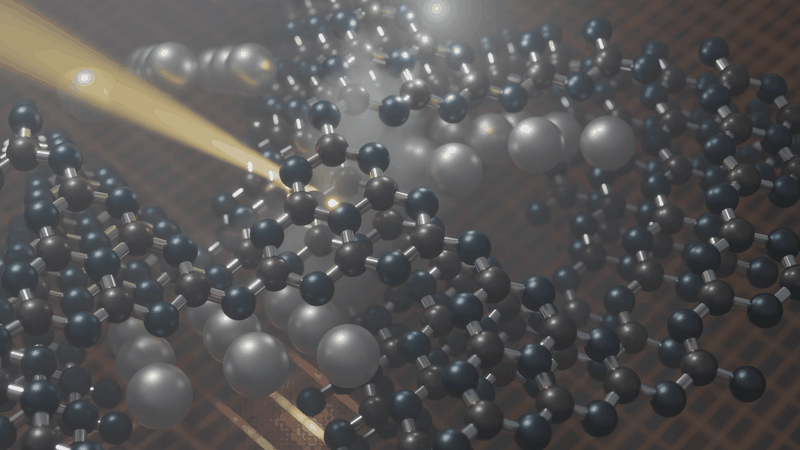
Three layers of a silver ion-doped polyheptazine imide polymeric network. In this example the metal ions are located between the layers, inducing lattice expansion and structural distortion. However, the polymeric backbone remains intact. Only the pore geometry changes.
(Source: Dr. Bernd Schröder)
Photocatalysis promises an efficient conversion of abundant solar energy into usable chemical energy. Polyheptazine imides have some key structural and functional twists that make them especially interesting for photocatalysis. So far, there was only limited knowledge about how structural changes affect the electronic and optical properties of the many material candidates in this class. A team led by researchers from the Center for Advanced Systems Understanding (CASUS) at Helmholtz-Zentrum Dresden-Rossendorf (HZDR) has now presented a reliable and reproducible theoretical method to solve this challenge that was confirmed by measurements done on genuine candidate materials (DOI: 10.1021/jacs.5c09930). The scientists expect the field of polyheptazine imide materials research to undergo a boom.
Polyheptazine imides belong to the family of carbon nitrides, which are layered, graphene-like compounds composed of nitrogen-rich, ring-shaped units. Unlike graphene, which exhibits excellent electrical conductivity but lacks photocatalytic activity, polyheptazine imides possess band gaps suitable for visible-light absorption.
Europe’s security landscape is changing rapidly
(Source: VCG)
As defence budgets rise and EU programmes expand, civil technology providers are becoming vital contributors to Europe’s strategic autonomy. The event will act as a neutral platform for dialogue between technology suppliers, integrators, and decision-makers shaping the next generation of European defence capabilities and aims to open doors between civil industry and defence procurement, providing practical insights.
Carbon nitride-based materials impress due to their low production cost, nontoxicity and thermal stability. However, the first generation of such materials were not ideal photocatalysts as the materials possessed properties that hindered charge separation. If a material has a low charge separation, the electron excited by an incoming photon quickly recombines with the hole it was propelled from – and releases energy only as heat or light. No energy is available to drive chemical reactions. “Polyheptazine imides containing positively charged metal ions exhibit markedly improved charge separation. This feature renders them highly suitable for practical applications,” says first author Dr. Zahra Hajiahmadi.
Computer science narrows down options
Better materials are for instance needed to realize the expected economic potential of photocatalytic reactions like water splitting (to produce hydrogen as a fuel), carbon dioxide reduction (to produce basic carbohydrates as fuels or industrial chemicals) or hydrogen peroxide production (as a basic industrial chemical). To successfully design a polyheptazine imide material that catalyzes a desired reaction smoothly, researchers have to fine-tune every aspect of the material. Obviously, this cannot be done by synthesizing every possible candidate material. This is where computer science comes to the rescue.
“The design space is enormous,” says Prof. Thomas D. Kühne, Director of CASUS, leader of the CASUS research team “Theory of Complex Systems” and senior author of the new publication. “One can for example add functional groups on the surface or substitute specific nitrogen or carbon atoms with oxygen or phosphorus atoms.” Kühne’s group at CASUS is developing novel numerical techniques, which are as efficient as possible and yet, at the same time, qualitatively reproduce the correct chemistry and physics of the underlying system.
Finding the perfect material – in a systematic way
Hajiahmadi’s research focused on the key feature of polyheptazine imides: the negatively charged pores that can be equipped with positively charged metal ions. This setup can greatly enhance catalytic activity. Hajiahmadi’s work is the first comprehensive study on the influence of different metal ions on the optoelectronic properties of polyheptazine imides. In total, 53 different metal ions were analyzed and classified with respect to their location (in plane or between the layers) and their effect on the geometry of the material (resulting in a distortion or not).
“We used a reliable and reproducible computational framework that goes beyond conventional modeling approaches,” says Hajiahmadi. “Standard computational studies of photocatalysts typically focus on ground-state properties and neglect excited-state effects, despite the fact that photocatalysis is inherently driven by photoexcited charge carriers. Specifically, we employ many-body perturbation theory methods.” Starting from an easily solvable non-interacting system, these methods treat interactions as small perturbations. The effects of interactions are calculated as small corrections to the known solution. In the end, all mathematical expansions result in an approximation of how large groups of particles influence each other. Because of their high computational cost these methods are rarely used in this field. But the presented study clearly confirms that the benefits are overwhelming as the new computational framework enables a qualitatively accurate description of a material’s optical absorption and electronic structure under illumination.
Date: 08.12.2025
Naturally, we always handle your personal data responsibly. Any personal data we receive from you is processed in accordance with applicable data protection legislation. For detailed information please see our privacy policy.
Consent to the use of data for promotional purposes
I hereby consent to Vogel Communications Group GmbH & Co. KG, Max-Planck-Str. 7-9, 97082 Würzburg including any affiliated companies according to §§ 15 et seq. AktG (hereafter: Vogel Communications Group) using my e-mail address to send editorial newsletters. A list of all affiliated companies can be found here
Newsletter content may include all products and services of any companies mentioned above, including for example specialist journals and books, events and fairs as well as event-related products and services, print and digital media offers and services such as additional (editorial) newsletters, raffles, lead campaigns, market research both online and offline, specialist webportals and e-learning offers. In case my personal telephone number has also been collected, it may be used for offers of aforementioned products, for services of the companies mentioned above, and market research purposes.
Additionally, my consent also includes the processing of my email address and telephone number for data matching for marketing purposes with select advertising partners such as LinkedIn, Google, and Meta. For this, Vogel Communications Group may transmit said data in hashed form to the advertising partners who then use said data to determine whether I am also a member of the mentioned advertising partner portals. Vogel Communications Group uses this feature for the purposes of re-targeting (up-selling, cross-selling, and customer loyalty), generating so-called look-alike audiences for acquisition of new customers, and as basis for exclusion for on-going advertising campaigns. Further information can be found in section “data matching for marketing purposes”.
In case I access protected data on Internet portals of Vogel Communications Group including any affiliated companies according to §§ 15 et seq. AktG, I need to provide further data in order to register for the access to such content. In return for this free access to editorial content, my data may be used in accordance with this consent for the purposes stated here. This does not apply to data matching for marketing purposes.
Right of revocation
I understand that I can revoke my consent at will. My revocation does not change the lawfulness of data processing that was conducted based on my consent leading up to my revocation. One option to declare my revocation is to use the contact form found at https://contact.vogel.de. In case I no longer wish to receive certain newsletters, I have subscribed to, I can also click on the unsubscribe link included at the end of a newsletter. Further information regarding my right of revocation and the implementation of it as well as the consequences of my revocation can be found in the data protection declaration, section editorial newsletter.
Using this approach, the scientists systematically investigated how the different metal ions influence the geometry of the polyheptazine imide polymeric network. The results show that ion incorporation can induce distinct structural distortions, including changes in layer spacing and local bonding environments. These geometric modifications directly affect the electronic band structure and optical behavior, including light-harvesting efficiency.
To validate the theoretical predictions, eight polyheptazine imides, each equipped with a different metal, were synthesized and tested for their suitability to catalyze hydrogen peroxide production. “The results clearly showed a high degree of agreement to our predictions and outperformed competing calculation methods,” Hajiahmadi concludes. Kühne adds: “If there was some doubt about polyheptazine imides being one of the most promising platforms for next-generation photocatalytic technologies, I believe this work put them to rest. The path toward the targeted design of efficient polyheptazine imide photocatalysts for sustainable reactions is clearer now. I firmly believe that it will be taken often and successfully.”




:quality(80)/p7i.vogel.de/wcms/8b/f4/8bf4a7aa5a40349c3a6f67a8aa806f6b/image-imageformat-carousel-505514996-2665x1498v1.jpeg "Each of the isolated indium atoms (in gold color) can catalyse the synthesis of methanol (top right). (Image:Constance Ko / ETH Zurich)")
:quality(80)/p7i.vogel.de/wcms/46/8e/468e6c3702956b17505237994d8dad97/0129920231v1.jpeg "Hensoldt, a sensor specialist for critical defence applications among other things, now has a strategic milestone ahead of it. The company is planning to acquire Nedinsco, an optronics company from Venlo in the Netherlands. Here's what's to come ... (Source: Hensoldt)")
:quality(80)/p7i.vogel.de/wcms/56/05/5605373104ee6d3fcf8bbfa608731091/0129915700v1.jpeg "After the first \"Kübel\" and the Schwimmwagen, Volkswagen has made itself popular with the Bundeswehr with this Kübel here, as well as with the VW Bus. Now there are initial reports that the armored vehicle track could also be used. (Source: Volkswagen)")
:quality(80)/p7i.vogel.de/wcms/ff/2a/ff2adcb48e6b6a81a77ce9c6f62334ce/0129914625v1.jpeg "Looking ahead to 2025, Renk cites record figures in particular. Find out here how the armaments business in particular is currently paying off for the Group ... (Image:Renk)")
:quality(80)/p7i.vogel.de/wcms/05/04/050472eef4626e049667afe3ae3e5909/pm-draht-lmd-bild-3-1920x1081v1.jpeg "(Source: Fraunhofer ILT, Aachen, Germany / Volker Lannert.)")
:quality(80)/p7i.vogel.de/wcms/34/48/3448103f90626143970ac1e54dc70f5c/0129896088v1.jpeg "View of a Wickert hydraulic press, which is suitable for producing safety-relevant components from various composite materials. The spectrum ranges from personal protection to the armoring of armor systems of all kinds. (Image:Wickert mechanical engineering)")
:quality(80)/p7i.vogel.de/wcms/5b/eb/5beb9d1d593df5ec59156f6dc22fbbd9/bischof-brugg-pipes-3y1a0339-2399x1349v1.jpeg "(Source: Brugg Pipes)")
:quality(80)/p7i.vogel.de/wcms/6f/eb/6feb6f0a4d94e54014d7b1869452ce53/picmax-3840x2158v1.png "Three layers of a silver ion-doped polyheptazine imide polymeric network. In this example the metal ions are located between the layers, inducing lattice expansion and structural distortion. However, the polymeric backbone remains intact. Only the pore geometry changes. (Source: Dr. Bernd Schröder)")
:quality(80)/p7i.vogel.de/wcms/9a/a0/9aa09568db7b06b1a5d1d196bd7d0bc5/0129568242v1.jpeg "Air bp and Airbus have signed a multi-year fuel supply contract. (Image:Airbus)")
:quality(80)/p7i.vogel.de/wcms/1e/52/1e52027cb1285c559cc28d89cee5954c/airbus-1251x703v1.png "(Image: Airbus)")
:quality(80)/p7i.vogel.de/wcms/21/e3/21e3203ba1d373548efb6fcfcdb26a6c/esa-20artemis-1920x1079v1.jpeg "(Source: NASA)")
:quality(80)/p7i.vogel.de/wcms/d6/2e/d62e273fe38b3d8e065f1a18fc0139ae/flugzeug-20am-20himmel-1792x1009v1.png "(Source: AI-generated)")
:quality(80)/p7i.vogel.de/wcms/93/f1/93f1e4dba53b2c9589fab17a525df55e/adobestock-163119218-2480x1394v1.jpeg "(Source: Kernkonzept GmbH)")
:quality(80)/p7i.vogel.de/wcms/8d/76/8d764c984e44153da8f0dfa88cd6d75e/0129843677v1.jpeg "A successful drone attack on two data centers of the Amazon subsidiary AWS shows that the danger of drones is virtually unavoidable in modern warfare ... (Source: Cerberus)")
:quality(80)/p7i.vogel.de/wcms/6f/a7/6fa76be29e77ecb487a2dbbda36fc514/ki-generiert3a35a036-d062-432c-914c-d4fa050cf58f-1536x864v1.png "(Source: AI-generated)")
:quality(80)/p7i.vogel.de/wcms/32/cb/32cb64c4a0486d2f9283b8ea57003421/fkie-fraunhofer-entwickelt-ki-gestuetztes-lernmanagementsystem-fuer-die-bundeswehr-1440x810v1.jpeg "(Source: Philipp Plum / Fraunhofer FOKUS)")
:quality(80)/p7i.vogel.de/wcms/22/ea/22ea2068a1f2a3ad3cac21eda628b0ad/range-motiv-a4-02-4741x2666v1.jpeg "The acquisition of NVL strengthens Rheinmetall’s position in naval shipbuilding and expands its capabilities in advanced maritime defence systems. (Image:Rheinmetall AG)")
:quality(80)/p7i.vogel.de/wcms/58/5a/585a92223bfdffdd69cbfc52d30e5367/7ba159ca-33ee-46ca-8da8-65ad1acc3aac-3102x1745v1.png "(Source: European Commission)")
:quality(80)/p7i.vogel.de/wcms/43/7b/437b848e817e7e6018612389b9e65046/0129580414v1.jpeg "Until now, Rheinmetall has primarily equipped warships with laser systems and cannons, such as the Oerlikon Millennium Gun for fast surface targets. Now, however, the Düsseldorf (Germany) -based defence company wants to build entire ships, as it is allowed to take over NVL ... (Image:Rheinmetall Air Defence AG)")
:quality(80)/p7i.vogel.de/wcms/42/53/425386d9947a2808f3ca893cb8e9a6b0/img-20251008-150724-4640x2608v1.webp "(Source: EDA)")
:quality(80)/p7i.vogel.de/wcms/f9/2f/f92f1ef8c739c34c70d99f7b0997621b/stra007-20--20cover-20image-5472x3076v1.jpeg "(Source: Stratasys)")
:quality(80)/p7i.vogel.de/wcms/5e/18/5e184e4961f190c86a1ea3227104cab5/26pm03-20kompakte-20l-c3-b6sungen-20f-c3-bcr-20luft--20und-20raumfahrt-202-2362x1329v1.jpeg "(Picture: Keysight)")
:quality(80)/p7i.vogel.de/wcms/67/4c/674c54baa745be497cecb716826af339/stahlwille-hero-1807x1016v1.jpeg "A new modular tool solution designed for safety, precision, and mobility in aviation maintenance. (Source: STAHLWILLE)")
:quality(80)/p7i.vogel.de/wcms/0d/01/0d01a051ba894332a8091e3a3f9394e1/hytorc-defense-solutions-boxersatz-1899x1068v1.jpeg "HYTORC’s Defence Solutions toolkit, proven on the GTK Boxer, enables safe, traceable fastening of critical components across multiple Bundeswehr platforms. (Source: Image: HYTORC)")
:fill(fff,0)/p7i.vogel.de/companies/64/fe/64fec73b1a2fb/logo-master-ggbbytimken-286blue.jpeg "logo-master-ggbbytimken-286blue (GGB)")
:fill(fff,0)/p7i.vogel.de/companies/69/6d/696de2483d115/logo--fastems-rgb-horizontal.jpeg "logo--fastems-rgb-horizontal (Fastems)")

:quality(80)/p7i.vogel.de/wcms/93/f1/93f1e4dba53b2c9589fab17a525df55e/adobestock-163119218-2480x1394v1.jpeg "adobestock-163119218-2480x1394v1 (Source: Kernkonzept GmbH)")
:quality(80)/p7i.vogel.de/wcms/16/fb/16fbc4df18d896b8f010ac7c3db31baf/the-image-combines-a-model-derived-from-a-scanning-electron-microscopy-image--28left-29-with-a-snippet-of-the-underlying-crystal-structure-of-a-studied-mxene-featuring-precisely-controlled-surface-terminations-1280x719v1.png "The image combines a model derived from a scanning electron microscopy image (left) with a snippet of the underlying crystal structure of a studied MXene featuring precisely controlled surface terminations. (Source: B. Schröder/HZDR)")
:quality(80)/p7i.vogel.de/wcms/8b/f4/8bf4a7aa5a40349c3a6f67a8aa806f6b/image-imageformat-carousel-505514996-2665x1498v1.jpeg "Each of the isolated indium atoms (in gold color) can catalyse the synthesis of methanol (top right). (Image:Constance Ko / ETH Zurich)")