Methanol is a key starting material for chemical products. Researchers from ETH Zurich can now produce this precursor from CO2 and hydrogen with high efficiency by using isolated metal atoms as catalysts.
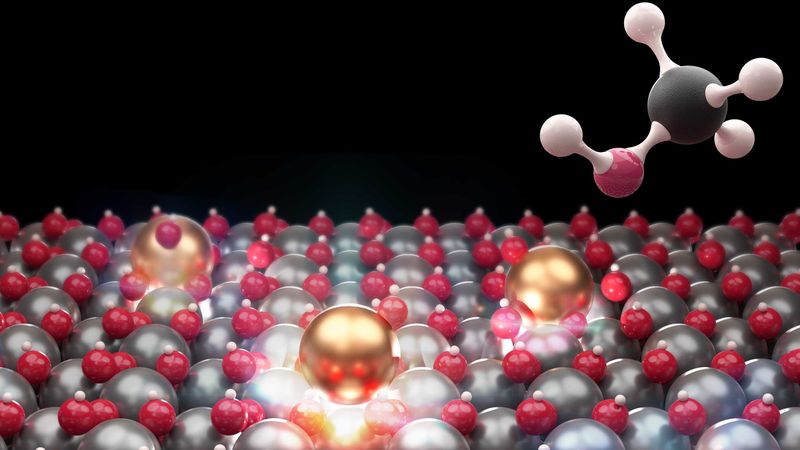
Each of the isolated indium atoms (in gold color) can catalyse the synthesis of methanol (top right).
(Image: Constance Ko / ETH Zurich)
Every chemical reaction faces a barrier: for substances to react with one another, it is first necessary to supply energy. In many cases, this energy barrier is low—such as when striking a match. For many key reactions in industry, however, it is much larger—and increased energy requirements drive up production costs. To lower this barrier, chemists use “reaction helpers” known as catalysts. The best of these substances contain metals—including, in some cases, rare metals.
Now, chemists from ETH Zurich have achieved a breakthrough in catalysis research on multiple levels:
They have developed a catalyst that significantly lowers the energy barrier for the production of methanol—an alcohol—from the greenhouse gas CO2 and hydrogen.
In their catalyst, the researchers use the metal indium in an extremely efficient manner—in the sense that each individual indium atom behaves as an active site.
In the past, catalysis research often followed a “hit or miss” approach. The newly discovered catalyst allows more precise analysis of the mechanisms taking place on its surface, paving the way for rational catalyst design.
Swiss army knife of green chemistry
“Methanol is a universal precursor for the production of a wide range of chemicals and materials, such as plastics—the Swiss army knife of chemistry, so to speak,” says Javier Pérez-Ramírez, Professor of Catalysis Engineering at ETH Zurich. The liquid therefore plays a vital role in the transition to sustainable and fossil-free production of chemical products and fuels.
If the energy used to produce the hydrogen and for catalysis is generated sustainably, methanol can ultimately even be produced in a climate-neutral manner. This provides a way of using CO2 from the atmosphere as a raw material instead of merely releasing it as we do today.
Maximum use of the metals
“Our new catalyst has a single atom architecture, in which isolated active metal atoms are anchored on the surface of a specially developed support material,” Pérez-Ramírez explains. In conventional catalysts, on the other hand, metals are usually present as aggregates, usually small particles. Although these particles are tiny, they often contain between a hundred and several thousand metal atoms.
If the atoms can work in isolation, their catalytic properties also frequently change. “Indium has already been used in this catalyst for over a decade,” says Pérez-Ramírez. “In our study, we show that isolated indium atoms on hafnium oxide allow more efficient CO2-based methanol synthesis than indium in the form of nanoparticles containing large numbers of atoms.”
It is no wonder that single-atom catalysts are currently a hot topic in catalysis research. They represent the pinnacle of efficiency when it comes to the use of expensive and scarce chemical elements. If metals are used as individual atoms, it can even be possible to use precious metals in an economically viable manner.
Single atoms in the right place
In order to anchor single indium atoms to the hafnium oxide surface in a targeted manner, the interdisciplinary ETH team developed various synthetic pathways in collaboration with colleagues from other research institutions. One key part of this development was the specific structure of the support material, which provides the atoms with a stable and, at the same time, reactive environment.
In one tested production process, the starting materials are combusted in a flame at 2,000 to 3,000°C (approx. 3,600 to 5,400°F) and then rapidly cooled. Under these conditions, the indium tends to remain on the surface, where it is stably incorporated.
With the incorporation of the catalyst atoms into a heat-resistant hafnium oxide support, the ETH chemists show that single-atom catalysts can remain stable even in extreme conditions. Reactions that require high temperatures and pressures are therefore also within reach. For example, the synthesis of methanol from CO2 and hydrogen gas requires temperatures of up to 300°C (approx. 570°F) and pressures of up to 50 times normal atmospheric pressure.
Interaction between catalyst metal and matrix
Moreover, the existing nanoparticles used for analysis were a black box. While the catalytic processes only took place at the small number of atoms on the surface, many measurement signals originated from inside the particles, from atoms that were not even involved in the reaction. This made interpretation more difficult. In catalysts with isolated atoms, however, the reaction mechanisms can be analysed with far fewer interfering signals.
Date: 08.12.2025
Naturally, we always handle your personal data responsibly. Any personal data we receive from you is processed in accordance with applicable data protection legislation. For detailed information please see our privacy policy.
Consent to the use of data for promotional purposes
I hereby consent to Vogel Communications Group GmbH & Co. KG, Max-Planck-Str. 7-9, 97082 Würzburg including any affiliated companies according to §§ 15 et seq. AktG (hereafter: Vogel Communications Group) using my e-mail address to send editorial newsletters. A list of all affiliated companies can be found here
Newsletter content may include all products and services of any companies mentioned above, including for example specialist journals and books, events and fairs as well as event-related products and services, print and digital media offers and services such as additional (editorial) newsletters, raffles, lead campaigns, market research both online and offline, specialist webportals and e-learning offers. In case my personal telephone number has also been collected, it may be used for offers of aforementioned products, for services of the companies mentioned above, and market research purposes.
Additionally, my consent also includes the processing of my email address and telephone number for data matching for marketing purposes with select advertising partners such as LinkedIn, Google, and Meta. For this, Vogel Communications Group may transmit said data in hashed form to the advertising partners who then use said data to determine whether I am also a member of the mentioned advertising partner portals. Vogel Communications Group uses this feature for the purposes of re-targeting (up-selling, cross-selling, and customer loyalty), generating so-called look-alike audiences for acquisition of new customers, and as basis for exclusion for on-going advertising campaigns. Further information can be found in section “data matching for marketing purposes”.
In case I access protected data on Internet portals of Vogel Communications Group including any affiliated companies according to §§ 15 et seq. AktG, I need to provide further data in order to register for the access to such content. In return for this free access to editorial content, my data may be used in accordance with this consent for the purposes stated here. This does not apply to data matching for marketing purposes.
Right of revocation
I understand that I can revoke my consent at will. My revocation does not change the lawfulness of data processing that was conducted based on my consent leading up to my revocation. One option to declare my revocation is to use the contact form found at https://contact.vogel.de. In case I no longer wish to receive certain newsletters, I have subscribed to, I can also click on the unsubscribe link included at the end of a newsletter. Further information regarding my right of revocation and the implementation of it as well as the consequences of my revocation can be found in the data protection declaration, section editorial newsletter.
Pérez-Ramírez has not only been researching better catalysts for methanol production from CO2 at ETH since 2010 but also works closely with industry and holds several patents in this area. One key factor in the development of the new single-atom catalyst method was the large network that has emerged in terms of catalysis research in Switzerland in recent years, says Pérez-Ramírez: “The development of the methanol catalyst and the detailed analysis of the mechanism would not have been possible without this interdisciplinary expertise.”
Centre of competence for sustainable chemical processes
Javier Pérez-Ramírez is Director of the external pageNational Centre of Competence in Research (NCCR) Catalysis, in which 45 Swiss research groups are working on more sustainable chemical processes. The single-atom catalyst for methanol production represents another key step in this direction.
Reference
Chiang YT, Ritopecki M, Willi PO, Raue K, Morales-Vidal J, Zou T, Agrachev M, Eliasson H, Wang J, Erni R, Stark WJ, Jeschke G, Grass RN, López N, Mitchell S, Pérez-Ramírez J: Single atoms of indium on hafnia enable superior CO2-based methanol synthesis. Nature Nanotechnology, 2 March 2026, DOI: external page10.1038/s41565-026-02135-y




:quality(80)/p7i.vogel.de/wcms/f6/95/f6954fa7c09ba58863a3730f5e384a62/arek-socha-on-pixabay-1707x960v1.jpeg "A new national space strategy brings together UK’s plans for growth, defence, and national security to help reindustrialise the UK. (Source: Arek Socha on Pixabay)")
:quality(80)/p7i.vogel.de/wcms/63/0f/630f214fa760b8c7f7f7d6279d411fcf/d4ceed8f2f52-2026-08-30-hydef-06--msc4159-1200x675v1.webp "(Source: Diehl Defence)")
:quality(80)/p7i.vogel.de/wcms/4e/7d/4e7d38327c6c928b403249e3c24a2a7c/0132118791v1.jpeg "Porsche Holding SE announces that it is once again turning to rocket technology. Following its investment in Isar Aerospace, the company is now acquiring a stake in a U.S. firm ... (Source: Porsche)")
:quality(80)/p7i.vogel.de/wcms/1c/08/1c082bbd9d05b634168b617aa26fcdcf/safe-bg-lv-ro-v1-991x557v1.png "(Source: European Commission)")
:quality(80)/p7i.vogel.de/wcms/0a/14/0a1495d9b570ae32a5a7cc748b9a3c60/st-hannover-035-1920x1079v1-999x562v1.jpeg "Fastening technology you can experience first-hand—visitors to Schraubtec in Bochum (Germany) can see it for themselves at the Ruhr Congress on September 30, 2026. (Source: PHOTOVISION-DH GmbH)")
:quality(80)/p7i.vogel.de/wcms/cd/a9/cda92b173afa9d0b455d4f11b281c9ea/0094-to-image--capstone-cdr-1440x810v1.png "(Source: Terran Orbital)")
:quality(80)/p7i.vogel.de/wcms/e0/45/e045bc5414d7263fb308bdd501b5fcc1/0133113962v1.jpeg "The HSWL 354 is the transmission used, for example, in the Leopard 2 main battle tank. Renk manufactures this system and is now preparing to significantly increase its cycle time. As a result, Renk is placing greater emphasis on the military sector as a customer ... (Source: Renk)")
:quality(80)/p7i.vogel.de/wcms/a1/5c/a15c2aeba563d5bc3e11fb879b21eb2c/0132989650v1.jpeg "FSS, the flexible clamping system for varying free-form surfaces, is designed for the aerospace industry and other sectors. (Source: Römheld GmbH Friedrichshütte)")
:quality(80)/p7i.vogel.de/wcms/46/8e/468effa87546a2b036dc88ca40e2843e/129fbcac92ce7da872b13af0281b0799-l-png-1920x1079v1.webp "(Source: Arianespace)")
:quality(80)/p7i.vogel.de/wcms/8f/10/8f10697d4bfbd70edf615cca76eaedfd/pete-linforth-on-pixabay-1920x1080v1.jpeg "(Source: Pete Linforth on Pixabay / AI-generated)")
:quality(80)/p7i.vogel.de/wcms/0f/99/0f99561bf51818af92b2960656405aa5/roland-4d-pippes-on-pixabay-1460x820v1.jpeg "(Source: Roland 4D Pippes on Pixabay)")
:quality(80)/p7i.vogel.de/wcms/05/49/054906f874b94ef08b09d5920396e27d/airbus-h160-1920x1079v1.jpeg "Airbus H160 (Source: Airbus)")
:quality(80)/p7i.vogel.de/wcms/9d/8a/9d8addea8cc4e6f7a4793563ca397f2a/ai-im-milit-r-1672x940v1.png "(Source: KI-generiert / Gemini)")
:quality(80)/p7i.vogel.de/wcms/7f/5f/7f5fba2c729ec3aa256bf1a18d74529b/ai-chip-1672x940v1.png "(Source: KI-generiert / Gemini)")
:quality(80)/p7i.vogel.de/wcms/64/1b/641b6474b2a614cde7730c89ef2a3015/2026-09-09-rheinmetall-veroeffentlicht-battlesuite-schnittstellen-e8c18194-1225x690v1.jpeg "Rheinmetall’s Battlesuite provides a modular digital platform for connecting and integrating sensors, hardware and software components. (Source: Rheinmetall AG)")
:quality(80)/p7i.vogel.de/wcms/6f/fe/6ffef325e7f233cc3521943158eb1ebd/0132763535v1.jpeg "Two companies are planning to establish, for the first time in 2027, an optical laser communication link directly between a satellite in low Earth orbit (LEO) and a re-entering spacecraft. (Source: ATMOS Space Cargo)")
:quality(80)/p7i.vogel.de/wcms/8f/f9/8ff91b78b26cb5a2b8a29e39835005b1/2026-09-10-repmus-teaser-images-retouched-dsc01292-1024x683-1024x576v1.jpeg "(Source: Quantum Systems GmbH)")
:quality(80)/p7i.vogel.de/wcms/bf/4a/bf4a237e60d3d4bd1bbdbad918f3c697/airbus-defence-and-space-3-1280x720v1.jpeg "(Source: Airbus Defence and Space)")
:quality(80)/p7i.vogel.de/wcms/e0/d1/e0d112a0d54a4fa9603ec855f7d25b47/t-rex-content-photo-jpg-pc-adaptive-990-medium-988x556v1.jpeg "Swarm of UAVs conducting a fully autonomous collaborative swarm mission. (Source: Lockheed Martin)")
:quality(80)/p7i.vogel.de/wcms/79/fc/79fcaa7ca33e393b11a4740d7d8f3dbe/vilkasss-handshake-9459740-1911x1076v1.jpeg "(Source: Vilius Kukanauskas on Pixabay)")
:quality(80)/p7i.vogel.de/wcms/90/a8/90a849f0023f11d1eb642eb4751a0321/bild2-h-c3-a4nel-ict-20truck-20and-20trailer-20parts-4320x2429v1.jpeg "Product information is visible at all times and retrieval of items
is confirmed by employees directly on the display of the Hänel MP 14 N
controller. (Source: René Marks)")
:quality(80)/p7i.vogel.de/wcms/4e/ca/4ecaa39f247490eded591b652c33aee3/thilmann-hcp-web-20kleiner-20ausschnitt-1442x811v1.jpeg "Entering the defence market can be challenging for start-ups, says HCP Sense CEO Ansgar Thilmann. (Picture: HCP Sense)")
:quality(80)/p7i.vogel.de/wcms/7a/51/7a511b80041d3f1335f3a5aa56fe75da/delivery-7022432-1280-1280x720v1.png "(Source: Mohamed_hassan)")
:quality(80)/p7i.vogel.de/wcms/f9/2f/f92f1ef8c739c34c70d99f7b0997621b/stra007-20--20cover-20image-5472x3076v1.jpeg "(Source: Stratasys)")
:quality(80)/p7i.vogel.de/wcms/ec/a9/eca9062ccbe4b042f8515846340410d8/aerospace-and-defence-stairways-platforms-and-much-morev1.jpeg "Modular constructions enable flexible modification. That applies to larger structures such as stairways and platforms, too. And that means aerospace and defence companies can reconfigure their maintenance platforms fast (itemitem)")
:quality(80)/p7i.vogel.de/wcms/30/2a/302a7b5723ad38fbde812fd3a468ad04/safety-on-stairways-in-industry-key-considerationsv1.jpeg "Stairways and platforms are used widely in maintenance and assembly areas in the aerospace and defence sectors. (Source: item)")
:quality(80)/p7i.vogel.de/wcms/f3/4e/f34ed744bb30817d3432c7ad522e6f30/engine-1v1.jpeg "Engineering with aluminium profiles really can be this easy – the item Engineeringtool and its smart functions help you save valuable time. (Source: item)")
:fill(fff,0)/p7i.vogel.de/companies/69/6d/696de2483d115/logo--fastems-rgb-horizontal.jpeg "logo--fastems-rgb-horizontal (Fastems)")
:fill(fff,0)/images.vogel.de/vogelonline/companyimg/84700/84735/65.jpg "logo_item_rgb_neu.jpg ()")
:quality(80)/p7i.vogel.de/wcms/1b/f0/1bf0495af837da5aa924738a45cc9dc6/image-cellsiusv1.jpeg "The H2-Sling, Switzerland's first hydrogen-powered aircraft, was developed by Cellsius at ETH Zurich. (Source: Cellsius)")
:quality(80)/p7i.vogel.de/wcms/16/fb/16fbc4df18d896b8f010ac7c3db31baf/the-image-combines-a-model-derived-from-a-scanning-electron-microscopy-image--28left-29-with-a-snippet-of-the-underlying-crystal-structure-of-a-studied-mxene-featuring-precisely-controlled-surface-terminations-1280x719v1.png "The image combines a model derived from a scanning electron microscopy image (left) with a snippet of the underlying crystal structure of a studied MXene featuring precisely controlled surface terminations. (Source: B. Schröder/HZDR)")