Nine small satellites built in Würzburg are setting a European record while demonstrating industrial satellite production, cooperative mission capabilities, and innovative Earth observation technologies.
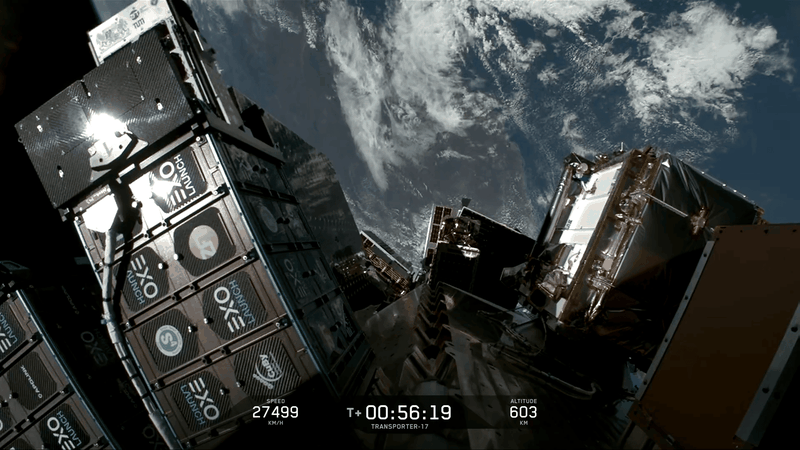
At the top left, CuBy-5 is being deployed from the container attached to the rocket.
(Source: Oliver Ruf S4 GmbH Würzburg, credits: SpaceX videostream)
Nine small satellites for Earth observation from Würzburg (Germany) were launched into space on 7 July. Never before have so many satellites manufactured in Europe by a single producer been launched simultaneously in two multi satellite missions. This demonstrates strategically important capabilities for the industrial serial production of satellites. All nine satellites are in excellent health.
Following an inspiring opening address by BMFTR Minister Bär, a SpaceX Falcon 9 rocket lifted the nine satellites from Würzburg (Germany) into space from California on 7 July at 9:10 am. These tiny satellites, each about the size of a shoebox, work together to carry out innovative Earth observation tasks across three different missions. This marks the first time in Europe that such a record number of satellites has been realised for different Earth observation applications. The missions are intended to provide important information for agriculture, forestry, disaster relief, and surveying more quickly and across larger areas.
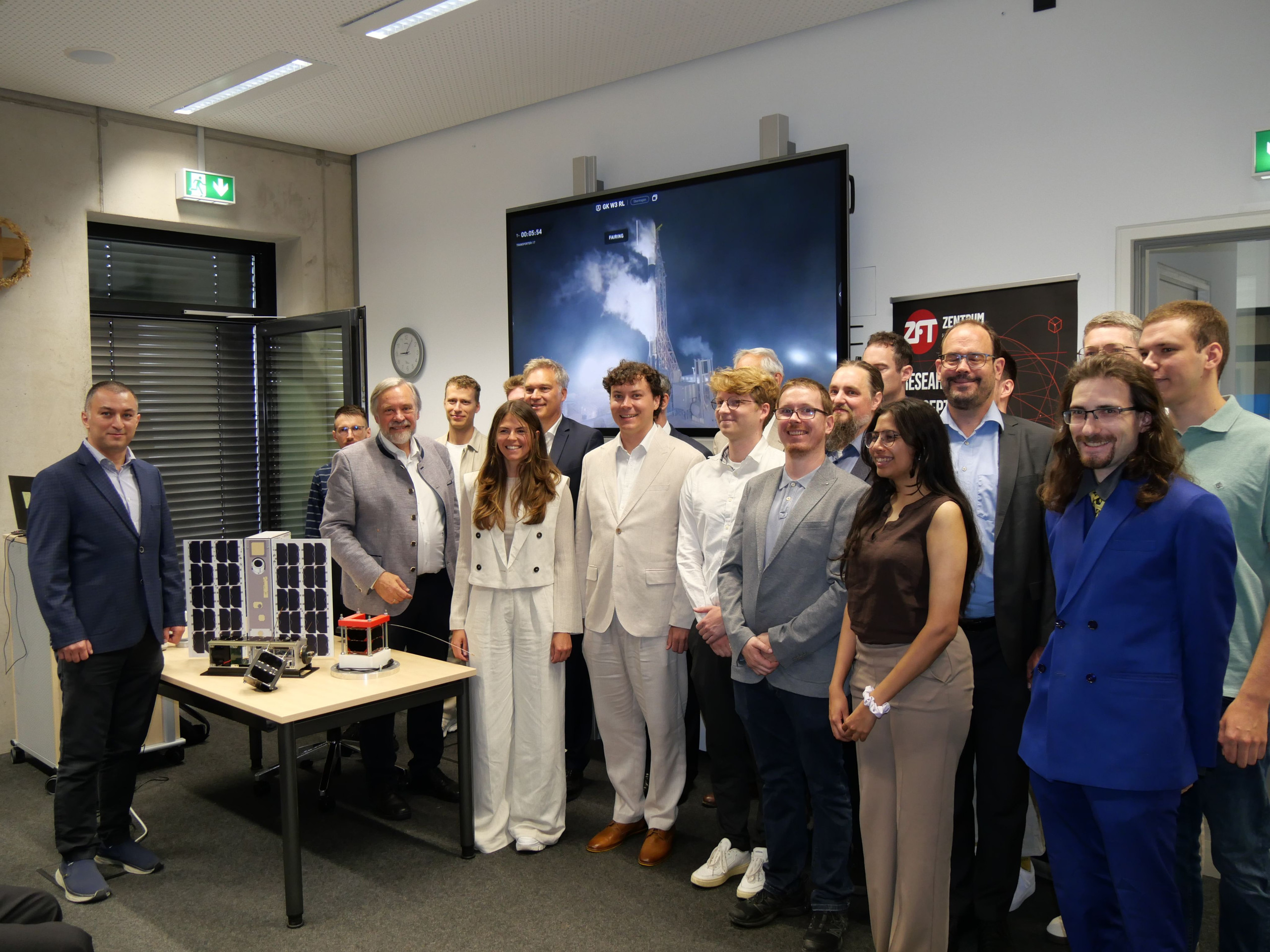
The Würzburg (Germany) satellite team shortly before the launch of the nine Earth observation satellites, gathered in front of the live video stream of the SpaceX rocket launch.
(Source: Robin Hess, Zentrum für Telematik Würzburg)
These small satellites, each with a mass of less than 10 kg (approx. 22 lb), were all built and extensively tested in Würzburg (Germany) by the independent research institution Centre for Telematics (ZfT) in cooperation with the start up Smart Small Satellite Systems GmbH (S4). Contact with all nine Würzburg satellites was established earlier than expected, and all are operating perfectly. The ground stations established stable communications just one hour after deployment, and the planned complex commissioning activities began.
“The transition from individually handcrafted, complex, large satellites to future markets based on industrially manufactured, numerous, simpler yet cooperating small satellites is still in its infancy in Europe—despite ambitious plans. This achievement marks important progress in establishing these strategically important technologies here as well,” said ZfT Executive Board member Prof. Dr. Klaus Schilling.
Scientific benefits for everyday life
The shared objective of the nine satellites is to generate benefits for everyday life through scientifically innovative approaches.
The Bavarian satellite network for remote sensing and biomonitoring, CuBy, consisting of five satellites, is designed to detect forest damage at an early stage while also collecting important information for flood disaster relief and surveying. Bavarian Minister of Finance and Regional Identity Albert Füracker highlighted the benefits for Bavaria: “For the Bavarian Surveying Administration, which is responsible for this pioneering project, and for Bavaria as a whole, this is a strong signal for our modern technology location. For the first time, we can photograph Bavaria from space and provide images with an accuracy of approximately five metres (approx. 16.4 ft). From image acquisition in space to the use of the data by public authorities, industry, and research, everything remains in Bavarian hands.”
The three TOM satellites observe the same target area from different directions in order to generate three dimensional imagery. This provides valuable additional information to support disaster response operations. Through international cooperation, ground stations on five continents are contributed by Bavarian partner regions to ensure that satellite data can be relayed efficiently and without delay.
The satellite team is completed by a precursor satellite for ten future CloudCT satellites designed to improve climate forecasting. It is funded through one of the European Research Council's top research awards, bringing together three researchers from very different disciplines. The concept uses computed tomography, similar to that used in medicine, with ten cooperating satellites to analyse the internal composition of clouds and thereby improve climate predictions.
Innovative self organisation technologies
All nine satellites employ innovative control technologies for satellite self organisation. They coordinate with one another in order to accomplish their tasks in the most effective way. This builds on the experience gained from ZfT's NetSat mission, which successfully operated four satellites in 2020. The project is preparing the way for more efficient operation of the next generation of global satellite networks. “Innovative control technologies for satellite self organisation are being applied here, opening enormous application potential in many other fields,” explained S4 Chief Technology Officer Oliver Ruf.
Completing and testing nine satellites in parallel requires capabilities that are being scientifically investigated in the ZfT Small Satellite Research Factory and made available to industry. The focus is on advanced production technologies that will enable the European space industry to compete with the United States and China in developing future satellite networks for autonomous driving, secure communications, continuous Earth observation, and navigation.
Date: 08.12.2025
Naturally, we always handle your personal data responsibly. Any personal data we receive from you is processed in accordance with applicable data protection legislation. For detailed information please see our privacy policy.
Consent to the use of data for promotional purposes
I hereby consent to Vogel Communications Group GmbH & Co. KG, Max-Planck-Str. 7-9, 97082 Würzburg including any affiliated companies according to §§ 15 et seq. AktG (hereafter: Vogel Communications Group) using my e-mail address to send editorial newsletters. A list of all affiliated companies can be found here
Newsletter content may include all products and services of any companies mentioned above, including for example specialist journals and books, events and fairs as well as event-related products and services, print and digital media offers and services such as additional (editorial) newsletters, raffles, lead campaigns, market research both online and offline, specialist webportals and e-learning offers. In case my personal telephone number has also been collected, it may be used for offers of aforementioned products, for services of the companies mentioned above, and market research purposes.
Additionally, my consent also includes the processing of my email address and telephone number for data matching for marketing purposes with select advertising partners such as LinkedIn, Google, and Meta. For this, Vogel Communications Group may transmit said data in hashed form to the advertising partners who then use said data to determine whether I am also a member of the mentioned advertising partner portals. Vogel Communications Group uses this feature for the purposes of re-targeting (up-selling, cross-selling, and customer loyalty), generating so-called look-alike audiences for acquisition of new customers, and as basis for exclusion for on-going advertising campaigns. Further information can be found in section “data matching for marketing purposes”.
In case I access protected data on Internet portals of Vogel Communications Group including any affiliated companies according to §§ 15 et seq. AktG, I need to provide further data in order to register for the access to such content. In return for this free access to editorial content, my data may be used in accordance with this consent for the purposes stated here. This does not apply to data matching for marketing purposes.
Right of revocation
I understand that I can revoke my consent at will. My revocation does not change the lawfulness of data processing that was conducted based on my consent leading up to my revocation. One option to declare my revocation is to use the contact form found at https://contact.vogel.de. In case I no longer wish to receive certain newsletters, I have subscribed to, I can also click on the unsubscribe link included at the end of a newsletter. Further information regarding my right of revocation and the implementation of it as well as the consequences of my revocation can be found in the data protection declaration, section editorial newsletter.
More than 20 years ago, UWE 1 (University of Würzburg Experimental Satellite) became the first operational European pico satellite. Its engineering models are now exhibited at the German Museum in Munich and the Hermann Oberth Museum in Feucht (Germany). This first student satellite has since given rise to an entire regional space ecosystem consisting of aerospace degree programmes, research institutes, and start up companies that provide future oriented jobs in Würzburg (Germany).




:quality(80)/p7i.vogel.de/wcms/30/07/300782652f0397e8a221f6edf5e087a4/pete-linforth-auf-pixabay-1920x1080v1.jpeg "(Source: Pete Linforth on Pixabay)")
:quality(80)/p7i.vogel.de/wcms/3a/4e/3a4eee9a02e9c88c4b88fe5b430be79d/bild1-1386x779v1.jpeg "Defence companies need more than investment and technology: They also need the skilled professionals who can turn both into new capabilities. (Source: YER Germany)")
:quality(80)/p7i.vogel.de/wcms/eb/e8/ebe871d26ae9dac0e71e99e23a8d7b43/c92090dc-3b0d-5e12-bf8b-0a763c150000-1506x847v1.png "Pioneering launch: The first Ariane 1 lifts off on December 24, 1979. (Source: ESA/CNES/Arianespace)")
:quality(80)/p7i.vogel.de/wcms/71/ec/71ecf89b9e6300685faabfbbf59343bb/0132787041v1.jpeg "Archer plans to acquire the Boeing subsidiaries, as well as Wisk, SkyGrid, and Insitu. (Source: Created with AI)")
:quality(80)/p7i.vogel.de/wcms/cd/a9/cda92b173afa9d0b455d4f11b281c9ea/0094-to-image--capstone-cdr-1440x810v1.png "(Source: Terran Orbital)")
:quality(80)/p7i.vogel.de/wcms/e0/45/e045bc5414d7263fb308bdd501b5fcc1/0133113962v1.jpeg "The HSWL 354 is the transmission used, for example, in the Leopard 2 main battle tank. Renk manufactures this system and is now preparing to significantly increase its cycle time. As a result, Renk is placing greater emphasis on the military sector as a customer ... (Source: Renk)")
:quality(80)/p7i.vogel.de/wcms/a1/5c/a15c2aeba563d5bc3e11fb879b21eb2c/0132989650v1.jpeg "FSS, the flexible clamping system for varying free-form surfaces, is designed for the aerospace industry and other sectors. (Source: Römheld GmbH Friedrichshütte)")
:quality(80)/p7i.vogel.de/wcms/9f/07/9f070dc919a95a6f19bcc1848e9f3089/image-2000-c966ec423c4d86c3769c5a9f1fff7655-1920x1079v1.jpeg "The Idefix rover is firmly mounted between the landing legs of the MMX spacecraft. Despite its compact size, Idefix essentially contains all the elements of a fully fledged scientific rover, yet thanks to its highly integrated design, it has a mass of only 25 kilograms (approx. 55 pounds). (Source: DLR (CC BY-NC-ND 3.0))")
:quality(80)/p7i.vogel.de/wcms/1f/d2/1fd2bffd9eeae597b0e2d2e3cad0adf0/20260828-en-5416166-1-1920x1079v1.jpeg "(Source: Saab)")
:quality(80)/p7i.vogel.de/wcms/d1/ea/d1ea25bed73e011051eb6d4ccf9acc95/hensoldt-and-eplane-1280x720v1.jpeg "Representatives from HENSOLDT and ePlane at the contract signing. (Source: HENSOLDT)")
:quality(80)/p7i.vogel.de/wcms/7b/35/7b351947b314400d23a07a25493ee6b3/encapsulation-mtg-i2-1-1294x728v1.jpeg "MTG-I2 being encapsulated. (Source: 2026 ESA-CNES-ARIANESPACE-ArianeGroup / Optique Vidéo de CSG—S MARTIN)")
:quality(80)/p7i.vogel.de/wcms/d0/3f/d03ffe56445e0af8485ff2f1388f10c0/20260822-en-5412280-1-1920x1080v1.jpeg "(Source: Saab AB)")
:quality(80)/p7i.vogel.de/wcms/6f/fe/6ffef325e7f233cc3521943158eb1ebd/0132763535v1.jpeg "Two companies are planning to establish, for the first time in 2027, an optical laser communication link directly between a satellite in low Earth orbit (LEO) and a re-entering spacecraft. (Source: ATMOS Space Cargo)")
:quality(80)/p7i.vogel.de/wcms/b2/6a/b26a277a3578fc2956b2c30d3b3b0146/0132928076v1.jpeg "Compact and standardised: CubeSats enable cost-effective space missions and are increasingly serving as a platform for testing new technologies—from sensors and communications to innovative power systems. (Source: City Labs, Inc.)")
:quality(80)/p7i.vogel.de/wcms/6d/f2/6df225601e1f8d4f9d07d53fd527cdb9/epc7050-7065-7066-pr-graphic-clean-1500x844v1.jpeg "(Source: EPC Space)")
:quality(80)/p7i.vogel.de/wcms/2a/ae/2aae2c389f328a77a3c1eb502b79f019/mc1779-image-space-csac-sa-65-1898x1067v1.jpeg "The Space CSAC-SA65 combines atomic-clock accuracy with built-in 1 PPS disciplining and low-power consumption. (Source: Microchip Technology Inc.)")
:quality(80)/p7i.vogel.de/wcms/88/c3/88c3d15379492ba52abe12f95b0aa4d3/dalo-2026-signing-4-1294x728v1.jpeg "(Left to Right) Danish Ministry of Defence Material and Procurement Agency Director Per Pugholm Olsen, Country Director Thales Denmark, Ireland, Iceland & Baltics, Martin Soegaard, Systematic CEO, Nikolaj Bramsen and Danish Minister of Defence, Jeppe Bruus. (Source: Rune Borre-Jensen)")
:quality(80)/p7i.vogel.de/wcms/ff/b1/ffb1d2c79ae4ac90473f50287e7bd7c0/saildrone-1567x881v1.jpeg "Saildrone Surveyor class unmanned surface vessel integrated with JAGM dual launcher. (Source: Lockheed Martin)")
:quality(80)/p7i.vogel.de/wcms/93/52/93529056c049ada3f0e5299694ca385b/2026-08-25-rheinmetall-laesst-modulares-camp-in-litauen-entstehen-media-06a35258-query-2x-0de5f682-1910x1075v1.jpeg "Rheinmetall is establishing a modular military camp in Lithuania under the G-CAP II SU programme. (Source: Rheinmetall AG)")
:quality(80)/p7i.vogel.de/wcms/ba/60/ba60f1a3891348d3bfb414721911c7bd/chatgpt-image-28--aug--2026-11-44-26-1228x691v1.png "(Source: AI - generated / ChatGPT)")
:quality(80)/p7i.vogel.de/wcms/90/a8/90a849f0023f11d1eb642eb4751a0321/bild2-h-c3-a4nel-ict-20truck-20and-20trailer-20parts-4320x2429v1.jpeg "Product information is visible at all times and retrieval of items
is confirmed by employees directly on the display of the Hänel MP 14 N
controller. (Source: René Marks)")
:quality(80)/p7i.vogel.de/wcms/4e/ca/4ecaa39f247490eded591b652c33aee3/thilmann-hcp-web-20kleiner-20ausschnitt-1442x811v1.jpeg "Entering the defence market can be challenging for start-ups, says HCP Sense CEO Ansgar Thilmann. (Picture: HCP Sense)")
:quality(80)/p7i.vogel.de/wcms/7a/51/7a511b80041d3f1335f3a5aa56fe75da/delivery-7022432-1280-1280x720v1.png "(Source: Mohamed_hassan)")
:quality(80)/p7i.vogel.de/wcms/f9/2f/f92f1ef8c739c34c70d99f7b0997621b/stra007-20--20cover-20image-5472x3076v1.jpeg "(Source: Stratasys)")
:quality(80)/p7i.vogel.de/wcms/ec/a9/eca9062ccbe4b042f8515846340410d8/aerospace-and-defence-stairways-platforms-and-much-morev1.jpeg "Modular constructions enable flexible modification. That applies to larger structures such as stairways and platforms, too. And that means aerospace and defence companies can reconfigure their maintenance platforms fast (itemitem)")
:quality(80)/p7i.vogel.de/wcms/30/2a/302a7b5723ad38fbde812fd3a468ad04/safety-on-stairways-in-industry-key-considerationsv1.jpeg "Stairways and platforms are used widely in maintenance and assembly areas in the aerospace and defence sectors. (Source: item)")
:quality(80)/p7i.vogel.de/wcms/f3/4e/f34ed744bb30817d3432c7ad522e6f30/engine-1v1.jpeg "Engineering with aluminium profiles really can be this easy – the item Engineeringtool and its smart functions help you save valuable time. (Source: item)")
:fill(fff,0)/p7i.vogel.de/companies/69/6d/696de2483d115/logo--fastems-rgb-horizontal.jpeg "logo--fastems-rgb-horizontal (Fastems)")
:fill(fff,0)/images.vogel.de/vogelonline/companyimg/84700/84735/65.jpg "logo_item_rgb_neu.jpg ()")
:quality(80)/p7i.vogel.de/wcms/ae/b8/aeb806093d53a301f45f2ccb74cdd6be/obelixlatino-vla-5066630-4288x2413v1.jpeg "obelixlatino-vla-5066630-4288x2413v1 (Source: Pierluigi D'Amelio on Pixabay)")
:quality(80)/p7i.vogel.de/wcms/eb/e8/ebe871d26ae9dac0e71e99e23a8d7b43/c92090dc-3b0d-5e12-bf8b-0a763c150000-1506x847v1.png "Pioneering launch: The first Ariane 1 lifts off on December 24, 1979. (Source: ESA/CNES/Arianespace)")