Every gram counts when it comes to zero-emission flight: Busch’s Mink MH recirculation blower reduces hydrogen consumption in ETH Zurich’s H2-Sling research aircraft. By precisely recirculating unburned fuel back to the anode, the range and efficiency are increased—crucial factors for the planned flight across the Alps.
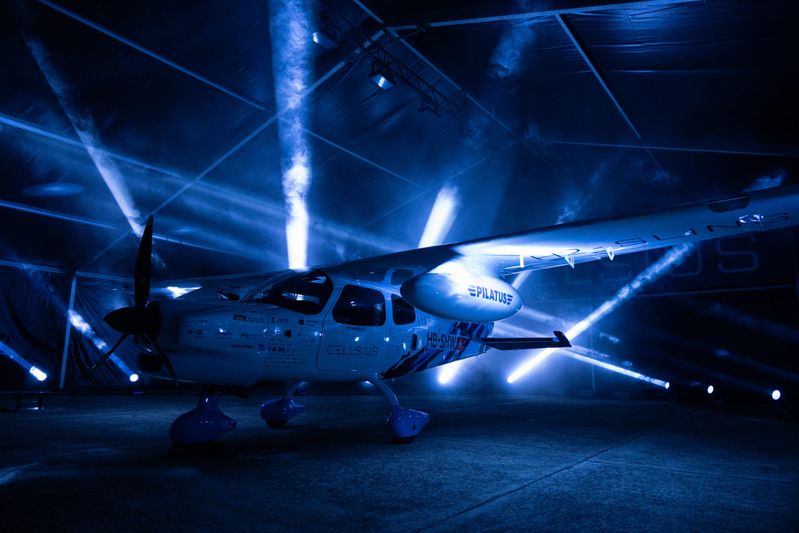
The H2-Sling, Switzerland's first hydrogen-powered aircraft, was developed by Cellsius at ETH Zurich.
(Source: Cellsius)
According to the German Aerospace Center, more than 36 million flights took off in 2024, making air travel responsible for about 2.1% of global CO2 emissions. This is roughly equivalent to the total annual emissions of a country like Germany. New technologies are needed to reduce the climate impact of aviation and make air travel significantly more environmentally friendly in the future. And Busch vacuum solutions are being used in research into precisely these technologies.
According to a report by the Office for Technology Assessment (TAB) of the German Bundestag, short-term innovations in the area of sustainable fuels make the most sense, since fuel consumption is the most important driver of aviation’s climate impact.
Hydrogen, in particular, offers great potential as a clean aviation fuel. In its report, however, the TAB also points out that storing hydrogen in aircraft poses a technical challenge, as it requires large, insulated tanks maintained at a temperature of minus 253 degrees Celsius. These tanks are very heavy. Overcoming these and other challenges will require further research and technological advancements in today’s aircraft and infrastructure.
A group of Swiss students, organized under the Cellsius association, has now developed a small aircraft powered exclusively by hydrogen. Cellsius is a nonprofit organization founded in 2022 that is dedicated to research into sustainable aviation. Here, students at ETH Zurich in their final year of their bachelor’s program can put the knowledge they’ve acquired into practice.
As part of this project, they developed the so-called H2-Sling: an aircraft powered by gaseous hydrogen. The Mink MH hydrogen recirculation blower ensures efficient recirculation of the hydrogen; Busch Vacuum Solutions donated this blower to ETH Zurich to support the research project and advance technological progress.
Switzerland's First Hydrogen-Powered Aircraft
The aircraft itself is powered by a 100-kilowatt fuel cell system. Since water is the only byproduct of the reaction, no climate-damaging greenhouse gases are emitted into the atmosphere during flight. The hydrogen is stored in two tanks located beneath the aircraft’s wings, each with a capacity of 2.6 kilograms. Because hydrogen has a high energy density, this amount gives the aircraft a range of 200 kilometers, which corresponds to approximately two hours of flight time. The aircraft was unveiled and first presented to the public in October 2025. It is now awaiting certification from the Swiss Federal Office of Civil Aviation so that the first test flight can take place in the spring of 2026. The ultimate goal: a flight across the Alps.
How does a fuel cell work?
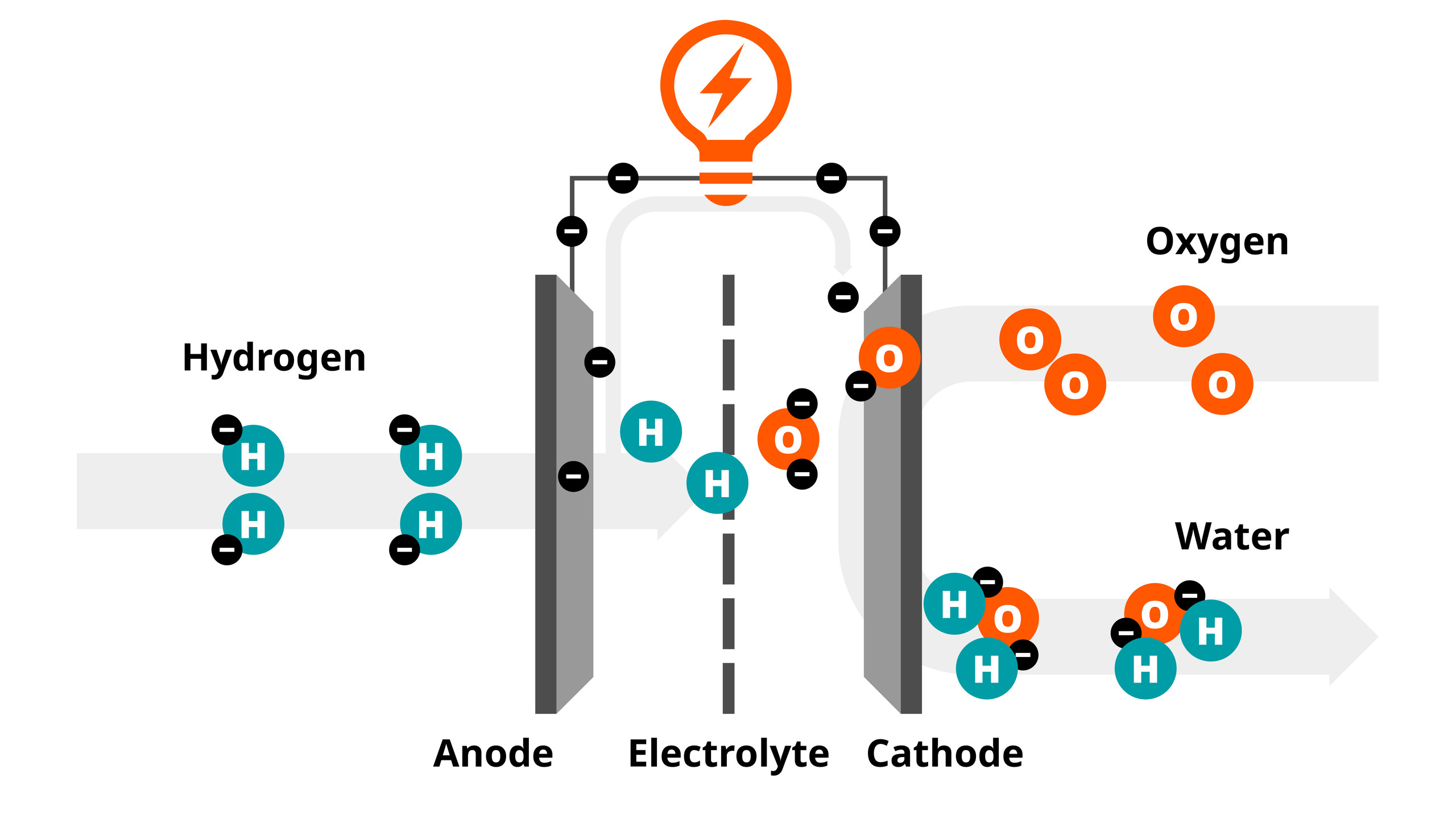
In a fuel cell, an electrochemical reaction between hydrogen and oxygen generates electricity and heat. The cell consists of two electrodes separated by an electrolyte membrane: an anode and a cathode. The membrane is responsible for ion transport.
Hydrogen enters on the anode side. The hydrogen molecules are split into protons and electrons. The hydrogen protons diffuse through the membrane to the cathode, where they react with oxygen from the ambient air to form water, releasing energy in the process. An electric motor then uses this energy, for example, to drive an airplane’s propeller.
A fuel cell consists of two electrodes separated by an electrolyte membrane: an anode and a cathode. The membrane is responsible for ion transport.
(Source: Busch Vacuum Solutions)
What is the effect of recirculation?
For the fuel cell to operate reliably, the chemical reaction must be sustained by a carefully controlled supply of hydrogen and air. The Mink MH recirculation blower from Busch ensures that unreacted hydrogen is not lost but is reused.
Here’s how it works: More hydrogen is supplied from the high-pressure tanks beneath the wings than is actually needed to ensure a stable chemical reaction in the fuel cell. This prevents local “depletion”—an effect that occurs when the concentration of the reactant in the cell drops so low that the reaction cycle ultimately comes to a halt.
Due to the excess supply, hydrogen remains after the reaction ends. If this residual hydrogen were not utilized, even larger hydrogen tanks would be required. This would increase the aircraft’s weight and reduce its performance. To maximize flight time and range, the unused hydrogen must therefore be recycled.
Recirculation fan specifically designed for fuel cells
To do this, the reactant must be directed from the fuel cell’s anode outlet back to its inlet. This is where Busch’s Mink MH comes into play: Two claw-shaped rotors rotate in opposite directions inside the compressor housing. The rotation of these claw rotors draws in the hydrogen, compresses it, and then returns it to the fuel cell’s anode, where it mixes with fresh hydrogen from the tank. This allows the reaction cycle to continue without interruption. Reusing unreacted hydrogen minimizes fuel consumption and conserves resources.
The TÜV-certified recirculation fan was developed specifically for use in fuel cells. “Busch is one of the few providers of solutions for hydrogen fuel cells. We’ve already had very good experiences with the smaller version of the Mink MH, which we installed in a test cycle,” explains Andres Neff, technical director of the H2-Sling project. “Everything worked perfectly in this test system, and the blower is very user-friendly. That’s why we were very pleased to be able to use the larger version of the blower for our project.”
Date: 08.12.2025
Naturally, we always handle your personal data responsibly. Any personal data we receive from you is processed in accordance with applicable data protection legislation. For detailed information please see our privacy policy.
Consent to the use of data for promotional purposes
I hereby consent to Vogel Communications Group GmbH & Co. KG, Max-Planck-Str. 7-9, 97082 Würzburg including any affiliated companies according to §§ 15 et seq. AktG (hereafter: Vogel Communications Group) using my e-mail address to send editorial newsletters. A list of all affiliated companies can be found here
Newsletter content may include all products and services of any companies mentioned above, including for example specialist journals and books, events and fairs as well as event-related products and services, print and digital media offers and services such as additional (editorial) newsletters, raffles, lead campaigns, market research both online and offline, specialist webportals and e-learning offers. In case my personal telephone number has also been collected, it may be used for offers of aforementioned products, for services of the companies mentioned above, and market research purposes.
Additionally, my consent also includes the processing of my email address and telephone number for data matching for marketing purposes with select advertising partners such as LinkedIn, Google, and Meta. For this, Vogel Communications Group may transmit said data in hashed form to the advertising partners who then use said data to determine whether I am also a member of the mentioned advertising partner portals. Vogel Communications Group uses this feature for the purposes of re-targeting (up-selling, cross-selling, and customer loyalty), generating so-called look-alike audiences for acquisition of new customers, and as basis for exclusion for on-going advertising campaigns. Further information can be found in section “data matching for marketing purposes”.
In case I access protected data on Internet portals of Vogel Communications Group including any affiliated companies according to §§ 15 et seq. AktG, I need to provide further data in order to register for the access to such content. In return for this free access to editorial content, my data may be used in accordance with this consent for the purposes stated here. This does not apply to data matching for marketing purposes.
Right of revocation
I understand that I can revoke my consent at will. My revocation does not change the lawfulness of data processing that was conducted based on my consent leading up to my revocation. One option to declare my revocation is to use the contact form found at https://contact.vogel.de. In case I no longer wish to receive certain newsletters, I have subscribed to, I can also click on the unsubscribe link included at the end of a newsletter. Further information regarding my right of revocation and the implementation of it as well as the consequences of my revocation can be found in the data protection declaration, section editorial newsletter.




:quality(80)/p7i.vogel.de/wcms/b0/0c/b00c0c6db6e218970b1ff051428f69f6/signature-cooperation-agreement-thales-alenia-space-4-1294x728v1.jpeg "From left to right: Athanasios Georgiadis, Director Account management, Sales and Bids, Thales Hellas; Eric Giraud, Head of Defence business, Thales Alenia Space; Vassilis Tsiamis, Chief Executive Metlen
Technologies. (Source: Thales Alenia Space)")
:quality(80)/p7i.vogel.de/wcms/0e/31/0e3175d75f5cdd02076b543196803431/dsc-4158-copy-1920x1080v1.jpeg "(Source: RSI)")
:quality(80)/p7i.vogel.de/wcms/36/7a/367adfa7fa6186160e10fafd2b403eb3/0134084456v1.jpeg "After Elon Musk has so far been rather reserved about a merger of Tesla and SpaceX that has been discussed for some time, it is now likely becoming more concrete—at least it seems so... (Source: Tesla)")
:quality(80)/p7i.vogel.de/wcms/d5/08/d508987ea0ae62aefdaa155f9bbd71af/military-material-soldier-2533669-1920x1079v1.jpeg "LinkedIn’s Top Startups 2026 ranking highlights Germany’s emerging companies, with AI, defence technology and energy innovation featuring prominently. (Source: Military_Material on Pixabay)")
:quality(80)/p7i.vogel.de/wcms/1e/05/1e05d4b35c5b6fae825d9ad2f852df33/rotor-clip-advanced-vision-inspection-1920x1079v1.jpeg "(Source: Rotor Clip)")
:quality(80)/p7i.vogel.de/wcms/17/05/1705108734040844028c8f0f054c06e2/202079-1350x759v1.jpeg "(Source: Rheinmetall AG)")
:quality(80)/p7i.vogel.de/wcms/d3/1c/d31caf0a2300bf7762f9dfbd272f0a4e/lockheed-martin-hadrian-1920x1079v1.jpeg "Hadrian will bring innovative, highly automated machining cells to the Grand Prairie facility, operated by the world-class Lockheed Martin production workforce. (Source: Lockheed Martin Corporation)")
:quality(80)/p7i.vogel.de/wcms/74/bb/74bbce6f561e163a760f8e6acb2412b5/art-0001-titelbild-1672x940v1.png "RF output and heat rejection share the same module. Conceptual illustration of a radar array and its thermal path; not a product photograph. (Source: KI-generiert / Imagen)")
:quality(80)/p7i.vogel.de/wcms/05/5f/055fac187d33e8e5fb93c4a75b7a806a/art-0008-titelbild-1672x940v1.png "A conceptual VLEO satellite collects atmospheric particles for electric propulsion. Illustration, not an image of a flown spacecraft. (Source: KI-generiert / Imagen)")
:quality(80)/p7i.vogel.de/wcms/74/34/7434bf25f22bb5ff84146fccb984bc28/0134080905v1.jpeg "GKN Aerospace and Saab have signed a long-term cooperation agreement covering the Gripen E/F propulsion system. (Source: Saab)")
:quality(80)/p7i.vogel.de/wcms/53/63/5363287e81bcc7fd8e0ce9ec17ec6b93/enbata-over-archipelagos-auraaero-1536x864v1.png "(Source: AURA AERO)")
:quality(80)/p7i.vogel.de/wcms/03/52/0352ed6450d99eefb77378b17e99bd72/art-0007-titelbild-1672x940v1.png "Reusable research vehicles make the flight-to-redesign loop possible. Conceptual illustration; no actual X-15 or Talon-A vehicle is depicted. (Source: KI-generiert / Imagen)")
:quality(80)/p7i.vogel.de/wcms/44/14/441466b475f60e684dee4ec1eef7a884/felixioncool-lab-385348-1920x1079v1.jpeg "Akkodis and Biolevate are combining AI-powered documentation technology with engineering and regulatory expertise to streamline workflows in highly regulated industries. (Source: felixioncool on Pixabay)")
:quality(80)/p7i.vogel.de/wcms/50/85/50856774ce46ad8f94f37e328ba3b6d3/ptc-frau-arbeitet-mit-model-am-pc-neben-turbine-1911x1076v1.jpeg "(Source: PTC)")
:quality(80)/p7i.vogel.de/wcms/9c/60/9c60e13e660fe6b444ec71c59b5598ce/publicdomainarchive-on-pixabay-1920x1079v1.jpeg "(Source: PublicDomainArchive on Pixabay)")
:quality(80)/p7i.vogel.de/wcms/ed/e6/ede67e479952b7bad62244697e3cd3db/aa383c9a-015c-424b-95da-d8d56156c227-1536x864v1.png "Intelic's AI-supported command-and-control system Nexus can integrate sensors and interceptor drones to counter aerial threats (Illustration). (Picture: AI generated)")
:quality(80)/p7i.vogel.de/wcms/a5/ce/a5ce58d51cba9063688079379feb732d/desko-id-analyze-passkontrolle-1-1920x1079v1.jpeg "(Bild: Desko)")
:quality(80)/p7i.vogel.de/wcms/df/5c/df5cb22ae3c8e224730e3543453abf54/argus-interceptor-phantom-8-von-29-1920x1079v1.png "Argus Interceptor Phantom (Source: Argus Interception)")
:quality(80)/p7i.vogel.de/wcms/44/f8/44f8dfc31e436cc3a2d5a4c98c2ff46f/drohnenabwehr-am-kraftwerk-bei-d-mmerung-1672x940v1.png "Across Europe, governments are increasingly considering allowing operators of critical civilian infrastructure to take responsibility for actively defending their facilities against hostile drones using military-grade counter-UAV technology. (Graphic: AI generated)")
:quality(80)/p7i.vogel.de/wcms/25/1f/251f3ec674139d548928e3a2f0a0a040/airbus-1920x1079v1.jpeg "IRIS-T SLM Live Firing. (Source: Bundeswehr/ Hildemann)")
:quality(80)/p7i.vogel.de/wcms/90/a8/90a849f0023f11d1eb642eb4751a0321/bild2-h-c3-a4nel-ict-20truck-20and-20trailer-20parts-4320x2429v1.jpeg "Product information is visible at all times and retrieval of items
is confirmed by employees directly on the display of the Hänel MP 14 N
controller. (Source: René Marks)")
:quality(80)/p7i.vogel.de/wcms/4e/ca/4ecaa39f247490eded591b652c33aee3/thilmann-hcp-web-20kleiner-20ausschnitt-1442x811v1.jpeg "Entering the defence market can be challenging for start-ups, says HCP Sense CEO Ansgar Thilmann. (Picture: HCP Sense)")
:quality(80)/p7i.vogel.de/wcms/7a/51/7a511b80041d3f1335f3a5aa56fe75da/delivery-7022432-1280-1280x720v1.png "(Source: Mohamed_hassan)")
:quality(80)/p7i.vogel.de/wcms/f9/2f/f92f1ef8c739c34c70d99f7b0997621b/stra007-20--20cover-20image-5472x3076v1.jpeg "(Source: Stratasys)")
:quality(80)/p7i.vogel.de/wcms/ec/a9/eca9062ccbe4b042f8515846340410d8/aerospace-and-defence-stairways-platforms-and-much-morev1.jpeg "Modular constructions enable flexible modification. That applies to larger structures such as stairways and platforms, too. And that means aerospace and defence companies can reconfigure their maintenance platforms fast (itemitem)")
:quality(80)/p7i.vogel.de/wcms/30/2a/302a7b5723ad38fbde812fd3a468ad04/safety-on-stairways-in-industry-key-considerationsv1.jpeg "Stairways and platforms are used widely in maintenance and assembly areas in the aerospace and defence sectors. (Source: item)")
:quality(80)/p7i.vogel.de/wcms/f3/4e/f34ed744bb30817d3432c7ad522e6f30/engine-1v1.jpeg "Engineering with aluminium profiles really can be this easy – the item Engineeringtool and its smart functions help you save valuable time. (Source: item)")
:fill(fff,0)/images.vogel.de/vogelonline/companyimg/84700/84735/65.jpg "logo_item_rgb_neu.jpg ()")
:quality(80)/p7i.vogel.de/wcms/0b/93/0b93fcec0baed888b9964be24db64d30/nato-demonstrates-kelluu-repmus-1-1920x1079v1.png "Representatives from Finnish company Kelluu test their unmanned airship at REPMUS 2025. The drills included tests of technology developed through NATO’s Defence Innovation Accelerator for the North Atlantic (DIANA). (Source: NATO)")
:quality(80)/p7i.vogel.de/wcms/b1/58/b158a5cc771fac7941d6bc3414becb5a/zeroe-20fully-20electric-20hydrogen-powered-20four-20pod-20aircraft-zeroe-turboprop-aib-vcity-16-9-5000x2811v1-999x562v1.jpeg "Airbus is working on the propulsion of short-haul aircraft using hydrogen and fuel cells as part of the “GENtwoPRO” project. (Source: Airbus SAS 2025)")