The Technical University of Würzburg-Schweinfurt (located in Germany) is working together with the aerospace-specialised engineering firm Kasaero on a modular electric fuel cell propulsion system. This is intended to enable retrofitting of existing ultralight aircraft with a climate-neutral drive.
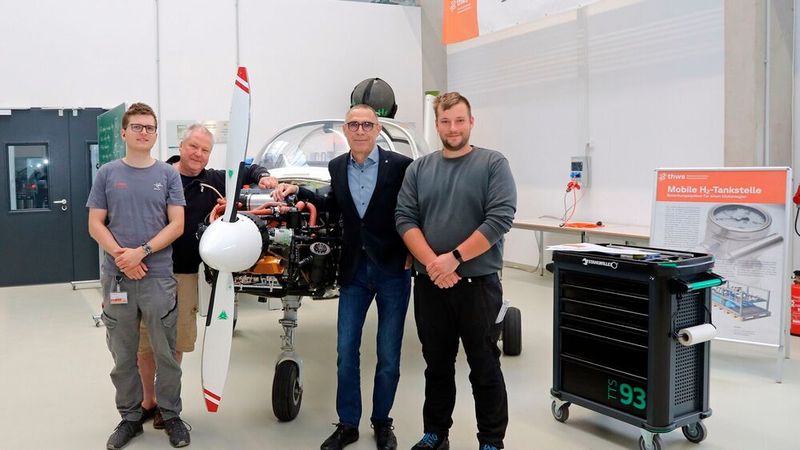
Work on the travel motor glider "Taifun 17 H₂": Research associate Jan Hußlein, engineer Tom Wollin, dean Prof. Dr. Johannes Paulus, and master’s student Sebastian Stenger (from left to right)
(Source: Eva Kaupp | THWS)
Climate-neutral flying without a guilty conscience—a team from the Faculty of Mechanical Engineering at the Würzburg-Schweinfurt University of Applied Sciences (THWS) has been working on this for several years. A new grant from the federal aviation research program contributes to continuing research on the self-developed touring motor glider “Taifun 17 H₂.” Around 890,000 euros (approx. 1.014.070 USD) can be allocated to this project at the university. Together with the aviation-specialised engineering firm Kasaero, THWS is developing a modular electric fuel cell propulsion system, which can also retrofit existing ultralight aircraft with a climate-neutral drive.
The "Taifun" is currently airworthy: The application for a flight permit and the necessary certifications are currently being reviewed by the Federal Aviation Authority. So far, the team has already conducted taxiing tests at the Haßfurt-Haßberge (located in Germany) airfield. This means accelerating up to take-off speed—"but before the wheels lost contact with the ground, braking was required again," explains Dean Prof. Dr. Johannes Paulus. Once the permit is granted, only a few more tests will be needed, and the aircraft could take off for the first time later this year.
Smaller, lighter, and more range
Thanks to the new funding program, the work for the team continues seamlessly. Everything is to become smaller, lighter, and more adaptable. A modular drive system could be installed in various similarly constructed light aircraft. Another goal is achieving high energy density to increase the range of the touring motor glider—which in turn is intended to boost acceptance of the new propulsion system. "The light aircraft has a dual drive—both directly electric with a battery and hydrogen-powered via a fuel cell," explains Prof. Dr. Paulus. "The fuel cell serves either as a range extender or as a booster." This allows for an increase in range and maximum propulsion performance.
To fit into the space of standard aircraft engines and undercut their weight, the electric fuel cell propulsion system now needs to be designed smaller and lighter. This is achieved primarily through a higher degree of integration in the power electronics, leading to size and weight reductions, as well as through the optimisation of cooling systems. Optimising the interaction between the electric and fuel cell propulsion systems provides additional opportunities to improve flight characteristics and increase range. All these efficiency improvements, in turn, make it possible to reduce the size of the buffer battery, which positively impacts the overall weight.
How does the project work proceed?
The work for the core team of the "Taifun" will not be ending anytime soon: Research associate Jan Hußlein is responsible for the test bench used to test the aircraft's fuel cell on the ground. Research associate Toni Schott mainly works on the powertrain and the integration of the propulsion system into the aircraft. Master's student Sebastian Stenger is currently developing a mobile hydrogen refueling station. With the electricity from the in-house photovoltaic system, the required hydrogen can be generated and stored. Laboratory engineer Tom Wollin handles the implementation of the designs and the assembly. The retired THWS professor and flight instructor Martin Hansen co-designed the aircraft and will also carry out the maiden flight.
Further third-party funded projects with industry partners are in the pipeline. Work is already underway to lighten the built-in battery and develop a new cooling concept for electrical components. Other side projects include the development of a lighter, more efficient propeller adapted to the propulsion of an electric motor, and the tank is still too heavy and is being optimised. (se)
Date: 08.12.2025
Naturally, we always handle your personal data responsibly. Any personal data we receive from you is processed in accordance with applicable data protection legislation. For detailed information please see our privacy policy.
Consent to the use of data for promotional purposes
I hereby consent to Vogel Communications Group GmbH & Co. KG, Max-Planck-Str. 7-9, 97082 Würzburg including any affiliated companies according to §§ 15 et seq. AktG (hereafter: Vogel Communications Group) using my e-mail address to send editorial newsletters. A list of all affiliated companies can be found here
Newsletter content may include all products and services of any companies mentioned above, including for example specialist journals and books, events and fairs as well as event-related products and services, print and digital media offers and services such as additional (editorial) newsletters, raffles, lead campaigns, market research both online and offline, specialist webportals and e-learning offers. In case my personal telephone number has also been collected, it may be used for offers of aforementioned products, for services of the companies mentioned above, and market research purposes.
Additionally, my consent also includes the processing of my email address and telephone number for data matching for marketing purposes with select advertising partners such as LinkedIn, Google, and Meta. For this, Vogel Communications Group may transmit said data in hashed form to the advertising partners who then use said data to determine whether I am also a member of the mentioned advertising partner portals. Vogel Communications Group uses this feature for the purposes of re-targeting (up-selling, cross-selling, and customer loyalty), generating so-called look-alike audiences for acquisition of new customers, and as basis for exclusion for on-going advertising campaigns. Further information can be found in section “data matching for marketing purposes”.
In case I access protected data on Internet portals of Vogel Communications Group including any affiliated companies according to §§ 15 et seq. AktG, I need to provide further data in order to register for the access to such content. In return for this free access to editorial content, my data may be used in accordance with this consent for the purposes stated here. This does not apply to data matching for marketing purposes.
Right of revocation
I understand that I can revoke my consent at will. My revocation does not change the lawfulness of data processing that was conducted based on my consent leading up to my revocation. One option to declare my revocation is to use the contact form found at https://contact.vogel.de. In case I no longer wish to receive certain newsletters, I have subscribed to, I can also click on the unsubscribe link included at the end of a newsletter. Further information regarding my right of revocation and the implementation of it as well as the consequences of my revocation can be found in the data protection declaration, section editorial newsletter.




:quality(80)/p7i.vogel.de/wcms/f6/95/f6954fa7c09ba58863a3730f5e384a62/arek-socha-on-pixabay-1707x960v1.jpeg "A new national space strategy brings together UK’s plans for growth, defence, and national security to help reindustrialise the UK. (Source: Arek Socha on Pixabay)")
:quality(80)/p7i.vogel.de/wcms/63/0f/630f214fa760b8c7f7f7d6279d411fcf/d4ceed8f2f52-2026-08-30-hydef-06--msc4159-1200x675v1.webp "(Source: Diehl Defence)")
:quality(80)/p7i.vogel.de/wcms/4e/7d/4e7d38327c6c928b403249e3c24a2a7c/0132118791v1.jpeg "Porsche Holding SE announces that it is once again turning to rocket technology. Following its investment in Isar Aerospace, the company is now acquiring a stake in a U.S. firm ... (Source: Porsche)")
:quality(80)/p7i.vogel.de/wcms/1c/08/1c082bbd9d05b634168b617aa26fcdcf/safe-bg-lv-ro-v1-991x557v1.png "(Source: European Commission)")
:quality(80)/p7i.vogel.de/wcms/0a/14/0a1495d9b570ae32a5a7cc748b9a3c60/st-hannover-035-1920x1079v1-999x562v1.jpeg "Fastening technology you can experience first-hand—visitors to Schraubtec in Bochum (Germany) can see it for themselves at the Ruhr Congress on September 30, 2026. (Source: PHOTOVISION-DH GmbH)")
:quality(80)/p7i.vogel.de/wcms/cd/a9/cda92b173afa9d0b455d4f11b281c9ea/0094-to-image--capstone-cdr-1440x810v1.png "(Source: Terran Orbital)")
:quality(80)/p7i.vogel.de/wcms/e0/45/e045bc5414d7263fb308bdd501b5fcc1/0133113962v1.jpeg "The HSWL 354 is the transmission used, for example, in the Leopard 2 main battle tank. Renk manufactures this system and is now preparing to significantly increase its cycle time. As a result, Renk is placing greater emphasis on the military sector as a customer ... (Source: Renk)")
:quality(80)/p7i.vogel.de/wcms/a1/5c/a15c2aeba563d5bc3e11fb879b21eb2c/0132989650v1.jpeg "FSS, the flexible clamping system for varying free-form surfaces, is designed for the aerospace industry and other sectors. (Source: Römheld GmbH Friedrichshütte)")
:quality(80)/p7i.vogel.de/wcms/46/8e/468effa87546a2b036dc88ca40e2843e/129fbcac92ce7da872b13af0281b0799-l-png-1920x1079v1.webp "(Source: Arianespace)")
:quality(80)/p7i.vogel.de/wcms/8f/10/8f10697d4bfbd70edf615cca76eaedfd/pete-linforth-on-pixabay-1920x1080v1.jpeg "(Source: Pete Linforth on Pixabay / AI-generated)")
:quality(80)/p7i.vogel.de/wcms/0f/99/0f99561bf51818af92b2960656405aa5/roland-4d-pippes-on-pixabay-1460x820v1.jpeg "(Source: Roland 4D Pippes on Pixabay)")
:quality(80)/p7i.vogel.de/wcms/05/49/054906f874b94ef08b09d5920396e27d/airbus-h160-1920x1079v1.jpeg "Airbus H160 (Source: Airbus)")
:quality(80)/p7i.vogel.de/wcms/9d/8a/9d8addea8cc4e6f7a4793563ca397f2a/ai-im-milit-r-1672x940v1.png "(Source: KI-generiert / Gemini)")
:quality(80)/p7i.vogel.de/wcms/7f/5f/7f5fba2c729ec3aa256bf1a18d74529b/ai-chip-1672x940v1.png "(Source: KI-generiert / Gemini)")
:quality(80)/p7i.vogel.de/wcms/64/1b/641b6474b2a614cde7730c89ef2a3015/2026-09-09-rheinmetall-veroeffentlicht-battlesuite-schnittstellen-e8c18194-1225x690v1.jpeg "Rheinmetall’s Battlesuite provides a modular digital platform for connecting and integrating sensors, hardware and software components. (Source: Rheinmetall AG)")
:quality(80)/p7i.vogel.de/wcms/6f/fe/6ffef325e7f233cc3521943158eb1ebd/0132763535v1.jpeg "Two companies are planning to establish, for the first time in 2027, an optical laser communication link directly between a satellite in low Earth orbit (LEO) and a re-entering spacecraft. (Source: ATMOS Space Cargo)")
:quality(80)/p7i.vogel.de/wcms/8f/f9/8ff91b78b26cb5a2b8a29e39835005b1/2026-09-10-repmus-teaser-images-retouched-dsc01292-1024x683-1024x576v1.jpeg "(Source: Quantum Systems GmbH)")
:quality(80)/p7i.vogel.de/wcms/bf/4a/bf4a237e60d3d4bd1bbdbad918f3c697/airbus-defence-and-space-3-1280x720v1.jpeg "(Source: Airbus Defence and Space)")
:quality(80)/p7i.vogel.de/wcms/e0/d1/e0d112a0d54a4fa9603ec855f7d25b47/t-rex-content-photo-jpg-pc-adaptive-990-medium-988x556v1.jpeg "Swarm of UAVs conducting a fully autonomous collaborative swarm mission. (Source: Lockheed Martin)")
:quality(80)/p7i.vogel.de/wcms/79/fc/79fcaa7ca33e393b11a4740d7d8f3dbe/vilkasss-handshake-9459740-1911x1076v1.jpeg "(Source: Vilius Kukanauskas on Pixabay)")
:quality(80)/p7i.vogel.de/wcms/90/a8/90a849f0023f11d1eb642eb4751a0321/bild2-h-c3-a4nel-ict-20truck-20and-20trailer-20parts-4320x2429v1.jpeg "Product information is visible at all times and retrieval of items
is confirmed by employees directly on the display of the Hänel MP 14 N
controller. (Source: René Marks)")
:quality(80)/p7i.vogel.de/wcms/4e/ca/4ecaa39f247490eded591b652c33aee3/thilmann-hcp-web-20kleiner-20ausschnitt-1442x811v1.jpeg "Entering the defence market can be challenging for start-ups, says HCP Sense CEO Ansgar Thilmann. (Picture: HCP Sense)")
:quality(80)/p7i.vogel.de/wcms/7a/51/7a511b80041d3f1335f3a5aa56fe75da/delivery-7022432-1280-1280x720v1.png "(Source: Mohamed_hassan)")
:quality(80)/p7i.vogel.de/wcms/f9/2f/f92f1ef8c739c34c70d99f7b0997621b/stra007-20--20cover-20image-5472x3076v1.jpeg "(Source: Stratasys)")
:quality(80)/p7i.vogel.de/wcms/ec/a9/eca9062ccbe4b042f8515846340410d8/aerospace-and-defence-stairways-platforms-and-much-morev1.jpeg "Modular constructions enable flexible modification. That applies to larger structures such as stairways and platforms, too. And that means aerospace and defence companies can reconfigure their maintenance platforms fast (itemitem)")
:quality(80)/p7i.vogel.de/wcms/30/2a/302a7b5723ad38fbde812fd3a468ad04/safety-on-stairways-in-industry-key-considerationsv1.jpeg "Stairways and platforms are used widely in maintenance and assembly areas in the aerospace and defence sectors. (Source: item)")
:quality(80)/p7i.vogel.de/wcms/f3/4e/f34ed744bb30817d3432c7ad522e6f30/engine-1v1.jpeg "Engineering with aluminium profiles really can be this easy – the item Engineeringtool and its smart functions help you save valuable time. (Source: item)")
:fill(fff,0)/p7i.vogel.de/companies/69/6d/696de2483d115/logo--fastems-rgb-horizontal.jpeg "logo--fastems-rgb-horizontal (Fastems)")
:fill(fff,0)/images.vogel.de/vogelonline/companyimg/84700/84735/65.jpg "logo_item_rgb_neu.jpg ()")
:quality(80)/p7i.vogel.de/wcms/34/5a/345a012d39ab2dbce1da22b9cc6d6819/0130656559v1.jpeg "Cross-sectional view of the 750 kW electric machine with oil cooling and hairpin windings. (Image:Thomas Schriefer / Fraunhofer IISB)")
:quality(80)/p7i.vogel.de/wcms/1b/f0/1bf0495af837da5aa924738a45cc9dc6/image-cellsiusv1.jpeg "The H2-Sling, Switzerland's first hydrogen-powered aircraft, was developed by Cellsius at ETH Zurich. (Source: Cellsius)")
:quality(80)/p7i.vogel.de/wcms/0b/93/0b93fcec0baed888b9964be24db64d30/nato-demonstrates-kelluu-repmus-1-1920x1079v1.png "Representatives from Finnish company Kelluu test their unmanned airship at REPMUS 2025. The drills included tests of technology developed through NATO’s Defence Innovation Accelerator for the North Atlantic (DIANA). (Source: NATO)")