In our section "Fascination Technology", we present impressive research and development projects to designers every week. Today: the development of NASA's new Nancy Grace Roman space telescope.
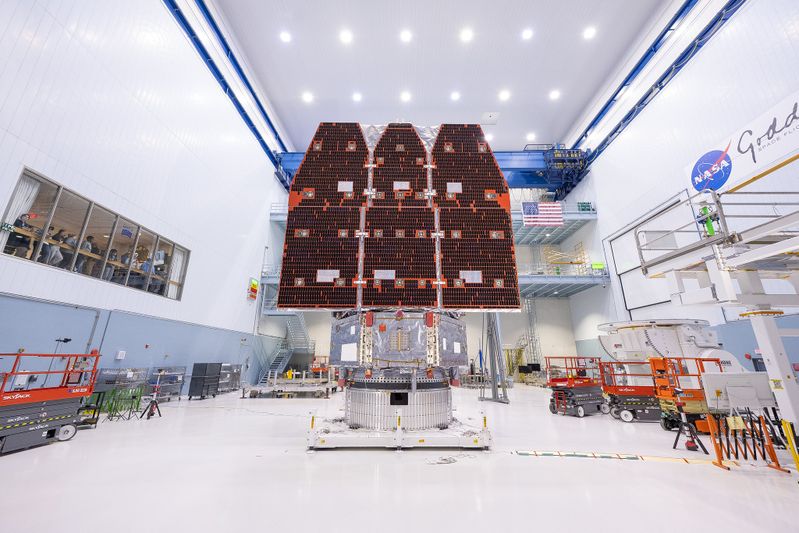
The Nancy Grace Roman Space Telescope was completed in the largest cleanroom of NASA's Goddard Space Flight Center. It is scheduled to launch into space in September 2026.
More than a thousand technicians and engineers assembled the Nancy Grace Roman Space Telescope from millions of individual parts. It is nearly 13 meters (approx. 43 ft) long and costs approximately 3.5 billion euros (approx. 4 billion USD).
Many components were manufactured and tested in parallel to save time. After completion, Roman is now undergoing a series of tests before being transported to NASA's Kennedy Space Center in Florida in the summer of 2026. The space telescope is scheduled to begin its mission in space by May 2027 at the latest, but the team is aiming for a launch as early as autumn 2026.
Roman uses state-of-the-art sensors built on years of experience with infrared detectors in NASA's Hubble and Webb instruments. However, Roman's imaging surface is significantly larger to capture a much wider field of view.
Greg Mosby, Research astrophysicist at NASA Goddard
Optical wide-angle capture on a new level
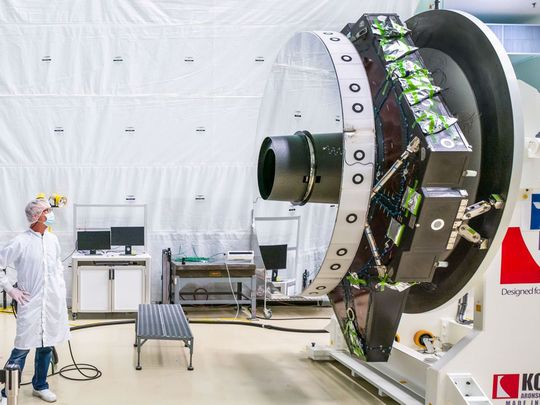
The primary mirror has a diameter of 2.4 meters (approx. 8 ft), making it the same size as the primary mirror of the Hubble Space Telescope.
(Source: NASA/Chris Gunn)
The Roman Telescope is not just another observatory in space—it represents a technological paradigm shift in optical wide-field imaging. Although it uses the same 2.4-meter (approx. 8 ft) primary mirror aperture as the legendary Hubble Telescope, its system design revolutionises the way astrophysical data is generated. Through the newly developed Wide-Field Instrument (WFI)—an infrared camera—the field of view is expanded by a factor of 100, while maintaining the exact same level of detail resolution.
The hardware specifications at a glance:
Optical sensing: An array of 18 high-precision H4RG-10 infrared detectors forms a focal plane with over 300 megapixels.
Data throughput: The optoelectronics generate around 11 terabits of raw data per day, which are transmitted to Earth at 250 to 500 Mbps.
Mechanical precision: A hexapod mechanism (Alignment Compensation Mechanism) aligns the detectors within the nanometer range (nm) to compensate for thermal deformations.
The detectors of the Wide Field Instrument (WFI)
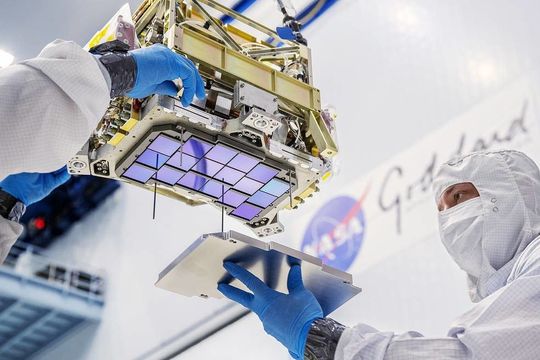
The detectors, each about the size of a saltine cracker, contain approximately 16.8 million tiny pixels and enable the mission to achieve excellent image resolution. In the image: Lead technician Billy Keim installs a cover plate over the detectors of the space telescope.
(Source: NASA/Chris Gunn)
Each of the infrared detectors—roughly the size of a saltine cracker—features an extremely high packing density of 16.8 million pixels. For the flight configuration, 18 of these sensors were integrated into the focal plane array of the WFI camera. In line with proven spacecraft redundancy concepts, NASA has six additional sensors available as flight-ready spares. This highly complex instrument converts infrared light into electrical signals, which are processed into 300-megapixel images. Each individual "shot" from this wide-field instrument captures a section of the sky larger than the apparent area of a full moon.
For the system architecture, this means a massive throughput: Roman collects data hundreds of times faster than Hubble and, over the course of its five-year primary mission, will generate a staggering 20 petabytes (20,000 terabytes) of image data.
Systematic scanning instead of point-specific capture
Instead of executing complex, lengthy individual maneuvers for specific target objects, Roman operates as a highly efficient "survey mission." This means the system continuously and automatically scans vast areas of the sky. The resulting comparative datasets are of such magnitude that they will pose new challenges for astronomical databases. The observational data from just a single month of operation will be enough to compile an unprecedented data foundation for the majority of the stars in our home galaxy.
This unparalleled data pipeline is crucial for mapping the distribution of matter in the cosmos, detecting exoplanets, and unraveling the physical mystery of dark energy.
Dual thermal and energy management
One of the most critical subsystems for the stable operation of the telescope is the Solar Array Sun Shield. Here, the engineers had to combine two fundamental requirements into one component group: a constant power supply and highly efficient passive thermal management. The structure consists of six panels, fully equipped with high-performance solar cells. While the two central panels remain fixed to the Outer Barrel Assembly (the outer housing structure), the four outer panels are deployed in space using a deployment mechanism and locked into alignment with the central panels.
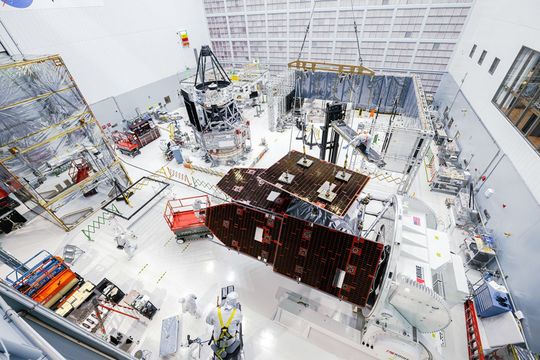
Technicians install solar panels on the exterior of the observatory. The inner part of the telescope is visible in the background, slightly to the left of the center of the image.
(Source: NASA/Sydney Rohde)
In its orbital alignment, this array is permanently oriented toward the Sun to reliably supply power to the onboard electronics. At the same time, the extended surface functions as a massive heat shield, keeping the sensitive optics and sensors in the shade. This thermal insulation is vital for an infrared telescope: since infrared radiation is essentially heat radiation, the heat generated by solar exposure on the housing would saturate the highly sensitive detectors and completely "blind" the telescope. The design of the Sun Shield is thus a prime example of multifunctional system integration in spaceflight.
Date: 08.12.2025
Naturally, we always handle your personal data responsibly. Any personal data we receive from you is processed in accordance with applicable data protection legislation. For detailed information please see our privacy policy.
Consent to the use of data for promotional purposes
I hereby consent to Vogel Communications Group GmbH & Co. KG, Max-Planck-Str. 7-9, 97082 Würzburg including any affiliated companies according to §§ 15 et seq. AktG (hereafter: Vogel Communications Group) using my e-mail address to send editorial newsletters. A list of all affiliated companies can be found here
Newsletter content may include all products and services of any companies mentioned above, including for example specialist journals and books, events and fairs as well as event-related products and services, print and digital media offers and services such as additional (editorial) newsletters, raffles, lead campaigns, market research both online and offline, specialist webportals and e-learning offers. In case my personal telephone number has also been collected, it may be used for offers of aforementioned products, for services of the companies mentioned above, and market research purposes.
Additionally, my consent also includes the processing of my email address and telephone number for data matching for marketing purposes with select advertising partners such as LinkedIn, Google, and Meta. For this, Vogel Communications Group may transmit said data in hashed form to the advertising partners who then use said data to determine whether I am also a member of the mentioned advertising partner portals. Vogel Communications Group uses this feature for the purposes of re-targeting (up-selling, cross-selling, and customer loyalty), generating so-called look-alike audiences for acquisition of new customers, and as basis for exclusion for on-going advertising campaigns. Further information can be found in section “data matching for marketing purposes”.
In case I access protected data on Internet portals of Vogel Communications Group including any affiliated companies according to §§ 15 et seq. AktG, I need to provide further data in order to register for the access to such content. In return for this free access to editorial content, my data may be used in accordance with this consent for the purposes stated here. This does not apply to data matching for marketing purposes.
Right of revocation
I understand that I can revoke my consent at will. My revocation does not change the lawfulness of data processing that was conducted based on my consent leading up to my revocation. One option to declare my revocation is to use the contact form found at https://contact.vogel.de. In case I no longer wish to receive certain newsletters, I have subscribed to, I can also click on the unsubscribe link included at the end of a newsletter. Further information regarding my right of revocation and the implementation of it as well as the consequences of my revocation can be found in the data protection declaration, section editorial newsletter.
Who is Nancy Grace Roman?
The space telescope is named after Dr. Nancy Grace Roman (1925–2018), a pioneer in astronomy and space exploration. She joined NASA in 1959, just a few months after the agency was founded. She was the first woman in a leadership position and served as NASA's first Chief of Astronomy. She dedicated her life to putting telescopes into orbit and established NASA's first astronomical space program.
Nancy Grace Roman played a crucial role in the conception, planning, and especially the funding of the Hubble Space Telescope. She spent years convincing members of Congress and skeptical scientists of the project.
Originally, the Roman project carried the purely technical name WFIRST (Wide Field Infrared Survey Telescope). In May 2020, NASA officially announced that the telescope would be renamed the Nancy Grace Roman Space Telescope in her honor.
In the fall of 2025, the observatory consisted of two main segments:
The inner part included the telescope, the instrument carrier, two instruments, and the satellite bus,
while the outer part consisted of the outer tube assembly, the deployable aperture cover, and the solar panels.
The outer part underwent a vibration test and an intensive acoustic test, while the inner part was subjected to a 65-day thermal vacuum test. At the end of November, the process of merging the two segments began, and NASA has now announced the completion of the Nancy Grace Roman Space Telescope.
With the completion of Roman, we stand on the brink of unimaginable scientific discoveries. In the first five years of the mission, over 100,000 distant worlds, hundreds of millions of stars, and billions of galaxies are expected to be explored.
Julie McEnery, Senior Research Scientists at NASA Goddard
Despite precisely defined mission parameters, the developers and scientists are especially excited about one thing: unpredictable system deviations in the form of scientific discoveries.




:quality(80)/p7i.vogel.de/wcms/f6/95/f6954fa7c09ba58863a3730f5e384a62/arek-socha-on-pixabay-1707x960v1.jpeg "A new national space strategy brings together UK’s plans for growth, defence, and national security to help reindustrialise the UK. (Source: Arek Socha on Pixabay)")
:quality(80)/p7i.vogel.de/wcms/63/0f/630f214fa760b8c7f7f7d6279d411fcf/d4ceed8f2f52-2026-08-30-hydef-06--msc4159-1200x675v1.webp "(Source: Diehl Defence)")
:quality(80)/p7i.vogel.de/wcms/4e/7d/4e7d38327c6c928b403249e3c24a2a7c/0132118791v1.jpeg "Porsche Holding SE announces that it is once again turning to rocket technology. Following its investment in Isar Aerospace, the company is now acquiring a stake in a U.S. firm ... (Source: Porsche)")
:quality(80)/p7i.vogel.de/wcms/1c/08/1c082bbd9d05b634168b617aa26fcdcf/safe-bg-lv-ro-v1-991x557v1.png "(Source: European Commission)")
:quality(80)/p7i.vogel.de/wcms/0a/14/0a1495d9b570ae32a5a7cc748b9a3c60/st-hannover-035-1920x1079v1-999x562v1.jpeg "Fastening technology you can experience first-hand—visitors to Schraubtec in Bochum (Germany) can see it for themselves at the Ruhr Congress on September 30, 2026. (Source: PHOTOVISION-DH GmbH)")
:quality(80)/p7i.vogel.de/wcms/cd/a9/cda92b173afa9d0b455d4f11b281c9ea/0094-to-image--capstone-cdr-1440x810v1.png "(Source: Terran Orbital)")
:quality(80)/p7i.vogel.de/wcms/e0/45/e045bc5414d7263fb308bdd501b5fcc1/0133113962v1.jpeg "The HSWL 354 is the transmission used, for example, in the Leopard 2 main battle tank. Renk manufactures this system and is now preparing to significantly increase its cycle time. As a result, Renk is placing greater emphasis on the military sector as a customer ... (Source: Renk)")
:quality(80)/p7i.vogel.de/wcms/a1/5c/a15c2aeba563d5bc3e11fb879b21eb2c/0132989650v1.jpeg "FSS, the flexible clamping system for varying free-form surfaces, is designed for the aerospace industry and other sectors. (Source: Römheld GmbH Friedrichshütte)")
:quality(80)/p7i.vogel.de/wcms/46/8e/468effa87546a2b036dc88ca40e2843e/129fbcac92ce7da872b13af0281b0799-l-png-1920x1079v1.webp "(Source: Arianespace)")
:quality(80)/p7i.vogel.de/wcms/8f/10/8f10697d4bfbd70edf615cca76eaedfd/pete-linforth-on-pixabay-1920x1080v1.jpeg "(Source: Pete Linforth on Pixabay / AI-generated)")
:quality(80)/p7i.vogel.de/wcms/0f/99/0f99561bf51818af92b2960656405aa5/roland-4d-pippes-on-pixabay-1460x820v1.jpeg "(Source: Roland 4D Pippes on Pixabay)")
:quality(80)/p7i.vogel.de/wcms/05/49/054906f874b94ef08b09d5920396e27d/airbus-h160-1920x1079v1.jpeg "Airbus H160 (Source: Airbus)")
:quality(80)/p7i.vogel.de/wcms/9d/8a/9d8addea8cc4e6f7a4793563ca397f2a/ai-im-milit-r-1672x940v1.png "(Source: KI-generiert / Gemini)")
:quality(80)/p7i.vogel.de/wcms/7f/5f/7f5fba2c729ec3aa256bf1a18d74529b/ai-chip-1672x940v1.png "(Source: KI-generiert / Gemini)")
:quality(80)/p7i.vogel.de/wcms/64/1b/641b6474b2a614cde7730c89ef2a3015/2026-09-09-rheinmetall-veroeffentlicht-battlesuite-schnittstellen-e8c18194-1225x690v1.jpeg "Rheinmetall’s Battlesuite provides a modular digital platform for connecting and integrating sensors, hardware and software components. (Source: Rheinmetall AG)")
:quality(80)/p7i.vogel.de/wcms/6f/fe/6ffef325e7f233cc3521943158eb1ebd/0132763535v1.jpeg "Two companies are planning to establish, for the first time in 2027, an optical laser communication link directly between a satellite in low Earth orbit (LEO) and a re-entering spacecraft. (Source: ATMOS Space Cargo)")
:quality(80)/p7i.vogel.de/wcms/8f/f9/8ff91b78b26cb5a2b8a29e39835005b1/2026-09-10-repmus-teaser-images-retouched-dsc01292-1024x683-1024x576v1.jpeg "(Source: Quantum Systems GmbH)")
:quality(80)/p7i.vogel.de/wcms/bf/4a/bf4a237e60d3d4bd1bbdbad918f3c697/airbus-defence-and-space-3-1280x720v1.jpeg "(Source: Airbus Defence and Space)")
:quality(80)/p7i.vogel.de/wcms/e0/d1/e0d112a0d54a4fa9603ec855f7d25b47/t-rex-content-photo-jpg-pc-adaptive-990-medium-988x556v1.jpeg "Swarm of UAVs conducting a fully autonomous collaborative swarm mission. (Source: Lockheed Martin)")
:quality(80)/p7i.vogel.de/wcms/79/fc/79fcaa7ca33e393b11a4740d7d8f3dbe/vilkasss-handshake-9459740-1911x1076v1.jpeg "(Source: Vilius Kukanauskas on Pixabay)")
:quality(80)/p7i.vogel.de/wcms/90/a8/90a849f0023f11d1eb642eb4751a0321/bild2-h-c3-a4nel-ict-20truck-20and-20trailer-20parts-4320x2429v1.jpeg "Product information is visible at all times and retrieval of items
is confirmed by employees directly on the display of the Hänel MP 14 N
controller. (Source: René Marks)")
:quality(80)/p7i.vogel.de/wcms/4e/ca/4ecaa39f247490eded591b652c33aee3/thilmann-hcp-web-20kleiner-20ausschnitt-1442x811v1.jpeg "Entering the defence market can be challenging for start-ups, says HCP Sense CEO Ansgar Thilmann. (Picture: HCP Sense)")
:quality(80)/p7i.vogel.de/wcms/7a/51/7a511b80041d3f1335f3a5aa56fe75da/delivery-7022432-1280-1280x720v1.png "(Source: Mohamed_hassan)")
:quality(80)/p7i.vogel.de/wcms/f9/2f/f92f1ef8c739c34c70d99f7b0997621b/stra007-20--20cover-20image-5472x3076v1.jpeg "(Source: Stratasys)")
:quality(80)/p7i.vogel.de/wcms/ec/a9/eca9062ccbe4b042f8515846340410d8/aerospace-and-defence-stairways-platforms-and-much-morev1.jpeg "Modular constructions enable flexible modification. That applies to larger structures such as stairways and platforms, too. And that means aerospace and defence companies can reconfigure their maintenance platforms fast (itemitem)")
:quality(80)/p7i.vogel.de/wcms/30/2a/302a7b5723ad38fbde812fd3a468ad04/safety-on-stairways-in-industry-key-considerationsv1.jpeg "Stairways and platforms are used widely in maintenance and assembly areas in the aerospace and defence sectors. (Source: item)")
:quality(80)/p7i.vogel.de/wcms/f3/4e/f34ed744bb30817d3432c7ad522e6f30/engine-1v1.jpeg "Engineering with aluminium profiles really can be this easy – the item Engineeringtool and its smart functions help you save valuable time. (Source: item)")
:fill(fff,0)/images.vogel.de/vogelonline/companyimg/84700/84735/65.jpg "logo_item_rgb_neu.jpg ()")
:quality(80)/p7i.vogel.de/wcms/2b/06/2b063c2d2d13378fbe6c97561dab548f/0131421970v1.jpeg "The Smile space probe was launched on May 19, 2026, at 5:52 AM CEST with a Vega-C rocket from the European Spaceport in French Guiana. (Source: ESA)")
:quality(80)/p7i.vogel.de/wcms/9f/07/9f070dc919a95a6f19bcc1848e9f3089/image-2000-c966ec423c4d86c3769c5a9f1fff7655-1920x1079v1.jpeg "The Idefix rover is firmly mounted between the landing legs of the MMX spacecraft. Despite its compact size, Idefix essentially contains all the elements of a fully fledged scientific rover, yet thanks to its highly integrated design, it has a mass of only 25 kilograms (approx. 55 pounds). (Source: DLR (CC BY-NC-ND 3.0))")