Increasing levels of automation and new applications are currently shaping industrial laser technology. High-performance lasers and photonic technologies are opening up new growth prospects, particularly in microelectronics, energy, aerospace, and medical technology.
Fraunhofer ILT in Aachen is developing a highly complex laser-optical system for a quantum computer currently under development at the 5th Institute of Physics at the University of Stuttgart.
(Source: Fraunhofer ILT)
These developments driving the industry were discussed in April at AKL’26 – the International Laser Technology Congress in Aachen. For 30 years now, the AKL has served as the platform where users, manufacturers, and developers exchange information on the current state of the art and the latest trends in industrial laser technology.
Moderate growth in the laser market
The Technology Business Day traditionally kicks off the congress with several presentations on the current market situation. Dr. Thierry Robin (TEMATYS) identified moderate growth in the laser market, from 14.5 billion USD in 2024 to over 15.5 billion USD in 2025. Dr. Stefan Ruppik (Coherent), a member of the Executive Board of the VDMA’s Laser and Laser Systems for Material Processing Working Group, saw a very similar trend: The global market for laser material processing systems grew by 4 percent. However, Dr. Henrikki Pantsar (then still with TRUMPF) pointed out that investments by automakers in the U.S. have plummeted. Still, high spending on new data centers promises growing sales for laser manufacturers.
Dr. Bo Gu’s (BOS Photonics) presentation on the Chinese laser market was eagerly anticipated. Growth there remains solid, as evidenced by the trade shows held in China. According to Gu, LASER Shanghai set new records in March with 1,500 exhibitors and 58,000 visitors. In the Chinese market for laser material processing systems, he anticipates growth of 6 to 7 percent for both 2025 and 2026. The fiber laser market has grown by 9.8 percent, while the market for ultrashort-pulse (USP) lasers has grown by as much as 14.7 percent.
However, Gu’s figures on the market share of Chinese manufacturers in their home market were striking: For lasers with 3 to 6 kW of power, this share stands at 98 percent, and for those with >10 kW, it is about 80 percent. Thus, the Chinese laser market is firmly in domestic hands.
Photonics as a cross-sectional technology
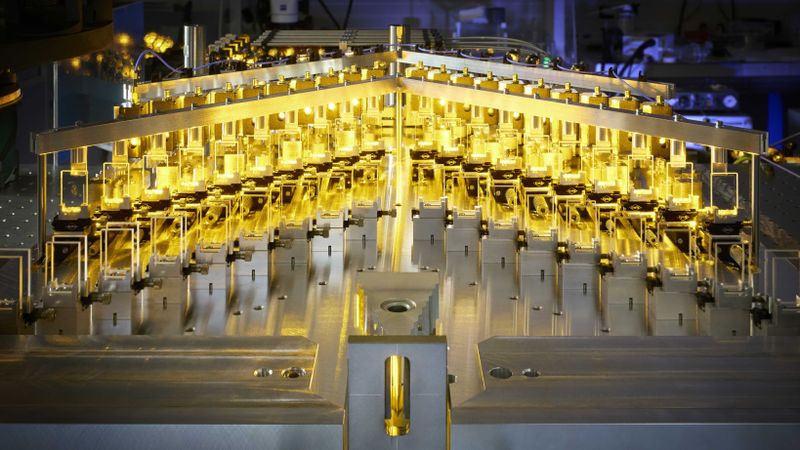
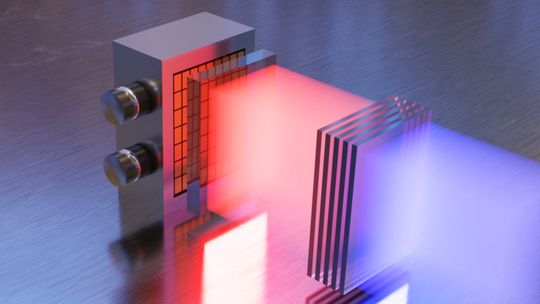
Visualization of a diode laser module with beam shaping for pumping stacked-plate ampli-fiers in high-energy lasers. Such diode laser pump modules are considered key components for the fusion power plants of the future
(Source: Fraunhofer ILT)
While sales of laser-based machine tools are generally estimated at between 10 and 20 billion euros, the market for laser-enabled products is in the trillions. No smartphone, no computer chip, and hardly any car is produced today without the use of laser technology. Photonics is the cross-cutting technology that, with the help of lasers, optical components, and complex processes, enables the industry to make progress in these areas.
At AKL’26, trends in the application of photonic technologies were discussed under the heading “New Perspectives for Lasers in Science and Industry” during the Gerd Herziger session. Trevor Ness (IPG Photonics) presented a clear vision: “Lasers will become integrated, scalable, and intelligent.” Robots equipped with lasers will achieve significant productivity gains and will also work in environments where humans cannot.
The photonic components and technologies required for this are being developed today. They are increasingly digitized and offer ever-higher performance. “The average power of USP lasers,” says Dr. Jochen Stollenwerk, acting director of the Fraunhofer ILT in Aachen, “is reaching the double-digit kilowatt (kW) range thanks to developments at the Fraunhofer Cluster of Excellence Advanced Photon Sources—CAPS.” For continuous-wave lasers, the power has now even exceeded 100 kW, according to representatives from various companies.
Prof. Constantin Häfner, Fraunhofer Executive Board Member for Research and Transfer, looked beyond these limits. He is focusing on fusion power plants and how they can be made a reality in Germany. They would also significantly transform the laser market: According to Häfner, the cost of laser diodes for just a few fusion power plants alone would exceed the volume of the current laser market. This means, first and foremost, that component costs will have to drop significantly in the future.
Lasers in the aviation industry reduce costs and emissions
Up to 3 percent fuel savings for aircraft—that’s the promise of the “shark skin” technology from 4Jet GmbH in Alsdorf near Aachen. This technology, which won the “Innovation Award Laser Technology 2026,” enables large-scale micro-machining using a CO₂ laser. It uses interference patterns for machining, allowing over 1,000 “riblets” to be created in a single pass. The technology generates microstructures across large surfaces that reduce aerodynamic drag. The company now has more than 800 systems in operation; they are used in the aviation, semiconductor, and solar industries.
Date: 08.12.2025
Naturally, we always handle your personal data responsibly. Any personal data we receive from you is processed in accordance with applicable data protection legislation. For detailed information please see our privacy policy.
Consent to the use of data for promotional purposes
I hereby consent to Vogel Communications Group GmbH & Co. KG, Max-Planck-Str. 7-9, 97082 Würzburg including any affiliated companies according to §§ 15 et seq. AktG (hereafter: Vogel Communications Group) using my e-mail address to send editorial newsletters. A list of all affiliated companies can be found here
Newsletter content may include all products and services of any companies mentioned above, including for example specialist journals and books, events and fairs as well as event-related products and services, print and digital media offers and services such as additional (editorial) newsletters, raffles, lead campaigns, market research both online and offline, specialist webportals and e-learning offers. In case my personal telephone number has also been collected, it may be used for offers of aforementioned products, for services of the companies mentioned above, and market research purposes.
Additionally, my consent also includes the processing of my email address and telephone number for data matching for marketing purposes with select advertising partners such as LinkedIn, Google, and Meta. For this, Vogel Communications Group may transmit said data in hashed form to the advertising partners who then use said data to determine whether I am also a member of the mentioned advertising partner portals. Vogel Communications Group uses this feature for the purposes of re-targeting (up-selling, cross-selling, and customer loyalty), generating so-called look-alike audiences for acquisition of new customers, and as basis for exclusion for on-going advertising campaigns. Further information can be found in section “data matching for marketing purposes”.
In case I access protected data on Internet portals of Vogel Communications Group including any affiliated companies according to §§ 15 et seq. AktG, I need to provide further data in order to register for the access to such content. In return for this free access to editorial content, my data may be used in accordance with this consent for the purposes stated here. This does not apply to data matching for marketing purposes.
Right of revocation
I understand that I can revoke my consent at will. My revocation does not change the lawfulness of data processing that was conducted based on my consent leading up to my revocation. One option to declare my revocation is to use the contact form found at https://contact.vogel.de. In case I no longer wish to receive certain newsletters, I have subscribed to, I can also click on the unsubscribe link included at the end of a newsletter. Further information regarding my right of revocation and the implementation of it as well as the consequences of my revocation can be found in the data protection declaration, section editorial newsletter.
In addition, many laser processes have become standard practice, particularly in laser material deposition. Companies such as Rolls-Royce are successfully using these methods to repair engines and are continually refining them.
Using lasers 24/7 in microelectronics
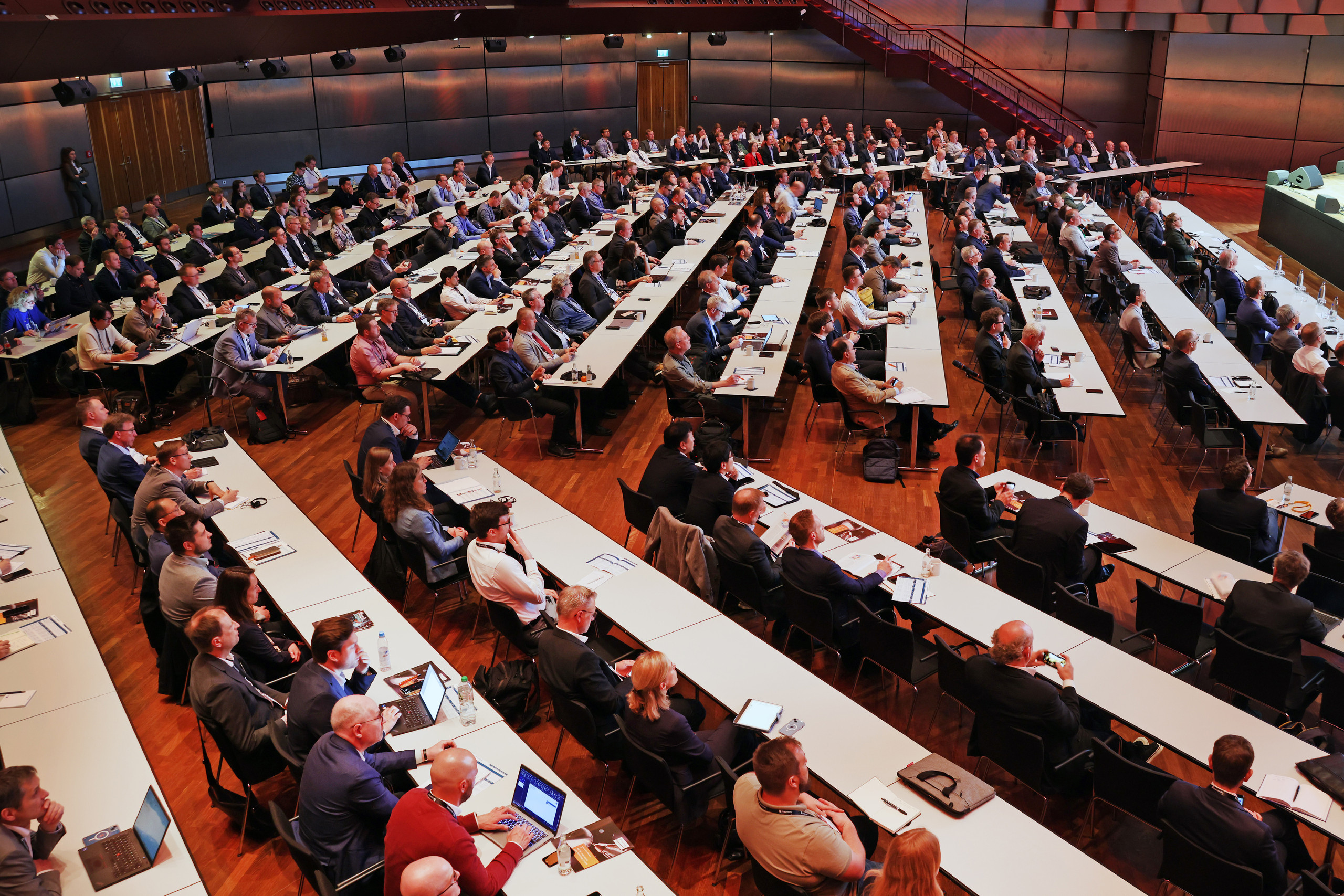
From April 22 to 24, 2026, the AKL’26—International Laser Technology Congress—took place in Aachen. There, more than 90 speakers briefed the 544 experts on the current state of in-dustrial laser technology.
(Source: Fraunhofer ILT)
In the beginning, the laser was a solution in search of a problem. Today, laser technology in its many forms plays a key role in the mass production of electronic consumer goods. This is particularly evident in display manufacturing, as demonstrated in Oliver Haupt’s (Coherent) presentation on the prospects for laser applications in micro-LEDs. In microelectronics, the next breakthrough is already on the horizon.
In his presentation, Dr. Christian Buchner (SCHMID Group) demonstrated that glass substrates can solve the bottleneck caused by increasing data transfer rates between processors and high-bandwidth memory (HBM). Glass is robust, inexpensive, and well-established in semiconductor processes. With selective laser-induced etching (SLE), users can now drill precise holes in transparent materials such as glass (through-glass vias). This industrial process generates excellent surface quality and high aspect ratios.
“Another trend in microelectronics is beam shaping,” explains Dr. Dennis Haasler, head of the Micro- and Nanostructuring Group at Fraunhofer ILT. “Both specialized beam shapes, such as Bessel beams, and multi-beam systems are increasingly being used in industry.” The latter allow for the parallelized use of ultrashort laser pulses in particular.
AI makes lasers faster, more flexible, and more autonomous
In the conference’s forward-looking final presentation, Prof. Carlo Holly (RWTH Aachen University and Fraunhofer ILT) spoke about “AI-driven innovation in photonics”. This topic now permeates every part of the process chain, from the design of optical components through quality assurance and the simulation of complex processes using digital twins, all the way to closed-loop control systems for first-time-right production in photonics.
Among the latest developments from his research are advances in self-supervised learning, which reduces the time required to train AI systems from weeks to minutes. Another innovation is AI-generated optics, which allows any beam profile to be changed during the process without the need for mechanical components.
According to Holly, AI is permeating all areas of laser technology—from planning to process control, where only AI can handle the flood of data, all the way to autonomous control. Self-learning machines are on the horizon, as are autonomous laboratories and factories. Work on the technology for this is underway in Aachen.



:quality(80)/p7i.vogel.de/wcms/f6/95/f6954fa7c09ba58863a3730f5e384a62/arek-socha-on-pixabay-1707x960v1.jpeg "A new national space strategy brings together UK’s plans for growth, defence, and national security to help reindustrialise the UK. (Source: Arek Socha on Pixabay)")
:quality(80)/p7i.vogel.de/wcms/63/0f/630f214fa760b8c7f7f7d6279d411fcf/d4ceed8f2f52-2026-08-30-hydef-06--msc4159-1200x675v1.webp "(Source: Diehl Defence)")
:quality(80)/p7i.vogel.de/wcms/4e/7d/4e7d38327c6c928b403249e3c24a2a7c/0132118791v1.jpeg "Porsche Holding SE announces that it is once again turning to rocket technology. Following its investment in Isar Aerospace, the company is now acquiring a stake in a U.S. firm ... (Source: Porsche)")
:quality(80)/p7i.vogel.de/wcms/1c/08/1c082bbd9d05b634168b617aa26fcdcf/safe-bg-lv-ro-v1-991x557v1.png "(Source: European Commission)")
:quality(80)/p7i.vogel.de/wcms/0a/14/0a1495d9b570ae32a5a7cc748b9a3c60/st-hannover-035-1920x1079v1-999x562v1.jpeg "Fastening technology you can experience first-hand—visitors to Schraubtec in Bochum (Germany) can see it for themselves at the Ruhr Congress on September 30, 2026. (Source: PHOTOVISION-DH GmbH)")
:quality(80)/p7i.vogel.de/wcms/cd/a9/cda92b173afa9d0b455d4f11b281c9ea/0094-to-image--capstone-cdr-1440x810v1.png "(Source: Terran Orbital)")
:quality(80)/p7i.vogel.de/wcms/e0/45/e045bc5414d7263fb308bdd501b5fcc1/0133113962v1.jpeg "The HSWL 354 is the transmission used, for example, in the Leopard 2 main battle tank. Renk manufactures this system and is now preparing to significantly increase its cycle time. As a result, Renk is placing greater emphasis on the military sector as a customer ... (Source: Renk)")
:quality(80)/p7i.vogel.de/wcms/a1/5c/a15c2aeba563d5bc3e11fb879b21eb2c/0132989650v1.jpeg "FSS, the flexible clamping system for varying free-form surfaces, is designed for the aerospace industry and other sectors. (Source: Römheld GmbH Friedrichshütte)")
:quality(80)/p7i.vogel.de/wcms/46/8e/468effa87546a2b036dc88ca40e2843e/129fbcac92ce7da872b13af0281b0799-l-png-1920x1079v1.webp "(Source: Arianespace)")
:quality(80)/p7i.vogel.de/wcms/8f/10/8f10697d4bfbd70edf615cca76eaedfd/pete-linforth-on-pixabay-1920x1080v1.jpeg "(Source: Pete Linforth on Pixabay / AI-generated)")
:quality(80)/p7i.vogel.de/wcms/0f/99/0f99561bf51818af92b2960656405aa5/roland-4d-pippes-on-pixabay-1460x820v1.jpeg "(Source: Roland 4D Pippes on Pixabay)")
:quality(80)/p7i.vogel.de/wcms/05/49/054906f874b94ef08b09d5920396e27d/airbus-h160-1920x1079v1.jpeg "Airbus H160 (Source: Airbus)")
:quality(80)/p7i.vogel.de/wcms/9d/8a/9d8addea8cc4e6f7a4793563ca397f2a/ai-im-milit-r-1672x940v1.png "(Source: KI-generiert / Gemini)")
:quality(80)/p7i.vogel.de/wcms/7f/5f/7f5fba2c729ec3aa256bf1a18d74529b/ai-chip-1672x940v1.png "(Source: KI-generiert / Gemini)")
:quality(80)/p7i.vogel.de/wcms/64/1b/641b6474b2a614cde7730c89ef2a3015/2026-09-09-rheinmetall-veroeffentlicht-battlesuite-schnittstellen-e8c18194-1225x690v1.jpeg "Rheinmetall’s Battlesuite provides a modular digital platform for connecting and integrating sensors, hardware and software components. (Source: Rheinmetall AG)")
:quality(80)/p7i.vogel.de/wcms/6f/fe/6ffef325e7f233cc3521943158eb1ebd/0132763535v1.jpeg "Two companies are planning to establish, for the first time in 2027, an optical laser communication link directly between a satellite in low Earth orbit (LEO) and a re-entering spacecraft. (Source: ATMOS Space Cargo)")
:quality(80)/p7i.vogel.de/wcms/8f/f9/8ff91b78b26cb5a2b8a29e39835005b1/2026-09-10-repmus-teaser-images-retouched-dsc01292-1024x683-1024x576v1.jpeg "(Source: Quantum Systems GmbH)")
:quality(80)/p7i.vogel.de/wcms/bf/4a/bf4a237e60d3d4bd1bbdbad918f3c697/airbus-defence-and-space-3-1280x720v1.jpeg "(Source: Airbus Defence and Space)")
:quality(80)/p7i.vogel.de/wcms/e0/d1/e0d112a0d54a4fa9603ec855f7d25b47/t-rex-content-photo-jpg-pc-adaptive-990-medium-988x556v1.jpeg "Swarm of UAVs conducting a fully autonomous collaborative swarm mission. (Source: Lockheed Martin)")
:quality(80)/p7i.vogel.de/wcms/79/fc/79fcaa7ca33e393b11a4740d7d8f3dbe/vilkasss-handshake-9459740-1911x1076v1.jpeg "(Source: Vilius Kukanauskas on Pixabay)")
:quality(80)/p7i.vogel.de/wcms/90/a8/90a849f0023f11d1eb642eb4751a0321/bild2-h-c3-a4nel-ict-20truck-20and-20trailer-20parts-4320x2429v1.jpeg "Product information is visible at all times and retrieval of items
is confirmed by employees directly on the display of the Hänel MP 14 N
controller. (Source: René Marks)")
:quality(80)/p7i.vogel.de/wcms/4e/ca/4ecaa39f247490eded591b652c33aee3/thilmann-hcp-web-20kleiner-20ausschnitt-1442x811v1.jpeg "Entering the defence market can be challenging for start-ups, says HCP Sense CEO Ansgar Thilmann. (Picture: HCP Sense)")
:quality(80)/p7i.vogel.de/wcms/7a/51/7a511b80041d3f1335f3a5aa56fe75da/delivery-7022432-1280-1280x720v1.png "(Source: Mohamed_hassan)")
:quality(80)/p7i.vogel.de/wcms/f9/2f/f92f1ef8c739c34c70d99f7b0997621b/stra007-20--20cover-20image-5472x3076v1.jpeg "(Source: Stratasys)")
:quality(80)/p7i.vogel.de/wcms/ec/a9/eca9062ccbe4b042f8515846340410d8/aerospace-and-defence-stairways-platforms-and-much-morev1.jpeg "Modular constructions enable flexible modification. That applies to larger structures such as stairways and platforms, too. And that means aerospace and defence companies can reconfigure their maintenance platforms fast (itemitem)")
:quality(80)/p7i.vogel.de/wcms/30/2a/302a7b5723ad38fbde812fd3a468ad04/safety-on-stairways-in-industry-key-considerationsv1.jpeg "Stairways and platforms are used widely in maintenance and assembly areas in the aerospace and defence sectors. (Source: item)")
:quality(80)/p7i.vogel.de/wcms/f3/4e/f34ed744bb30817d3432c7ad522e6f30/engine-1v1.jpeg "Engineering with aluminium profiles really can be this easy – the item Engineeringtool and its smart functions help you save valuable time. (Source: item)")
:fill(fff,0)/p7i.vogel.de/companies/69/6d/696de2483d115/logo--fastems-rgb-horizontal.jpeg "logo--fastems-rgb-horizontal (Fastems)")
:fill(fff,0)/images.vogel.de/vogelonline/companyimg/84700/84735/65.jpg "logo_item_rgb_neu.jpg ()")
:quality(80)/p7i.vogel.de/wcms/6c/0f/6c0f988379c1c0aa73845b1210d9331c/basisbild-1672x940v1.png "basisbild-1672x940v1 (Source: AI-Generated/ChatGPT)")
:quality(80)/p7i.vogel.de/wcms/05/04/050472eef4626e049667afe3ae3e5909/pm-draht-lmd-bild-3-1920x1081v1.jpeg "pm-draht-lmd-bild-3-1920x1081v1 (Source: Fraunhofer ILT, Aachen, Germany / Volker Lannert.)")
:quality(80)/p7i.vogel.de/wcms/c5/ae/c5ae900d260c64049119f9027cac5c2e/0128777874v1.jpeg "The aerospace industry is one of the beneficiaries of current developments in metallic 3D printing. Small quantities and the high complexity of lightweight, high-performance components are already among the strengths of additive manufacturing. (Image:Fraunhofer-ILT)")