The Submarine Delivery Group is using advanced and additive manufacturing to improve submarine availability.
(Source: GOV.UK)
The Submarine Delivery Group (SDG), which is part of the Defence Nuclear Enterprise, is using advanced and additive manufacturing to improve submarine availability. The work of the SDG Additive Manufacturing (AdM) team, alongside industry and the Royal Navy, is reducing reliance on traditional supply chains, and building an enduring AdM industrial capability across the UK’s submarine programmes.
What are advanced manufacturing and additive manufacturing?
Advanced manufacturing uses innovative techniques and technologies, including automation, artificial intelligence and additive manufacturing, to improve productivity, precision and sustainability in production.
Additive manufacturing—commonly known as ‘3D printing’—builds components layer by layer from a digital file. Unlike traditional manufacturing, which cuts or shapes material, additive processes can produce complex parts quickly, with less waste.
(Source: GOV.UK)
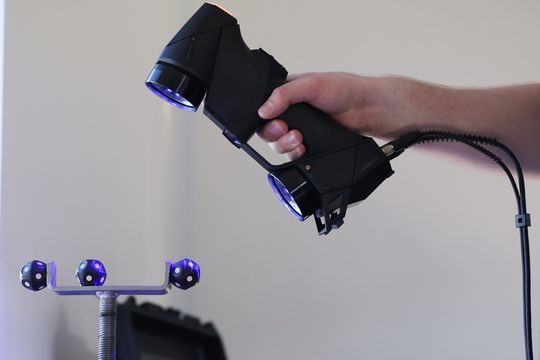
In the submarine context, subject to appropriate legal, safety and quality considerations, this includes using handheld scanners to create precise digital replicas of existing components and printing those components using stainless steel, as well as other techniques and materials.
Why it matters for submarines
Sourcing replacement components for submarines can involve lengthy supply chains and extended lead times. This can increase the time required alongside for a vessel waiting for parts that are obsolete, or no longer commercially available within operational timescales.
The AdM team was established as part of the SDG’s Platform Equipment Delivery Team (PEDT) in February 2024 to address this challenge directly. Championed by Sir Chris Gardner KBE, Director General SDG, the team’s role is to harness advanced and additive manufacturing to improve submarine availability, capability, and delivery across all programmes—predominantly in in-service submarines but also including the submarine build programmes.
The Market Access Cell
A central part of the team’s work is the Market Access Cell, which manages demand signals from ship’s staff and joint planning teams when components are unavailable, or lead times are too long. When a demand signal is received, the team works with QinetiQ, the SDG Design Authority, and other in-service teams to identify the best manufacturing solution and get the component to the submarine as quickly as possible.
One method of creating the digital design files for components uses handheld scanners, operated by QinetiQ engineers, to capture precise measurements of components on board. They are converted into digital files that can be used to manufacture bespoke replacements. This is particularly valuable for one-off or legacy parts where no existing design file exists.
Deployable workshops at HMNB Clyde
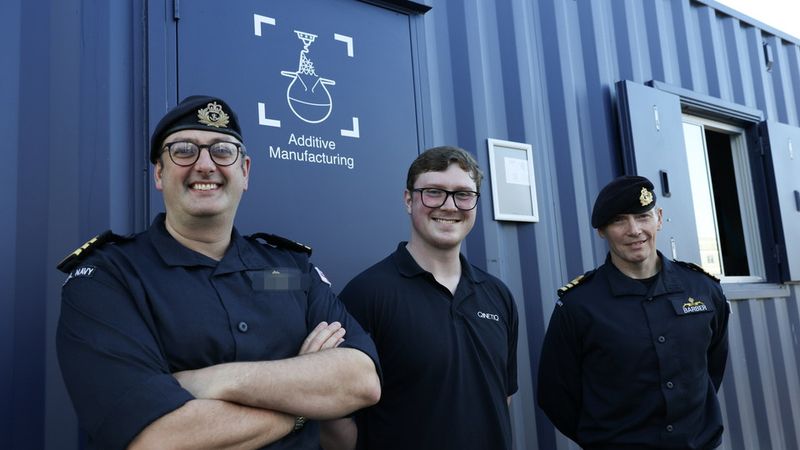
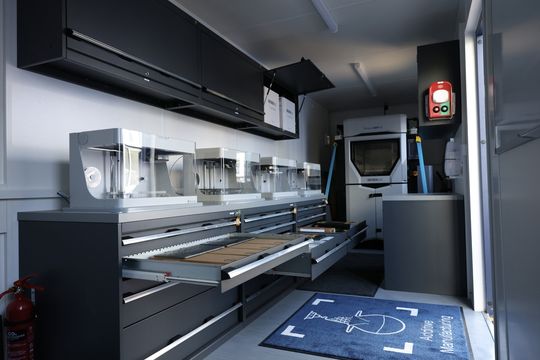
Shipping containers have now arrived at HM Naval Base Clyde, providing an on-site additive manufacturing capability that includes metal printing, scanning equipment, and dedicated engineering workspace. Two of the containers are custom-designed by QinetiQ, based on the requirements of the PEDT. QinetiQ staff will operate the facility alongside ship’s staff and the Submarine Flotilla (SUBFLOT) Engineering Support Group for the first twelve months. Ship’s staff are also receiving training to use the capability directly.
Max, a Commander in the Royal Navy and SDG Additive Manufacturing Lead said:
“This capability enhances our capacity to return submarines to service faster, directly supporting operational readiness.
Date: 08.12.2025
Naturally, we always handle your personal data responsibly. Any personal data we receive from you is processed in accordance with applicable data protection legislation. For detailed information please see our privacy policy.
Consent to the use of data for promotional purposes
I hereby consent to Vogel Communications Group GmbH & Co. KG, Max-Planck-Str. 7-9, 97082 Würzburg including any affiliated companies according to §§ 15 et seq. AktG (hereafter: Vogel Communications Group) using my e-mail address to send editorial newsletters. A list of all affiliated companies can be found here
Newsletter content may include all products and services of any companies mentioned above, including for example specialist journals and books, events and fairs as well as event-related products and services, print and digital media offers and services such as additional (editorial) newsletters, raffles, lead campaigns, market research both online and offline, specialist webportals and e-learning offers. In case my personal telephone number has also been collected, it may be used for offers of aforementioned products, for services of the companies mentioned above, and market research purposes.
Additionally, my consent also includes the processing of my email address and telephone number for data matching for marketing purposes with select advertising partners such as LinkedIn, Google, and Meta. For this, Vogel Communications Group may transmit said data in hashed form to the advertising partners who then use said data to determine whether I am also a member of the mentioned advertising partner portals. Vogel Communications Group uses this feature for the purposes of re-targeting (up-selling, cross-selling, and customer loyalty), generating so-called look-alike audiences for acquisition of new customers, and as basis for exclusion for on-going advertising campaigns. Further information can be found in section “data matching for marketing purposes”.
In case I access protected data on Internet portals of Vogel Communications Group including any affiliated companies according to §§ 15 et seq. AktG, I need to provide further data in order to register for the access to such content. In return for this free access to editorial content, my data may be used in accordance with this consent for the purposes stated here. This does not apply to data matching for marketing purposes.
Right of revocation
I understand that I can revoke my consent at will. My revocation does not change the lawfulness of data processing that was conducted based on my consent leading up to my revocation. One option to declare my revocation is to use the contact form found at https://contact.vogel.de. In case I no longer wish to receive certain newsletters, I have subscribed to, I can also click on the unsubscribe link included at the end of a newsletter. Further information regarding my right of revocation and the implementation of it as well as the consequences of my revocation can be found in the data protection declaration, section editorial newsletter.
(Source: GOV.UK)
“These deployable additive manufacturing workshops represent a significant advancement in how the Royal Navy supports submarine maintenance. By enabling engineers to produce components on-site, we are reducing dependence on complex supply chains and accelerating repair timelines, ultimately improving the submarine’s material state and availability.”
Supporting the submarine maintenance recovery plan
The deployable workshops and the broader additive manufacturing programme will support the Submarine Maintenance Recovery Plan (SMRP), which was launched by the First Sea Lord in January 2026. By bringing manufacturing capability to the front line, the programme supports a more agile and responsive maintenance model.
First Sea Lord, General Sir Gwyn Jenkins, said:
“The arrival of these deployable workshops marks a step forward in delivering the Submarine Maintenance Recovery Plan. This new technology has the potential to change how we maintain our submarines—cutting time alongside and increasing availability. It represents the real, tangible, progress the Royal Navy is making to strengthen the underwater fleet.”
AUKUS and international collaboration
Additive manufacturing is also a key enabler of the AUKUS submarine partnership. The SDG is working with US and Australian submarine industrial bases to develop common material standards and requirements, enabling allied nations to share advanced manufacturing equipment and recognise each other’s qualified components.
This was demonstrated successfully at the UK Submarine Maintenance Period at HMAS Stirling in Australia in early 2026, where QinetiQ UK and QinetiQ Australia, working with Australian supply chain partners, produced additively manufactured parts that were approved for use on HMS Anson.
A trilateral advanced manufacturing landscape review is under way to map existing capabilities across the UK, US, and Australia to identify gaps, and determine how they can be exploited across all three nations’ submarine programmes. The review will inform the development of shared Defence Standards covering material requirements, which will eventually enable the qualification of higher-risk components such as valves.
Looking ahead
The long-term ambition is for additive and advanced manufacturing to become business as usual across the submarine build, in-service, and disposal programmes. Future developments include:
qualifying higher-risk components, such as hull valves, through trilateral Defence Standards
optimising component designs digitally—not simply reproducing legacy parts, but improving performance, fatigue life, and other characteristics such as reducing weight
recycling additive materials recovered from decommissioned submarines
embedding additive manufacturing skills into training at the newly opened Royal Navy Submarine Training Centre at HMNB Clyde
Max said: “Additive manufacturing is not a silver bullet, and it does not replace traditional supply chain methods. But it is absolutely about supplementing and augmenting current manufacturing to support submarine maintenance. It’s just another option that Chief Engineers and Duty Holders have when considering solutions—and one that will only become more capable over time.”



:quality(80)/p7i.vogel.de/wcms/f6/95/f6954fa7c09ba58863a3730f5e384a62/arek-socha-on-pixabay-1707x960v1.jpeg "A new national space strategy brings together UK’s plans for growth, defence, and national security to help reindustrialise the UK. (Source: Arek Socha on Pixabay)")
:quality(80)/p7i.vogel.de/wcms/63/0f/630f214fa760b8c7f7f7d6279d411fcf/d4ceed8f2f52-2026-08-30-hydef-06--msc4159-1200x675v1.webp "(Source: Diehl Defence)")
:quality(80)/p7i.vogel.de/wcms/4e/7d/4e7d38327c6c928b403249e3c24a2a7c/0132118791v1.jpeg "Porsche Holding SE announces that it is once again turning to rocket technology. Following its investment in Isar Aerospace, the company is now acquiring a stake in a U.S. firm ... (Source: Porsche)")
:quality(80)/p7i.vogel.de/wcms/1c/08/1c082bbd9d05b634168b617aa26fcdcf/safe-bg-lv-ro-v1-991x557v1.png "(Source: European Commission)")
:quality(80)/p7i.vogel.de/wcms/0a/14/0a1495d9b570ae32a5a7cc748b9a3c60/st-hannover-035-1920x1079v1-999x562v1.jpeg "Fastening technology you can experience first-hand—visitors to Schraubtec in Bochum (Germany) can see it for themselves at the Ruhr Congress on September 30, 2026. (Source: PHOTOVISION-DH GmbH)")
:quality(80)/p7i.vogel.de/wcms/cd/a9/cda92b173afa9d0b455d4f11b281c9ea/0094-to-image--capstone-cdr-1440x810v1.png "(Source: Terran Orbital)")
:quality(80)/p7i.vogel.de/wcms/e0/45/e045bc5414d7263fb308bdd501b5fcc1/0133113962v1.jpeg "The HSWL 354 is the transmission used, for example, in the Leopard 2 main battle tank. Renk manufactures this system and is now preparing to significantly increase its cycle time. As a result, Renk is placing greater emphasis on the military sector as a customer ... (Source: Renk)")
:quality(80)/p7i.vogel.de/wcms/a1/5c/a15c2aeba563d5bc3e11fb879b21eb2c/0132989650v1.jpeg "FSS, the flexible clamping system for varying free-form surfaces, is designed for the aerospace industry and other sectors. (Source: Römheld GmbH Friedrichshütte)")
:quality(80)/p7i.vogel.de/wcms/46/8e/468effa87546a2b036dc88ca40e2843e/129fbcac92ce7da872b13af0281b0799-l-png-1920x1079v1.webp "(Source: Arianespace)")
:quality(80)/p7i.vogel.de/wcms/8f/10/8f10697d4bfbd70edf615cca76eaedfd/pete-linforth-on-pixabay-1920x1080v1.jpeg "(Source: Pete Linforth on Pixabay / AI-generated)")
:quality(80)/p7i.vogel.de/wcms/0f/99/0f99561bf51818af92b2960656405aa5/roland-4d-pippes-on-pixabay-1460x820v1.jpeg "(Source: Roland 4D Pippes on Pixabay)")
:quality(80)/p7i.vogel.de/wcms/05/49/054906f874b94ef08b09d5920396e27d/airbus-h160-1920x1079v1.jpeg "Airbus H160 (Source: Airbus)")
:quality(80)/p7i.vogel.de/wcms/9d/8a/9d8addea8cc4e6f7a4793563ca397f2a/ai-im-milit-r-1672x940v1.png "(Source: KI-generiert / Gemini)")
:quality(80)/p7i.vogel.de/wcms/7f/5f/7f5fba2c729ec3aa256bf1a18d74529b/ai-chip-1672x940v1.png "(Source: KI-generiert / Gemini)")
:quality(80)/p7i.vogel.de/wcms/64/1b/641b6474b2a614cde7730c89ef2a3015/2026-09-09-rheinmetall-veroeffentlicht-battlesuite-schnittstellen-e8c18194-1225x690v1.jpeg "Rheinmetall’s Battlesuite provides a modular digital platform for connecting and integrating sensors, hardware and software components. (Source: Rheinmetall AG)")
:quality(80)/p7i.vogel.de/wcms/6f/fe/6ffef325e7f233cc3521943158eb1ebd/0132763535v1.jpeg "Two companies are planning to establish, for the first time in 2027, an optical laser communication link directly between a satellite in low Earth orbit (LEO) and a re-entering spacecraft. (Source: ATMOS Space Cargo)")
:quality(80)/p7i.vogel.de/wcms/8f/f9/8ff91b78b26cb5a2b8a29e39835005b1/2026-09-10-repmus-teaser-images-retouched-dsc01292-1024x683-1024x576v1.jpeg "(Source: Quantum Systems GmbH)")
:quality(80)/p7i.vogel.de/wcms/bf/4a/bf4a237e60d3d4bd1bbdbad918f3c697/airbus-defence-and-space-3-1280x720v1.jpeg "(Source: Airbus Defence and Space)")
:quality(80)/p7i.vogel.de/wcms/e0/d1/e0d112a0d54a4fa9603ec855f7d25b47/t-rex-content-photo-jpg-pc-adaptive-990-medium-988x556v1.jpeg "Swarm of UAVs conducting a fully autonomous collaborative swarm mission. (Source: Lockheed Martin)")
:quality(80)/p7i.vogel.de/wcms/79/fc/79fcaa7ca33e393b11a4740d7d8f3dbe/vilkasss-handshake-9459740-1911x1076v1.jpeg "(Source: Vilius Kukanauskas on Pixabay)")
:quality(80)/p7i.vogel.de/wcms/90/a8/90a849f0023f11d1eb642eb4751a0321/bild2-h-c3-a4nel-ict-20truck-20and-20trailer-20parts-4320x2429v1.jpeg "Product information is visible at all times and retrieval of items
is confirmed by employees directly on the display of the Hänel MP 14 N
controller. (Source: René Marks)")
:quality(80)/p7i.vogel.de/wcms/4e/ca/4ecaa39f247490eded591b652c33aee3/thilmann-hcp-web-20kleiner-20ausschnitt-1442x811v1.jpeg "Entering the defence market can be challenging for start-ups, says HCP Sense CEO Ansgar Thilmann. (Picture: HCP Sense)")
:quality(80)/p7i.vogel.de/wcms/7a/51/7a511b80041d3f1335f3a5aa56fe75da/delivery-7022432-1280-1280x720v1.png "(Source: Mohamed_hassan)")
:quality(80)/p7i.vogel.de/wcms/f9/2f/f92f1ef8c739c34c70d99f7b0997621b/stra007-20--20cover-20image-5472x3076v1.jpeg "(Source: Stratasys)")
:quality(80)/p7i.vogel.de/wcms/ec/a9/eca9062ccbe4b042f8515846340410d8/aerospace-and-defence-stairways-platforms-and-much-morev1.jpeg "Modular constructions enable flexible modification. That applies to larger structures such as stairways and platforms, too. And that means aerospace and defence companies can reconfigure their maintenance platforms fast (itemitem)")
:quality(80)/p7i.vogel.de/wcms/30/2a/302a7b5723ad38fbde812fd3a468ad04/safety-on-stairways-in-industry-key-considerationsv1.jpeg "Stairways and platforms are used widely in maintenance and assembly areas in the aerospace and defence sectors. (Source: item)")
:quality(80)/p7i.vogel.de/wcms/f3/4e/f34ed744bb30817d3432c7ad522e6f30/engine-1v1.jpeg "Engineering with aluminium profiles really can be this easy – the item Engineeringtool and its smart functions help you save valuable time. (Source: item)")
:fill(fff,0)/p7i.vogel.de/companies/69/6d/696de2483d115/logo--fastems-rgb-horizontal.jpeg "logo--fastems-rgb-horizontal (Fastems)")
:fill(fff,0)/images.vogel.de/vogelonline/companyimg/84700/84735/65.jpg "logo_item_rgb_neu.jpg ()")
:quality(80)/p7i.vogel.de/wcms/da/fe/dafe89d79099a06a572ac0cea8359899/additive-20manufacturing-20is-20a-20key-20logistics-20enabler-20for-20troops-20in-20contested-20environments-2c-20where-20traditional-20supply-20routes-20are-20not-20always-20available--2972x1673v1.jpeg "Additive manufacturing is a key logistics enabler for troops in contested environments, where traditional supply routes are not always available. (Source: Replique)")
:quality(80)/p7i.vogel.de/wcms/30/a7/30a735b90303294ce6c9029ddd2ce137/ron-porter-on-pixabay-1597x898v1.jpeg "Around 315 jobs across the UK, including highly skilled engineering roles, sustained by new £135 million contract. (Source: Ron Porter on Pixabay)")