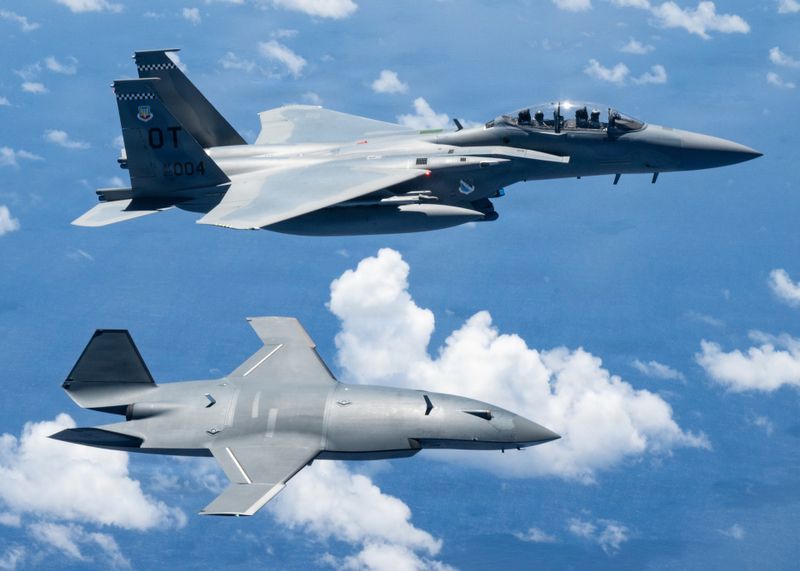
Boeing and Rheinmetall are accelerating Germany’s development of sovereign Collaborative Combat Aircraft capabilities by combining the mature MQ-28 Ghost Bat platform with a German industrial ecosystem.
(Source: Rheinmetall AG)
Leading air forces worldwide are now beginning the practical introduction of Collaborative Combat Aircraft (CCA), also referred to as fighter-bomber drones for air-to-ground missions. They are thus moving from the concept phase to the concrete establishment of this new military capability. The Bundeswehr also has corresponding plans.
With the MQ-28 Ghost Bat, a mature platform is already available today that enables this rapid capability development. Previous flight tests show that the MQ-28 can meet German requirements for both air-to-ground and air-to-air missions.
The high level of maturity of the MQ-28 enables Germany to immediately establish sovereign capabilities—including the integration of German sensors, weapons and mission software.
Boeing is continuously investing in the further development of the MQ-28, including its air-to-ground capabilities. To ensure the accelerated development of CCA capabilities in Germany, Rheinmetall is contributing as a system integrator.
The high level of maturity that the MQ-28 Ghost Bat already has today is decisive: The MQ-28 Ghost Bat is the first and so far only fighter-bomber drone to have participated in multinational exercises, such as the US military exercise Exercise Valiant Shield. Glen Ferguson, Global Director of the MQ-28 programme at Boeing Defense Australia, says: “While many CCA programmes worldwide are still in the concept, definition or early test phase, the MQ-28A Ghost Bat has already completed these key development steps.”
Europe’s security landscape is changing rapidly
(Source: VCG)
As defence budgets rise and EU programmes expand, civil technology providers are becoming vital contributors to Europe’s strategic autonomy. The event will act as a neutral platform for dialogue between technology suppliers, integrators, and decision-makers shaping the next generation of European defence capabilities and aims to open doors between civil industry and defence procurement, providing practical insights.
At the same time, the MQ-28 Ghost Bat provides the German Air Force with a realistic development and test environment in which to further develop procedures and tactics for cooperation between manned and unmanned aircraft. Glen Ferguson emphasises: “If the goal is to achieve such a capability by 2029, this work must begin today with the development of tactics, training, the definition of force structure and the integration of sovereign technologies.”
Together with Rheinmetall, Rohde & Schwarz, Diehl Defence and Hensoldt, Boeing is currently establishing an industrial ecosystem that will enable Germany in the long term to develop and integrate the required capabilities within the country.
Rheinmetall is taking the first step by establishing independent system integration for the MQ-28 in Germany. Mike Schmidt, CEO of the Air, Uncrewed and Space business unit, says: “Germany does not have to choose between speed and independence. We offer a way to achieve both at the same time. The MQ-28 enables us to bypass the lengthy development phase of a new aircraft and move directly to the decisive task: making the capabilities of unmanned combat aircraft systems available to the German Air Force.”
Establishing independent system integration is also an investment in the German defence industry. Software development, mission integration and intellectual property will remain within the German industrial ecosystem.
This means that national capabilities can be developed, tested and integrated directly on the MQ-28. Future CCA platforms will subsequently benefit from this experience.
With the help of a Digital Twin, the MQ-28 is being continuously further developed, supported by extensive flight test data and findings from the test programme with the Royal Australian Air Force (RAAF).
Glen Ferguson says: “The MQ-28 Ghost Bat was designed from the outset as a highly adaptable platform. Experience gathered in service to date shows that the MQ-28’s architecture can be rapidly adapted to new mission requirements, including air-to-ground capabilities. This is not about retrofitting, but about making use of a modular design that was designed from the ground up for continuous adaptation.”
Date: 08.12.2025
Naturally, we always handle your personal data responsibly. Any personal data we receive from you is processed in accordance with applicable data protection legislation. For detailed information please see our privacy policy.
Consent to the use of data for promotional purposes
I hereby consent to Vogel Communications Group GmbH & Co. KG, Max-Planck-Str. 7-9, 97082 Würzburg including any affiliated companies according to §§ 15 et seq. AktG (hereafter: Vogel Communications Group) using my e-mail address to send editorial newsletters. A list of all affiliated companies can be found here
Newsletter content may include all products and services of any companies mentioned above, including for example specialist journals and books, events and fairs as well as event-related products and services, print and digital media offers and services such as additional (editorial) newsletters, raffles, lead campaigns, market research both online and offline, specialist webportals and e-learning offers. In case my personal telephone number has also been collected, it may be used for offers of aforementioned products, for services of the companies mentioned above, and market research purposes.
Additionally, my consent also includes the processing of my email address and telephone number for data matching for marketing purposes with select advertising partners such as LinkedIn, Google, and Meta. For this, Vogel Communications Group may transmit said data in hashed form to the advertising partners who then use said data to determine whether I am also a member of the mentioned advertising partner portals. Vogel Communications Group uses this feature for the purposes of re-targeting (up-selling, cross-selling, and customer loyalty), generating so-called look-alike audiences for acquisition of new customers, and as basis for exclusion for on-going advertising campaigns. Further information can be found in section “data matching for marketing purposes”.
In case I access protected data on Internet portals of Vogel Communications Group including any affiliated companies according to §§ 15 et seq. AktG, I need to provide further data in order to register for the access to such content. In return for this free access to editorial content, my data may be used in accordance with this consent for the purposes stated here. This does not apply to data matching for marketing purposes.
Right of revocation
I understand that I can revoke my consent at will. My revocation does not change the lawfulness of data processing that was conducted based on my consent leading up to my revocation. One option to declare my revocation is to use the contact form found at https://contact.vogel.de. In case I no longer wish to receive certain newsletters, I have subscribed to, I can also click on the unsubscribe link included at the end of a newsletter. Further information regarding my right of revocation and the implementation of it as well as the consequences of my revocation can be found in the data protection declaration, section editorial newsletter.




:quality(80)/p7i.vogel.de/wcms/a2/da/a2da4222cfe9ec14a72668ce4100fd5b/pistorius-experimentalserie-land-1400x787v1.jpeg "Defence Minister Boris Pistorius at the Land Experimental Series at the Bergen military training area in Lower Saxony. Innovative systems are being tested for their suitability for use by the troops — not in a laboratory, but out in the open. (Source: Bundeswehr/Janin Garzke)")
:quality(80)/p7i.vogel.de/wcms/ae/e3/aee34d59fdc80ce5fc6722e1107500b6/word-press-featured-image-1024x695-1024x576v1.jpeg "(Source: Bundesregierung/Tobias Koch)")
:quality(80)/p7i.vogel.de/wcms/58/11/5811cc8443afc0e733552da84d1b2120/nasa-imagery-international-space-station-974-1920x1080v1.jpeg "(Source: NASA-Imagery on Pixabay)")
:quality(80)/p7i.vogel.de/wcms/a6/3c/a63c2c0f1b1fd4c960a5ab6c3c01aa45/denk-kallas-annual-defence-readiness-report-web-1920x1079v1.png "(Source: EDA)")
:quality(80)/p7i.vogel.de/wcms/91/c9/91c93dbd66b08824c35643875aabe61f/bild1-1245x700v1.jpeg "Two scientists in front of a vacuum chamber used for testing. (Source: Busch Group)")
:quality(80)/p7i.vogel.de/wcms/76/1d/761de63f32752dc5a9722559c527fc1f/design-ohne-titel-5-1920x1079v1.png "(Source: Analog Devices)")
:quality(80)/p7i.vogel.de/wcms/33/a7/33a7f8ac37b143e73964dad10c8aafbc/0133560493v1.jpeg "Benedikt Gundling and Tobias Hannen in front of a tank component of the Ariane 6. (Source: Grob Works)")
:quality(80)/p7i.vogel.de/wcms/4f/3a/4f3a22eb23991207008533412c8dc817/screenshot-2026-09-25-125155-1405x790v1.png "(Source: BINDER GmbH)")
:quality(80)/p7i.vogel.de/wcms/6e/32/6e326befcb6db2834c32c9485bd3db20/hyperion-and-posidonia-satellites-1920x1079v1.png "(Source: Open Cosmos)")
:quality(80)/p7i.vogel.de/wcms/bf/49/bf496085f7c7f24528ad7bb46a7fd7b1/alex-myers-on-pixabay-1920x1079v1.jpeg "(Source: Alex Myers on Pixabay)")
:quality(80)/p7i.vogel.de/wcms/44/6a/446abaeb94d165fe9fb76bde421c775f/692ee9be62dc569f674fdccb-eeee-1920x1079v1.png "(Source: HyImpulse Technologies GmbH)")
:quality(80)/p7i.vogel.de/wcms/45/d0/45d0707281dcef7a1a2c2a6e255d18fc/0133602931v1.jpeg "This is how the SpaceX specialists were working just a few years ago on the world’s largest rocket—the Starship. Now, Elon Musk’s company has reached a milestone as part of a test flight: orbit around the Earth! But there was also a bitter aftertaste... (Source: Spacex)")
:quality(80)/p7i.vogel.de/wcms/cb/a2/cba2ecda891b2874327a30f69f773bdb/hexaforce-15-1920x1079v1.jpeg "(Source: Thales/Gauthier Chauffrut)")
:quality(80)/p7i.vogel.de/wcms/9d/8a/9d8addea8cc4e6f7a4793563ca397f2a/ai-im-milit-r-1672x940v1.png "(Source: KI-generiert / Gemini)")
:quality(80)/p7i.vogel.de/wcms/7f/5f/7f5fba2c729ec3aa256bf1a18d74529b/ai-chip-1672x940v1.png "(Source: KI-generiert / Gemini)")
:quality(80)/p7i.vogel.de/wcms/64/1b/641b6474b2a614cde7730c89ef2a3015/2026-09-09-rheinmetall-veroeffentlicht-battlesuite-schnittstellen-e8c18194-1225x690v1.jpeg "Rheinmetall’s Battlesuite provides a modular digital platform for connecting and integrating sensors, hardware and software components. (Source: Rheinmetall AG)")
:quality(80)/p7i.vogel.de/wcms/54/d5/54d5207a3dab5139de6761523319cf84/airbus-delivers-first-batch-of-new-eutelsat-s-oneweb-satellites-23-1920x1079v1.jpeg "(Source: Airbus Defence and Space SAS 2026)")
:quality(80)/p7i.vogel.de/wcms/64/21/6421fb9366ca8d1fe53938189ef904c1/131c0764-1166-4436-8cf1-bbdf81ee0543-1536x864v1.png "Germany could become the fourth partner in the GCAP next-generation fighter programme. (Picture: AI generated)")
:quality(80)/p7i.vogel.de/wcms/d6/07/d60779ebff1f78acb6a030ae285bdebe/a37d9ab70cd8-2026-f125-newlauncher-slm-pip-3zu1-767x432v1.webp "(Source: Diehl Defence)")
:quality(80)/p7i.vogel.de/wcms/7c/39/7c394ae7c22216bddd6996005f54b4cc/pr-mou-ukraine-hensoldt-bild-997x561v1.png "HENSOLDT CEO Oliver Dörre with German Chancellor Friedrich Merz and Ukrainian President Volodymyr Zelenskyy during the visit. (Source: HENSOLDT)")
:quality(80)/p7i.vogel.de/wcms/90/a8/90a849f0023f11d1eb642eb4751a0321/bild2-h-c3-a4nel-ict-20truck-20and-20trailer-20parts-4320x2429v1.jpeg "Product information is visible at all times and retrieval of items
is confirmed by employees directly on the display of the Hänel MP 14 N
controller. (Source: René Marks)")
:quality(80)/p7i.vogel.de/wcms/4e/ca/4ecaa39f247490eded591b652c33aee3/thilmann-hcp-web-20kleiner-20ausschnitt-1442x811v1.jpeg "Entering the defence market can be challenging for start-ups, says HCP Sense CEO Ansgar Thilmann. (Picture: HCP Sense)")
:quality(80)/p7i.vogel.de/wcms/7a/51/7a511b80041d3f1335f3a5aa56fe75da/delivery-7022432-1280-1280x720v1.png "(Source: Mohamed_hassan)")
:quality(80)/p7i.vogel.de/wcms/f9/2f/f92f1ef8c739c34c70d99f7b0997621b/stra007-20--20cover-20image-5472x3076v1.jpeg "(Source: Stratasys)")
:quality(80)/p7i.vogel.de/wcms/ec/a9/eca9062ccbe4b042f8515846340410d8/aerospace-and-defence-stairways-platforms-and-much-morev1.jpeg "Modular constructions enable flexible modification. That applies to larger structures such as stairways and platforms, too. And that means aerospace and defence companies can reconfigure their maintenance platforms fast (itemitem)")
:quality(80)/p7i.vogel.de/wcms/30/2a/302a7b5723ad38fbde812fd3a468ad04/safety-on-stairways-in-industry-key-considerationsv1.jpeg "Stairways and platforms are used widely in maintenance and assembly areas in the aerospace and defence sectors. (Source: item)")
:quality(80)/p7i.vogel.de/wcms/f3/4e/f34ed744bb30817d3432c7ad522e6f30/engine-1v1.jpeg "Engineering with aluminium profiles really can be this easy – the item Engineeringtool and its smart functions help you save valuable time. (Source: item)")
:fill(fff,0)/p7i.vogel.de/companies/69/6d/696de2483d115/logo--fastems-rgb-horizontal.jpeg "logo--fastems-rgb-horizontal (Fastems)")
:fill(fff,0)/images.vogel.de/vogelonline/companyimg/84700/84735/65.jpg "logo_item_rgb_neu.jpg ()")

:quality(80)/p7i.vogel.de/wcms/32/68/3268a408c665230aebb583a23c94ca7f/boeing-mq-28-ghost-bat-at-2023-avalon-airshow--283-29-cropped-1369x770v1.jpeg "The Boeing MQ-28 Ghost Bat at 2023 Avalon Airshow. (Photo: Wiki Commons)")
:quality(80)/p7i.vogel.de/wcms/62/84/6284f0e5b1606c516062554459a719ac/-c2-a9airbus-ucca-ila2026-sky-1-20-281-29--c2-a9airbus-ucca-ila2026-sky-1-20-281-29-3837x2160v1.jpeg "-c2-a9airbus-ucca-ila2026-sky-1-20-281-29--c2-a9airbus-ucca-ila2026-sky-1-20-281-29-3837x2160v1 (Source: Airbus Defence and Space SAS 2026)")