Europe’s rapidly expanding defence industry is creating major opportunities for automation specialists capable of delivering flexible, highly automated production systems for next generation military manufacturing.
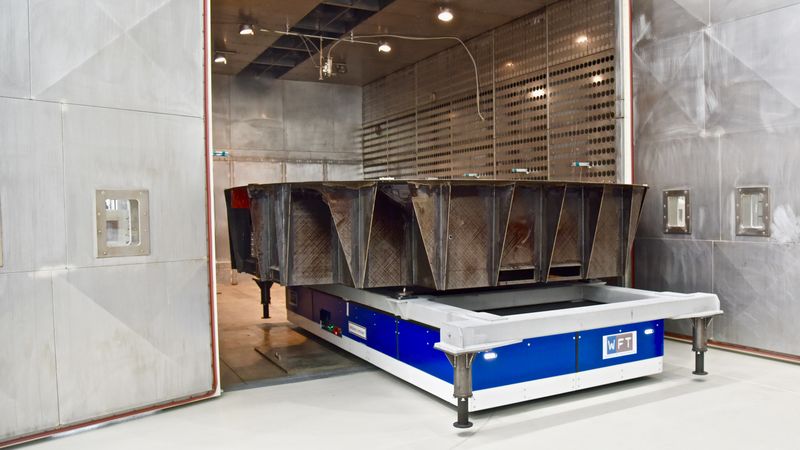
A CFRP aircraft component on its way into the enormous oven, where it cures at temperatures of up to 400°C (approx. 752°F).
(Source: Ralf Högel)
The European Union must reposition itself militarily in order to ensure its defence capabilities. Achieving this goal requires massive investments in production capacities for military equipment. For good reason, this production should take place in Europe and with European manufacturers. Stäubli offers its robotics expertise for the planning and construction of highly automated production systems.
Mechanical engineering is weakening. Competitive pressure, particularly from China, is increasing, location conditions are far from ideal, and the automotive industry, one of its key customer sectors, is undergoing its biggest transformation phase in more than one hundred years. The gradual move away from the combustion engine alone means that fewer and fewer machines and systems are required for the production of components. And this is only one of several trends negatively affecting automotive production in Europe.
The automation industry must therefore look for new sales markets. At the same time, the defence industry is being forced to massively expand its capacities. Reasons include increasing geopolitical tensions and the realisation that every European NATO country should invest more heavily in its own defence readiness.
Public funding for supporting such an investment offensive is available, in Germany through the special defence fund. Social acceptance is also in place, as are established companies currently planning significant expansions of their manufacturing operations, including Airbus, Diehl Defence, Hensoldt, KNDS, Rheinmetall, ThyssenKrupp Marine Systems and others. In addition, there are new market participants ramping up production of new drone types: Germandrones, Helsing, Quantum Systems, Tytan...
Goal: rapid expansion of production capacities
Funding is available, demand is immense and defence companies are ready. However, the manufacturing of military equipment still partly resembles workshop style production. What is lacking are state of the art, scalable production lines with pioneering automation and the use of intelligent robotics which, unlike rigid production systems, guarantees the necessary flexibility. Only this approach will make it possible to close the existing gap within the targeted timeframe.
Germany has a broad base of suppliers, machine manufacturers and special system builders capable of delivering quickly. Unfortunately, not all companies possess the required certifications and qualifications. Important regulations include those of the German Federal Office of Bundeswehr Equipment, Information Technology and In Service Support (BWB) and the Federal Office for Economic Affairs and Export Control (BAFA), as well as ISO 9100, which supplements ISO 9001 with specific safety and reliability requirements for the aerospace and defence industries.
Prerequisite: trustworthy collaboration
From the perspective of companies in the defence industry, another highly important criterion applies when selecting suppliers of automation technology: confidentiality in collaboration. In plain terms, information from projects must never fall into the wrong hands. In terms of security and confidentiality, military projects differ significantly from civilian projects. This may, for example, require the installation of secure data servers according to NATO specifications with strict access requirements.
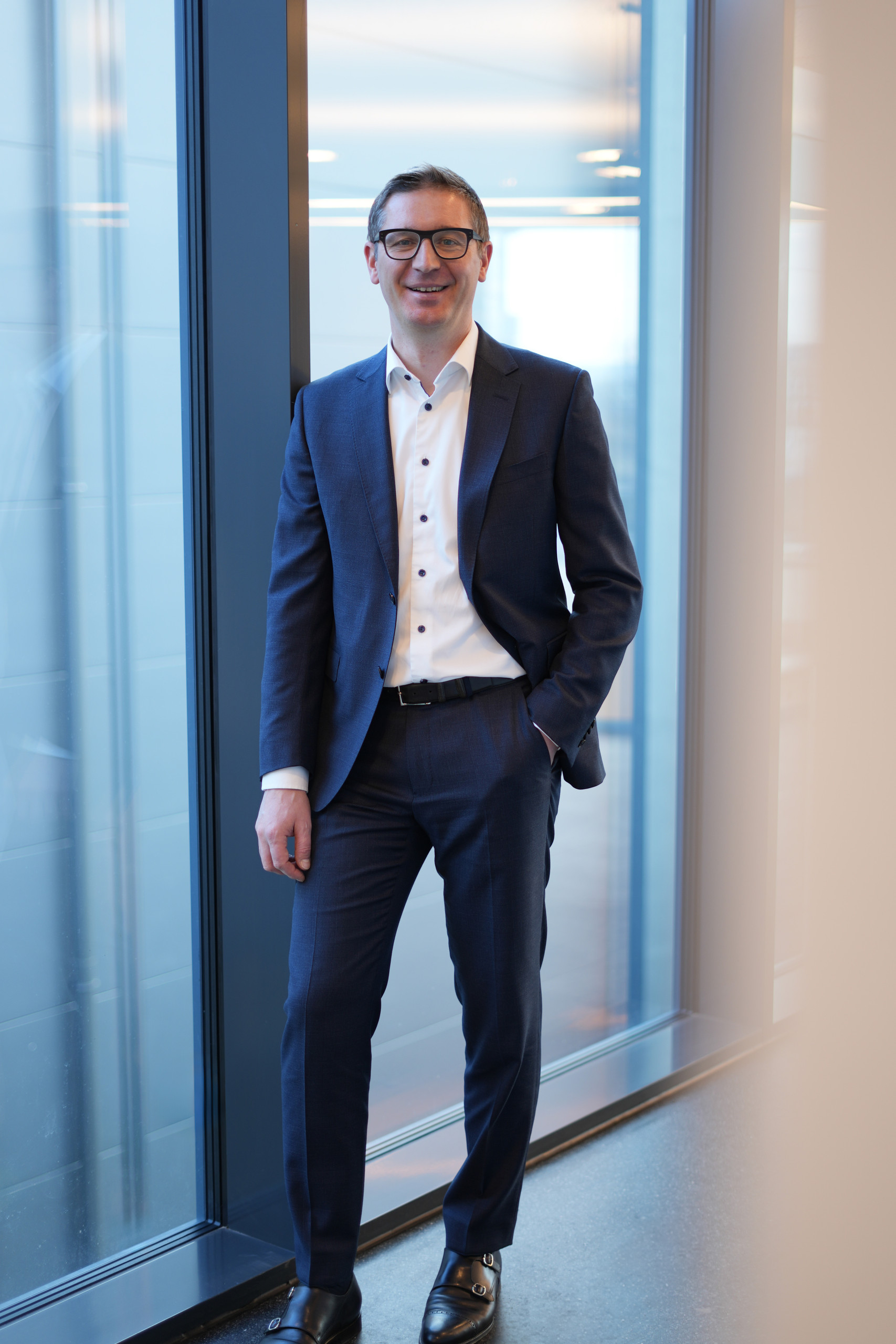
Peter Pühringer, Managing Director at Stäubli Robotics
(Source: Stäubli)
According to Peter Pühringer, Managing Director of Stäubli Robotics Bayreuth (Germany), cooperation with Stäubli offers clear advantages for customers in defence technology: “As a Swiss family owned company with a strong footprint in Germany, we are among the last robot manufacturers with exclusively European origins, including development and supply chain. In addition, we are strongly technology driven, our robots operate with extreme precision, they are exceptionally durable and we bring experience across all fields of automation, from assembly and handling through to quality assurance.”
Date: 08.12.2025
Naturally, we always handle your personal data responsibly. Any personal data we receive from you is processed in accordance with applicable data protection legislation. For detailed information please see our privacy policy.
Consent to the use of data for promotional purposes
I hereby consent to Vogel Communications Group GmbH & Co. KG, Max-Planck-Str. 7-9, 97082 Würzburg including any affiliated companies according to §§ 15 et seq. AktG (hereafter: Vogel Communications Group) using my e-mail address to send editorial newsletters. A list of all affiliated companies can be found here
Newsletter content may include all products and services of any companies mentioned above, including for example specialist journals and books, events and fairs as well as event-related products and services, print and digital media offers and services such as additional (editorial) newsletters, raffles, lead campaigns, market research both online and offline, specialist webportals and e-learning offers. In case my personal telephone number has also been collected, it may be used for offers of aforementioned products, for services of the companies mentioned above, and market research purposes.
Additionally, my consent also includes the processing of my email address and telephone number for data matching for marketing purposes with select advertising partners such as LinkedIn, Google, and Meta. For this, Vogel Communications Group may transmit said data in hashed form to the advertising partners who then use said data to determine whether I am also a member of the mentioned advertising partner portals. Vogel Communications Group uses this feature for the purposes of re-targeting (up-selling, cross-selling, and customer loyalty), generating so-called look-alike audiences for acquisition of new customers, and as basis for exclusion for on-going advertising campaigns. Further information can be found in section “data matching for marketing purposes”.
In case I access protected data on Internet portals of Vogel Communications Group including any affiliated companies according to §§ 15 et seq. AktG, I need to provide further data in order to register for the access to such content. In return for this free access to editorial content, my data may be used in accordance with this consent for the purposes stated here. This does not apply to data matching for marketing purposes.
Right of revocation
I understand that I can revoke my consent at will. My revocation does not change the lawfulness of data processing that was conducted based on my consent leading up to my revocation. One option to declare my revocation is to use the contact form found at https://contact.vogel.de. In case I no longer wish to receive certain newsletters, I have subscribed to, I can also click on the unsubscribe link included at the end of a newsletter. Further information regarding my right of revocation and the implementation of it as well as the consequences of my revocation can be found in the data protection declaration, section editorial newsletter.
Robotics solutions for demanding QA tasks
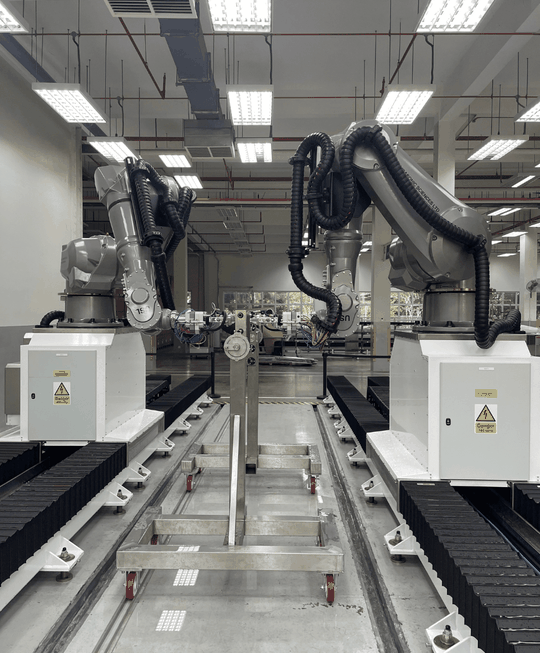
The first choice for use in ultrasonic testing systems for aircraft components: a pair of perfectly synchronised Stäubli robots.
(Source: Ultrasonic Sciences Ltd.)
One example is the British company Ultrasonic Science Ltd., which builds systems for the non destructive ultrasonic testing of aircraft fuselages made from fibre composite materials. The sometimes very large and complex shaped components must be inspected square centimetre by square centimetre for irregularities such as foreign body inclusions and delamination. This is done by synchronously applying a movable water jet to both sides of the parts being inspected, with the jet required to strike the surface at exactly the same angle.
Two six axis Stäubli robots travelling on a linear axis guide the water jet with maximum precision and absolute synchronisation. In total, 18 axes are coordinated and synchronised during the inspection process, making this a highly demanding and safety critical task even from the perspective of robotics experts.
For further demanding applications in defence technology and ammunition production, Stäubli Robotics offers specially equipped robotic systems, including complete temperature monitoring of all drives, ESD protection, air purge options and ATEX versions.
Mobile robots for specialised logistics tasks
Peter Pühringer also sees Stäubli’s innovative solutions in the field of mobile robotics as another decisive advantage: “We offer a broad range of autonomous mobile robots, including heavy duty transport systems. Our AGVs and autonomous forklifts are the first choice for optimising and automating logistical processes, for example in the production of armoured vehicles, aircraft and rockets.”
One such heavy duty AGV system from Stäubli is used at the Centre for Lightweight Production Technology in Augsburg (Germany). Here, the remotely controlled vehicle transports CFRP structural aircraft components into curing ovens. This takes place in tools weighing up to 20 tonnes (approx. 22 US tons), which give the component its shape.
New concepts for automated yet flexible production
One of Stäubli’s goals in working with companies in the defence industry is to support these customers in implementing new production concepts. To achieve this, the robot manufacturer cooperates with special system builders that already possess experience in the defence industry, such as automation specialist M.A.i. from Kronach (Germany) in Franconia.
Its Managing Director Mario Michel recommends an intelligent approach rather than pure mass production: “Particularly for drones and other highly advanced systems, the objective is not to produce the highest possible quantities for stockpiling. Instead, it makes more sense to build manufacturing capacities. The conflict in Ukraine demonstrates that drones can become outdated within just a few weeks. The goal is therefore to be able to produce high quantities of the latest generation drones on demand within the shortest possible time. This requires flexibility, which we can ideally ensure through automation and robotics.”
Best approach: holistic solutions from a single source
Even system integrators and robot manufacturers cannot provide such automated yet flexible production systems entirely from their own resources. In demanding application fields such as the defence industry, they must be able to rely on additional manufacturing expertise. These competencies are combined within the recently founded initiative Partners for Defence, or P4D for short, which alongside M.A.i. and Stäubli also includes seven additional companies from the mechanical engineering and automation sectors.
This alliance combines experience, technological excellence and innovative strength across all production areas relevant to the defence industry. Peter Pühringer explains: “The aim of the partnership is to create synergies, share know how and jointly provide powerful, practical manufacturing systems tailored to the requirements of the defence industry, enabling the rapid establishment of the necessary production capacities.”
Joint effort for entering a new market
The importance Stäubli Robotics assigns to the defence sector is underlined by a symposium entitled “Connecting Expertise in Automation and Defence”, which the company will host on 2 July 2026 at its new Welcome Centre in Bayreuth (Germany). Renowned experts with experience in the defence sector have been secured as speakers.
At the start of the symposium, Marc Helmig, Head of SME Affairs at the German Security and Defence Industry Association, will explain the ecosystem of this industry, outline the fundamentals and identify the requirements for market access. This will be followed by presentations from representatives of medium sized companies including ASIS, M.A.i. and Rösler, all active within the P4D initiative and prepared as well as capable of providing impulses for the automation of production within the defence industry.




:quality(80)/p7i.vogel.de/wcms/e5/97/e5972729567e7eaf4c7099a2bff83347/isar-aerospace-spectrum-on-pad-wide-shot-1920x1079v1.jpeg "(Source: Isar Aerospace)")
:quality(80)/p7i.vogel.de/wcms/ad/2c/ad2c3b94242458ff7fdb034746e5a916/spectrum-on-the-launch-pad-under-northern-lights-1920x1079v1.jpeg "Spectrum ahead of its second flight on the launch pad at Norway’s Andøya Spaceport. With the successful flight, Isar Aerospace has become the first company to launch satellites into orbit from continental Europe. (Photo: Isar Aerospace / ESA – ESA Standard Licence)")
:quality(80)/p7i.vogel.de/wcms/30/07/300782652f0397e8a221f6edf5e087a4/pete-linforth-auf-pixabay-1920x1080v1.jpeg "(Source: Pete Linforth on Pixabay)")
:quality(80)/p7i.vogel.de/wcms/3a/4e/3a4eee9a02e9c88c4b88fe5b430be79d/bild1-1386x779v1.jpeg "Defence companies need more than investment and technology: They also need the skilled professionals who can turn both into new capabilities. (Source: YER Germany)")
:quality(80)/p7i.vogel.de/wcms/cd/a9/cda92b173afa9d0b455d4f11b281c9ea/0094-to-image--capstone-cdr-1440x810v1.png "(Source: Terran Orbital)")
:quality(80)/p7i.vogel.de/wcms/e0/45/e045bc5414d7263fb308bdd501b5fcc1/0133113962v1.jpeg "The HSWL 354 is the transmission used, for example, in the Leopard 2 main battle tank. Renk manufactures this system and is now preparing to significantly increase its cycle time. As a result, Renk is placing greater emphasis on the military sector as a customer ... (Source: Renk)")
:quality(80)/p7i.vogel.de/wcms/a1/5c/a15c2aeba563d5bc3e11fb879b21eb2c/0132989650v1.jpeg "FSS, the flexible clamping system for varying free-form surfaces, is designed for the aerospace industry and other sectors. (Source: Römheld GmbH Friedrichshütte)")
:quality(80)/p7i.vogel.de/wcms/9f/07/9f070dc919a95a6f19bcc1848e9f3089/image-2000-c966ec423c4d86c3769c5a9f1fff7655-1920x1079v1.jpeg "The Idefix rover is firmly mounted between the landing legs of the MMX spacecraft. Despite its compact size, Idefix essentially contains all the elements of a fully fledged scientific rover, yet thanks to its highly integrated design, it has a mass of only 25 kilograms (approx. 55 pounds). (Source: DLR (CC BY-NC-ND 3.0))")
:quality(80)/p7i.vogel.de/wcms/0b/93/0b93fcec0baed888b9964be24db64d30/nato-demonstrates-kelluu-repmus-1-1920x1079v1.png "Representatives from Finnish company Kelluu test their unmanned airship at REPMUS 2025. The drills included tests of technology developed through NATO’s Defence Innovation Accelerator for the North Atlantic (DIANA). (Source: NATO)")
:quality(80)/p7i.vogel.de/wcms/1f/d2/1fd2bffd9eeae597b0e2d2e3cad0adf0/20260828-en-5416166-1-1920x1079v1.jpeg "(Source: Saab)")
:quality(80)/p7i.vogel.de/wcms/d1/ea/d1ea25bed73e011051eb6d4ccf9acc95/hensoldt-and-eplane-1280x720v1.jpeg "Representatives from HENSOLDT and ePlane at the contract signing. (Source: HENSOLDT)")
:quality(80)/p7i.vogel.de/wcms/7b/35/7b351947b314400d23a07a25493ee6b3/encapsulation-mtg-i2-1-1294x728v1.jpeg "MTG-I2 being encapsulated. (Source: 2026 ESA-CNES-ARIANESPACE-ArianeGroup / Optique Vidéo de CSG—S MARTIN)")
:quality(80)/p7i.vogel.de/wcms/6f/fe/6ffef325e7f233cc3521943158eb1ebd/0132763535v1.jpeg "Two companies are planning to establish, for the first time in 2027, an optical laser communication link directly between a satellite in low Earth orbit (LEO) and a re-entering spacecraft. (Source: ATMOS Space Cargo)")
:quality(80)/p7i.vogel.de/wcms/b2/6a/b26a277a3578fc2956b2c30d3b3b0146/0132928076v1.jpeg "Compact and standardised: CubeSats enable cost-effective space missions and are increasingly serving as a platform for testing new technologies—from sensors and communications to innovative power systems. (Source: City Labs, Inc.)")
:quality(80)/p7i.vogel.de/wcms/6d/f2/6df225601e1f8d4f9d07d53fd527cdb9/epc7050-7065-7066-pr-graphic-clean-1500x844v1.jpeg "(Source: EPC Space)")
:quality(80)/p7i.vogel.de/wcms/2a/ae/2aae2c389f328a77a3c1eb502b79f019/mc1779-image-space-csac-sa-65-1898x1067v1.jpeg "The Space CSAC-SA65 combines atomic-clock accuracy with built-in 1 PPS disciplining and low-power consumption. (Source: Microchip Technology Inc.)")
:quality(80)/p7i.vogel.de/wcms/9d/d6/9dd61fd68817d5639462786c7a286fb4/jr3-demo-900-900x506v1.jpeg "Lockheed Martin’s Joint Reduced Range Rocket (JR3) successfully launches during a flight test at Yuma Proving Ground, Arizona. (Source: Lockheed Martin)")
:quality(80)/p7i.vogel.de/wcms/63/fc/63fccbb5ddb29682fefbad9d8d176086/lora-missile-launcher-974x548v1.jpeg "IAI's LORA long-range ballistic missile and its mobile launcher. The German Navy has now successfully tested the naval version of the weapon system from a frigate in the North Atlantic. (Photo: )")
:quality(80)/p7i.vogel.de/wcms/88/c3/88c3d15379492ba52abe12f95b0aa4d3/dalo-2026-signing-4-1294x728v1.jpeg "(Left to Right) Danish Ministry of Defence Material and Procurement Agency Director Per Pugholm Olsen, Country Director Thales Denmark, Ireland, Iceland & Baltics, Martin Soegaard, Systematic CEO, Nikolaj Bramsen and Danish Minister of Defence, Jeppe Bruus. (Source: Rune Borre-Jensen)")
:quality(80)/p7i.vogel.de/wcms/ff/b1/ffb1d2c79ae4ac90473f50287e7bd7c0/saildrone-1567x881v1.jpeg "Saildrone Surveyor class unmanned surface vessel integrated with JAGM dual launcher. (Source: Lockheed Martin)")
:quality(80)/p7i.vogel.de/wcms/90/a8/90a849f0023f11d1eb642eb4751a0321/bild2-h-c3-a4nel-ict-20truck-20and-20trailer-20parts-4320x2429v1.jpeg "Product information is visible at all times and retrieval of items
is confirmed by employees directly on the display of the Hänel MP 14 N
controller. (Source: René Marks)")
:quality(80)/p7i.vogel.de/wcms/4e/ca/4ecaa39f247490eded591b652c33aee3/thilmann-hcp-web-20kleiner-20ausschnitt-1442x811v1.jpeg "Entering the defence market can be challenging for start-ups, says HCP Sense CEO Ansgar Thilmann. (Picture: HCP Sense)")
:quality(80)/p7i.vogel.de/wcms/7a/51/7a511b80041d3f1335f3a5aa56fe75da/delivery-7022432-1280-1280x720v1.png "(Source: Mohamed_hassan)")
:quality(80)/p7i.vogel.de/wcms/f9/2f/f92f1ef8c739c34c70d99f7b0997621b/stra007-20--20cover-20image-5472x3076v1.jpeg "(Source: Stratasys)")
:quality(80)/p7i.vogel.de/wcms/ec/a9/eca9062ccbe4b042f8515846340410d8/aerospace-and-defence-stairways-platforms-and-much-morev1.jpeg "Modular constructions enable flexible modification. That applies to larger structures such as stairways and platforms, too. And that means aerospace and defence companies can reconfigure their maintenance platforms fast (itemitem)")
:quality(80)/p7i.vogel.de/wcms/30/2a/302a7b5723ad38fbde812fd3a468ad04/safety-on-stairways-in-industry-key-considerationsv1.jpeg "Stairways and platforms are used widely in maintenance and assembly areas in the aerospace and defence sectors. (Source: item)")
:quality(80)/p7i.vogel.de/wcms/f3/4e/f34ed744bb30817d3432c7ad522e6f30/engine-1v1.jpeg "Engineering with aluminium profiles really can be this easy – the item Engineeringtool and its smart functions help you save valuable time. (Source: item)")
:fill(fff,0)/p7i.vogel.de/companies/69/6d/696de2483d115/logo--fastems-rgb-horizontal.jpeg "logo--fastems-rgb-horizontal (Fastems)")
:fill(fff,0)/images.vogel.de/vogelonline/companyimg/84700/84735/65.jpg "logo_item_rgb_neu.jpg ()")
:quality(80)/p7i.vogel.de/wcms/da/fe/dafe89d79099a06a572ac0cea8359899/additive-20manufacturing-20is-20a-20key-20logistics-20enabler-20for-20troops-20in-20contested-20environments-2c-20where-20traditional-20supply-20routes-20are-20not-20always-20available--2972x1673v1.jpeg "Additive manufacturing is a key logistics enabler for troops in contested environments, where traditional supply routes are not always available. (Source: Replique)")
:quality(80)/p7i.vogel.de/wcms/b7/9d/b79da9ab0d8dd5ddf5a66e06772de8cc/2601-sonplas-vb-enforcetac-pic1-1724x969v1.jpeg "Together with CUONICS and de Jonge, Sonplas brings together expertise in development, mechanical engineering, and AI-based electronics in a joint trade show presence. (Source: Sonplas)")
:quality(80)/p7i.vogel.de/wcms/6c/22/6c2214595f175cac0cb8933c26d12cc6/2601-sonplas-vb-enforcetac-pic2-8057x4532v1.jpeg "Sonplas' customised assembly and production systems enable precise, reliable, and flexible serial manufacturing of technical components. (Source: Sonplas GmbH)")