Thales Alenia Space signs phase 1 contract with ESA.
(Source: OHB)
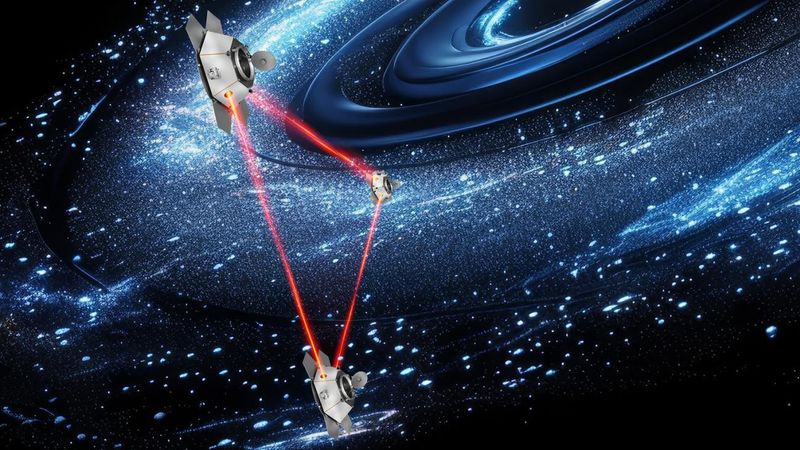
Thales Alenia Space, the joint venture between Thales (67%) and Leonardo (33%), announces the signing of a €26.1 million (approx. 31 million USD) phase 1 contract with the European Space Agency (ESA) related to the development of LISA’s telescopes. Made up of three satellites, the LISA (Laser Interferometer Space Antenna) mission will be the first European space observatory capable of detecting and studying gravitational waves generated by extreme cosmic events.
This latest announcement follows the signing of two other contracts related to the same mission. In June 2025, Thales Alenia Space announced a contract with prime contractor OHB System AG to provide several critical elements, including the spacecraft avionics and control software, the telecommunication system, and the drag-free and attitude control system (DFACS). In January 2026, the company was also selected by OHB System AG to provide the propulsion subsystem.
Thales Alenia Space’s optical excellence at the service of space exploration
In France, Thales Alenia Space and Thales SESO®, which are responsible for developing the optical payload telescopes, will make a major contribution to the mission.
Based on its globally renowned expertise in the design and manufacture of advanced optical technologies, Thales Alenia Space has been selected by the European Space Agency (ESA) to conduct Phase 1 for the development of the six telescopes, which is expected to proceed in three phases.
As prime contractor, Thales Alenia Space will be responsible for the development, design, assembly, and testing of the telescopes. The manufacture of the six telescopes, made entirely of Zerodur®, will present an unprecedented technological challenge.
It is only the combined expertise in design and manufacturing of Thales SESO and Thales Alenia Space, along with Zerodur®’s extremely low thermal sensitivity, that will enable the picometer-level stability required by LISA mission.
For this initial development contract, Thales Alenia Space will be able to draw on the long-standing expertise of Thales SESO, Europe’s leading supplier of ultra-lightweight Zerodur mirrors.
Thales SESO will be responsible for the procurement, machining, and polishing of the optics and structure. In addition, Thales Alenia Space and Thales SESO will jointly be responsible for assembling the telescopes, aligning the optics, and conducting environmental and performance tests. With more than 200 Zerodur® Space mirrors manufactured and flying, Thales SESO is among the world top leaders for optical surface precision achieved through polishing, with 0.2 nanometers reached over the 230-mm (approx. 9 inches) diameter surface of the mirrors made for Virgo (the European ground gravitational wave detector) —a level of precision that is priceless for the LISA mission.
"LISA represents a pioneering initiative in astrophysics and space exploration that has not previously been attempted. Thales Alenia Space is responsible for several mission-critical components of the LISA project. I am pleased to expand our collaboration with Thales Alenia Space to include the first phase of the development of the telescopes, significantly mitigating the risk of this technological challenge. Thales Alenia Space will partner with Thales SESO, a leading European supplier of ultra-lightweight Zerodur mirrors. I am looking forward to seeing the first results of this development by year-end.” said Filippo Marliani, LISA Project Manager at ESA.
“We are extremely proud to be part of this exceptional mission dedicated to the study of gravitational waves from space, and we would like to thank ESA for its renewed trust,” said Bertrand Denis, Vice President Observation, Science, and Exploration at Thales Alenia Space in France. “The development of these telescopes is fully aligned with the core expertise of Thales Alenia Space and Thales SESO in high-performance optical instrumentation. Our capability to produce instruments in series will also be a real asset in the project’s success.”
LISA: the first space-based observatory for the study of gravitational waves
LISA (Laser Interferometer Space Antenna) is a unique space exploration mission by the European Space Agency (ESA) designed to detect gravitational waves directly from space. This space observatory will detect the tiniest distortions in spacetime caused by gravitational waves generated by the acceleration of massive objects, as predicted by Albert Einstein’s theory of general relativity in 1916, with a sensitivity and within a very low frequency range (between 0.1 mHz and 100 mHz), inaccessible to existing ground-based measurement facilities such as LIGO in the United States and VIRGO in Europe, due to their limited size and seismic interferences.
Date: 08.12.2025
Naturally, we always handle your personal data responsibly. Any personal data we receive from you is processed in accordance with applicable data protection legislation. For detailed information please see our privacy policy.
Consent to the use of data for promotional purposes
I hereby consent to Vogel Communications Group GmbH & Co. KG, Max-Planck-Str. 7-9, 97082 Würzburg including any affiliated companies according to §§ 15 et seq. AktG (hereafter: Vogel Communications Group) using my e-mail address to send editorial newsletters. A list of all affiliated companies can be found here
Newsletter content may include all products and services of any companies mentioned above, including for example specialist journals and books, events and fairs as well as event-related products and services, print and digital media offers and services such as additional (editorial) newsletters, raffles, lead campaigns, market research both online and offline, specialist webportals and e-learning offers. In case my personal telephone number has also been collected, it may be used for offers of aforementioned products, for services of the companies mentioned above, and market research purposes.
Additionally, my consent also includes the processing of my email address and telephone number for data matching for marketing purposes with select advertising partners such as LinkedIn, Google, and Meta. For this, Vogel Communications Group may transmit said data in hashed form to the advertising partners who then use said data to determine whether I am also a member of the mentioned advertising partner portals. Vogel Communications Group uses this feature for the purposes of re-targeting (up-selling, cross-selling, and customer loyalty), generating so-called look-alike audiences for acquisition of new customers, and as basis for exclusion for on-going advertising campaigns. Further information can be found in section “data matching for marketing purposes”.
In case I access protected data on Internet portals of Vogel Communications Group including any affiliated companies according to §§ 15 et seq. AktG, I need to provide further data in order to register for the access to such content. In return for this free access to editorial content, my data may be used in accordance with this consent for the purposes stated here. This does not apply to data matching for marketing purposes.
Right of revocation
I understand that I can revoke my consent at will. My revocation does not change the lawfulness of data processing that was conducted based on my consent leading up to my revocation. One option to declare my revocation is to use the contact form found at https://contact.vogel.de. In case I no longer wish to receive certain newsletters, I have subscribed to, I can also click on the unsubscribe link included at the end of a newsletter. Further information regarding my right of revocation and the implementation of it as well as the consequences of my revocation can be found in the data protection declaration, section editorial newsletter.
The LISA mission will provide a new opportunity to understand the early universe that existed before the formation of stars and galaxies, as well as celestial phenomena such as the interaction of compact stars or the merger of supermassive black holes at the centers of galaxies.
LISA consists of a constellation of three satellites, each spaced 2.5 million kilometers (approx. 1.6 million miles) apart, forming an equilateral triangle and each carrying two test masses. These three satellites are linked by six laser beams, thus forming a massive optical interferometer. These inter-satellite laser beams will measure the displacement of these masses with an accuracy on the order of a picometer (smaller than an atom).
The LISA mission satellites benefit from the experience gained during the LISA Pathfinder program, launched in 2015, which successfully demonstrated the ability to maintain test masses in a state of “free fall” with exceptional precision. The same precision propulsion system, also used for ESA’s Gaia and Euclid missions, will ensure that each satellite keeps the laser interferometer beams pointed toward the other satellites with the utmost precision.
LISA will employ advanced laser interferometry measurement techniques to study astrophysical phenomena involving massive and distant systems, thereby offering unprecedented opportunities to explore and understand our universe. The three satellites are scheduled to launch in 2035 aboard an Ariane 6 rocket.
LISA mission: Thales Alenia Space’s contribution
Thales Alenia Space will provide prime contractor OHB System AG with several mission-critical elements, including the spacecraft avionics and control software, the telecommunication system, and the drag-free and attitude control system (DFACS). The joint venture will be responsible for the design, manufacture, assembly, integration, and testing of the propulsion subsystem for the LISA mission. Thales Alenia Space is also responsible for ensuring the exceptional electromagnetic, radiation, and self-gravity operational environment for the payload, essential to mission performance, for which Thales Alenia Space is also managing the budgets.
Thales Alenia Space in Turin, Italy, as member of the LISA Core Team makes use of the experience and design solutions inherited from the five-year study phase led by Thales Alenia Space as the prime contractor. Our facility, in Gorgonzola, Italy, will develop the On Board Computer and the Mass Memory in the same integrated unit. In the United Kingdom, the company is supplying the propulsion system, while France is responsible for developing the telescopes in collaboration with Thales SESO. Our teams in Switzerland are involved in developing part of the instrument's electronics and of the Constellation Acquisition System for LISA.
Leonardo is also contributing with its technologies to the LISA mission with some key equipment, such as the micro propulsion assemblies, a highly precise system of thrusters used to control the satellite’s attitude with extreme accuracy. Other company sites will also have the opportunity to contribute to the LISA mission, supplying spacecraft subsystems or equipment.




:quality(80)/p7i.vogel.de/wcms/e6/34/e634876855ad98bb8dcb153ad57ffa5a/watercat-m18-marine-alutech-jpg-1200x675v1.jpeg "(Source: Bundeswehr Equipment, Information Technology and In-Service Support)")
:quality(80)/p7i.vogel.de/wcms/8f/ff/8fff797bf8cd83f5dd0e310d7d21ded7/a330-mrtt-refuelling-1920x1079v1.jpeg "Spain, Germany and Belgium moved ahead on 8 October 2026 with the second phase of a European Defence Agency (EDA) Research, Technology and Innovation project towards the automation of mid-air hose-and-drogue refuelling of military aircraft. The final aim of the project is to enable air-to-air refuelling between unmanned aircraft. (Source: European Defence Agency)")
:quality(80)/p7i.vogel.de/wcms/55/05/55056f815947f093f95f1c3827ed0650/edf-calls-closing-990x557v1.png "(Source: European Commission)")
:quality(80)/p7i.vogel.de/wcms/24/d7/24d7cb3e5341f65678b914829b3650f8/airbus-u740-valkyrie-first-flight-photo-02-valkyrie-heroshots-0010-8033-1920x1079v1.jpeg "The Airbus U740 Valkyrie during its first European flight test. (Photo: Airbus Defence and Space GmbH 2026)")
:quality(80)/p7i.vogel.de/wcms/9a/bf/9abfeb002156253fb3a82749de35ca28/saf2020-0333676-1800x1013v1.jpeg "A new \"Factory 4.0\" to make primary mirror segments for the Extremely Large Telescope. (Source: Safran Group)")
:quality(80)/p7i.vogel.de/wcms/a6/71/a6713b64fb8aee687258fcf1014ea3b5/2026-03-08-aerospike-09-980x551v1.jpeg "The engine was developed with the aid of Noyron, LEAP 71’s computer-aided design model. Noyron uses basic physical principles, engineering logic, and manufacturing specifications to design autonomously without human intervention. (Source: LEAP 71)")
:quality(80)/p7i.vogel.de/wcms/91/c9/91c93dbd66b08824c35643875aabe61f/bild1-1245x700v1.jpeg "Two scientists in front of a vacuum chamber used for testing. (Source: Busch Group)")
:quality(80)/p7i.vogel.de/wcms/76/1d/761de63f32752dc5a9722559c527fc1f/design-ohne-titel-5-1920x1079v1.png "(Source: Analog Devices)")
:quality(80)/p7i.vogel.de/wcms/f6/90/f69066c327229cfea821628238013ad1/6e0dd4339494960c5f2c491aa30a8d26-l-jpg-1920x1079v1.webp "(Source: Arianespace)")
:quality(80)/p7i.vogel.de/wcms/ae/c1/aec143cc59607cd59eeb8b824b860172/faroe-flag-image-for-pr-6-1680x944v1.png "(Source: Thales)")
:quality(80)/p7i.vogel.de/wcms/94/c2/94c200c11610b28c5107f271c8269c48/airbus-u740-valkyrie-first-flight-photo-02-valkyrie-heroshots-0010-8033-1920x1079v1.jpeg "The Airbus U740 takes off for its first flight in Europe.
(Source: Airbus Defence and Space GmbH 2026)")
:quality(80)/p7i.vogel.de/wcms/41/16/41162d793da057b8926aa216d1917f3a/image-2000-87c4e85417d8ad2252869e1109a24719-1918x1079v1.jpeg "Launch of SpaceX’s Transporter-18 Mission. (Source: SpaceX)")
:quality(80)/p7i.vogel.de/wcms/50/85/50856774ce46ad8f94f37e328ba3b6d3/ptc-frau-arbeitet-mit-model-am-pc-neben-turbine-1911x1076v1.jpeg "(Source: PTC)")
:quality(80)/p7i.vogel.de/wcms/9c/60/9c60e13e660fe6b444ec71c59b5598ce/publicdomainarchive-on-pixabay-1920x1079v1.jpeg "(Source: PublicDomainArchive on Pixabay)")
:quality(80)/p7i.vogel.de/wcms/b6/6d/b66d11215bcdb8e107ca626e6cfd3643/tungart7-future-9045696-1920x1079v1.jpeg "Transparent and controllable AI architectures can support crisis management by making data sources, reasoning processes and uncertainties visible to human decision-makers. (Source: Tung Lam on Pixabay)")
:quality(80)/p7i.vogel.de/wcms/ed/e6/ede67e479952b7bad62244697e3cd3db/aa383c9a-015c-424b-95da-d8d56156c227-1536x864v1.png "Intelic's AI-supported command-and-control system Nexus can integrate sensors and interceptor drones to counter aerial threats (Illustration). (Picture: AI generated)")
:quality(80)/p7i.vogel.de/wcms/b9/fa/b9fa8db023a4ba7b2f0c7b6e0a611d89/2026-10-12-american-rheinmetall-auf-der-ausa-2026-69222c75-1225x690v1.jpeg "American Rheinmetall presents next-generation defence technologies and capabilities at AUSA 2026 in Washington, D.C. (Source: Rheinmetall AG)")
:quality(80)/p7i.vogel.de/wcms/0e/88/0e889ba1354b3833bccdc0d32aaf76a2/airborne-electronic-attack-scenario-1246x700v1.jpeg "Modern air warfare is no longer decided solely by kinetic capabilities. A significant part of military conflicts has shifted to an invisible dimension: the electromagnetic spectrum. (Source: HENSOLDT)")
:quality(80)/p7i.vogel.de/wcms/d4/8e/d48e922adf87b94ec8356eabaaebc9b8/morfius-image-resize-jpg-pc-adaptive-full-medium-900x506v1.jpeg "Lockheed Martin’s MORFIUS® X-Rotor is the first of its kind counter-drone system. (Source: Lockheed Martin)")
:quality(80)/p7i.vogel.de/wcms/93/7e/937e0958ca684b36382d6025daa4880e/2026-10-06-rheinmetall-integriert-human-machine-teaming-in-gepanzerte-fahrzeuge-media-06a35258-query-2x-c641d5e7-1910x1075v1.jpeg "Rheinmetall and Breaker are integrating Human-Machine Teaming into the Boxer Combat Reconnaissance Vehicle, enabling crews to control teams of autonomous systems by voice command. (Source: Rheinmetall AG)")
:quality(80)/p7i.vogel.de/wcms/90/a8/90a849f0023f11d1eb642eb4751a0321/bild2-h-c3-a4nel-ict-20truck-20and-20trailer-20parts-4320x2429v1.jpeg "Product information is visible at all times and retrieval of items
is confirmed by employees directly on the display of the Hänel MP 14 N
controller. (Source: René Marks)")
:quality(80)/p7i.vogel.de/wcms/4e/ca/4ecaa39f247490eded591b652c33aee3/thilmann-hcp-web-20kleiner-20ausschnitt-1442x811v1.jpeg "Entering the defence market can be challenging for start-ups, says HCP Sense CEO Ansgar Thilmann. (Picture: HCP Sense)")
:quality(80)/p7i.vogel.de/wcms/7a/51/7a511b80041d3f1335f3a5aa56fe75da/delivery-7022432-1280-1280x720v1.png "(Source: Mohamed_hassan)")
:quality(80)/p7i.vogel.de/wcms/f9/2f/f92f1ef8c739c34c70d99f7b0997621b/stra007-20--20cover-20image-5472x3076v1.jpeg "(Source: Stratasys)")
:quality(80)/p7i.vogel.de/wcms/ec/a9/eca9062ccbe4b042f8515846340410d8/aerospace-and-defence-stairways-platforms-and-much-morev1.jpeg "Modular constructions enable flexible modification. That applies to larger structures such as stairways and platforms, too. And that means aerospace and defence companies can reconfigure their maintenance platforms fast (itemitem)")
:quality(80)/p7i.vogel.de/wcms/30/2a/302a7b5723ad38fbde812fd3a468ad04/safety-on-stairways-in-industry-key-considerationsv1.jpeg "Stairways and platforms are used widely in maintenance and assembly areas in the aerospace and defence sectors. (Source: item)")
:quality(80)/p7i.vogel.de/wcms/f3/4e/f34ed744bb30817d3432c7ad522e6f30/engine-1v1.jpeg "Engineering with aluminium profiles really can be this easy – the item Engineeringtool and its smart functions help you save valuable time. (Source: item)")
:fill(fff,0)/p7i.vogel.de/companies/64/fe/64fec73b1a2fb/logo-master-ggbbytimken-286blue.jpeg "logo-master-ggbbytimken-286blue (GGB)")
:fill(fff,0)/p7i.vogel.de/companies/69/6d/696de2483d115/logo--fastems-rgb-horizontal.jpeg "logo--fastems-rgb-horizontal (Fastems)")
:fill(fff,0)/images.vogel.de/vogelonline/companyimg/84700/84735/65.jpg "logo_item_rgb_neu.jpg ()")
:quality(80)/p7i.vogel.de/wcms/b2/db/b2db599d38480ee76cb0632c3c5ac968/sentinel3c-sadeploymentthalesaleniaspace-alban-pichon-3-1680x944v1.jpeg "sentinel3c-sadeploymentthalesaleniaspace-alban-pichon-3-1680x944v1 (Source: Thales Alenia Space, A. Pichon)")
:quality(80)/p7i.vogel.de/wcms/9a/bf/9abfeb002156253fb3a82749de35ca28/saf2020-0333676-1800x1013v1.jpeg "A new \"Factory 4.0\" to make primary mirror segments for the Extremely Large Telescope. (Source: Safran Group)")