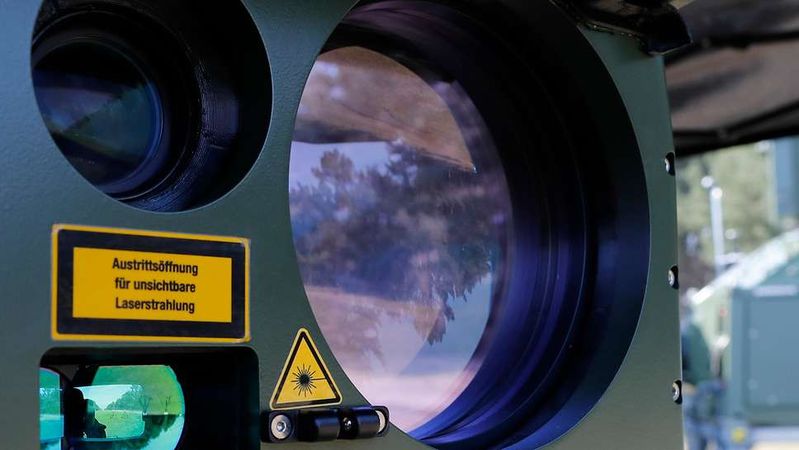
Modern laser weapons are rapidly emerging as a precise and cost-efficient complement to conventional defence systems.
(Source: Bundeswehr/Dirk Bannert)
Drones and increasingly complex threat scenarios are pushing established defence systems to their limits more frequently: missiles are expensive, ammunition is limited, and response times are too slow. As a result, laser weapons are becoming a key focus of military development and testing. They impress with speed, high precision, and comparatively low costs.
High-energy lasers destroy their targets compared to conventional weapons by means of a precise and focused laser beam directed at a previously selected point with sufficient energy. This creates such a high concentration of heat at that point that materials immediately begin to melt, structures are weakened, or electronics are damaged. In this way, targets can be engaged from kilometres away.
What is a laser weapon demonstrator?
A laser weapon demonstrator is a laser system with which part of the functions or the entire functional chain, meaning target detection, tracking, and engagement, of a laser weapon can be demonstrated and tested in practice together with the required system components. The aim is to identify and minimise risks and weaknesses for product maturity at an early stage. System components include laser sources, beam shaping, energy supply, cooling, optics, radar, and targeting units.
One example is the laser system MILOS (Modular Integrated Laser Optical System), which, together with other systems, is being tested by the German Armed Forces Technical Centre for Weapons and Ammunition (WTD 91) at its laser test range in Meppen, Lower Saxony. MILOS is a compact, static demonstrator that in its current configuration is used to destroy targets with little or no movement. The system can detonate munitions such as mines, disrupt cameras, or open access points, all using concentrated laser light.
Precise and portable: the MILOS test model has proven convincing. The goal is to further improve the system’s performance in order to increase the effective range or reduce the required engagement time. The system is controlled via a standard commercial gamepad and a monitor with a view of the target. Testing in Meppen has shown that operators are already familiar with this type of control from everyday life, making it intuitive to use.
Gallery
Effective protection on land and at sea
Another system being thoroughly tested in Meppen is the Joint Universal Platform for Laser Integration, Test and Evaluation in Realtime, or JUPITER. The German-Dutch project includes a module of the GTK Boxer system in which the required laser weapon technology is integrated, making it highly flexible. JUPITER can be deployed against drones as well as munitions. The system allows firing while on the move, making it suitable for convoy protection in the future. Cooperation with the Netherlands to optimise the system is ongoing.
Also mobile, as it has been tested on the frigate “Sachsen”, is the laser weapon demonstrator of the procurement project “High-precision and scalable effect against agile/low-signature targets in the close and very close range of naval platforms”, abbreviated HoWiSM. Using radar, the operator detects targets in the surrounding area, can then aim at them and select the target point according to the principle “what you see is what you hit”. The targeted object is then neutralised.
If the radar fails, the system can rely entirely on powerful, daylight-independent camera systems and continue to counter threats. A key feature is so-called background discrimination. This makes it possible to precisely detect targets even at long distances and track them throughout the entire engagement. The system is expected to be operational for harbour protection or platform self-defence at sea by 2029.
Prepared for drone swarms
The newest system on the test range in Meppen is the Laser Weapon Demonstrator 24, which has been optimised for tracking targets over long distances. This laser weapon, currently in the testing phase, can accurately shoot through three coins, each with a diameter of approximately four centimetres (approx. 1.6 inches), mounted on a standard commercial drone, even at long distances. On the user interface, targets are selected one after another and penetrated within seconds.
The system is primarily intended for counter-drone operations, but future deployment against missiles and artillery ammunition is also conceivable. Target tracking, meaning following a selected target even while it is moving, is handled entirely by software. In the future, targets are also expected to be selected with AI support. This will further automate the engagement of increasingly fast-moving drones and increase reaction speed even more. The system is expected to be market-ready from 2028.
Date: 08.12.2025
Naturally, we always handle your personal data responsibly. Any personal data we receive from you is processed in accordance with applicable data protection legislation. For detailed information please see our privacy policy.
Consent to the use of data for promotional purposes
I hereby consent to Vogel Communications Group GmbH & Co. KG, Max-Planck-Str. 7-9, 97082 Würzburg including any affiliated companies according to §§ 15 et seq. AktG (hereafter: Vogel Communications Group) using my e-mail address to send editorial newsletters. A list of all affiliated companies can be found here
Newsletter content may include all products and services of any companies mentioned above, including for example specialist journals and books, events and fairs as well as event-related products and services, print and digital media offers and services such as additional (editorial) newsletters, raffles, lead campaigns, market research both online and offline, specialist webportals and e-learning offers. In case my personal telephone number has also been collected, it may be used for offers of aforementioned products, for services of the companies mentioned above, and market research purposes.
Additionally, my consent also includes the processing of my email address and telephone number for data matching for marketing purposes with select advertising partners such as LinkedIn, Google, and Meta. For this, Vogel Communications Group may transmit said data in hashed form to the advertising partners who then use said data to determine whether I am also a member of the mentioned advertising partner portals. Vogel Communications Group uses this feature for the purposes of re-targeting (up-selling, cross-selling, and customer loyalty), generating so-called look-alike audiences for acquisition of new customers, and as basis for exclusion for on-going advertising campaigns. Further information can be found in section “data matching for marketing purposes”.
In case I access protected data on Internet portals of Vogel Communications Group including any affiliated companies according to §§ 15 et seq. AktG, I need to provide further data in order to register for the access to such content. In return for this free access to editorial content, my data may be used in accordance with this consent for the purposes stated here. This does not apply to data matching for marketing purposes.
Right of revocation
I understand that I can revoke my consent at will. My revocation does not change the lawfulness of data processing that was conducted based on my consent leading up to my revocation. One option to declare my revocation is to use the contact form found at https://contact.vogel.de. In case I no longer wish to receive certain newsletters, I have subscribed to, I can also click on the unsubscribe link included at the end of a newsletter. Further information regarding my right of revocation and the implementation of it as well as the consequences of my revocation can be found in the data protection declaration, section editorial newsletter.
Laser weapons are effective, as we have demonstrated today. Together with industry, we can take the next steps.
Armin S., Business Unit Manager Laser Technology, WTD 91
Advantages and challenges
The advantages of laser weapons are clear: lower cost per use, no need for ammunition, high precision, and an almost immediate effect. At the WTD 91 test range in Meppen, future laser systems are tested for effectiveness and further developed so they can be made available to the armed forces as soon as possible. Possible application scenarios include infrastructure protection and the protection of soldiers. In addition, high-energy lasers can be used for tasks ranging from defusing an explosive device at a distance of a few hundred metres (approx. hundreds of yards) to engaging satellites.
Europe’s security landscape is changing rapidly
(Source: VCG)
As defence budgets rise and EU programmes expand, civil technology providers are becoming vital contributors to Europe’s strategic autonomy. The event will act as a neutral platform for dialogue between technology suppliers, integrators, and decision-makers shaping the next generation of European defence capabilities and aims to open doors between civil industry and defence procurement, providing practical insights.
However, there are also physical factors that limit these weapons. Atmospheric influences such as fog, rain, or dust can reduce the effectiveness of the laser beam. Heat shimmer near the ground can also affect precision. Critical aspects of laser weapons also include the required manufacturing technologies and the high demands placed on the quality of lasers, optics, camera systems, and mechatronics. Considerable specialised knowledge and expertise are required for production.
Furthermore, the laser weapon must withstand harsh military operating conditions. Energy management and weather conditions are taken into account in the design of such systems, as each laser weapon is optimised for a specific target spectrum and operational scenario to ensure the defence capabilities of the German Armed Forces.
On the path to market maturity
High-energy lasers, or laser weapons, are among the most technologically exciting developments within the armed forces. The German Armed Forces and their partners in science and the defence industry are working intensively to make these systems operational. For more than two decades, partners have been researching weapon-capable lasers and laser systems. The next step is to bring them to market maturity. In the future, laser weapons will likely be one thing above all: a powerful complement to conventional weapon systems, enabling adaptation to an ever-changing threat landscape.




:quality(80)/p7i.vogel.de/wcms/a5/e5/a5e5eecaf9443bd94c6833c158d7cced/20260924-en-5431005-1-640x360v1.jpeg "(Source: Saab AB)")
:quality(80)/p7i.vogel.de/wcms/e0/e7/e0e7bcd804912a34cd152be69b05a70f/rfa-esaboost-uk-1024x682-1024x576v1.jpeg "(Source: RFA)")
:quality(80)/p7i.vogel.de/wcms/32/42/3242e8a344e00905a0d8c7fc465178a9/defence-industry-sruvey-990x557v1.jpeg "(Source: European Commission)")
:quality(80)/p7i.vogel.de/wcms/b2/db/b2db599d38480ee76cb0632c3c5ac968/sentinel3c-sadeploymentthalesaleniaspace-alban-pichon-3-1680x944v1.jpeg "(Source: Thales Alenia Space, A. Pichon)")
:quality(80)/p7i.vogel.de/wcms/13/12/1312059ec82b1ed9e3df080350b29dc4/f46335bf-a581-4786-959f-4a0e9a74aed1-1671x940v1.png "Military radar architecture using distributed RF sensor nodes connected through optical fibre to central processing. (Source: KI-generiert / Gemini)")
:quality(80)/p7i.vogel.de/wcms/0a/14/0a1495d9b570ae32a5a7cc748b9a3c60/st-hannover-035-1920x1079v1-999x562v1.jpeg "Fastening technology you can experience first-hand—visitors to Schraubtec in Bochum (Germany) can see it for themselves at the Ruhr Congress on September 30, 2026. (Source: PHOTOVISION-DH GmbH)")
:quality(80)/p7i.vogel.de/wcms/cd/a9/cda92b173afa9d0b455d4f11b281c9ea/0094-to-image--capstone-cdr-1440x810v1.png "(Source: Terran Orbital)")
:quality(80)/p7i.vogel.de/wcms/e0/45/e045bc5414d7263fb308bdd501b5fcc1/0133113962v1.jpeg "The HSWL 354 is the transmission used, for example, in the Leopard 2 main battle tank. Renk manufactures this system and is now preparing to significantly increase its cycle time. As a result, Renk is placing greater emphasis on the military sector as a customer ... (Source: Renk)")
:quality(80)/p7i.vogel.de/wcms/5a/5a/5a5a0a2b51dbe1dd52c884b951db8cc7/aefa03eb-8efe-4b02-b8dd-824db7ae426f-1672x940v1.png "(Source: KI-generiert / Gemini)")
:quality(80)/p7i.vogel.de/wcms/1f/c2/1fc25ec2bd47a47b4617766e40033de2/image-2000-74f03b8e935a22580e24d2b05fe5ca3c-1920x1079v1.jpeg "The Airbus A310 ZERO-G stands ready for the 47th DLR parabolic flight campaign. It took place in Bordeaux from 7 to 18 September 2026. A total of twelve experiments from the fields of biology, physics, technology and materials science were on board. (Source: DLR (CC BY-NC-ND 3.0))")
:quality(80)/p7i.vogel.de/wcms/22/81/22812f686fd6ec1235f02392a3df56b9/34370ad9-163a-5941-9825-9c87a0e50000-1920x1079v1.png "Ariane 6 A64 flight VA267 with 32 satellites for Amazon LEO constellation, ready for launch at Europe's Spaceport in Kourou, French Guiana on 12 February 2026. (Source: ESA—M. Pédoussaut)")
:quality(80)/p7i.vogel.de/wcms/04/6b/046bda5de33193b13ebda873c3372868/iris2-1ceuropean-commission-1-1680x944v1.jpeg "(Source: European Commission)")
:quality(80)/p7i.vogel.de/wcms/cb/a2/cba2ecda891b2874327a30f69f773bdb/hexaforce-15-1920x1079v1.jpeg "(Source: Thales/Gauthier Chauffrut)")
:quality(80)/p7i.vogel.de/wcms/9d/8a/9d8addea8cc4e6f7a4793563ca397f2a/ai-im-milit-r-1672x940v1.png "(Source: KI-generiert / Gemini)")
:quality(80)/p7i.vogel.de/wcms/7f/5f/7f5fba2c729ec3aa256bf1a18d74529b/ai-chip-1672x940v1.png "(Source: KI-generiert / Gemini)")
:quality(80)/p7i.vogel.de/wcms/64/1b/641b6474b2a614cde7730c89ef2a3015/2026-09-09-rheinmetall-veroeffentlicht-battlesuite-schnittstellen-e8c18194-1225x690v1.jpeg "Rheinmetall’s Battlesuite provides a modular digital platform for connecting and integrating sensors, hardware and software components. (Source: Rheinmetall AG)")
:quality(80)/p7i.vogel.de/wcms/f1/c8/f1c88c768ba87dd2d71c708945c7df78/s960-applied-intuition04-960x640-960x540v1.jpeg "(Source: UK Government)")
:quality(80)/p7i.vogel.de/wcms/ef/1e/ef1eaddf8243b9c30cbfef17a4151def/aufmacherv1.jpeg "What works against drones—and what should be kept in mind when it comes to chain-based defence strategies? (Source: Mattheck)")
:quality(80)/p7i.vogel.de/wcms/b1/f0/b1f00d146f272acbef15ea82996259de/s960-halo-shield-2-960x540v1.png "Quell’s SkySpyke system in action (Source: UK Government)")
:quality(80)/p7i.vogel.de/wcms/2b/3d/2b3d42b7dc255aaaf5cadf57dab47d3b/43907b28dda9-sky-striker-demo-2-1600x899v1.webp "Diehl Defence and Elbit Systems demonstrate the capabilities of the SkyStriker loitering munition during a live demonstration. (Source: Diehl Defence)")
:quality(80)/p7i.vogel.de/wcms/90/a8/90a849f0023f11d1eb642eb4751a0321/bild2-h-c3-a4nel-ict-20truck-20and-20trailer-20parts-4320x2429v1.jpeg "Product information is visible at all times and retrieval of items
is confirmed by employees directly on the display of the Hänel MP 14 N
controller. (Source: René Marks)")
:quality(80)/p7i.vogel.de/wcms/4e/ca/4ecaa39f247490eded591b652c33aee3/thilmann-hcp-web-20kleiner-20ausschnitt-1442x811v1.jpeg "Entering the defence market can be challenging for start-ups, says HCP Sense CEO Ansgar Thilmann. (Picture: HCP Sense)")
:quality(80)/p7i.vogel.de/wcms/7a/51/7a511b80041d3f1335f3a5aa56fe75da/delivery-7022432-1280-1280x720v1.png "(Source: Mohamed_hassan)")
:quality(80)/p7i.vogel.de/wcms/f9/2f/f92f1ef8c739c34c70d99f7b0997621b/stra007-20--20cover-20image-5472x3076v1.jpeg "(Source: Stratasys)")
:quality(80)/p7i.vogel.de/wcms/ec/a9/eca9062ccbe4b042f8515846340410d8/aerospace-and-defence-stairways-platforms-and-much-morev1.jpeg "Modular constructions enable flexible modification. That applies to larger structures such as stairways and platforms, too. And that means aerospace and defence companies can reconfigure their maintenance platforms fast (itemitem)")
:quality(80)/p7i.vogel.de/wcms/30/2a/302a7b5723ad38fbde812fd3a468ad04/safety-on-stairways-in-industry-key-considerationsv1.jpeg "Stairways and platforms are used widely in maintenance and assembly areas in the aerospace and defence sectors. (Source: item)")
:quality(80)/p7i.vogel.de/wcms/f3/4e/f34ed744bb30817d3432c7ad522e6f30/engine-1v1.jpeg "Engineering with aluminium profiles really can be this easy – the item Engineeringtool and its smart functions help you save valuable time. (Source: item)")
:fill(fff,0)/p7i.vogel.de/companies/64/fe/64fec73b1a2fb/logo-master-ggbbytimken-286blue.jpeg "logo-master-ggbbytimken-286blue (GGB)")
:fill(fff,0)/p7i.vogel.de/companies/69/6d/696de2483d115/logo--fastems-rgb-horizontal.jpeg "logo--fastems-rgb-horizontal (Fastems)")
:fill(fff,0)/images.vogel.de/vogelonline/companyimg/84700/84735/65.jpg "logo_item_rgb_neu.jpg ()")
:quality(80)/p7i.vogel.de/wcms/6b/65/6b65f74f69139b50d4d83c5d9df544db/bild-2er-panel-1-bild-1-kommandobereichv1.jpeg "From the radiation-shielded command area of the WTD 91 laser test range in Meppen, MILOS triggers a precisely targeted detonation of an anti-tank directional mine(Source: Bundeswehr/Dirk Bannert)")
:quality(80)/p7i.vogel.de/wcms/b9/93/b993fd9144d3c57ae23a28520236dd15/bild-2er-panel-1-bild-2-milos-stellungv1.jpeg "From the position, the target is barely visible to the naked eye. Yet MILOS hits with pinpoint accuracy(Source: Bundeswehr/Dirk Bannert)")
:quality(80)/p7i.vogel.de/wcms/f7/b5/f7b5da6129c4c58dc0cd1a10f14005c2/bild-2er-panel-2-bild-1-jupiter-auf-boxerv1.jpeg "Mounted on the GTK Boxer, JUPITER is highly mobile and can primarily be used for convoy protection(Source: Bundeswehr/Dirk Bannert)")
:quality(80)/p7i.vogel.de/wcms/30/f8/30f805e6063e16c320b51490571a672e/bild-2er-panel-2-bild-2-zielanvisierung-beim-howismv1.jpeg "For now, a human operator performs target acquisition for the HoWiSM laser weapon demonstrator. AI-supported systems are also conceivable here in the future(Source: Bundeswehr/Dirk Bannert)")

:quality(80)/p7i.vogel.de/wcms/bf/b0/bfb0d0693aaf56f1360459f18a7a11db/9e0fdb49-4246-4e96-ae39-32164c3a5eb6-1672x940v1.png "Germany is moving from a naval laser demonstrator towards an operational high-energy laser weapon system. (Source: KI-generiert / Gemini)")
:quality(80)/p7i.vogel.de/wcms/a5/cc/a5cca2bed05ea32579ba45227ac8358c/0127697031v1.jpeg "Here, a drone defence system has detected and hit a target! What is still done today with conventional ammunition or missiles might soon be handled by high-performance lasers. Even fast-flying projectiles would no longer be safe, as Rheinmetall emphasizes... (Image:Ursldomasz)")