Modern defense systems and equipment — ranging from optronic components and radar systems to remotely operated weapon stations — place the highest demands on the reliability of their components. Wherever masses must be moved, tilting moments absorbed, and positions maintained with high precision — often under complex climatic conditions — the choice of bearing technology determines performance, service life, and ultimately operational safety.
Exemplary representation of an aircraft with integrated Franke slewing joint
(Source: adobeStock)
One technology that has proven particularly reliable in this environment is the wire race bearing. For companies in the defense and security sector, it offers extensive possibilities in design, material selection, and system integration — while ensuring high load capacity, repeatable precision, and robustness.
Design Principle with Clear Application Advantages
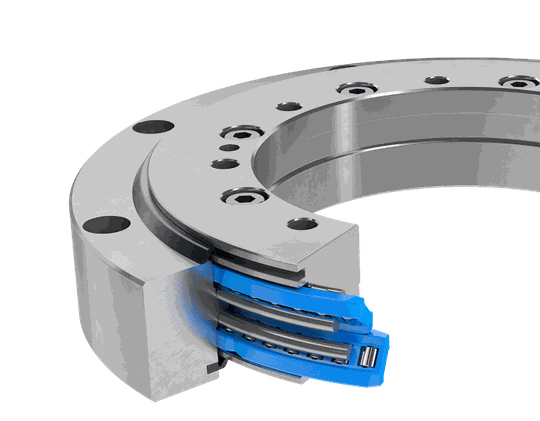
The fundamental difference between a conventional roller bearing and a wire race bearing lies in the design of the raceways. In traditional bearing technologies, rolling elements run directly on hardened raceways integrated into the housing. In contrast, in a wire race bearing, balls or rollers roll on toughened, hardened race rings made of spring steel wire. These race rings are integrated into the surrounding structure but remain functionally independent from it.
Franke slewing ring integrated double-row angular contact roller bearing
(Source: Franke)
This structural separation between housing and rolling element raceways provides a decisive advantage: mechanically highly stressed raceways can be directly integrated into lightweight structural materials. This enables:
Free selection of materials for the surrounding structure
Use of various surface treatment technologies depending on material
High flexibility in integration within limited installation spaces
The rolling elements — balls or, in applications with high tilting moments, preferably rollers — distribute loads uniformly along the hardened race rings. The bearing cage ensures defined spacing, smooth running characteristics, and operational stability.
Since preload in wire race bearing systems can be individually adjusted, an optimal balance between stiffness and rotational resistance can always be defined.
Material Freedom as a Lever for System Performance
In demanding applications, the relationship between stiffness, rotational resistance, weight, and load capacity is a key design parameter. Wire race bearings allow the load-carrying structure to be manufactured from materials required by the application — ranging from steel and aluminum to stainless steels and fiber-reinforced composites.
For design engineers, this means:
Weight reduction with high load capacity
Optimized stiffness-to-mass ratio
Adaptability to extreme temperature and corrosion conditions
Seamless integration into complex system architectures
Because the raceways are made of toughened spring steel, their mechanical performance remains independent of the chosen housing material. For example, lightweight aluminum housings can be combined with high-strength steel gear components to form a complete slewing ring assembly.
Surface and Sealing Concepts for Extreme Environments
Military applications frequently involve simultaneous exposure to multiple stress factors: shock, vibration, temperature fluctuations, seawater, sand, and dust.
Wire race bearings offer the advantage that housing components can be specifically adapted to application requirements through targeted surface treatments. Functional coatings for increased hardness or corrosion protection can be applied to the housing without the need to coat the raceways themselves.
Furthermore, a wide range of sealing concepts can be integrated from the outset of the design process. Environmental seals, for example, can be accommodated in a space-saving manner within the housing structure.
With lubricants optimized for the specific application, maximum service life can be achieved — even under harsh operating conditions.
Geared Slewing Rings: Precision Under Load
Geared slewing rings are commonly used in gun turrets, radar antennas, and electro-optical platforms. The combination of wire race bearing technology with integrated internal or external gearing enables the transmission of high torques while maintaining low friction torque.
Shock and vibration resistance are addressed during the design phase through analytical evaluation of both the gearing and bearing elements.
Particularly in azimuth and elevation movements of safety-critical systems, the following properties are essential:
High stiffness with compact design
Repeatable positioning accuracy
Adequate drive performance through adjustable rotational resistance
Large central bore for integration of cables, fluid lines, and sensor systems
Application-Specific Design and Variant Diversity
Slewing ring assemblies are always designed application-specifically. In many projects, collaboration therefore begins at an early stage of system development.
Experience gained from numerous realized projects, combined with close coordination during the early design phase, significantly contributes to optimizing functionality, service life, and overall system performance.
Slewing rings can be realized from a quantity of one unit and are available in diameters ranging from 100 mm to 2,000 mm. Depending on application requirements, suitable bearing types are selected, including:
Ball bearings
Cross-roller bearings
Angular contact ball bearings
Angular contact roller bearings
Application-specific solutions can be engineered for operating temperatures from –50 °C to +90 °C and beyond.
Application Scenarios in Defense and Security Systems
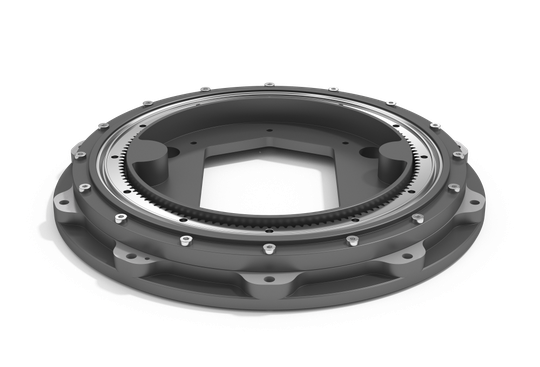
Application-specific slewing ring for sensor platforms
(Source: Franke)
Sensor platforms and optronic systems benefit from compact, lightweight slewing rings with high stiffness and uniform rotational torque. Smooth, jerk-free motion and precise positioning are essential for target acquisition, reconnaissance, and surveillance.
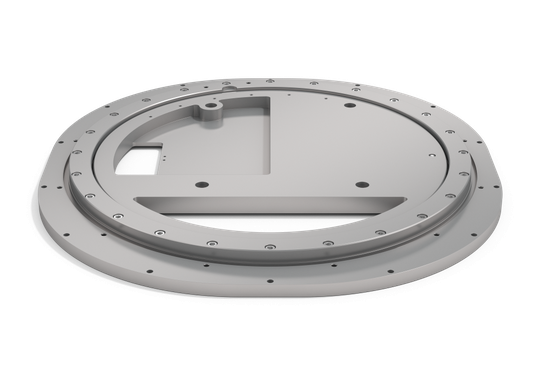
Application-specific slewing ring for radar systems
(Source: Franke)
Radar systems impose high demands in terms of diameter, stiffness, and continuous operation. Slewing rings with diameters of up to 1,800 mm must ensure precise alignment even under wind loads, vibration, and temperature fluctuations. Dedicated sealing and lubrication concepts ensure long-term reliability.
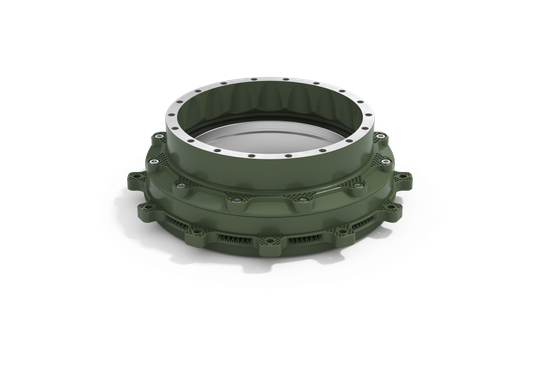
Application-specific slewing ring for weapon stations
(Source: Franke)
Weapon carriers and turret systems require high shock resistance, vibration robustness, and secure absorption of tilting moments and torsional loads. Geared slewing rings based on wire race bearing technology combine robust power transmission with precise motion behavior.
In all of these systems, bearing quality directly influences overall operational safety and reliability.
Validation
For high-quality components, design engineering is only part of the task. Comprehensive testing and validation procedures are equally critical.
Vibration tests, thermal load testing including torque measurement, and test rigs capable of applying moment, axial, and radial loads enable realistic simulation of operational scenarios.
Analysis of torque behavior, temperature rise, wear, and stiffness changes supports evaluation of:
Performance under operational conditions
Field failure risks
For manufacturers and system integrators, this ensures planning reliability — from prototype phase through series approval.
Conclusio: Technological Foundation for High-Performance Defense Systems
Slewing rings based on wire race bearing technology are more than an alternative to conventional roller bearings. They represent a design platform combining material flexibility, integration capability, and optimized weight-to-performance ratios.
In defense applications where precision, robustness, and reliability under extreme conditions are mandatory, they form the foundation for innovative, compact, and durable rotational assemblies.
For the security and defense sector, this means maximum design freedom combined with optimal performance — a decisive prerequisite when engineering excellence meets operational defense requirements.
Naturally, we always handle your personal data responsibly. Any personal data we receive from you is processed in accordance with applicable data protection legislation. For detailed information please see our privacy policy.
Consent to the use of data for promotional purposes
I hereby consent to Vogel Communications Group GmbH & Co. KG, Max-Planck-Str. 7-9, 97082 Würzburg including any affiliated companies according to §§ 15 et seq. AktG (hereafter: Vogel Communications Group) using my e-mail address to send editorial newsletters. A list of all affiliated companies can be found here
Newsletter content may include all products and services of any companies mentioned above, including for example specialist journals and books, events and fairs as well as event-related products and services, print and digital media offers and services such as additional (editorial) newsletters, raffles, lead campaigns, market research both online and offline, specialist webportals and e-learning offers. In case my personal telephone number has also been collected, it may be used for offers of aforementioned products, for services of the companies mentioned above, and market research purposes.
Additionally, my consent also includes the processing of my email address and telephone number for data matching for marketing purposes with select advertising partners such as LinkedIn, Google, and Meta. For this, Vogel Communications Group may transmit said data in hashed form to the advertising partners who then use said data to determine whether I am also a member of the mentioned advertising partner portals. Vogel Communications Group uses this feature for the purposes of re-targeting (up-selling, cross-selling, and customer loyalty), generating so-called look-alike audiences for acquisition of new customers, and as basis for exclusion for on-going advertising campaigns. Further information can be found in section “data matching for marketing purposes”.
In case I access protected data on Internet portals of Vogel Communications Group including any affiliated companies according to §§ 15 et seq. AktG, I need to provide further data in order to register for the access to such content. In return for this free access to editorial content, my data may be used in accordance with this consent for the purposes stated here. This does not apply to data matching for marketing purposes.
Right of revocation
I understand that I can revoke my consent at will. My revocation does not change the lawfulness of data processing that was conducted based on my consent leading up to my revocation. One option to declare my revocation is to use the contact form found at https://contact.vogel.de. In case I no longer wish to receive certain newsletters, I have subscribed to, I can also click on the unsubscribe link included at the end of a newsletter. Further information regarding my right of revocation and the implementation of it as well as the consequences of my revocation can be found in the data protection declaration, section editorial newsletter.




:quality(80)/p7i.vogel.de/wcms/d9/a3/d9a3c241961e6c2aa668d0147292bc49/screenshot-2026-09-17-113517-931x524v1.png "Dr. Elisabeth Hauschild will take over as Chief Executive of the BDSV in November 2026. (Source: BDSV)")
:quality(80)/p7i.vogel.de/wcms/da/35/da35a98002ba254047f09248e6bbca56/si-wafer-1920x1080v1.jpeg "Fridge, Car, Tank? Semiconductors are a key dual-use technology. Chips developed for civilian markets are increasingly critical to drones, sensors, communications and other defence systems. (Photo: )")
:quality(80)/p7i.vogel.de/wcms/f9/b2/f9b2efe6f896ab3431ddf07882ea4cfd/chatgpt-image-17--sept--2026-10-47-05-1536x864v1.png "Rare Earth supply will remain a bottleneck for European Defence companies as China controls most mining and production capacities. (Picture: AI generated)")
:quality(80)/p7i.vogel.de/wcms/54/cb/54cbfdb9d826c9efc90ac358dcf62c6c/ktyvus-624x351v1.jpeg "(Source: Aktyvus Photonics)")
:quality(80)/p7i.vogel.de/wcms/0a/14/0a1495d9b570ae32a5a7cc748b9a3c60/st-hannover-035-1920x1079v1-999x562v1.jpeg "Fastening technology you can experience first-hand—visitors to Schraubtec in Bochum (Germany) can see it for themselves at the Ruhr Congress on September 30, 2026. (Source: PHOTOVISION-DH GmbH)")
:quality(80)/p7i.vogel.de/wcms/cd/a9/cda92b173afa9d0b455d4f11b281c9ea/0094-to-image--capstone-cdr-1440x810v1.png "(Source: Terran Orbital)")
:quality(80)/p7i.vogel.de/wcms/e0/45/e045bc5414d7263fb308bdd501b5fcc1/0133113962v1.jpeg "The HSWL 354 is the transmission used, for example, in the Leopard 2 main battle tank. Renk manufactures this system and is now preparing to significantly increase its cycle time. As a result, Renk is placing greater emphasis on the military sector as a customer ... (Source: Renk)")
:quality(80)/p7i.vogel.de/wcms/a1/5c/a15c2aeba563d5bc3e11fb879b21eb2c/0132989650v1.jpeg "FSS, the flexible clamping system for varying free-form surfaces, is designed for the aerospace industry and other sectors. (Source: Römheld GmbH Friedrichshütte)")
:quality(80)/p7i.vogel.de/wcms/93/5b/935bf130ead9c4dc6aac0f47e386a56a/0133268906v1.jpeg "Here, two experts from Lufthansa Technik are applying the film called “AeroSHARK” to an aircraft. Until now, Boeing has been using this coating, which mimics the skin structure of sharks. Now Airbus also wants to use it to make its aircraft more fuel-efficient. (Source: Lufthansa Technik)")
:quality(80)/p7i.vogel.de/wcms/fc/14/fc144df6171fd26da8fe1a0a30c28505/bild-1-tom-bild-der-herausgeschleuderten-aschewolke-anak-krakatau-9-2026-tom-zentrum-f-r-telematik-w-rzburg-802x451v1.png "The TOM satellites happened to be flying over the volcanic island of Anak Krakatau during the eruption and observed the rising volcanic ash cloud from an optimal position as it was ejected to an altitude of up to 15 km (approx. 9.3 miles). (Source: TOM, Center for Telematics Würzburg)")
:quality(80)/p7i.vogel.de/wcms/46/8e/468effa87546a2b036dc88ca40e2843e/129fbcac92ce7da872b13af0281b0799-l-png-1920x1079v1.webp "(Source: Arianespace)")
:quality(80)/p7i.vogel.de/wcms/8f/10/8f10697d4bfbd70edf615cca76eaedfd/pete-linforth-on-pixabay-1920x1080v1.jpeg "(Source: Pete Linforth on Pixabay / AI-generated)")
:quality(80)/p7i.vogel.de/wcms/9d/8a/9d8addea8cc4e6f7a4793563ca397f2a/ai-im-milit-r-1672x940v1.png "(Source: KI-generiert / Gemini)")
:quality(80)/p7i.vogel.de/wcms/7f/5f/7f5fba2c729ec3aa256bf1a18d74529b/ai-chip-1672x940v1.png "(Source: KI-generiert / Gemini)")
:quality(80)/p7i.vogel.de/wcms/64/1b/641b6474b2a614cde7730c89ef2a3015/2026-09-09-rheinmetall-veroeffentlicht-battlesuite-schnittstellen-e8c18194-1225x690v1.jpeg "Rheinmetall’s Battlesuite provides a modular digital platform for connecting and integrating sensors, hardware and software components. (Source: Rheinmetall AG)")
:quality(80)/p7i.vogel.de/wcms/6f/fe/6ffef325e7f233cc3521943158eb1ebd/0132763535v1.jpeg "Two companies are planning to establish, for the first time in 2027, an optical laser communication link directly between a satellite in low Earth orbit (LEO) and a re-entering spacecraft. (Source: ATMOS Space Cargo)")
:quality(80)/p7i.vogel.de/wcms/8f/f9/8ff91b78b26cb5a2b8a29e39835005b1/2026-09-10-repmus-teaser-images-retouched-dsc01292-1024x683-1024x576v1.jpeg "(Source: Quantum Systems GmbH)")
:quality(80)/p7i.vogel.de/wcms/bf/4a/bf4a237e60d3d4bd1bbdbad918f3c697/airbus-defence-and-space-3-1280x720v1.jpeg "(Source: Airbus Defence and Space)")
:quality(80)/p7i.vogel.de/wcms/e0/d1/e0d112a0d54a4fa9603ec855f7d25b47/t-rex-content-photo-jpg-pc-adaptive-990-medium-988x556v1.jpeg "Swarm of UAVs conducting a fully autonomous collaborative swarm mission. (Source: Lockheed Martin)")
:quality(80)/p7i.vogel.de/wcms/79/fc/79fcaa7ca33e393b11a4740d7d8f3dbe/vilkasss-handshake-9459740-1911x1076v1.jpeg "(Source: Vilius Kukanauskas on Pixabay)")
:quality(80)/p7i.vogel.de/wcms/90/a8/90a849f0023f11d1eb642eb4751a0321/bild2-h-c3-a4nel-ict-20truck-20and-20trailer-20parts-4320x2429v1.jpeg "Product information is visible at all times and retrieval of items
is confirmed by employees directly on the display of the Hänel MP 14 N
controller. (Source: René Marks)")
:quality(80)/p7i.vogel.de/wcms/4e/ca/4ecaa39f247490eded591b652c33aee3/thilmann-hcp-web-20kleiner-20ausschnitt-1442x811v1.jpeg "Entering the defence market can be challenging for start-ups, says HCP Sense CEO Ansgar Thilmann. (Picture: HCP Sense)")
:quality(80)/p7i.vogel.de/wcms/7a/51/7a511b80041d3f1335f3a5aa56fe75da/delivery-7022432-1280-1280x720v1.png "(Source: Mohamed_hassan)")
:quality(80)/p7i.vogel.de/wcms/f9/2f/f92f1ef8c739c34c70d99f7b0997621b/stra007-20--20cover-20image-5472x3076v1.jpeg "(Source: Stratasys)")
:quality(80)/p7i.vogel.de/wcms/ec/a9/eca9062ccbe4b042f8515846340410d8/aerospace-and-defence-stairways-platforms-and-much-morev1.jpeg "Modular constructions enable flexible modification. That applies to larger structures such as stairways and platforms, too. And that means aerospace and defence companies can reconfigure their maintenance platforms fast (itemitem)")
:quality(80)/p7i.vogel.de/wcms/30/2a/302a7b5723ad38fbde812fd3a468ad04/safety-on-stairways-in-industry-key-considerationsv1.jpeg "Stairways and platforms are used widely in maintenance and assembly areas in the aerospace and defence sectors. (Source: item)")
:quality(80)/p7i.vogel.de/wcms/f3/4e/f34ed744bb30817d3432c7ad522e6f30/engine-1v1.jpeg "Engineering with aluminium profiles really can be this easy – the item Engineeringtool and its smart functions help you save valuable time. (Source: item)")

:quality(80)/p7i.vogel.de/wcms/b0/f3/b0f385879d74f4c0a19e76f5f4292bb5/header-antenne-fahrzeug-gloom960x540v1.jpeg "header-antenne-fahrzeug-gloom960x540v1 (Source: Franke GmbH)")
:quality(80)/p7i.vogel.de/wcms/28/60/2860a59872de8ebd68fb3366d4e6df42/franke-lagerelemente-standardprogramm-lel-1200x674v1.png "Franke’s wire race bearings combine lightweight design, high load capacity, and durability for use in radar systems, armoured vehicles, and maritime surveillance applications. (Source: Franke GmbH)")